

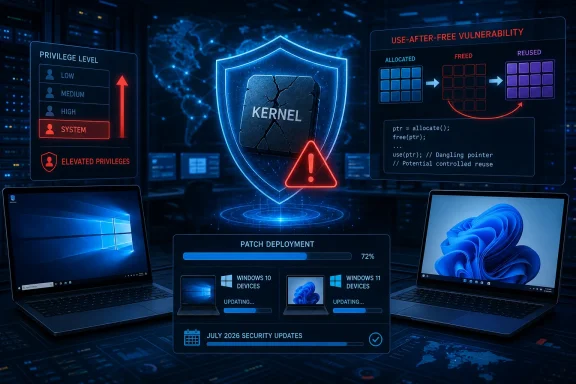
CVE-2026-49798 is a newly patched Windows Kernel use-after-free vulnerability that can let a local attacker gain elevated privileges without already holding a privileged account. Microsoft released the fix on July 14, 2026, across supported Windows client and server editions, assigning the flaw a 9.3 CVSS score while rating it “Important” under its own severity system.
Microsoft’s Security Response Center describes the issue as a local elevation-of-privilege vulnerability caused by unsafe reuse of freed kernel memory. The National Vulnerability Database, which was still enriching its record shortly after publication, identifies the weakness as CWE-416, Use After Free, and reproduces Microsoft’s CVSS 3.1 vector.
There is no indication in Microsoft’s initial disclosure that CVE-2026-49798 was publicly known or exploited before the update arrived. The SANS Internet Storm Center’s July 2026 Patch Tuesday inventory likewise lists neither active exploitation nor prior public disclosure, making this a preventative patch rather than a documented zero-day response.
CVE-2026-49798 is not remotely exploitable on its own. An attacker must be able to execute code locally, which normally means another weakness, a malicious application, a compromised user session, or some other initial-access route must come first.
That limitation does not make the vulnerability harmless. Microsoft’s CVSS vector is
The “no privileges required” rating is the detail administrators should notice. Many Windows elevation-of-privilege flaws require an attacker to begin with an authenticated, low-privilege account. Microsoft’s vector instead suggests that the vulnerable kernel path does not itself demand existing privileges, although the attacker still needs a way to run code on the machine.
A successful exploit could therefore turn limited execution into broad control of the affected Windows installation. In a real intrusion, that could allow malware to disable security controls, access protected information, create privileged accounts, install persistent components or interfere with the operating system.
Microsoft has not published a proof of concept, a detailed call sequence or the precise Windows Kernel subsystem involved. The vulnerability’s existence and general root cause are vendor-confirmed, but the initial public record leaves defenders without the low-level information needed to create highly specific detections.
Inside the Windows Kernel, this class of error can be especially dangerous because kernel code executes with extensive system authority. Successful exploitation generally requires careful manipulation of memory allocation and object lifetimes, but the resulting primitive may provide arbitrary reads, writes or control-flow manipulation.
Microsoft has assessed the attack complexity as low, distinguishing CVE-2026-49798 from kernel vulnerabilities that depend on tight race windows, unusual hardware or highly specific system states. That score does not guarantee reliable exploitation across every Windows build, but it indicates that Microsoft does not consider extraordinary conditions necessary for an attack.
The lack of required user interaction also matters. Once malicious code reaches the device and invokes the vulnerable kernel behavior, the victim should not need to open another file, accept a prompt or perform a separate action to trigger privilege escalation.
This makes CVE-2026-49798 valuable as the second stage of an attack chain. A browser, document, scripting or service vulnerability might provide initial code execution with limited rights; the kernel flaw could then supply the jump to a more powerful security context.
The broad product list suggests that the vulnerable kernel code is longstanding or shared across multiple Windows generations. Microsoft has not said when the defect was introduced, so the affected-version ranges should not be interpreted as a disclosure of the bug’s actual age.
For Windows 11 24H2 and 25H2, administrators should verify that endpoints reach at least build 26100.8875 or 26200.8875 after installing the July cumulative update. Merely seeing a successful Windows Update scan is not sufficient evidence when deployment rings, safeguard holds, offline machines or update-management policies can delay installation.
Because CVE-2026-49798 requires local execution, it does not present the same immediate perimeter threat as an unauthenticated network vulnerability in Remote Desktop Services, DHCP Server or HTTP.sys. An internet scanner cannot directly exploit this kernel flaw against an exposed address based on the currently published information.
The operational risk rises sharply on systems where untrusted code routinely runs. Shared workstations, virtual desktop hosts, developer machines, application servers, jump boxes and endpoints exposed to frequent phishing attempts offer more realistic routes to the local execution an attacker needs.
Security teams should prioritize the July updates on systems where an initial compromise would otherwise remain constrained by standard-user rights. Endpoint detection controls remain useful for catching the delivery and execution stages, but there is no published configuration workaround that removes the underlying kernel defect.
Organizations that cannot deploy immediately should reduce opportunities for local code execution, enforce application control where practical, monitor unexpected process launches and watch for suspicious changes to accounts, services, drivers and security tooling. Those measures can complicate an attack chain, but they are not replacements for the cumulative Windows update.
CVE-2026-49798 entered the public record on July 14 with vendor confirmation, a defined memory-safety root cause and an unusually high technical severity score, but without evidence of active exploitation. The immediate task for administrators is consequently straightforward: deploy the July 2026 Windows security updates, confirm the resulting OS build numbers, and treat any device below the fixed thresholds as still exposed.
Microsoft’s Security Response Center describes the issue as a local elevation-of-privilege vulnerability caused by unsafe reuse of freed kernel memory. The National Vulnerability Database, which was still enriching its record shortly after publication, identifies the weakness as CWE-416, Use After Free, and reproduces Microsoft’s CVSS 3.1 vector.
There is no indication in Microsoft’s initial disclosure that CVE-2026-49798 was publicly known or exploited before the update arrived. The SANS Internet Storm Center’s July 2026 Patch Tuesday inventory likewise lists neither active exploitation nor prior public disclosure, making this a preventative patch rather than a documented zero-day response.
 A Local Bug With an Unusually Severe Score
CVE-2026-49798 is not remotely exploitable on its own. An attacker must be able to execute code locally, which normally means another weakness, a malicious application, a compromised user session, or some other initial-access route must come first.That limitation does not make the vulnerability harmless. Microsoft’s CVSS vector is
CVSS:3.1/AV:L/AC:L/PR:N/UI:N/S:C/C:H/I:H/A:H, indicating low attack complexity, no required privileges, no user interaction and potentially complete impact to confidentiality, integrity and availability. The scope-change component also signals that exploitation may cross a security boundary rather than merely granting additional rights inside the vulnerable component.The “no privileges required” rating is the detail administrators should notice. Many Windows elevation-of-privilege flaws require an attacker to begin with an authenticated, low-privilege account. Microsoft’s vector instead suggests that the vulnerable kernel path does not itself demand existing privileges, although the attacker still needs a way to run code on the machine.
A successful exploit could therefore turn limited execution into broad control of the affected Windows installation. In a real intrusion, that could allow malware to disable security controls, access protected information, create privileged accounts, install persistent components or interfere with the operating system.
Microsoft has not published a proof of concept, a detailed call sequence or the precise Windows Kernel subsystem involved. The vulnerability’s existence and general root cause are vendor-confirmed, but the initial public record leaves defenders without the low-level information needed to create highly specific detections.
The Use-After-Free Mechanism Raises Exploitability Concerns
A use-after-free condition occurs when software continues to reference memory after that memory has been released. If an attacker can influence what subsequently occupies the freed region, the stale reference may operate on attacker-controlled data instead of the original object.Inside the Windows Kernel, this class of error can be especially dangerous because kernel code executes with extensive system authority. Successful exploitation generally requires careful manipulation of memory allocation and object lifetimes, but the resulting primitive may provide arbitrary reads, writes or control-flow manipulation.
Microsoft has assessed the attack complexity as low, distinguishing CVE-2026-49798 from kernel vulnerabilities that depend on tight race windows, unusual hardware or highly specific system states. That score does not guarantee reliable exploitation across every Windows build, but it indicates that Microsoft does not consider extraordinary conditions necessary for an attack.
The lack of required user interaction also matters. Once malicious code reaches the device and invokes the vulnerable kernel behavior, the victim should not need to open another file, accept a prompt or perform a separate action to trigger privilege escalation.
This makes CVE-2026-49798 valuable as the second stage of an attack chain. A browser, document, scripting or service vulnerability might provide initial code execution with limited rights; the kernel flaw could then supply the jump to a more powerful security context.
July Updates Cover Windows 10 Through Windows 11 26H1
Microsoft’s affected-product data spans legacy Windows releases still receiving security servicing and the newest Windows 11 branch. The fixed build thresholds recorded in the CVE data include:- Windows 10 Version 1607 and Windows Server 2016 are protected at build 14393.9339 or later.
- Windows 10 Version 1809 and Windows Server 2019 are protected at build 17763.9020 or later.
- Windows 10 Version 21H2 is protected at build 19044.7548 or later.
- Windows 10 Version 22H2 is protected at build 19045.7548 or later.
- Windows 11 Version 24H2 is protected at build 26100.8875 or later.
- Windows 11 Version 25H2 is protected at build 26200.8875 or later.
- Windows 11 Version 26H1 is protected at build 28000.2269 or later.
- Windows Server 2022 is protected at build 20348.5386 or later.
- Windows Server 2025 is protected at build 26100.33158 or later.
The broad product list suggests that the vulnerable kernel code is longstanding or shared across multiple Windows generations. Microsoft has not said when the defect was introduced, so the affected-version ranges should not be interpreted as a disclosure of the bug’s actual age.
For Windows 11 24H2 and 25H2, administrators should verify that endpoints reach at least build 26100.8875 or 26200.8875 after installing the July cumulative update. Merely seeing a successful Windows Update scan is not sufficient evidence when deployment rings, safeguard holds, offline machines or update-management policies can delay installation.
Patch Priority Depends on the Threat Model, Not Just the Label
Microsoft’s “Important” rating may appear inconsistent with the critical 9.3 CVSS score. The difference reflects the way the two systems frame risk: CVSS models the technical characteristics and maximum impact, while Microsoft’s severity classification also considers how exploitation reaches a Windows system.Because CVE-2026-49798 requires local execution, it does not present the same immediate perimeter threat as an unauthenticated network vulnerability in Remote Desktop Services, DHCP Server or HTTP.sys. An internet scanner cannot directly exploit this kernel flaw against an exposed address based on the currently published information.
The operational risk rises sharply on systems where untrusted code routinely runs. Shared workstations, virtual desktop hosts, developer machines, application servers, jump boxes and endpoints exposed to frequent phishing attempts offer more realistic routes to the local execution an attacker needs.
Security teams should prioritize the July updates on systems where an initial compromise would otherwise remain constrained by standard-user rights. Endpoint detection controls remain useful for catching the delivery and execution stages, but there is no published configuration workaround that removes the underlying kernel defect.
Organizations that cannot deploy immediately should reduce opportunities for local code execution, enforce application control where practical, monitor unexpected process launches and watch for suspicious changes to accounts, services, drivers and security tooling. Those measures can complicate an attack chain, but they are not replacements for the cumulative Windows update.
CVE-2026-49798 entered the public record on July 14 with vendor confirmation, a defined memory-safety root cause and an unusually high technical severity score, but without evidence of active exploitation. The immediate task for administrators is consequently straightforward: deploy the July 2026 Windows security updates, confirm the resulting OS build numbers, and treat any device below the fixed thresholds as still exposed.
References
- Primary source: MSRC
Published: 2026-07-14T07:00:00-07:00
Security Update Guide - Microsoft Security Response Center
 msrc.microsoft.com
- Related coverage: aha.org
- Official source: microsoft.com
CVE-2026-31431: Copy Fail vulnerability enables Linux root privilege escalation across cloud environments | Microsoft Security Blog
A high-severity Linux vulnerability, “Copy Fail” (CVE-2026-31431), enables root privilege escalation across cloud environments and Kubernetes workloads. With a working exploit already in the wild, organizations should act quickly to detect, mitigate, and reduce risk.www.microsoft.com - Official source: support.microsoft.com
April 2026 Windows security updates introduce protections to known vulnerable kernel drivers | Microsoft Support
April 2026 Windows security updates introduce protections to known vulnerable kernel driverssupport.microsoft.com
