

CVE-2026-50292 is a newly disclosed libinput vulnerability, published in early June 2026 and fixed in libinput 1.30.4 and 1.31.3, in which unescaped physical device information can be abused through udev handling to enable arbitrary code execution as root on affected Linux systems. Microsoft’s appearance in the story is not because Windows suddenly ships libinput, but because the MSRC Update Guide has become a clearinghouse for risks that touch mixed estates, Linux workloads, and the broader software supply chain. The bug is a reminder that modern endpoint security is no longer bounded by the logo on the login screen. A small helper program in the Linux input stack can become an enterprise concern when Windows administrators also own WSL, developer workstations, Azure-hosted Linux, Steam-enabled endpoints, and cross-platform patch reporting.
At first glance, CVE-2026-50292 looks like the kind of vulnerability that should live entirely in a Linux distribution advisory. Libinput is the user-space input stack used by modern Linux desktops and compositors to handle keyboards, mice, touchpads, touchscreens, tablets, and other human-interface devices. It is not a Windows component, and it is not something most Windows desktop administrators have ever had to inventory directly.
Yet this is exactly why the advisory is interesting. Microsoft’s security ecosystem increasingly surfaces vulnerabilities that do not map neatly to the classic Windows Update mental model. The modern Microsoft estate includes Windows clients, Windows Server, WSL, Azure Linux guests, Defender-managed Linux endpoints, container hosts, developer workstations, and security dashboards that normalize CVEs across platforms.
That does not mean every Windows machine is affected. It does mean the old habit of reading “Microsoft security advisory” as “Windows patch required” is no longer safe. In 2026, the more useful question is whether the vulnerable code exists anywhere in the environment Microsoft tools help you manage.
The vulnerability itself is technically compact but operationally ugly. A helper called
That is the sort of bug administrators hate because it sits at the seam between “data” and “policy.” A string that should describe where a device came from becomes something the system treats as instructions. Once that boundary fails, the rest of the privilege model starts to look less comforting.
Libinput does not sit alone. It participates in a chain that includes kernel device interfaces, virtual input devices, udev rules, desktop sessions, compositor behavior, and distribution packaging decisions. The vulnerability becomes serious because the affected helper printed data in a form that udev consumed as
The reported attack path involves a malicious uinput or uhid device setting a crafted
That is why the phrase “CRLF injection” understates the risk. Developers hear CRLF and think of web headers, log files, or old-school HTTP response splitting. Here, the newline is not merely making output untidy; it is changing how a privileged device-management system interprets trusted state.
The particular example that has drawn attention is udev’s ability to react to properties such as removal commands. Whether a given system is practically exploitable depends on installed rules, permissions on
On paper, the exploit requires an attacker to create a malicious uinput or uhid device. Those interfaces are typically restricted to root, which would make the vulnerability less useful as an escalation route in a default locked-down system. But Linux desktops are not always default locked-down systems, especially when gaming peripherals, remote-control tools, device emulators, accessibility software, and KDE Connect-style integrations enter the picture.
The upstream advisory called out an important wrinkle: some packages can ship udev rules that grant seated users access to uinput. Fedora packages such as
This is where CVSS becomes both useful and misleading. A scanner can tell you that a vulnerable libinput version exists. It cannot always tell you whether a package installed for a game controller or phone integration quietly changed the permissions that matter most.
For administrators, the lesson is to treat severity as the start of triage rather than the end. If vulnerable libinput is installed on a headless cloud server with no relevant device access exposed, urgency may differ from a developer laptop running Wayland, Steam tooling, KDE Connect, and local unprivileged users. The version number matters, but the surrounding device policy matters just as much.
But the smallness of the fix should not make the bug look trivial. Many serious vulnerabilities are one missed escape function away from disaster. The underlying failure is that output intended for a structured consumer must be treated as hostile unless every byte has been normalized for that structure.
In practical terms, defenders should not spend days reverse-engineering the flaw before patching. If a distribution has shipped updated libinput packages, take them. If a system is pinned to an older branch, verify whether the vendor has backported the upstream fix rather than relying only on the upstream version number. Enterprise Linux distributions often carry patched older version strings, which can confuse simplistic scanner logic.
For rolling-release users and desktop-heavy Linux fleets, the update path is likely to be direct. For appliance-like systems, lab machines, developer images, or golden workstation templates, the risk is that vulnerable libinput persists in places nobody thinks to check. Input libraries are not glamorous, which is precisely why they can survive longer than browser or kernel patches in internal images.
The most important operational move is to identify systems where local users have device-creation privileges. If
The most obvious exposure is developer workstations. Windows developers frequently run WSL, Linux VMs, containers, USB forwarding tools, remote desktop stacks, and cross-platform build environments. CVE-2026-50292 is not a WSL kernel bug, and WSL’s architecture does not magically turn every Windows endpoint into a vulnerable Linux desktop. Still, any Linux desktop VM, dual-boot developer machine, or USB-forwarded test environment using affected libinput packages belongs in the audit.
Azure and hybrid environments are another path. Microsoft-managed security tooling can surface Linux CVEs because Microsoft customers run Linux at scale. A vulnerability appearing in an MSRC-adjacent workflow may represent risk in Azure Linux guests, DevOps runners, kiosk-like Linux endpoints, or security-managed devices rather than in Windows itself.
There is also the gaming-and-peripherals corner of the enterprise, which sounds niche until you count real-world exceptions. Engineering labs, design studios, QA benches, accessibility deployments, training rooms, and bring-your-own-device corners often carry packages that ordinary server baselines do not. Tools that allow user-space input emulation are exactly the kind of convenience layer that can change a theoretical local bug into a practical escalation path.
This is where Microsoft-centric administrators need a broader inventory model. The question is not “Does Windows use libinput?” The question is “Do any systems I am responsible for run affected libinput versions, and do my management tools know the difference between irrelevant and exploitable?”
But availability is the least interesting part of this CVE. The more alarming property is not that a system can be made unavailable, but that a device-metadata injection flaw can cross into root execution. Root means the attacker can modify system state, plant persistence, tamper with logs, alter input behavior, capture data, or pivot into other local trust relationships.
That does not make denial-of-service irrelevant. On desktops, a broken input stack can be functionally equivalent to a lockout. On kiosks, point-of-sale terminals, lab equipment, and embedded Linux systems, denial of input can become denial of operation. In those environments, “only local” can still mean “business critical.”
The better way to read the impact is as a hierarchy. At the top is arbitrary root execution, which implies confidentiality and integrity compromise. Beneath it is availability damage, which may be the most visible symptom. Beneath both is the root cause: an input-management trust boundary failed to sanitize data before passing it to privileged automation.
Security teams should resist reducing the issue to a single impact label. If your vulnerability dashboard highlights availability, do not let that obscure the code-execution consequence. If your scanner highlights critical RCE, do not ignore the local preconditions that separate a burn-down-now emergency from a targeted desktop-hardening task.
The problem is that a virtual device can be as security-sensitive as a real one. Once software can present itself as hardware, it may influence privileged parts of the stack that were originally designed around the assumption that devices are dumb, external, and mostly descriptive. CVE-2026-50292 is a case study in how that assumption ages badly.
Steam controller support is a good example because it is not exotic. Gaming packages often need broader device permissions so ordinary users can use controllers without running games as root. That is a sane usability decision, but it has security consequences when another component mishandles device-provided strings.
The same pattern appears in remote input tools, phone integration utilities, macro systems, accessibility layers, test harnesses, and hardware simulation frameworks. Every time a system gives a user the ability to create or manipulate virtual input devices, it is deciding that the input stack is part of the user’s reachable attack surface. That may be acceptable, but it must be explicit.
The uncomfortable truth is that desktop Linux security is now shaped as much by udev rules and seat permissions as by traditional package versions. Administrators who manage Linux desktops like small servers miss this distinction. Desktops have human-interface complexity, and that complexity often lives in exactly the device plumbing CVE-2026-50292 exploits.
This matters because libinput is commonly installed as part of the graphical stack, not as an application users consciously update. An administrator may patch browsers, kernels, OpenSSL, and SSH while assuming the rest of the desktop stack will follow. If the endpoint’s package manager is frozen, the vulnerable library can remain in place even though the system “looks patched” from a user’s perspective.
Scanner output may also be noisy. Upstream version checks can flag enterprise packages that have been fixed by backport. Conversely, package inventories can miss stale images, offline lab systems, or custom distributions. The right answer is to combine vendor advisory status, package changelogs, and actual deployed version data.
There is a Windows parallel here. Administrators already know that a build number alone does not tell the whole story when optional components, mitigations, and cumulative updates interact. Linux package management has its own version of that complexity. The difference is that Windows admins may be less practiced at reading it.
A good response to CVE-2026-50292 starts with version inventory, but it should not stop there. Check whether updated libinput packages are available from the distribution vendor. Confirm whether affected systems expose uinput or uhid to non-root users. Review installed packages that modify device permissions. Rebuild images rather than merely patching live machines if those images are used to provision new endpoints.
For some readers, seeing a Linux CVE in a Microsoft workflow will feel like scope creep. For defenders, it is more accurately a reflection of the environment they already inhabit. Microsoft Defender, Azure, GitHub, WSL, Intune-adjacent device management, and cloud workload protection all pull Linux into Microsoft’s operational orbit.
This does not absolve Linux vendors of responsibility. The authoritative fix still comes from the libinput project and distribution maintainers. Microsoft’s role is to surface the risk where its customers manage security, not to replace the upstream patch chain.
The challenge is presentation. Security portals flatten very different vulnerabilities into similar-looking rows: CVE, severity, impact, product, remediation. That flattening is helpful for dashboards and dangerous for judgment. CVE-2026-50292 needs context about local device access, installed packages, desktop usage, and upstream fixed versions. Without that context, one team may panic unnecessarily while another dismisses a real exposure.
This is the future of enterprise vulnerability management: less about memorizing vendor silos, more about understanding where code actually runs. A Windows admin who can reason about Linux device permissions is not wandering outside their lane. They are following the estate where it already went.
Shared Linux workstations deserve special attention. Any bug that can turn local user reachability into root execution is more serious when multiple users have shell access, graphical sessions, or lab accounts. The attacker does not need to be remote from the internet if they are already a low-privileged local user on a valuable machine.
Developer machines are similarly attractive. They often hold source code, signing material, cloud tokens, SSH keys, local secrets, and access to internal services. A root compromise on a developer workstation can be more damaging than a compromise of a low-value server because it provides context, credentials, and trust relationships.
The risk is also amplified by the cultural status of desktop packages. Developers and power users install controller tools, phone-sync utilities, desktop extensions, and input automation software without thinking of them as security-relevant. CVE-2026-50292 shows why those packages need to be part of endpoint posture, not just user preference.
For Windows-heavy shops, the most useful mental model is the privileged developer laptop. Whether that laptop boots Windows, Linux, or both matters less than the access it carries. If Linux desktop components on that machine are vulnerable, the organizational risk is real even if the Microsoft logo never appears in the vulnerable code path.
The audit is where teams should spend more thought. Identify systems running libinput before 1.30.4 or 1.31.3, but also identify systems where users can create uinput or uhid devices. Look for udev rules shipped by peripheral, gaming, remote-control, accessibility, and phone-integration packages. Pay close attention to workstation images used by developers, labs, QA, and shared Linux desktops.
There is a temptation to remove every package that touches uinput. That may be overkill and may break legitimate workflows. The better approach is to make the permission decision explicit. If a package grants seated users device-creation rights, the security team should know that, document it, and ensure the components consuming that input path are patched quickly.
Administrators should also be careful with compensating controls. Blocking physical USB devices does not necessarily block virtual uinput creation. Restricting remote login does not necessarily protect a shared graphical seat. Relying on root-only defaults may fail if a package has installed a permissive udev rule.
The correct response is not panic. It is inventory, patch, and permission review. The bug is serious because root execution is serious, but it is also bounded by local-device creation conditions that can be understood and managed.
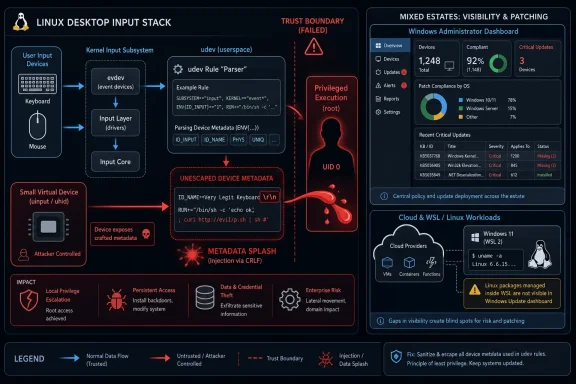 A Linux Input Bug Lands in a Windows Administrator’s Queue
At first glance, CVE-2026-50292 looks like the kind of vulnerability that should live entirely in a Linux distribution advisory. Libinput is the user-space input stack used by modern Linux desktops and compositors to handle keyboards, mice, touchpads, touchscreens, tablets, and other human-interface devices. It is not a Windows component, and it is not something most Windows desktop administrators have ever had to inventory directly.Yet this is exactly why the advisory is interesting. Microsoft’s security ecosystem increasingly surfaces vulnerabilities that do not map neatly to the classic Windows Update mental model. The modern Microsoft estate includes Windows clients, Windows Server, WSL, Azure Linux guests, Defender-managed Linux endpoints, container hosts, developer workstations, and security dashboards that normalize CVEs across platforms.
That does not mean every Windows machine is affected. It does mean the old habit of reading “Microsoft security advisory” as “Windows patch required” is no longer safe. In 2026, the more useful question is whether the vulnerable code exists anywhere in the environment Microsoft tools help you manage.
The vulnerability itself is technically compact but operationally ugly. A helper called
libinput-device-group used a device’s phys sysfs attribute as part of output imported by udev as environment-style key-value data. If a malicious uinput or uhid device could smuggle a newline into that value, udev could interpret the result as more than one property, opening the door to injected properties and, in the worst case, root command execution.That is the sort of bug administrators hate because it sits at the seam between “data” and “policy.” A string that should describe where a device came from becomes something the system treats as instructions. Once that boundary fails, the rest of the privilege model starts to look less comforting.
The Dangerous Part Is Not the Keyboard, It Is the Parser
Input handling sounds physical, and physical-sounding bugs are easy to underrate. A mouse moves, a keyboard types, a gamepad vibrates; surely this is local hardware plumbing rather than a serious enterprise security problem. CVE-2026-50292 argues the opposite: the operating system’s trust in hardware metadata can be just as sensitive as its trust in network packets.Libinput does not sit alone. It participates in a chain that includes kernel device interfaces, virtual input devices, udev rules, desktop sessions, compositor behavior, and distribution packaging decisions. The vulnerability becomes serious because the affected helper printed data in a form that udev consumed as
KEY=VALUE properties. If untrusted data is not escaped before it enters that grammar, the grammar itself becomes an attack surface.The reported attack path involves a malicious uinput or uhid device setting a crafted
phys value. In normal English, that means a device-like object can present a physical-location string containing a newline. Instead of one property being imported, udev can be tricked into seeing two. If the injected property is powerful enough, the attacker moves from metadata manipulation to root-level behavior.That is why the phrase “CRLF injection” understates the risk. Developers hear CRLF and think of web headers, log files, or old-school HTTP response splitting. Here, the newline is not merely making output untidy; it is changing how a privileged device-management system interprets trusted state.
The particular example that has drawn attention is udev’s ability to react to properties such as removal commands. Whether a given system is practically exploitable depends on installed rules, permissions on
/dev/uinput and /dev/uhid, session access controls, and packaging choices. But the architectural lesson is broader: once privileged automation consumes unescaped device-supplied strings, the distance between “plugged in” and “executed as root” gets uncomfortably short.CVSS Disagreement Tells the Real Story Better Than the Score
The vulnerability has produced a familiar scoring split. MITRE’s CNA scoring treats the bug as a high-severity local attack with high complexity, while NVD analysis has presented a more severe vector. That disagreement is not bureaucratic noise; it reflects the central uncertainty of the bug.On paper, the exploit requires an attacker to create a malicious uinput or uhid device. Those interfaces are typically restricted to root, which would make the vulnerability less useful as an escalation route in a default locked-down system. But Linux desktops are not always default locked-down systems, especially when gaming peripherals, remote-control tools, device emulators, accessibility software, and KDE Connect-style integrations enter the picture.
The upstream advisory called out an important wrinkle: some packages can ship udev rules that grant seated users access to uinput. Fedora packages such as
steam-devices, antimicrox, and kdeconnectd were specifically named in the public discussion as examples that may widen access. That does not automatically make every Fedora workstation exploitable, but it shows how the real attack surface is assembled by the distribution, the package set, and the logged-in user model.This is where CVSS becomes both useful and misleading. A scanner can tell you that a vulnerable libinput version exists. It cannot always tell you whether a package installed for a game controller or phone integration quietly changed the permissions that matter most.
For administrators, the lesson is to treat severity as the start of triage rather than the end. If vulnerable libinput is installed on a headless cloud server with no relevant device access exposed, urgency may differ from a developer laptop running Wayland, Steam tooling, KDE Connect, and local unprivileged users. The version number matters, but the surrounding device policy matters just as much.
The Fix Is Small Because the Trust Boundary Was Small
The fix versions are straightforward: libinput 1.30.4 and 1.31.3 close the vulnerability. The affected ranges are libinput before 1.30.4 and the 1.31.x series before 1.31.3. That clarity is welcome, especially compared with bugs that require kernel updates, firmware revisions, and application rewrites.But the smallness of the fix should not make the bug look trivial. Many serious vulnerabilities are one missed escape function away from disaster. The underlying failure is that output intended for a structured consumer must be treated as hostile unless every byte has been normalized for that structure.
In practical terms, defenders should not spend days reverse-engineering the flaw before patching. If a distribution has shipped updated libinput packages, take them. If a system is pinned to an older branch, verify whether the vendor has backported the upstream fix rather than relying only on the upstream version number. Enterprise Linux distributions often carry patched older version strings, which can confuse simplistic scanner logic.
For rolling-release users and desktop-heavy Linux fleets, the update path is likely to be direct. For appliance-like systems, lab machines, developer images, or golden workstation templates, the risk is that vulnerable libinput persists in places nobody thinks to check. Input libraries are not glamorous, which is precisely why they can survive longer than browser or kernel patches in internal images.
The most important operational move is to identify systems where local users have device-creation privileges. If
/dev/uinput or /dev/uhid is accessible beyond root because of custom udev rules or installed packages, those systems deserve closer attention. The exploitability of CVE-2026-50292 is not defined by libinput alone; it is defined by who can feed malicious device metadata into the stack.Windows Shops Are Exposed Through Their Linux Habits
For WindowsForum readers, the natural temptation is to file this under “Linux problem” and move on. That is partly true and mostly unhelpful. The average unmanaged Windows 11 laptop is not vulnerable because libinput is not part of the Windows input subsystem. But few serious IT environments are monocultures anymore.The most obvious exposure is developer workstations. Windows developers frequently run WSL, Linux VMs, containers, USB forwarding tools, remote desktop stacks, and cross-platform build environments. CVE-2026-50292 is not a WSL kernel bug, and WSL’s architecture does not magically turn every Windows endpoint into a vulnerable Linux desktop. Still, any Linux desktop VM, dual-boot developer machine, or USB-forwarded test environment using affected libinput packages belongs in the audit.
Azure and hybrid environments are another path. Microsoft-managed security tooling can surface Linux CVEs because Microsoft customers run Linux at scale. A vulnerability appearing in an MSRC-adjacent workflow may represent risk in Azure Linux guests, DevOps runners, kiosk-like Linux endpoints, or security-managed devices rather than in Windows itself.
There is also the gaming-and-peripherals corner of the enterprise, which sounds niche until you count real-world exceptions. Engineering labs, design studios, QA benches, accessibility deployments, training rooms, and bring-your-own-device corners often carry packages that ordinary server baselines do not. Tools that allow user-space input emulation are exactly the kind of convenience layer that can change a theoretical local bug into a practical escalation path.
This is where Microsoft-centric administrators need a broader inventory model. The question is not “Does Windows use libinput?” The question is “Do any systems I am responsible for run affected libinput versions, and do my management tools know the difference between irrelevant and exploitable?”
The Availability Language Is True, but It Is Not the Whole Threat
The user-provided availability language emphasizes total or serious loss of availability in the impacted component. That language fits the standard vulnerability taxonomy: a successful exploit can damage confidentiality, integrity, and availability, and arbitrary root execution is inherently catastrophic. If an attacker can run code as root, they can deny access, destroy services, lock users out, or corrupt the local environment.But availability is the least interesting part of this CVE. The more alarming property is not that a system can be made unavailable, but that a device-metadata injection flaw can cross into root execution. Root means the attacker can modify system state, plant persistence, tamper with logs, alter input behavior, capture data, or pivot into other local trust relationships.
That does not make denial-of-service irrelevant. On desktops, a broken input stack can be functionally equivalent to a lockout. On kiosks, point-of-sale terminals, lab equipment, and embedded Linux systems, denial of input can become denial of operation. In those environments, “only local” can still mean “business critical.”
The better way to read the impact is as a hierarchy. At the top is arbitrary root execution, which implies confidentiality and integrity compromise. Beneath it is availability damage, which may be the most visible symptom. Beneath both is the root cause: an input-management trust boundary failed to sanitize data before passing it to privileged automation.
Security teams should resist reducing the issue to a single impact label. If your vulnerability dashboard highlights availability, do not let that obscure the code-execution consequence. If your scanner highlights critical RCE, do not ignore the local preconditions that separate a burn-down-now emergency from a targeted desktop-hardening task.
Device Emulation Has Become a Security Boundary
For years, user-space input emulation has been treated as a convenience feature. It lets applications create virtual keyboards, game controllers, accessibility devices, remote-control endpoints, and automation harnesses. Modern desktops depend on these patterns more than many users realize.The problem is that a virtual device can be as security-sensitive as a real one. Once software can present itself as hardware, it may influence privileged parts of the stack that were originally designed around the assumption that devices are dumb, external, and mostly descriptive. CVE-2026-50292 is a case study in how that assumption ages badly.
Steam controller support is a good example because it is not exotic. Gaming packages often need broader device permissions so ordinary users can use controllers without running games as root. That is a sane usability decision, but it has security consequences when another component mishandles device-provided strings.
The same pattern appears in remote input tools, phone integration utilities, macro systems, accessibility layers, test harnesses, and hardware simulation frameworks. Every time a system gives a user the ability to create or manipulate virtual input devices, it is deciding that the input stack is part of the user’s reachable attack surface. That may be acceptable, but it must be explicit.
The uncomfortable truth is that desktop Linux security is now shaped as much by udev rules and seat permissions as by traditional package versions. Administrators who manage Linux desktops like small servers miss this distinction. Desktops have human-interface complexity, and that complexity often lives in exactly the device plumbing CVE-2026-50292 exploits.
The Patch Cadence Will Be Messier Than the Advisory
Upstream has done its part by publishing fixed versions. From there, the story becomes distribution-specific. Rolling distributions may move quickly; enterprise distributions may backport; long-term-support images may lag until the next maintenance window; containers and immutable desktop images may require rebuilds.This matters because libinput is commonly installed as part of the graphical stack, not as an application users consciously update. An administrator may patch browsers, kernels, OpenSSL, and SSH while assuming the rest of the desktop stack will follow. If the endpoint’s package manager is frozen, the vulnerable library can remain in place even though the system “looks patched” from a user’s perspective.
Scanner output may also be noisy. Upstream version checks can flag enterprise packages that have been fixed by backport. Conversely, package inventories can miss stale images, offline lab systems, or custom distributions. The right answer is to combine vendor advisory status, package changelogs, and actual deployed version data.
There is a Windows parallel here. Administrators already know that a build number alone does not tell the whole story when optional components, mitigations, and cumulative updates interact. Linux package management has its own version of that complexity. The difference is that Windows admins may be less practiced at reading it.
A good response to CVE-2026-50292 starts with version inventory, but it should not stop there. Check whether updated libinput packages are available from the distribution vendor. Confirm whether affected systems expose uinput or uhid to non-root users. Review installed packages that modify device permissions. Rebuild images rather than merely patching live machines if those images are used to provision new endpoints.
Microsoft’s Security Guide Is Becoming a Cross-Platform Signal
The MSRC Update Guide’s presence in this story is a sign of where vulnerability management has gone. Microsoft is no longer merely the vendor of Windows patches; it is also a security platform vendor, a cloud operator, an identity provider, a Linux distributor in select contexts, and a manager of multi-OS risk. That expansion makes the guide more useful, but also easier to misread.For some readers, seeing a Linux CVE in a Microsoft workflow will feel like scope creep. For defenders, it is more accurately a reflection of the environment they already inhabit. Microsoft Defender, Azure, GitHub, WSL, Intune-adjacent device management, and cloud workload protection all pull Linux into Microsoft’s operational orbit.
This does not absolve Linux vendors of responsibility. The authoritative fix still comes from the libinput project and distribution maintainers. Microsoft’s role is to surface the risk where its customers manage security, not to replace the upstream patch chain.
The challenge is presentation. Security portals flatten very different vulnerabilities into similar-looking rows: CVE, severity, impact, product, remediation. That flattening is helpful for dashboards and dangerous for judgment. CVE-2026-50292 needs context about local device access, installed packages, desktop usage, and upstream fixed versions. Without that context, one team may panic unnecessarily while another dismisses a real exposure.
This is the future of enterprise vulnerability management: less about memorizing vendor silos, more about understanding where code actually runs. A Windows admin who can reason about Linux device permissions is not wandering outside their lane. They are following the estate where it already went.
The Practical Risk Sits on Developer Desktops and Shared Linux Seats
If there is a most likely place for CVE-2026-50292 to matter, it is not the hardened server with no graphical stack. It is the Linux desktop, the developer workstation, the lab computer, the shared engineering box, or the gaming-capable machine where input-emulation packages are installed for perfectly legitimate reasons. Those systems combine local users, rich device stacks, and permissive usability choices.Shared Linux workstations deserve special attention. Any bug that can turn local user reachability into root execution is more serious when multiple users have shell access, graphical sessions, or lab accounts. The attacker does not need to be remote from the internet if they are already a low-privileged local user on a valuable machine.
Developer machines are similarly attractive. They often hold source code, signing material, cloud tokens, SSH keys, local secrets, and access to internal services. A root compromise on a developer workstation can be more damaging than a compromise of a low-value server because it provides context, credentials, and trust relationships.
The risk is also amplified by the cultural status of desktop packages. Developers and power users install controller tools, phone-sync utilities, desktop extensions, and input automation software without thinking of them as security-relevant. CVE-2026-50292 shows why those packages need to be part of endpoint posture, not just user preference.
For Windows-heavy shops, the most useful mental model is the privileged developer laptop. Whether that laptop boots Windows, Linux, or both matters less than the access it carries. If Linux desktop components on that machine are vulnerable, the organizational risk is real even if the Microsoft logo never appears in the vulnerable code path.
The Fix Should Be Boring, the Audit Should Not
The remediation itself should be deliberately boring. Update libinput to a fixed package. Prefer distribution-provided security updates over hand-built libraries. Reboot or restart affected sessions where required by the distribution’s packaging. Confirm the new package is actually active on the systems that need it.The audit is where teams should spend more thought. Identify systems running libinput before 1.30.4 or 1.31.3, but also identify systems where users can create uinput or uhid devices. Look for udev rules shipped by peripheral, gaming, remote-control, accessibility, and phone-integration packages. Pay close attention to workstation images used by developers, labs, QA, and shared Linux desktops.
There is a temptation to remove every package that touches uinput. That may be overkill and may break legitimate workflows. The better approach is to make the permission decision explicit. If a package grants seated users device-creation rights, the security team should know that, document it, and ensure the components consuming that input path are patched quickly.
Administrators should also be careful with compensating controls. Blocking physical USB devices does not necessarily block virtual uinput creation. Restricting remote login does not necessarily protect a shared graphical seat. Relying on root-only defaults may fail if a package has installed a permissive udev rule.
The correct response is not panic. It is inventory, patch, and permission review. The bug is serious because root execution is serious, but it is also bounded by local-device creation conditions that can be understood and managed.
The Lesson Microsoft Shops Should Carry Into the Next CVE
CVE-2026-50292 is not the biggest vulnerability of the year, and for many Windows-only endpoints it will be a non-event. But it is an unusually good teaching case because it crosses so many modern boundaries: Linux desktop plumbing, udev policy, virtual devices, Microsoft security visibility, and enterprise patch triage. The concrete work is simple; the strategic lesson is larger.- Systems running libinput earlier than 1.30.4, or 1.31.x earlier than 1.31.3, should be updated through their distribution’s security channel.
- The highest-priority checks belong on Linux desktops, developer workstations, shared lab machines, and systems with packages that grant non-root access to uinput or uhid.
- Windows clients are not directly affected by libinput, but Windows-centric teams may still own affected Linux VMs, dual-boot machines, WSL-adjacent workflows, Azure Linux hosts, or Defender-managed Linux endpoints.
- Severity scores should be read alongside local access conditions, because exploitability depends heavily on device-creation permissions and installed udev rules.
- The vulnerability is best understood as a trust-boundary failure in privileged device metadata handling, not merely as a generic availability problem.
References
- Primary source: MSRC
Published: 2026-06-09T01:45:39-07:00
Security Update Guide - Microsoft Security Response Center
 msrc.microsoft.com
- Related coverage: mondoo.com
UBUNTU-CVE-2026-50292 | Mondoo Vulnerability Intelligence
UBUNTU-CVE-2026-50292 - CRITICAL severity: In libinput before 1.30.4 and 1.31.x before 1.31.3, libinput-device-group unescaped phys output can inject udev pr...mondoo.com - Related coverage: cvepremium.circl.lu
Vulnerability-Lookup
Vulnerability-Lookup - Fast vulnerability lookup correlation from different sources.cvepremium.circl.lu - Related coverage: security.snyk.io
CRLF Injection in libinput | CVE-2026-50292 | Snyk
Critical severity (9.8) CRLF Injection in libinput | CVE-2026-50292security.snyk.io - Related coverage: phoronix.com
Widely-Used libinput Updated Due To Arbitrary Root Code Execution - Phoronix
The libinput input handling library used by both X.Org and Wayland environments on modern Linux desktops is out with a new security fix releasewww.phoronix.com
- Related coverage: mywebuniversity.com
- Related coverage: encyb.com
