

CVE-2026-50293 is a high-severity Windows privilege-escalation vulnerability that can let a locally authenticated attacker exploit the Windows Internal Task Bar and gain elevated rights. Microsoft addressed the flaw in security updates available for Windows 10, Windows 11 24H2 through 26H1, and Windows Server 2025.
Published by the Microsoft Security Response Center on July 14, 2026, the vulnerability carries a CVSS 3.1 score of 7.8. Microsoft describes the underlying defect as a use-after-free memory-management error and classifies it as CWE-416.
The vulnerability is not remotely exploitable on its own: an attacker must already be authorized to access the target machine and execute the attack locally. However, Microsoft’s scoring says exploitation requires low privileges, low complexity, and no interaction from another user, making prompt deployment important on shared workstations, servers, and devices exposed to untrusted accounts.
CVE-2026-50293 exists in a component Microsoft identifies as the Windows Internal Task Bar. That name should not be confused with Windows Task Scheduler, and Microsoft has not published enough architectural detail to identify the precise taskbar process, object, or memory operation involved.
The disclosed root cause is more useful to defenders. A use-after-free vulnerability occurs when software continues using an object after the associated memory has been released. If an attacker can influence what replaces that object in memory, subsequent operations may process attacker-controlled data under the privileges of the affected component.
Microsoft’s CVSS vector rates the vulnerability as local, low-complexity, and usable by an attacker with low privileges. No separate victim action is required once the attacker is in a position to trigger the flaw.
A successful exploit could produce high impact across confidentiality, integrity, and availability. In practical terms, elevated access can allow an attacker to read protected information, alter system settings, disable security controls, install persistent tooling, or interfere with normal Windows operation.
That makes CVE-2026-50293 more relevant to enterprise attack chains than its local classification might initially suggest. Phishing, malicious installers, compromised developer tools, browser exploits, and stolen low-privilege credentials can all provide an initial foothold; a reliable elevation-of-privilege exploit can then remove the restrictions that would otherwise contain it.
Microsoft’s CVE record does not indicate proven exploitation in the wild. Its CVSS temporal data marks exploit maturity as unproven while recording the vulnerability’s technical confidence as confirmed and an official fix as available. Administrators should therefore avoid labeling it a zero-day or an actively exploited vulnerability without further evidence.
Windows Server 2025 reaches build 26100.33158 through KB5099536. Both the Desktop Experience and Server Core variants are covered by the CVE record, which matters for organizations that might otherwise assume the absence of the standard desktop shell removes exposure to a taskbar-named vulnerability.
Windows 10 receives the relevant builds through KB5099539. Version 22H2 reached the end of ordinary support on October 14, 2025, meaning most remaining installations need eligibility under Microsoft’s Extended Security Updates program to continue receiving security fixes. Windows 10 Enterprise LTSC and IoT Enterprise LTSC deployments follow their respective servicing lifecycles.
The Windows 11 26H1 entry is unusual because Microsoft lists build 28000.2269—the June 9, 2026 security baseline—as the first unaffected build. Machines already updated in June therefore meet the CVE’s minimum fixed-build requirement, while the July cumulative update KB5101649 advances 26H1 further to build 28000.2525.
That value should not be read as confirmation that attackers are exploiting CVE-2026-50293. Report confidence measures whether the flaw and its technical characterization are credible. Exploit maturity is a separate measurement, and Microsoft currently records that as unproven.
The distinction matters for patch prioritization. Security teams should treat the flaw as real and technically validated, but the public record available at publication time does not establish an active campaign, publicly released proof of concept, or inclusion in the Cybersecurity and Infrastructure Security Agency’s Known Exploited Vulnerabilities catalog.
Microsoft also has not published exploitation steps, indicators of compromise, event-log signatures, or a workaround. That limits opportunities for compensating controls and threat hunting. The supported remediation is to install the applicable cumulative security update.
Application-control policies such as Windows Defender Application Control and AppLocker can reduce opportunities for an attacker to run an exploit, but they do not repair the faulty memory handling. Endpoint detection and response products may also identify suspicious post-exploitation activity, yet detection should not replace the update when an official fix is available.
Administrators can validate deployment using
CVE-2026-50293 is not an unauthenticated remote-code-execution emergency, but it closes a valuable step in the attacker’s path from ordinary account access to system-level control. The practical endpoint is straightforward: bring every affected machine to the listed build or a later cumulative update, then verify that unsupported Windows 10 installations have not silently fallen outside the organization’s security-update coverage.
Published by the Microsoft Security Response Center on July 14, 2026, the vulnerability carries a CVSS 3.1 score of 7.8. Microsoft describes the underlying defect as a use-after-free memory-management error and classifies it as CWE-416.
The vulnerability is not remotely exploitable on its own: an attacker must already be authorized to access the target machine and execute the attack locally. However, Microsoft’s scoring says exploitation requires low privileges, low complexity, and no interaction from another user, making prompt deployment important on shared workstations, servers, and devices exposed to untrusted accounts.
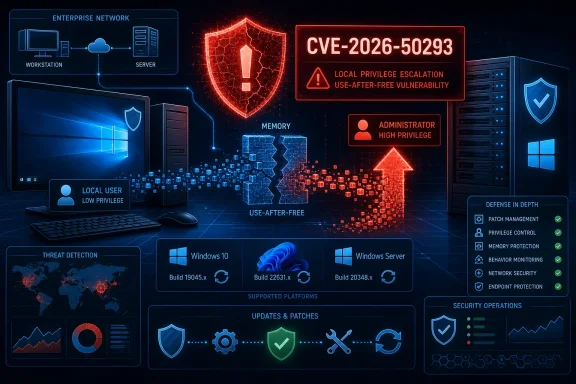 A Local Foothold Can Become a Full Compromise
CVE-2026-50293 exists in a component Microsoft identifies as the Windows Internal Task Bar. That name should not be confused with Windows Task Scheduler, and Microsoft has not published enough architectural detail to identify the precise taskbar process, object, or memory operation involved.The disclosed root cause is more useful to defenders. A use-after-free vulnerability occurs when software continues using an object after the associated memory has been released. If an attacker can influence what replaces that object in memory, subsequent operations may process attacker-controlled data under the privileges of the affected component.
Microsoft’s CVSS vector rates the vulnerability as local, low-complexity, and usable by an attacker with low privileges. No separate victim action is required once the attacker is in a position to trigger the flaw.
A successful exploit could produce high impact across confidentiality, integrity, and availability. In practical terms, elevated access can allow an attacker to read protected information, alter system settings, disable security controls, install persistent tooling, or interfere with normal Windows operation.
That makes CVE-2026-50293 more relevant to enterprise attack chains than its local classification might initially suggest. Phishing, malicious installers, compromised developer tools, browser exploits, and stolen low-privilege credentials can all provide an initial foothold; a reliable elevation-of-privilege exploit can then remove the restrictions that would otherwise contain it.
Microsoft’s CVE record does not indicate proven exploitation in the wild. Its CVSS temporal data marks exploit maturity as unproven while recording the vulnerability’s technical confidence as confirmed and an official fix as available. Administrators should therefore avoid labeling it a zero-day or an actively exploited vulnerability without further evidence.
The Fixed Builds Define the Deployment Target
Microsoft’s machine-readable CVE record identifies the affected releases by build number. Systems below the following revisions remain vulnerable:- Windows 10 version 21H2 must be updated to OS Build 19044.7548 or later.
- Windows 10 version 22H2 must be updated to OS Build 19045.7548 or later.
- Windows 11 version 24H2 must be updated to OS Build 26100.8875 or later.
- Windows 11 version 25H2 must be updated to OS Build 26200.8875 or later.
- Windows 11 version 26H1 must be running OS Build 28000.2269 or later.
- Windows Server 2025, including Server Core installations, must be updated to OS Build 26100.33158 or later.
Windows Server 2025 reaches build 26100.33158 through KB5099536. Both the Desktop Experience and Server Core variants are covered by the CVE record, which matters for organizations that might otherwise assume the absence of the standard desktop shell removes exposure to a taskbar-named vulnerability.
Windows 10 receives the relevant builds through KB5099539. Version 22H2 reached the end of ordinary support on October 14, 2025, meaning most remaining installations need eligibility under Microsoft’s Extended Security Updates program to continue receiving security fixes. Windows 10 Enterprise LTSC and IoT Enterprise LTSC deployments follow their respective servicing lifecycles.
The Windows 11 26H1 entry is unusual because Microsoft lists build 28000.2269—the June 9, 2026 security baseline—as the first unaffected build. Machines already updated in June therefore meet the CVE’s minimum fixed-build requirement, while the July cumulative update KB5101649 advances 26H1 further to build 28000.2525.
The Confidence Metric Is Not an Exploitation Warning
The text accompanying the advisory discusses confidence in the vulnerability’s existence and in the available technical details. In the CVSS vector, Microsoft assigns the report-confidence valueRC:C, meaning the vulnerability is considered confirmed rather than hypothetical or based only on uncorroborated research.That value should not be read as confirmation that attackers are exploiting CVE-2026-50293. Report confidence measures whether the flaw and its technical characterization are credible. Exploit maturity is a separate measurement, and Microsoft currently records that as unproven.
The distinction matters for patch prioritization. Security teams should treat the flaw as real and technically validated, but the public record available at publication time does not establish an active campaign, publicly released proof of concept, or inclusion in the Cybersecurity and Infrastructure Security Agency’s Known Exploited Vulnerabilities catalog.
Microsoft also has not published exploitation steps, indicators of compromise, event-log signatures, or a workaround. That limits opportunities for compensating controls and threat hunting. The supported remediation is to install the applicable cumulative security update.
Shared Systems Carry the Clearest Risk
CVE-2026-50293 presents the most immediate concern where untrusted or partially trusted users can sign in locally or run code. That includes Windows 365 and Azure Virtual Desktop session hosts, physical lab computers, kiosks that permit application execution, development workstations, jump boxes, and servers used by multiple administrative tiers.Application-control policies such as Windows Defender Application Control and AppLocker can reduce opportunities for an attacker to run an exploit, but they do not repair the faulty memory handling. Endpoint detection and response products may also identify suspicious post-exploitation activity, yet detection should not replace the update when an official fix is available.
Administrators can validate deployment using
winver, PowerShell inventory, Windows Update for Business reports, Microsoft Intune, Configuration Manager, or their vulnerability-management platform. Checking only whether the July update was offered is insufficient; the installed OS build should be compared with Microsoft’s fixed-build thresholds, particularly on Windows 10 ESU devices and Windows 11 26H1 systems that may already have crossed the safe baseline in June.CVE-2026-50293 is not an unauthenticated remote-code-execution emergency, but it closes a valuable step in the attacker’s path from ordinary account access to system-level control. The practical endpoint is straightforward: bring every affected machine to the listed build or a later cumulative update, then verify that unsupported Windows 10 installations have not silently fallen outside the organization’s security-update coverage.
References
- Primary source: MSRC
Published: 2026-07-14T07:00:00-07:00
Security Update Guide - Microsoft Security Response Center
 msrc.microsoft.com
- Related coverage: aha.org
