

CVE-2026-50318 exposes Windows Resilient File System code to a local privilege-escalation attack, allowing a low-privileged attacker to potentially gain extensive control over an affected Windows machine. Microsoft fixed the flaw in its July 14, 2026 security updates, making prompt deployment particularly important on servers and workstations that use or regularly mount ReFS volumes.
Detailed in the Microsoft Security Response Center’s Security Update Guide, the vulnerability is a stack-based buffer overflow in ReFS. Microsoft assigned it a CVSS 3.1 base score of 7.8 and rated it Important, while the National Vulnerability Database classifies the underlying weakness as CWE-121.
This is not a drive-by Internet attack. An attacker must already have local access and low-level privileges, but exploitation requires no action from another user and is assessed as low complexity. That combination makes CVE-2026-50318 relevant to administrators concerned about turning a limited foothold into a much more damaging compromise.
ReFS is Microsoft’s modern file system for workloads that prioritize resilience, integrity checking, scalability and recovery from storage corruption. It is most closely associated with Windows Server, Storage Spaces, virtualization infrastructure and large data volumes, although support also exists across several Windows client releases.
According to Microsoft’s CVE description, an authorized local attacker can trigger a stack-based buffer overflow inside the ReFS implementation. A buffer overflow occurs when code writes more data into a reserved memory area than it can safely contain, potentially overwriting nearby control information or other program state.
The CVSS vector —
Successful exploitation could have a high impact on confidentiality, integrity and availability. In operational terms, that means a compromised standard account or process could potentially become a route to reading protected data, altering system resources or disrupting the machine.
Microsoft’s public description does not provide a proof of concept, the precise malformed ReFS structure involved or the privilege level obtained after exploitation. The elevation-of-privilege classification nevertheless indicates that the security boundary crossed is more consequential than an ordinary application crash.
Confirmed vulnerability details do not mean confirmed attacks. The “report confidence” text included in Microsoft’s advisory describes the CVSS metric used to indicate that the flaw has been validated by the vendor or supported by credible technical evidence. It should not be read as evidence that CVE-2026-50318 is being exploited in the wild.
The public record available at release does not establish active exploitation or widespread disclosure of working exploit code. Administrators should continue monitoring Microsoft’s advisory and threat-intelligence feeds because local elevation flaws frequently become useful components in multi-stage attacks after initial access has been obtained by another method.
Server exposure includes Windows Server 2016, Windows Server 2019, Windows Server 2022 and Windows Server 2025, including applicable Server Core installations. This broad list matters because an administrator cannot safely treat ReFS as a niche issue confined to one current server release.
The immediate question is not simply whether the operating system can create an ReFS volume. Security teams should determine whether vulnerable machines can access ReFS-formatted storage through local disks, attached virtual disks, Storage Spaces deployments, development environments, backup workflows or removable media.
ReFS is especially relevant in infrastructure where storage availability and integrity are operational priorities. Hyper-V hosts, backup servers, file servers and machines responsible for handling virtual hard disks deserve early attention because they can combine valuable data with elevated service accounts and privileged management tooling.
Workstations should not be ignored. A developer, administrator or support engineer may mount test images, recovery media or virtual disks even if the machine’s primary system drive uses NTFS. Asset inventories that classify exposure solely by the format of
A local attack requirement reduces exposure compared with a remotely reachable flaw in SMB, RDP or a network service. It does not make the vulnerability harmless. Malware, a compromised remote session, a malicious insider or an attacker operating through stolen credentials may already satisfy that prerequisite.
That is why privilege-escalation vulnerabilities are commonly used as the second step of an intrusion. Initial access provides an account or process with restricted rights; a flaw such as CVE-2026-50318 may then help the attacker bypass those restrictions, interfere with security controls and establish deeper persistence.
Windows Server 2025 receives its July security fixes through KB5099536, which advances that platform to build 26100.33158. Windows Server 2019 and Windows 10 version 1809 receive KB5099538 and move to build 17763.9020.
Microsoft’s CVE data also identifies the patched thresholds for several other releases. Windows 10 version 1607 and Windows Server 2016 are protected at build 14393.9339 or later, while Windows 10 versions 21H2 and 22H2 move to builds 19044.7548 and 19045.7548. Windows 11 26H1 is protected at build 28000.2525 or later.
Because these are cumulative Windows updates, organizations should use the package associated with the exact Windows edition, architecture and servicing channel rather than attempting to locate a standalone ReFS-only patch. Supported deployment routes include Windows Update, Windows Update for Business, Microsoft Update Catalog and Windows Server Update Services where applicable.
Administrators can confirm installed builds with
The July packages also contain changes unrelated to CVE-2026-50318. Microsoft warns, for example, that security updates released on or after July 14 enforce registration requirements for third-party Transport Driver Interface transports, potentially disrupting applications that depend on unregistered TDI transports. That compatibility concern warrants testing, but it should be handled through staged deployment rather than used as a reason to leave exposed ReFS systems indefinitely unpatched.
IT teams should prioritize systems where low-privileged users can sign in, untrusted code can execute or ReFS volumes hold sensitive and operationally critical content. Multi-user servers, development machines, virtual desktop infrastructure and remotely administered hosts are stronger candidates for accelerated deployment than isolated systems with tightly controlled access.
Temporary risk reduction should focus on limiting the local foothold that exploitation requires. Administrators can review interactive logon rights, restrict unnecessary remote administration, remove dormant accounts, enforce application control and avoid mounting untrusted storage images. Disabling or removing production ReFS volumes merely to avoid the vulnerability is unlikely to be a practical substitute for installing the update.
Detection is more difficult because Microsoft has not publicly documented a distinctive event, crash signature or exploit artifact for CVE-2026-50318. Endpoint monitoring should therefore watch for suspicious processes attempting to access storage components followed by abrupt privilege changes, security-tool interference, new services or unexpected execution as SYSTEM.
CVE-2026-50318 is not presented as an unauthenticated remote emergency, but its low-complexity path from existing local access to high-impact compromise makes it a poor candidate for long deferral. The concrete milestone for administrators is straightforward: bring every affected Windows system that can encounter ReFS to its July 14, 2026 patched build, then verify the build and reboot state rather than relying solely on deployment reports.
Detailed in the Microsoft Security Response Center’s Security Update Guide, the vulnerability is a stack-based buffer overflow in ReFS. Microsoft assigned it a CVSS 3.1 base score of 7.8 and rated it Important, while the National Vulnerability Database classifies the underlying weakness as CWE-121.
This is not a drive-by Internet attack. An attacker must already have local access and low-level privileges, but exploitation requires no action from another user and is assessed as low complexity. That combination makes CVE-2026-50318 relevant to administrators concerned about turning a limited foothold into a much more damaging compromise.
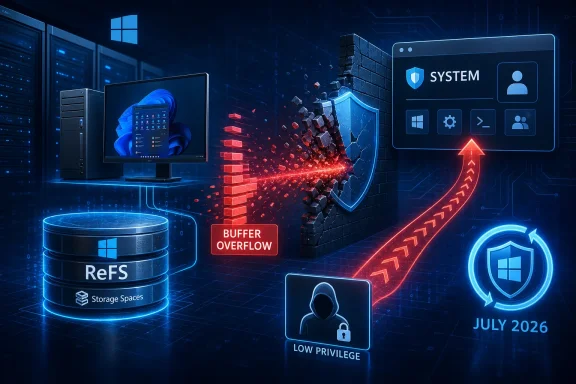 ReFS Turns a Local Foothold Into a System-Level Risk
ReFS is Microsoft’s modern file system for workloads that prioritize resilience, integrity checking, scalability and recovery from storage corruption. It is most closely associated with Windows Server, Storage Spaces, virtualization infrastructure and large data volumes, although support also exists across several Windows client releases.According to Microsoft’s CVE description, an authorized local attacker can trigger a stack-based buffer overflow inside the ReFS implementation. A buffer overflow occurs when code writes more data into a reserved memory area than it can safely contain, potentially overwriting nearby control information or other program state.
The CVSS vector —
AV:L/AC:L/PR:L/UI:N/S:U/C:H/I:H/A:H — captures the practical attack conditions. Exploitation is local, has low complexity, requires low privileges and does not depend on a victim clicking a file, approving a prompt or opening a malicious document.Successful exploitation could have a high impact on confidentiality, integrity and availability. In operational terms, that means a compromised standard account or process could potentially become a route to reading protected data, altering system resources or disrupting the machine.
Microsoft’s public description does not provide a proof of concept, the precise malformed ReFS structure involved or the privilege level obtained after exploitation. The elevation-of-privilege classification nevertheless indicates that the security boundary crossed is more consequential than an ordinary application crash.
Confirmed vulnerability details do not mean confirmed attacks. The “report confidence” text included in Microsoft’s advisory describes the CVSS metric used to indicate that the flaw has been validated by the vendor or supported by credible technical evidence. It should not be read as evidence that CVE-2026-50318 is being exploited in the wild.
The public record available at release does not establish active exploitation or widespread disclosure of working exploit code. Administrators should continue monitoring Microsoft’s advisory and threat-intelligence feeds because local elevation flaws frequently become useful components in multi-stage attacks after initial access has been obtained by another method.
The Exposure Extends Beyond Dedicated Storage Servers
Microsoft’s affected-product data spans multiple generations of Windows. The record includes Windows 10 versions 1607, 1809, 21H2 and 22H2, along with Windows 11 versions 24H2, 25H2 and 26H1.Server exposure includes Windows Server 2016, Windows Server 2019, Windows Server 2022 and Windows Server 2025, including applicable Server Core installations. This broad list matters because an administrator cannot safely treat ReFS as a niche issue confined to one current server release.
The immediate question is not simply whether the operating system can create an ReFS volume. Security teams should determine whether vulnerable machines can access ReFS-formatted storage through local disks, attached virtual disks, Storage Spaces deployments, development environments, backup workflows or removable media.
ReFS is especially relevant in infrastructure where storage availability and integrity are operational priorities. Hyper-V hosts, backup servers, file servers and machines responsible for handling virtual hard disks deserve early attention because they can combine valuable data with elevated service accounts and privileged management tooling.
Workstations should not be ignored. A developer, administrator or support engineer may mount test images, recovery media or virtual disks even if the machine’s primary system drive uses NTFS. Asset inventories that classify exposure solely by the format of
C: can therefore miss realistic paths into the vulnerable component.A local attack requirement reduces exposure compared with a remotely reachable flaw in SMB, RDP or a network service. It does not make the vulnerability harmless. Malware, a compromised remote session, a malicious insider or an attacker operating through stolen credentials may already satisfy that prerequisite.
That is why privilege-escalation vulnerabilities are commonly used as the second step of an intrusion. Initial access provides an account or process with restricted rights; a flaw such as CVE-2026-50318 may then help the attacker bypass those restrictions, interfere with security controls and establish deeper persistence.
July’s Cumulative Updates Carry the Fix
On Windows 11 24H2 and 25H2, Microsoft delivers the correction through KB5101650, moving the operating systems to builds 26100.8875 and 26200.8875 respectively. The package is a cumulative update, so administrators receive the ReFS security correction alongside the month’s other security fixes and quality changes.Windows Server 2025 receives its July security fixes through KB5099536, which advances that platform to build 26100.33158. Windows Server 2019 and Windows 10 version 1809 receive KB5099538 and move to build 17763.9020.
Microsoft’s CVE data also identifies the patched thresholds for several other releases. Windows 10 version 1607 and Windows Server 2016 are protected at build 14393.9339 or later, while Windows 10 versions 21H2 and 22H2 move to builds 19044.7548 and 19045.7548. Windows 11 26H1 is protected at build 28000.2525 or later.
Because these are cumulative Windows updates, organizations should use the package associated with the exact Windows edition, architecture and servicing channel rather than attempting to locate a standalone ReFS-only patch. Supported deployment routes include Windows Update, Windows Update for Business, Microsoft Update Catalog and Windows Server Update Services where applicable.
Administrators can confirm installed builds with
winver, PowerShell or their endpoint-management inventory. Verification should extend beyond whether an update job reported success: machines pending a restart, devices outside maintenance groups and offline servers may remain on vulnerable builds.The July packages also contain changes unrelated to CVE-2026-50318. Microsoft warns, for example, that security updates released on or after July 14 enforce registration requirements for third-party Transport Driver Interface transports, potentially disrupting applications that depend on unregistered TDI transports. That compatibility concern warrants testing, but it should be handled through staged deployment rather than used as a reason to leave exposed ReFS systems indefinitely unpatched.
Storage Roles Deserve a Shorter Patch Window
The CVSS score provides a useful baseline, but it cannot reflect the importance of a specific machine or the consequences of losing control over its storage. A lightly used test PC and a Hyper-V host containing production virtual machines may carry the same CVE score while presenting very different organizational risks.IT teams should prioritize systems where low-privileged users can sign in, untrusted code can execute or ReFS volumes hold sensitive and operationally critical content. Multi-user servers, development machines, virtual desktop infrastructure and remotely administered hosts are stronger candidates for accelerated deployment than isolated systems with tightly controlled access.
Temporary risk reduction should focus on limiting the local foothold that exploitation requires. Administrators can review interactive logon rights, restrict unnecessary remote administration, remove dormant accounts, enforce application control and avoid mounting untrusted storage images. Disabling or removing production ReFS volumes merely to avoid the vulnerability is unlikely to be a practical substitute for installing the update.
Detection is more difficult because Microsoft has not publicly documented a distinctive event, crash signature or exploit artifact for CVE-2026-50318. Endpoint monitoring should therefore watch for suspicious processes attempting to access storage components followed by abrupt privilege changes, security-tool interference, new services or unexpected execution as SYSTEM.
CVE-2026-50318 is not presented as an unauthenticated remote emergency, but its low-complexity path from existing local access to high-impact compromise makes it a poor candidate for long deferral. The concrete milestone for administrators is straightforward: bring every affected Windows system that can encounter ReFS to its July 14, 2026 patched build, then verify the build and reboot state rather than relying solely on deployment reports.
References
- Primary source: MSRC
Published: 2026-07-14T07:00:00-07:00
Security Update Guide - Microsoft Security Response Center
 msrc.microsoft.com
