

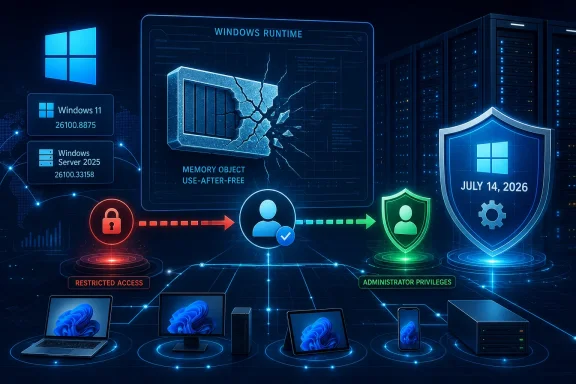
CVE-2026-50340, a high-severity Windows Runtime elevation-of-privilege flaw, is fixed in Microsoft’s July 14, 2026 security updates for Windows 11 and Windows Server 2025. The vulnerability carries a CVSS 3.1 score of 8.5 and could let an authenticated attacker elevate privileges through a network-accessible attack path.
Microsoft’s Security Update Guide describes the underlying defect as a use-after-free vulnerability in Windows Runtime. The company rates it Important rather than Critical, says exploitation is less likely, and reports no evidence that the flaw was publicly disclosed or exploited before the patch arrived. The Zero Day Initiative’s July update review independently lists CVE-2026-50340 as neither public nor under active attack.
The immediate action is straightforward: Windows 11 24H2 and 25H2 systems should reach the July cumulative-update build ending in 8875, while Windows Server 2025 should reach build 26100.33158. Administrators should not treat the absence of known exploitation as a reason to defer the update indefinitely, particularly on shared systems and servers reachable by untrusted authenticated users.
Most Windows elevation-of-privilege vulnerabilities require an attacker to execute code locally after obtaining an initial foothold. CVE-2026-50340 stands out because Microsoft says an authorized attacker can trigger the Windows Runtime flaw over a network.
That wording needs careful interpretation. “Authorized” indicates that exploitation requires some level of existing access or credentials; this is not described as an unauthenticated, wormable vulnerability that arbitrary internet clients can exploit. It is nevertheless more concerning than a conventional local-only privilege escalation because the attacker may not need an interactive desktop session or the ability to launch a local executable directly.
A network-reachable privilege escalation can matter in environments where low-privilege accounts are deliberately permitted to interact with services on shared Windows machines. Remote Desktop Session Hosts, development servers, multi-user workstations, virtual desktop infrastructure and Windows Server systems exposing authenticated services deserve particular attention.
The vulnerability’s 8.5 score reflects that combination of reachability and potential impact. Microsoft has not publicly documented the precise Windows Runtime interface, object or service involved, nor has it provided a proof of concept or a detailed exploitation sequence. That limited disclosure is normal for newly patched Windows flaws, but it means defenders cannot currently build reliable detection around a documented request pattern.
What is confirmed is the weakness category: CWE-416, or use after free. This type of memory-safety failure occurs when software continues to reference memory after the associated object has been released. Under the right conditions, an attacker may be able to influence the reused memory and redirect execution or corrupt security-sensitive state.
The vulnerability-confidence language accompanying Microsoft’s advisory is therefore useful but should not be mistaken for an exploitation forecast. Confidence measures whether the vulnerability and its technical basis are established; exploitability measures how practical an attack is likely to be. Microsoft has confirmed the defect and shipped code changes, while separately assessing real-world exploitation as less likely.
The vulnerable and corrected build boundaries are:
Windows Server 2025 receives the correction through KB5099536, bringing the operating system to build 26100.33158. That same baseline applies to Server Core installations. Microsoft’s July container release also publishes refreshed Windows Server 2025 Server Core and Nano Server base images at 10.0.26100.33158; container administrators must pull and rebuild against the updated images because Windows containers are not serviced in place like a conventional host.
Windows 11 version 26H1 has a slightly different chronology. Microsoft’s affected-version data places the corrected boundary at build 28000.2269, associated with the June 9 update KB5095051, while the July 14 cumulative update KB5101649 advances the branch to build 28000.2525. Installing the latest July cumulative update therefore includes the required protection, even though the vulnerable-build boundary predates the CVE’s public disclosure.
That distinction matters to vulnerability scanners. A tool that checks only whether a July KB is installed could report a different result from one that compares the actual operating-system build. For CVE-2026-50340, the build number is the more dependable compliance signal.
Administrators can verify it with
Microsoft says it is not currently aware of general known issues in KB5101650, but the company has temporarily withheld the Windows 11 update from a limited number of Dell systems with Intel processors. Dell reported an incompatibility that could cause unexpected shutdowns, reduced performance, excess heat and battery drain. Microsoft and Dell are working on a resolution, so administrators managing affected models should not attempt to circumvent a safeguard hold without vendor guidance.
The July updates also enforce registration requirements for third-party TDI transports. Applications attempting to use sockets through an unregistered legacy transport may stop working after installation. That change is separate from CVE-2026-50340, but it belongs in the same deployment test plan because cumulative servicing makes the two inseparable.
Windows Server 2025 administrators have additional reasons to stage the update carefully. KB5099536 includes networking, cryptography, container-performance and system-reliability changes, while Microsoft continues to document an existing WSUS reporting limitation affecting synchronization error details. None of these issues cancels the need to patch, but they argue for the familiar deployment sequence: test representative workloads, update a controlled ring, monitor authentication and network services, then expand.
Security teams should also avoid waiting for an exploit signature. A use-after-free bug with no disclosed trigger offers little dependable network telemetry, and successful privilege escalation may resemble legitimate activity performed by the compromised account or a higher-privilege Windows process. Endpoint detection should instead watch for unusual privilege changes, unexpected child processes from Windows services, suspicious remote-authentication patterns and privileged actions immediately following low-trust sessions.
It does not make the vulnerability benign. Privilege escalation is a common second stage after credential theft, phishing, password spraying or exploitation of another service. Once an attacker has obtained an authorized but restricted identity, a flaw that crosses security boundaries can turn limited access into control over sensitive data, services or the machine itself.
The affected-product list also concentrates the risk on current platforms that enterprises are actively deploying. Windows Server 2025 and Windows 11 24H2 or later are likely to host newer management stacks, virtual desktops, developer tooling and security-sensitive workloads. Their modernity is not a compensating control when the vulnerable component is built into Windows.
For most organizations, CVE-2026-50340 belongs in the normal July Patch Tuesday rollout rather than an out-of-band emergency. Systems exposed to large populations of authenticated but untrusted users should move nearer the front of that queue. The practical finish line is build 26100.8875 or 26200.8875 on mainstream Windows 11, build 28000.2269 or later on Windows 11 26H1, and build 26100.33158 on Windows Server 2025.
Microsoft’s Security Update Guide describes the underlying defect as a use-after-free vulnerability in Windows Runtime. The company rates it Important rather than Critical, says exploitation is less likely, and reports no evidence that the flaw was publicly disclosed or exploited before the patch arrived. The Zero Day Initiative’s July update review independently lists CVE-2026-50340 as neither public nor under active attack.
The immediate action is straightforward: Windows 11 24H2 and 25H2 systems should reach the July cumulative-update build ending in 8875, while Windows Server 2025 should reach build 26100.33158. Administrators should not treat the absence of known exploitation as a reason to defer the update indefinitely, particularly on shared systems and servers reachable by untrusted authenticated users.
 A Network Vector Changes the Usual Privilege-Escalation Calculation
Most Windows elevation-of-privilege vulnerabilities require an attacker to execute code locally after obtaining an initial foothold. CVE-2026-50340 stands out because Microsoft says an authorized attacker can trigger the Windows Runtime flaw over a network.That wording needs careful interpretation. “Authorized” indicates that exploitation requires some level of existing access or credentials; this is not described as an unauthenticated, wormable vulnerability that arbitrary internet clients can exploit. It is nevertheless more concerning than a conventional local-only privilege escalation because the attacker may not need an interactive desktop session or the ability to launch a local executable directly.
A network-reachable privilege escalation can matter in environments where low-privilege accounts are deliberately permitted to interact with services on shared Windows machines. Remote Desktop Session Hosts, development servers, multi-user workstations, virtual desktop infrastructure and Windows Server systems exposing authenticated services deserve particular attention.
The vulnerability’s 8.5 score reflects that combination of reachability and potential impact. Microsoft has not publicly documented the precise Windows Runtime interface, object or service involved, nor has it provided a proof of concept or a detailed exploitation sequence. That limited disclosure is normal for newly patched Windows flaws, but it means defenders cannot currently build reliable detection around a documented request pattern.
What is confirmed is the weakness category: CWE-416, or use after free. This type of memory-safety failure occurs when software continues to reference memory after the associated object has been released. Under the right conditions, an attacker may be able to influence the reused memory and redirect execution or corrupt security-sensitive state.
The vulnerability-confidence language accompanying Microsoft’s advisory is therefore useful but should not be mistaken for an exploitation forecast. Confidence measures whether the vulnerability and its technical basis are established; exploitability measures how practical an attack is likely to be. Microsoft has confirmed the defect and shipped code changes, while separately assessing real-world exploitation as less likely.
The Fixed Builds Draw a Narrow Modern-Windows Boundary
Microsoft’s affected-product data limits CVE-2026-50340 to recent Windows releases rather than the entire supported Windows estate. Both x64 and Arm64 editions are affected where applicable.The vulnerable and corrected build boundaries are:
- Windows 11 version 24H2 is affected before build 26100.8875.
- Windows 11 version 25H2 is affected before build 26200.8875.
- Windows 11 version 26H1 is affected before build 28000.2269.
- Windows Server 2025 is affected before build 26100.33158.
- Windows Server 2025 Server Core is affected before build 26100.33158.
Windows Server 2025 receives the correction through KB5099536, bringing the operating system to build 26100.33158. That same baseline applies to Server Core installations. Microsoft’s July container release also publishes refreshed Windows Server 2025 Server Core and Nano Server base images at 10.0.26100.33158; container administrators must pull and rebuild against the updated images because Windows containers are not serviced in place like a conventional host.
Windows 11 version 26H1 has a slightly different chronology. Microsoft’s affected-version data places the corrected boundary at build 28000.2269, associated with the June 9 update KB5095051, while the July 14 cumulative update KB5101649 advances the branch to build 28000.2525. Installing the latest July cumulative update therefore includes the required protection, even though the vulnerable-build boundary predates the CVE’s public disclosure.
That distinction matters to vulnerability scanners. A tool that checks only whether a July KB is installed could report a different result from one that compares the actual operating-system build. For CVE-2026-50340, the build number is the more dependable compliance signal.
Administrators can verify it with
winver, the Get-ComputerInfo PowerShell cmdlet or their endpoint-management inventory. Server teams using Configuration Manager, Intune, Azure Update Manager or third-party scanners should confirm that detection rules recognize the corrected build thresholds rather than merely looking for a matching update title.Patch Testing Has a Wider July Footprint
The CVE fix arrives inside cumulative updates, so organizations cannot deploy it as an isolated Windows Runtime patch. KB5101650 and KB5099536 also contain the previous month’s quality changes and additional July security hardening.Microsoft says it is not currently aware of general known issues in KB5101650, but the company has temporarily withheld the Windows 11 update from a limited number of Dell systems with Intel processors. Dell reported an incompatibility that could cause unexpected shutdowns, reduced performance, excess heat and battery drain. Microsoft and Dell are working on a resolution, so administrators managing affected models should not attempt to circumvent a safeguard hold without vendor guidance.
The July updates also enforce registration requirements for third-party TDI transports. Applications attempting to use sockets through an unregistered legacy transport may stop working after installation. That change is separate from CVE-2026-50340, but it belongs in the same deployment test plan because cumulative servicing makes the two inseparable.
Windows Server 2025 administrators have additional reasons to stage the update carefully. KB5099536 includes networking, cryptography, container-performance and system-reliability changes, while Microsoft continues to document an existing WSUS reporting limitation affecting synchronization error details. None of these issues cancels the need to patch, but they argue for the familiar deployment sequence: test representative workloads, update a controlled ring, monitor authentication and network services, then expand.
Security teams should also avoid waiting for an exploit signature. A use-after-free bug with no disclosed trigger offers little dependable network telemetry, and successful privilege escalation may resemble legitimate activity performed by the compromised account or a higher-privilege Windows process. Endpoint detection should instead watch for unusual privilege changes, unexpected child processes from Windows services, suspicious remote-authentication patterns and privileged actions immediately following low-trust sessions.
“Less Likely” Is Not the Same as Low Priority
Microsoft’s exploitability assessment provides useful triage context: CVE-2026-50340 was not publicly known, was not being exploited when the July update shipped and is considered less likely to be exploited. That places it below actively exploited zero-days and straightforward remote-code-execution bugs in an emergency patch queue.It does not make the vulnerability benign. Privilege escalation is a common second stage after credential theft, phishing, password spraying or exploitation of another service. Once an attacker has obtained an authorized but restricted identity, a flaw that crosses security boundaries can turn limited access into control over sensitive data, services or the machine itself.
The affected-product list also concentrates the risk on current platforms that enterprises are actively deploying. Windows Server 2025 and Windows 11 24H2 or later are likely to host newer management stacks, virtual desktops, developer tooling and security-sensitive workloads. Their modernity is not a compensating control when the vulnerable component is built into Windows.
For most organizations, CVE-2026-50340 belongs in the normal July Patch Tuesday rollout rather than an out-of-band emergency. Systems exposed to large populations of authenticated but untrusted users should move nearer the front of that queue. The practical finish line is build 26100.8875 or 26200.8875 on mainstream Windows 11, build 28000.2269 or later on Windows 11 26H1, and build 26100.33158 on Windows Server 2025.
References
- Primary source: MSRC
Published: 2026-07-14T07:00:00-07:00
Security Update Guide - Microsoft Security Response Center
 msrc.microsoft.com
- Official source: microsoft.com
Microsoft Mitigates Outlook Elevation of Privilege Vulnerability
www.microsoft.com
- Related coverage: aha.org
