

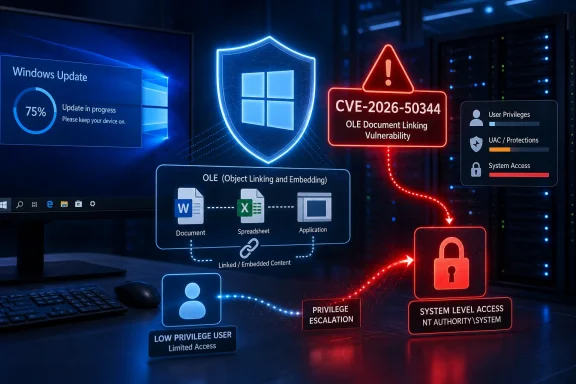
Detailed in Microsoft’s Security Update Guide and recorded by the National Vulnerability Database, the vulnerability stems from improper authorization in Windows Object Linking and Embedding. Microsoft considers the vulnerability confirmed, but its current assessment does not indicate that it was publicly disclosed or exploited before the update became available.
That combination makes CVE-2026-50344 a conventional but consequential Patch Tuesday issue: it is not the vulnerability most likely to provide an attacker with initial access, but it could help turn a limited foothold into broad control over a Windows endpoint or server.
A Local Attack With SYSTEM-Level Consequences
Microsoft describes the required attacker as “authorized,” meaning exploitation begins after the attacker has obtained the ability to execute code or otherwise interact with the targeted machine as a legitimate, low-privilege user. The CVSS vector confirms that this is a local attack requiring low privileges, with no additional user interaction needed once the attack is launched.
The score breaks down as follows:
- The attack vector is local rather than network-based.
- Attack complexity is rated low.
- The attacker requires an existing low-privilege account or execution context.
- No second user must open a file, approve a prompt, or perform another action.
- Successful exploitation can have high confidentiality, integrity, and availability impact.
Microsoft has not publicly documented the precise OLE interface, process, or authorization decision involved. It also has not published proof-of-concept code or step-by-step exploitation details. The available description therefore establishes what the vulnerability can achieve without revealing exactly how an attacker reaches the vulnerable code path.
That distinction matters when interpreting the advisory’s confidence information. The vulnerability’s report confidence is confirmed because Microsoft, the vendor responsible for Windows OLE, has acknowledged and patched it. It does not mean that every technical detail is publicly available or that exploitation has been independently demonstrated in public research.
The CVSS vector indicates the attacker remains within the same security scope while escalating privileges. In practical terms, the vulnerable Windows component improperly grants authority that the initiating account should not possess, allowing the attacker to compromise resources controlled by the affected system.
OLE Remains Embedded Deep in Windows
Object Linking and Embedding is a long-standing Microsoft technology used to connect data and functionality between documents, applications, and system components. Familiar examples include embedding an Excel worksheet in a Word document or using OLE Automation to let one application control another, but the technology’s reach extends beyond visible Office document features.
That breadth is why an OLE vulnerability should not be treated as an Office-only problem. CVE-2026-50344 is categorized as a Windows OLE vulnerability, and Microsoft’s affected-product data spans Windows client and Windows Server releases. Systems do not need Microsoft Office installed to contain Windows’ underlying OLE infrastructure.
The current CVE record identifies affected Windows client releases including Windows 10 versions 1607, 1809, 21H2, and 22H2, as well as Windows 11 versions 24H2, 25H2, and 26H1. Both x64 and Arm64 editions are represented where Microsoft supports them, while older Windows 10 branches also include 32-bit systems.
Microsoft’s fixed build thresholds include:
- Windows 10 1607 reaches build 14393.9339.
- Windows 10 1809 reaches build 17763.9020.
- Windows 10 21H2 reaches build 19044.7548.
- Windows 10 22H2 reaches build 19045.7548.
- Windows 11 24H2 reaches build 26100.8875.
- Windows 11 25H2 reaches build 26200.8875.
- Windows 11 26H1 reaches build 28000.2269.
The affected inventory also includes Windows Server editions, including Server Core installations. Administrators should rely on the Security Update Guide, Windows Update, Windows Server Update Services, Microsoft Configuration Manager, or their normal patch-management platform to match each operating-system release with its July 2026 security update.
Build thresholds are especially useful in mixed estates because they provide a direct verification point after deployment. Running winver, querying the operating-system build through PowerShell, or checking endpoint-management inventory can distinguish a machine that merely received an update deployment command from one that has actually restarted into the corrected build.
Why “Important” Still Deserves Prompt Deployment
Elevation-of-privilege vulnerabilities are frequently used as the second stage of an intrusion. A malicious document, browser exploit, compromised application, stolen standard-user credential, or abused remote-management session may initially place an attacker inside a low-privilege process. CVE-2026-50344 could then provide a route toward more powerful access.
Microsoft’s CVSS assessment assigns high impact across all three primary security properties. An attacker who successfully reaches the elevated context could potentially read protected information, alter system data or configuration, and disrupt the machine. The advisory does not specify the exact privileges obtained, so administrators should avoid assuming a particular account level until Microsoft or independent researchers publish further technical analysis.
The lack of a network attack vector lowers the immediate exposure compared with an unauthenticated remote-code-execution flaw in an Internet-facing service. It does not remove risk from shared systems, virtual desktop infrastructure, Remote Desktop Session Hosts, developer workstations, jump servers, or machines where untrusted code may execute under restricted accounts.
Servers present a particularly important deployment case. Local access on a server may come from a compromised service account, a vulnerable application, an interactive administrative workflow, or another exploit in a chain. Preventing the privilege-escalation step can stop an attacker from converting that initial access into control of the host.
There is no separate workaround in the public material that offers equivalent protection. Disabling Office macros, blocking OLE packages in email, or tightening document-handling policies may reduce other OLE-related risks, but those controls should not be treated as substitutes for the Windows update. The weakness is in authorization performed by the Windows component itself.
Patch Verification Matters More Than CVE Counting
CVE-2026-50344 arrived in an unusually large July 2026 Patch Tuesday release. BleepingComputer counted 570 Microsoft vulnerabilities addressed during the month, including 254 elevation-of-privilege issues and three zero-days. CVE-2026-50344 was not among the vulnerabilities identified as actively exploited or publicly disclosed before a fix was available.
That larger volume creates a risk of treating individual vulnerabilities as rows in a spreadsheet rather than checking whether affected devices actually received the correct cumulative update. Because Windows security fixes are normally delivered cumulatively, administrators generally do not deploy a stand-alone OLE patch; they deploy the appropriate July 2026 operating-system update.
IT teams should confirm installation status after the required reboot and pay attention to devices that have fallen outside normal servicing. Windows 10 branches retained for Long-Term Servicing Channel or Extended Security Updates require the update appropriate to that servicing model. A device reporting an older build remains vulnerable even if another July update with a similar name appears in its history.
Security monitoring should also treat unexplained privilege changes, unusual child processes launched from desktop applications, and suspicious activity crossing from standard-user to privileged contexts as investigation points. Microsoft has not supplied a CVE-specific detection signature, so defenders must rely on broader endpoint telemetry until more technical details become available.
The immediate action is straightforward: deploy the July 14, 2026 Windows cumulative security update, restart affected machines, and verify that their builds meet or exceed Microsoft’s corrected versions. The remaining question is whether researchers will disclose the vulnerable OLE authorization path now that patches are available—a development that could make delayed patching substantially riskier.
References
- CVE-2026-50344 Windows OLE Elevation of Privilege Vulnerability MSRC · 2026-07-14T07:00:00-07:00