

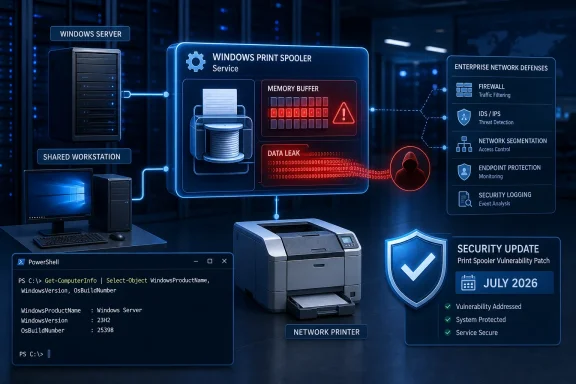
Microsoft’s Security Response Center describes the flaw as a buffer over-read in Windows Print Spooler components. An authorized attacker with low-level privileges could exploit it locally, without another user taking action, to expose information that should remain inaccessible.
The vulnerability carries a CVSS 3.1 base score of 6.1. Microsoft had not identified public disclosure or active exploitation when the advisory was released, and its assessment placed exploitation in the “less likely” category.
A Local Flaw With High Confidentiality Impact
CVE-2026-50383 is not a PrintNightmare-style route from the internet to SYSTEM privileges. Its CVSS vector, AV:L/AC:L/PR:L/UI:N/S:U/C:H/I:N/A:L, shows that exploitation requires local access and low privileges. Attack complexity is low, however, and no user interaction is required once the attacker is in position.
The most significant element is the high confidentiality impact. A buffer over-read occurs when software reads beyond the intended boundary of a memory buffer, potentially returning adjacent memory contents. Depending on what the Print Spooler process holds at that moment, such disclosure can expose data useful for further attacks, although Microsoft has not publicly detailed the exact information recoverable through this flaw.
The integrity impact is scored as none, meaning Microsoft does not believe CVE-2026-50383 directly permits modification of protected data. Availability impact is low, indicating exploitation could cause limited disruption but is not expected to produce a complete or persistent denial of service.
That combination makes the vulnerability more relevant after an attacker has already crossed an initial security boundary. Information disclosures can reveal memory addresses, process data, or other environmental details that help bypass mitigations or improve the reliability of a separate exploit. Microsoft’s public description does not establish that CVE-2026-50383 can be chained with another specific vulnerability, but defenders should not treat the absence of direct code execution as the absence of security value to an attacker.
Supported Windows Releases Need the July Updates
The CVE record identifies affected releases across the currently serviced Windows client and server estate. They include Windows 10 Version 1809, Windows 10 21H2 and 22H2, Windows 11 24H2, Windows 11 25H2, Windows 11 26H1, Windows Server 2019, Windows Server 2022, and Windows Server 2025. Server Core installations are also affected.
Microsoft’s version data sets the following patched build thresholds:
- Windows 10 Version 1809 and Windows Server 2019 are protected at build 17763.9020 or later.
- Windows 10 Versions 21H2 and 22H2 are protected at builds 19044.7548 and 19045.7548 or later.
- Windows 11 Versions 24H2 and 25H2 are protected at build 26100.8875 and 26200.8875 or later.
- Windows 11 Version 26H1 is protected at build 28000.2269 or later.
- Windows Server 2022 is protected at build 20348.5386 or later.
- Windows Server 2025 is protected at build 26100.33158 or later.
The relevant July servicing packages include KB5099538 for Windows Server 2019, bringing it to OS Build 17763.9020, and KB5099540 for Windows Server 2022, bringing it to OS Build 20348.5386. KB5099536 moves Windows Server 2025 to OS Build 26100.33158. Client and specialized Windows 11 editions may receive different KB packages even where their underlying servicing branches are closely related, so administrators should validate the installed OS build rather than assuming one KB number covers every platform.
Because the fix is delivered through cumulative Windows servicing, there is no separate Print Spooler hotfix to locate. Devices that successfully install the applicable July 2026 security update should receive the correction alongside the month’s other Windows fixes.
Administrators can confirm the result with winver, PowerShell, endpoint-management inventory, or the Windows Update history. For larger estates, build-number compliance is more dependable than checking whether an update merely appears as offered or downloaded.
“Confirmed” Describes Evidence, Not Active Attacks
The report-confidence field included in Microsoft’s advisory can be easy to misread. A value of Confirmed means Microsoft considers the existence of the vulnerability and its technical basis sufficiently established. It can reflect vendor confirmation, detailed research, reproducible behavior, or code that allows the finding to be independently validated.
It does not mean exploitation has been confirmed in customer environments. Microsoft separately tracks whether a vulnerability was publicly disclosed and whether it has been exploited. For CVE-2026-50383, those fields were “No” at publication on July 14, 2026.
The temporal CVSS score of 5.3 is lower than the 6.1 base score because Microsoft lists exploit-code maturity as unproven and an official fix as available. The confirmed report-confidence rating raises confidence in the underlying technical finding, while the unproven exploit maturity indicates that Microsoft was not aware of functional public exploit code at release.
This distinction matters operationally. Security teams should not escalate CVE-2026-50383 as though Microsoft had announced a zero-day campaign, but neither should they postpone remediation because the flaw is only an information disclosure. The vulnerability is considered real, reproducible enough for vendor confirmation, and straightforward enough to receive a low attack-complexity rating.
Print Spooler Exposure Still Depends on the Machine’s Role
The Windows Print Spooler has a long history of attracting security scrutiny because it processes complex printer data, loads drivers, communicates with remote print infrastructure, and commonly runs with substantial privileges. CVE-2026-50383 is narrower than the Spooler vulnerabilities that enabled remote code execution or elevation of privilege, but it affects the same security-sensitive subsystem.
Risk is highest where low-privileged users can execute code locally on systems that also handle sensitive workloads. Multi-user servers, virtual desktop infrastructure, shared engineering workstations, computer laboratories, kiosk-management systems, and jump hosts deserve earlier attention than locked-down single-user endpoints.
On servers that do not print and do not act as print servers, disabling the Print Spooler remains a useful hardening measure. Administrators can inspect its state with:
Get-Service Spooler
Where business requirements permit, it can be stopped and disabled:
Stop-Service Spooler
Set-Service Spooler -StartupType Disabled
That should not be applied indiscriminately. Disabling the service breaks local and network printing and can affect applications that generate documents through Windows printing interfaces. It is also a defense-in-depth choice rather than a substitute for installing the security update.
Print servers and endpoints that require printing should remain enabled and patched. Organizations should also continue limiting who can install printer drivers, controlling Point and Print behavior, and monitoring unexpected processes or users interacting with printing services.
Patch Priority Comes From Access, Not Internet Reachability
CVE-2026-50383 does not warrant the emergency posture associated with an actively exploited, unauthenticated remote-code-execution flaw. Its local attack vector and low-privilege requirement place an important boundary around exposure: an attacker must first obtain access to the Windows system.
For enterprise defenders, that makes it a normal but meaningful Patch Tuesday deployment rather than a reason to dismantle printing infrastructure overnight. Test the July cumulative updates against print servers, line-of-business printing applications, label systems, and older printer drivers, then move them through the regular security rollout without unnecessary delay.
Systems shared by many users should sit near the front of that rollout. An information leak from a privileged Windows service can become more consequential when combined with credential theft, sandbox escape, elevation-of-privilege, or memory-corruption techniques.
Microsoft had reported no public disclosure and no exploitation as of July 14, 2026. The practical milestone is therefore straightforward: bring affected machines to the listed July build levels, verify that the update completed successfully, and disable the Print Spooler only on systems where printing is genuinely unnecessary.
References
- CVE-2026-50383 Windows Print Spooler Information Disclosure Vulnerability MSRC · 2026-07-14T07:00:00-07:00