

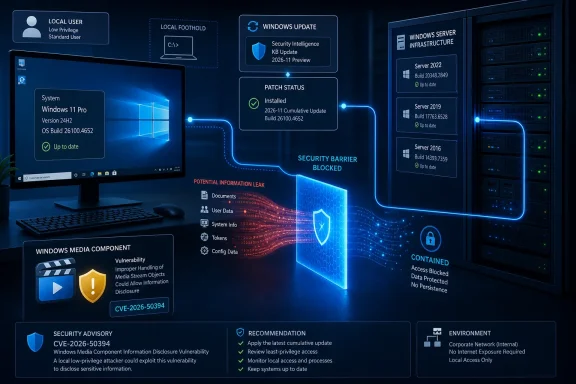
Detailed in Microsoft’s Security Update Guide and published on July 14, CVE-2026-50394 carries a CVSS 3.1 base score of 5.5. The National Vulnerability Database classifies the underlying weakness as CWE-200, or exposure of sensitive information to an unauthorized actor, although NIST was still awaiting its own enrichment of the record at publication time.
Microsoft has not publicly described exactly what data Windows Media could expose, which Windows Media subsystem contains the defect, or how an attacker would trigger it. That limited disclosure makes the CVSS vector and affected-build list especially important for deciding where the vulnerability belongs in an organization’s patch queue.
Local Access Keeps the Door Narrow
The CVSS vector is CVSS:3.1/AV:L/AC:L/PR:L/UI:N/S:U/C:H/I:N/A:N. In practical terms, exploitation is local, has low attack complexity, requires low privileges, and needs no action from another user.
This is not a vulnerability that an unauthenticated attacker can directly exploit by sending a packet to a Windows PC over the internet. An attacker must first obtain authorized access at a low privilege level, whether through a compromised account, malicious code already running on the device, an exposed interactive session, or another initial-access technique.
The absence of a user-interaction requirement is nevertheless significant. Once the attacker has the necessary foothold, Microsoft’s score indicates that exploitation does not depend on persuading someone to open a media file, follow a link, or dismiss a warning.
Microsoft assesses the potential confidentiality impact as high while assigning no integrity or availability impact. A successful attack could therefore reveal information that should not be available to the attacker, but CVE-2026-50394 is not independently scored as allowing data modification, system disruption, privilege escalation, or arbitrary code execution.
That distinction prevents the “Windows Media” name from creating the wrong threat model. Microsoft has separately fixed critical Windows Media remote-code-execution vulnerabilities in the same July release, but CVE-2026-50394 is a local disclosure issue, not one of those critical code-execution flaws.
The Patch Boundary Runs Across Client and Server
Microsoft’s affected-build data shows that the vulnerability reaches across Windows client and server releases, including Server Core installations. Systems below the following July 2026 build levels remain within the affected ranges:
- Windows 10 version 1607 is affected below build 14393.9339.
- Windows 10 version 1809 is affected below build 17763.9020.
- Windows 10 version 21H2 is affected below build 19044.7548.
- Windows 10 version 22H2 is affected below build 19045.7548.
- Windows 11 version 24H2 is affected below build 26100.8875.
- Windows 11 version 25H2 is affected below build 26200.8875.
- Windows 11 version 26H1 is affected below build 28000.2269.
- Windows Server 2012 R2 is affected below build 9600.23291.
- Windows Server 2016 is affected below build 14393.9339.
- Windows Server 2019 is affected below build 17763.9020.
- Windows Server 2022 is affected below build 20348.5386.
- Windows Server 2025 is affected below build 26100.33158.
The Windows 10 version 21H2 and 22H2 fixes arrive at builds 19044.7548 and 19045.7548 through KB5099539 for the supported Enterprise LTSC and IoT Enterprise LTSC branches. Organizations should use Microsoft’s Security Update Guide or their normal update-management inventory to match the correct July package to every other release rather than treating one KB number as universal.
Server Core’s inclusion also matters. The absence of the full desktop shell does not remove the affected Windows Media code from Microsoft’s supported configurations, so administrators should not exclude Core servers solely because nobody uses them as media playback devices.
Likewise, disabling or removing the visible Windows Media Player application cannot be assumed to mitigate CVE-2026-50394. “Windows Media” can refer to shared operating-system components and codecs used by applications and services, and Microsoft has not documented an application-removal workaround for this flaw.
Report Confidence Is Not Exploitability
The report-confidence language included with Microsoft’s advisory describes how strongly the vulnerability’s existence and technical basis have been established. A confirmed rating means the vendor or available technical evidence substantiates the flaw; it does not mean that exploitation has been observed.
SANS Internet Storm Center’s July Patch Tuesday tracking lists CVE-2026-50394 as neither publicly disclosed nor exploited in the wild. It also records Microsoft’s Important rating, the 5.5 base score, and a 4.8 temporal score.
Those distinctions are easy to blur in vulnerability dashboards. Report confidence answers whether defenders should trust that the defect is real, while exploit maturity and public disclosure indicate how much usable attack knowledge may already be circulating.
At the time of Microsoft’s July 14 release, CVE-2026-50394 was not identified as a zero-day. There was no public proof of concept in the available vendor information, and Microsoft did not report active attacks involving this specific flaw.
The low-complexity designation still means administrators should avoid treating the missing technical details as evidence that exploitation would be difficult. It means the required conditions are straightforward once an attacker has obtained local, low-privilege access, even if the public does not yet know the exact trigger.
A Supporting Role in a Larger Intrusion
CVE-2026-50394 is unlikely to serve as an attacker’s first step into a properly firewalled Windows environment. Its more plausible role is as a post-compromise primitive: code running under a restricted account uses Windows Media to retrieve information it should not be able to read.
Microsoft has not identified the exposed data, so defenders cannot yet say whether the disclosure would reveal memory contents, pointers, credentials, media metadata, or another class of sensitive information. Claims about a specific leak mechanism would be speculation until Microsoft updates the advisory or independent researchers publish verified analysis.
Information disclosures are frequently valuable when chained with other defects. Leaked memory addresses can sometimes weaken exploit mitigations, while exposed configuration or user data can support credential theft, lateral movement, or follow-on privilege escalation. That is a general risk pattern rather than a confirmed exploitation path for CVE-2026-50394.
For enterprise triage, the vulnerability should sit below remotely exploitable and actively abused July fixes, but it should not be deferred indefinitely. Shared workstations, remote desktop hosts, jump servers, virtual desktop infrastructure, kiosks, and other machines where untrusted or semi-trusted users receive local sessions present a more relevant exposure than tightly controlled single-user endpoints.
Security teams should also treat scanner results carefully. A scanner that reports the Windows Media application as absent may still miss vulnerable operating-system components, while a build-based assessment provides a stronger indication of patch status.
July’s Cumulative Update Is the Practical Fix
Microsoft has not published a workaround or mitigation that substitutes for the security update. The operational response is therefore conventional: test the July 14 cumulative updates, deploy them according to exposure and business criticality, and verify the resulting OS build rather than relying only on a successful deployment status.
Endpoints managed through Windows Update, Windows Update for Business, Microsoft Intune, Windows Server Update Services, or Configuration Manager should receive the fix through the normal cumulative-update channel. Administrators maintaining Windows Server 2012 R2 or other systems with special servicing arrangements must confirm that those devices remain eligible for and are actually receiving their applicable security updates.
CVE-2026-50394 is not the headline vulnerability in Microsoft’s unusually large July 2026 Patch Tuesday release, which BleepingComputer counted at 570 Microsoft flaws and three zero-days. Its practical lesson is narrower: local access reduces immediate internet exposure, but a high-confidentiality leak with no user interaction can still strengthen an attacker who has already crossed the perimeter.
The measurable finish line is the patched build boundary. Until affected Windows clients and servers reach their applicable July 2026 build or later, Windows Media remains an available information-disclosure path for any attacker who can establish a low-privilege local foothold.
References
- CVE-2026-50394 Windows Media Information Disclosure Vulnerability MSRC · 2026-07-14T07:00:00-07:00