

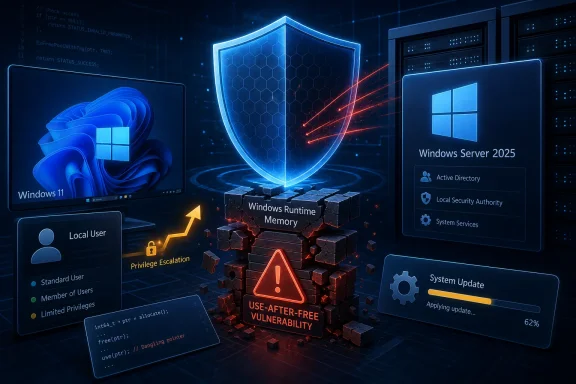
CVE-2026-50413 is a high-severity Windows Runtime vulnerability that can let a locally authenticated attacker elevate privileges, potentially gaining extensive control over an affected Windows 11 or Windows Server 2025 system. Microsoft addressed the flaw through cumulative updates associated with the July 14, 2026 Patch Tuesday release, with administrators urged to verify build numbers rather than assume that update approval equals successful installation.
Detailed in Microsoft’s Security Update Guide and recorded by the National Vulnerability Database, the vulnerability carries a CVSS 3.1 base score of 8.8 out of 10. It affects Windows 11 versions 24H2 and 25H2, Windows 11 version 26H1, and both the full and Server Core installation options of Windows Server 2025.
The weakness is a use-after-free memory-management error in Windows Runtime. Microsoft has confirmed the vulnerability, but the public record currently provides little detail about the specific Windows Runtime interface, service, or application path required to reach the vulnerable code.
CVE-2026-50413 is not remotely exploitable by an unauthenticated attacker over the network. Its CVSS vector specifies local access, low attack complexity, low privileges, and no user interaction:
In practical terms, an attacker must already be able to execute code or access an account on the target. That prerequisite limits the vulnerability’s usefulness as an initial entry point, but it makes the flaw potentially valuable after phishing, credential theft, malicious software installation, or exploitation of another vulnerability.
The absence of a user-interaction requirement is particularly important. Once the attacker has the necessary low-level access, exploitation does not require a second user to open a document, click a warning, or approve another action.
Microsoft’s scoring also assigns high potential impact to confidentiality, integrity, and availability. A successful exploit could therefore allow an attacker to access protected information, alter system resources, interfere with security controls, or disrupt the affected machine.
The CVSS scope is marked as changed, indicating that exploitation can cross a security boundary beyond the authority of the initially vulnerable component. That helps explain why the score reaches 8.8 despite the requirement for local access and existing privileges.
CISA’s initial SSVC data lists no known exploitation and classifies the issue as not readily automatable. Its technical-impact assessment is nevertheless “total,” reflecting the level of control that a successful privilege escalation could provide. That combination argues for prompt patching without treating the vulnerability as an Internet-wide emergency on the scale of a pre-authentication remote-code-execution flaw.
Exploitation depends on controlling the program’s memory state closely enough to turn that invalid reference into a useful security primitive. Microsoft’s low attack-complexity rating indicates that the company does not believe unusual race conditions or highly specialized environmental circumstances are necessary for repeatable exploitation.
Windows Runtime, commonly called WinRT, supplies APIs and infrastructure used by Windows and packaged applications. The broad component name does not establish that every WinRT application is directly exploitable, nor does Microsoft’s brief description identify a malicious file type or exposed API that administrators could disable as a temporary defense.
That lack of component-level detail limits the value of network signatures and application-specific mitigations. Endpoint controls that reduce unauthorized code execution remain useful, but the direct remediation is to deploy a cumulative Windows update containing the corrected Runtime code.
Microsoft’s “confirmed” report-confidence assessment is also worth separating from exploit maturity. It means the vendor has sufficient evidence to verify that the vulnerability exists; it does not mean working exploit code is publicly available or that attacks have been observed.
The affected-version information supplied by Microsoft places the security boundary at those builds:
The Windows 11 version 26H1 entry is less conventional. Microsoft lists build 28000.2269 as the fixed threshold; that build was delivered by KB5095051 on June 9, 2026. Systems already at or above that revision are therefore outside the affected range even though the CVE itself was published on July 14.
For administrators, this is a reminder that CVE publication dates and the first availability of corrected code do not always match. A fix may ship inside an earlier cumulative package and only be documented publicly after coordinated disclosure is complete.
Inventory systems should evaluate the installed OS version and revision together. Looking only for KB5101650 would miss Windows Server 2025 and would not correctly evaluate Windows 11 26H1.
Administrators can check an individual endpoint by running
Application allowlisting, Microsoft Defender for Endpoint attack-surface reduction rules, least-privilege policies, and Endpoint Privilege Management can reduce the opportunities available before exploitation. They do not replace the operating-system fix because the flaw sits in a Windows component and requires no additional victim interaction once its prerequisites are met.
Server administrators should prioritize Windows Server 2025 machines where low-privilege interactive sessions or application accounts can execute untrusted code. Multi-user systems, development hosts, remote application servers, and workloads that process code or packages from less-trusted sources deserve particular attention.
Deployment teams should still follow normal cumulative-update testing because the July packages contain far more than this single correction. Microsoft’s July release also introduces networking hardening that may disrupt applications relying on unregistered third-party TDI transports, making representative validation important for older enterprise software.
That operational caveat should shape rollout sequencing, not justify leaving the vulnerability open. The immediate target is clear: Windows 11 24H2 must reach 26100.8875, Windows 11 25H2 must reach 26200.8875, Windows 11 26H1 must be at least 28000.2269, and Windows Server 2025 must reach 26100.33158.
Detailed in Microsoft’s Security Update Guide and recorded by the National Vulnerability Database, the vulnerability carries a CVSS 3.1 base score of 8.8 out of 10. It affects Windows 11 versions 24H2 and 25H2, Windows 11 version 26H1, and both the full and Server Core installation options of Windows Server 2025.
The weakness is a use-after-free memory-management error in Windows Runtime. Microsoft has confirmed the vulnerability, but the public record currently provides little detail about the specific Windows Runtime interface, service, or application path required to reach the vulnerable code.
 Local Access Does Not Make This Low Risk
CVE-2026-50413 is not remotely exploitable by an unauthenticated attacker over the network. Its CVSS vector specifies local access, low attack complexity, low privileges, and no user interaction: CVSS:3.1/AV:L/AC:L/PR:L/UI:N/S:C/C:H/I:H/A:H.In practical terms, an attacker must already be able to execute code or access an account on the target. That prerequisite limits the vulnerability’s usefulness as an initial entry point, but it makes the flaw potentially valuable after phishing, credential theft, malicious software installation, or exploitation of another vulnerability.
The absence of a user-interaction requirement is particularly important. Once the attacker has the necessary low-level access, exploitation does not require a second user to open a document, click a warning, or approve another action.
Microsoft’s scoring also assigns high potential impact to confidentiality, integrity, and availability. A successful exploit could therefore allow an attacker to access protected information, alter system resources, interfere with security controls, or disrupt the affected machine.
The CVSS scope is marked as changed, indicating that exploitation can cross a security boundary beyond the authority of the initially vulnerable component. That helps explain why the score reaches 8.8 despite the requirement for local access and existing privileges.
CISA’s initial SSVC data lists no known exploitation and classifies the issue as not readily automatable. Its technical-impact assessment is nevertheless “total,” reflecting the level of control that a successful privilege escalation could provide. That combination argues for prompt patching without treating the vulnerability as an Internet-wide emergency on the scale of a pre-authentication remote-code-execution flaw.
The Fault Is a Use-After-Free in Windows Runtime
The vulnerability is categorized as CWE-416, or use after free. This class of bug occurs when software continues to reference memory after the program has released it, creating an opportunity for corrupted or attacker-influenced data to occupy the same location.Exploitation depends on controlling the program’s memory state closely enough to turn that invalid reference into a useful security primitive. Microsoft’s low attack-complexity rating indicates that the company does not believe unusual race conditions or highly specialized environmental circumstances are necessary for repeatable exploitation.
Windows Runtime, commonly called WinRT, supplies APIs and infrastructure used by Windows and packaged applications. The broad component name does not establish that every WinRT application is directly exploitable, nor does Microsoft’s brief description identify a malicious file type or exposed API that administrators could disable as a temporary defense.
That lack of component-level detail limits the value of network signatures and application-specific mitigations. Endpoint controls that reduce unauthorized code execution remain useful, but the direct remediation is to deploy a cumulative Windows update containing the corrected Runtime code.
Microsoft’s “confirmed” report-confidence assessment is also worth separating from exploit maturity. It means the vendor has sufficient evidence to verify that the vulnerability exists; it does not mean working exploit code is publicly available or that attacks have been observed.
Fixed Builds Define the Patch Boundary
For Windows 11 versions 24H2 and 25H2, the relevant July cumulative update is KB5101650. Successful installation moves Windows 11 24H2 to OS Build 26100.8875 and Windows 11 25H2 to OS Build 26200.8875.The affected-version information supplied by Microsoft places the security boundary at those builds:
- Windows 11 version 24H2 on x64 and ARM64 is affected below build 26100.8875.
- Windows 11 version 25H2 on x64 and ARM64 is affected below build 26200.8875.
- Windows 11 version 26H1 on x64 and ARM64 is affected below build 28000.2269.
- Windows Server 2025, including Server Core, is affected below build 26100.33158.
The Windows 11 version 26H1 entry is less conventional. Microsoft lists build 28000.2269 as the fixed threshold; that build was delivered by KB5095051 on June 9, 2026. Systems already at or above that revision are therefore outside the affected range even though the CVE itself was published on July 14.
For administrators, this is a reminder that CVE publication dates and the first availability of corrected code do not always match. A fix may ship inside an earlier cumulative package and only be documented publicly after coordinated disclosure is complete.
Inventory systems should evaluate the installed OS version and revision together. Looking only for KB5101650 would miss Windows Server 2025 and would not correctly evaluate Windows 11 26H1.
Administrators can check an individual endpoint by running
winver, viewing Settings under System and About, or querying the build through PowerShell and their endpoint-management platform. In managed environments, compliance reporting should confirm that the final build revision meets or exceeds Microsoft’s stated threshold.Patch the Privilege-Escalation Link in the Attack Chain
CVE-2026-50413 is most relevant to organizations that assume standard-user accounts substantially contain a compromised endpoint. If attackers can reliably convert an ordinary authenticated session into higher privileges, they may be able to disable protections, extract credentials, establish persistence, or gain access to data unavailable to the original account.Application allowlisting, Microsoft Defender for Endpoint attack-surface reduction rules, least-privilege policies, and Endpoint Privilege Management can reduce the opportunities available before exploitation. They do not replace the operating-system fix because the flaw sits in a Windows component and requires no additional victim interaction once its prerequisites are met.
Server administrators should prioritize Windows Server 2025 machines where low-privilege interactive sessions or application accounts can execute untrusted code. Multi-user systems, development hosts, remote application servers, and workloads that process code or packages from less-trusted sources deserve particular attention.
Deployment teams should still follow normal cumulative-update testing because the July packages contain far more than this single correction. Microsoft’s July release also introduces networking hardening that may disrupt applications relying on unregistered third-party TDI transports, making representative validation important for older enterprise software.
That operational caveat should shape rollout sequencing, not justify leaving the vulnerability open. The immediate target is clear: Windows 11 24H2 must reach 26100.8875, Windows 11 25H2 must reach 26200.8875, Windows 11 26H1 must be at least 28000.2269, and Windows Server 2025 must reach 26100.33158.
References
- Primary source: MSRC
Published: 2026-07-14T07:00:00-07:00
Security Update Guide - Microsoft Security Response Center
 msrc.microsoft.com
