

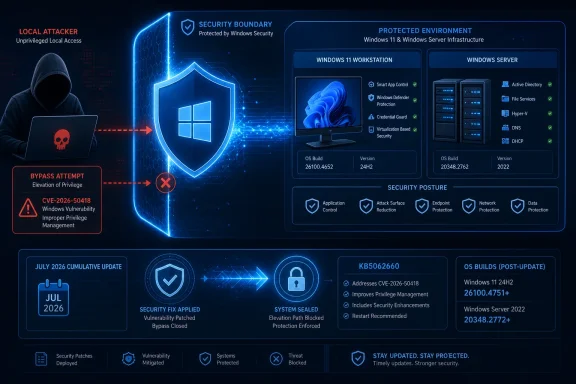
Microsoft’s Security Response Center describes the underlying weakness as improper access control in Windows System. The National Vulnerability Database, which received the Microsoft-issued record on July 14, classifies it as CWE-284 and lists a CVSS 3.1 base score of 5.1, placing it in the Medium range under the standard scoring system.
The concise disclosure leaves one crucial detail unanswered: Microsoft has not publicly identified the particular Windows security feature that can be bypassed. Administrators therefore have little basis for creating a narrowly targeted mitigation and should treat installation of the July cumulative update as the primary remedy.
Local Does Not Mean Authenticated
The CVSS vector for CVE-2026-50418 is CVSS:3.1/AV:L/AC:L/PR:N/UI:N/S:U/C:L/I:L/A:N. In practical terms, exploitation must originate from the affected computer rather than arrive directly across the network, but the attacker does not need existing privileges or cooperation from another user.
That combination deserves attention. An attack with a local vector often depends on malicious code, a hostile peripheral, physical access, or another vulnerability that gives an attacker an initial foothold. It is not equivalent to a remotely exploitable flaw that can be triggered against an exposed Windows service from anywhere on the internet.
However, PR:N and UI:N indicate that exploitation does not require the attacker to begin with an authorized Windows account or persuade a signed-in user to open a file or approve an action. Microsoft also rates the attack complexity as low, suggesting that no unusual race condition, elaborate configuration, or hard-to-reproduce circumstance is required once the attacker reaches the vulnerable interface.
A successful attack can produce low confidentiality and integrity impacts. The attacker may be able to obtain some information that should remain protected and make limited unauthorized changes, but Microsoft’s scoring does not indicate a total loss of confidentiality or integrity. Availability is unaffected, meaning the vulnerability is not expected to crash Windows or make the system unavailable.
The scope remains unchanged. Any resulting impact stays within the same security authority instead of crossing into a separately controlled component.
The Affected List Starts With Windows 11 24H2
According to Microsoft’s CVE record as reproduced by NIST, CVE-2026-50418 affects a relatively focused set of current Windows releases:
- Windows 11 version 24H2 is affected on x64 and Arm64 systems before OS build 26100.8875.
- Windows 11 version 25H2 is affected on x64 and Arm64 systems before the July 2026 servicing level in the 26200.887x build range.
- Windows 11 version 26H1 is affected on x64 and Arm64 systems before the fixed July build.
- Windows Server 2022 is affected before OS build 20348.5386.
- Windows Server 2025, including Server Core installations, is affected before OS build 26100.33158.
Windows 11 24H2 and 25H2 receive the fix through KB5101650, released July 14. Microsoft’s support documentation identifies OS build 26100.8875 for version 24H2 and the corresponding 26200.887x servicing branch for version 25H2.
Windows 11 version 26H1 receives KB5101649, which advances the operating system to build 28000.2525. Microsoft’s CVE data uses build 28000.2269 as the lower affected-version boundary, but that was the June 9 servicing level rather than the newly patched July build. Systems should therefore be checked for KB5101649 or a later cumulative update, not merely build 28000.2269.
For servers, Windows Server 2022 receives KB5099540, bringing it to build 20348.5386. Windows Server 2025 receives KB5099536, bringing both Desktop Experience and Server Core installations to build 26100.33158.
Because Windows cumulative updates supersede previous releases, a later monthly update will also contain the correction. Administrators do not need to locate a standalone CVE-specific package.
“Confirmed” Describes Evidence, Not Exploitation
The report-confidence language displayed in Microsoft’s Security Update Guide is easy to misread. It explains how strongly the existence and technical basis of a vulnerability have been established; it does not indicate how frequently attackers are exploiting it.
For CVE-2026-50418, vendor publication provides strong confirmation that the vulnerability exists. Microsoft is the assigning CVE Numbering Authority, has supplied the affected-version ranges and CVSS vector, and has released corrected Windows builds. That is materially different from an uncorroborated security claim or a preliminary researcher report.
Confirmed report confidence is not the same as confirmed exploitation. It does not by itself mean that attack code is publicly available, that malware is using the flaw, or that Microsoft has detected attacks in the wild. The sparse disclosure also means would-be attackers have not been handed a component name, proof of concept, or technical explanation by Microsoft.
Conversely, the absence of public implementation details is not a reason to defer patching indefinitely. Attackers can compare pre-update and post-update Windows binaries to isolate security-relevant changes, a process known as patch diffing. The low-complexity rating suggests exploitation may be repeatable if researchers identify the corrected access-control path.
CVE-2026-50418 is best viewed as a building block rather than an obvious standalone compromise route. A local security-feature bypass can become more consequential when chained with an initial-access or code-execution vulnerability. Attackers frequently combine lower-scored weaknesses to move from an untrusted local context into access that Windows intended to deny.
Deployment Risk Is Broader Than This CVE
For unmanaged Windows 11 PCs, Windows Update should install the July cumulative package automatically under the device’s normal update policy. Users can verify the result by running winver or checking Settings under Windows Update and Update history.
Enterprise administrators should confirm compliance by KB number or OS build through Microsoft Intune, Windows Update for Business reporting, Configuration Manager, WSUS, or their endpoint-management platform. Vulnerability scanners may initially rely on package detection because Microsoft has disclosed too little about the affected component for dependable behavior-based identification.
The July updates contain more than the CVE-2026-50418 fix, so normal pilot-ring testing remains appropriate. Microsoft warns that applications using sockets over unregistered third-party TDI transports may stop working after Windows security updates released on or after July 14, 2026. Server 2022 deployments may also encounter a one-time BitLocker recovery prompt on a limited set of machines with an unrecommended PCR7 Group Policy configuration.
Those compatibility considerations justify controlled rollout, not omission of the update. Administrators should escrow BitLocker recovery keys, audit unusual networking software and validate critical server workloads before broad deployment.
CVE-2026-50418 does not carry the profile of an internet-wide emergency: it is local, has limited confidentiality and integrity impact, and has no availability impact in Microsoft’s scoring. Its unauthorized, interaction-free and low-complexity characteristics nevertheless make it a meaningful hardening fix. The concrete target is straightforward: move Windows 11 systems to KB5101650 or KB5101649, Windows Server 2022 to build 20348.5386, and Windows Server 2025 to build 26100.33158 or later.
References
- CVE-2026-50418 Windows System Secure Feature Bypass Vulnerability MSRC · 2026-07-14T07:00:00-07:00