

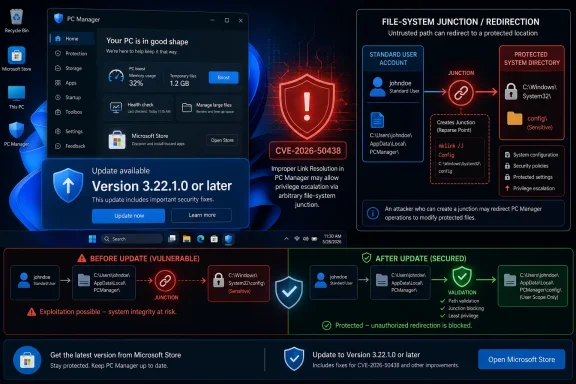
Detailed in the Microsoft Security Response Center’s Security Update Guide, the vulnerability carries a CVSS 3.1 base score of 8.8. The National Vulnerability Database identifies affected releases as Microsoft PC Manager 1.0.0 through versions earlier than 3.22.1.0, making version 3.22.1.0 the first listed non-vulnerable release.
This is not a remote, unauthenticated Windows takeover. An attacker must already have local access and low-level privileges, but exploitation requires neither elevated rights nor interaction from another user. That combination makes CVE-2026-50438 relevant to shared PCs, managed endpoints and environments where one compromised standard account must not become a route to broader system control.
PC Manager Trips Over a File-System Trust Boundary
Microsoft describes the underlying weakness as improper link resolution before file access, categorized as CWE-59. This class of vulnerability occurs when privileged software accesses a file or directory without safely resolving symbolic links, junctions or other redirection mechanisms first.
The result can be a link-following attack. A lower-privileged user prepares a path that appears to point to an ordinary location, but redirects a privileged operation toward a protected file or directory. If the elevated component follows that link while deleting, replacing, creating or modifying data, the attacker may be able to turn an otherwise legitimate maintenance task into an operation against a security-sensitive target.
Microsoft has not publicly documented the exact PC Manager component, file path or cleanup operation involved. That limits administrators’ ability to build a precise behavioral detection independently of the update, but it also avoids giving attackers an immediate recipe for reproducing the flaw.
PC Manager is an especially notable place for this bug because its purpose involves operations that naturally cross privilege boundaries. The application can clean temporary files, inspect running processes, manage startup entries, scan storage and coordinate with Windows Security and Windows Update. Several of those tasks require access beyond an ordinary application’s working directory.
That does not mean every PC Manager feature is vulnerable. It means the application’s combination of privileged services and file-management functions gives a link-resolution mistake potentially serious consequences.
An 8.8 Score Without a Remote Attack
The CVSS vector assigned by Microsoft is CVSS:3.1/AV:L/AC:L/PR:L/UI:N/S:C/C:H/I:H/A:H. Each part narrows the practical risk.
The attack vector is local, so an attacker cannot exploit CVE-2026-50438 merely by sending a packet to an exposed Windows PC. The attacker needs a foothold on the affected machine, such as access to a standard user account or code execution obtained through another vulnerability, a malicious download or stolen credentials.
Attack complexity is rated low, indicating that exploitation is not expected to depend on a rare race, unusual configuration or difficult-to-control condition. Low privileges are required, while user interaction is not. Once the attacker is in position, another user does not need to open a document, approve a dialog or click a crafted link.
Microsoft also marks the scope as changed. In CVSS terms, that indicates exploitation can cross from the vulnerable PC Manager component into a different security authority. The confidentiality, integrity and availability impacts are all rated high, reflecting the possibility of gaining broad control over protected data and system operations.
The confirmed report confidence attached to the advisory should not be confused with evidence of active attacks. Report confidence describes Microsoft’s certainty that the vulnerability exists and that the technical assessment is credible. It does not mean a public proof of concept is available or that exploitation has been observed in customer environments.
The Cybersecurity and Infrastructure Security Agency’s SSVC data recorded no known exploitation as of July 15. Its assessment also categorized exploitation as non-automatable while assigning a total technical impact. In practical terms, this is a serious post-compromise capability rather than an Internet-wide worm scenario.
The Fix Arrives Through the App, Not Windows Update
CVE-2026-50438 affects Microsoft PC Manager itself rather than the underlying Windows 10 or Windows 11 operating system. Installing July’s Windows cumulative update therefore should not be treated as proof that the vulnerability has been removed.
Administrators and users need to verify the application version directly. PC Manager 3.22.1.0 was already appearing through Microsoft’s distribution channels before the July 14 advisory; third-party software catalogs recorded the release in early July. Systems pinned to older packages, disconnected from Microsoft Store updates or managed through an internal software repository may still be running a vulnerable build.
The appropriate response is straightforward:
- Update Microsoft PC Manager to version 3.22.1.0 or later through the Microsoft Store or the organization’s approved application-management channel.
- Inventory managed endpoints for installations of PC Manager earlier than 3.22.1.0.
- Remove the application from systems where it is not required and cannot be updated promptly.
- Confirm that Store application updates have not been disabled by policy or blocked by network controls.
- Replace cached installers and deployment packages so that newly provisioned PCs do not receive a vulnerable version.
Microsoft PC Manager is an optional utility, not a core requirement for Windows. Organizations that do not deliberately deploy it may still find it on user-managed PCs or devices where employees installed it from the Store. That makes application inventory more useful than assuming the fleet is unaffected because PC Manager does not appear in the standard Windows servicing dashboard.
Endpoint tools that collect MSIX and Microsoft Store package versions should be able to identify old installations. For unmanaged machines, users can open PC Manager’s settings or application information page and compare the displayed version against 3.22.1.0.
Local Privilege Escalation Remains a Chain Builder
CVE-2026-50438 is unlikely to be an attacker’s initial entry point, but that does not make it low priority. Modern Windows attacks commonly combine a user-level foothold with a separate privilege-escalation bug, allowing malicious code that began inside one account to disable defenses, access other users’ data, establish persistence or tamper with system files.
The absence of required user interaction makes that chaining scenario more useful. After compromising a standard account, an attacker would not need to persuade an administrator to approve a User Account Control prompt. The vulnerable privileged component could potentially become the bridge.
Defensive monitoring should consequently focus on suspicious file-system redirection and privileged PC Manager activity, although Microsoft’s limited technical disclosure prevents a narrowly tailored detection rule. Unexpected junction or symbolic-link creation in directories used by PC Manager, followed by elevated file operations, would merit investigation. Such behavior is not proof of exploitation on its own because legitimate software also uses reparse points.
Removing local administrator rights remains good containment practice, but it does not resolve this flaw: Microsoft’s vector explicitly assumes an attacker starts with low privileges. Application allowlisting, attack-surface reduction and endpoint detection can make the initial foothold harder to obtain, while the product update closes the escalation path itself.
The immediate milestone for IT teams is therefore not July’s Windows patch compliance percentage. It is confirming that every installed copy of Microsoft PC Manager has reached version 3.22.1.0 or newer, including Store apps that may sit outside the organization’s normal cumulative-update workflow.
References
- CVE-2026-50438 Microsoft PC Manager Elevation of Privilege Vulnerability MSRC · 2026-07-14T07:00:00-07:00