

CVE-2026-50457 is a high-severity Windows Runtime vulnerability that can let a locally authenticated attacker elevate privileges through a use-after-free memory error. Microsoft addressed the flaw in security updates released on July 14, 2026, covering Windows 11 24H2, 25H2 and 26H1, supported Windows 10 servicing channels, Windows Server 2019, and Windows Server 2025.
Detailed in Microsoft’s Security Update Guide, the vulnerability carries a CVSS 3.1 base score of 7.8 out of 10 and an “Important” severity rating. Microsoft describes the underlying problem as both a race condition and a use-after-free weakness in Windows Runtime, indicating that improper synchronization can leave code operating on memory after it has been released.
This is not a remote, unauthenticated entry point. Exploitation requires local access and low-level privileges, but no user interaction, and successful exploitation could give an attacker complete control over the affected system’s confidentiality, integrity, and availability.
The CVSS vector for CVE-2026-50457 is AV:L/AC:L/PR:L/UI:N/S:U/C:H/I:H/A:H. In practical terms, an attacker must already be able to run code on the target machine, but Microsoft assesses the attack complexity as low once that condition is met.
That distinction matters. CVE-2026-50457 is unlikely to be an organization’s initial breach vector, but it could become the second stage of an attack that begins with a malicious download, stolen user credentials, a compromised application, or another vulnerability that provides limited code execution. Malware operating as an ordinary user could potentially use the flaw to escape those restrictions and obtain more powerful privileges.
The lack of a user-interaction requirement also removes a common obstacle. Once an attacker has authenticated and placed suitable code on the machine, exploitation does not require another user to open a file, approve a prompt, or visit a crafted website.
Microsoft assigns high potential impact across all three core CVSS categories. An attacker who successfully elevates privileges could potentially access protected information, alter system configuration, tamper with security tools, install persistent components, or disrupt Windows. The exact privileges obtained and exploitation method have not been publicly documented, so those outcomes describe the practical risk of a successful privilege escalation rather than a confirmed exploit chain.
Windows Runtime is a foundational set of APIs and supporting infrastructure used by Windows components and applications. Microsoft has not identified the precise class, broker, service, or callable interface involved in CVE-2026-50457, limiting defenders’ ability to build a reliable component-specific workaround.
Use-after-free vulnerabilities are significant because the released memory may be reallocated and filled with attacker-controlled content. If vulnerable code subsequently treats that content as the original object, it may read invalid data, follow manipulated pointers, or perform operations the attacker can influence.
A race condition adds a timing requirement, although Microsoft still rates the attack complexity as low. That assessment indicates exploitation is not expected to depend on unusually narrow circumstances, extensive preparation, or conditions outside the attacker’s control.
The vulnerability record supplies enough information to confirm that the defect exists and that Microsoft has shipped a correction. It does not disclose the vulnerable function, affected binary, proof-of-concept technique, or the identity of the researcher who reported it.
That is where the confidence metric accompanying Microsoft’s CVSS data should be read carefully. The temporal vector uses RC:C, meaning report confidence confirmed: Microsoft, as the product vendor and assigning authority, has acknowledged the vulnerability and released fixes. It does not mean exploitation has been observed or that complete technical details are public.
As of July 15, CISA’s vulnerability record marked exploitation as “none” and the attack as not automatable. CVE-2026-50457 was also not identified among the publicly disclosed or actively exploited zero-days highlighted in reporting on Microsoft’s July 2026 Patch Tuesday release. Administrators should therefore treat it as a confirmed, patchable local privilege-escalation risk—not as evidence of an active campaign.
Windows Server 2022 and Windows 11 23H2 do not appear in Microsoft’s confirmed affected-product record for this CVE. Administrators should not infer vulnerability merely because a product received a July cumulative update; deployment and vulnerability scanners should match both the CVE’s product list and the installed build.
Windows 10 requires additional attention because general support for versions 21H2 and 22H2 has ended outside eligible servicing programs. Devices still receiving applicable Extended Security Updates or covered by editions such as Enterprise LTSC must be brought to the corrected build. An unmanaged Windows 10 PC that no longer receives security updates should not be assumed protected simply because Windows Update reports no ordinary optional updates.
The immediate administrative task is therefore straightforward: verify the OS version, cumulative update, and build rather than relying solely on a successful Windows Update scan.
Organizations should prioritize shared workstations, remote desktop hosts, application servers, developer systems, and other machines where untrusted or lower-privileged code can run alongside privileged services. Local privilege-escalation flaws become especially valuable on systems where many users log on or where a compromised service account would otherwise have limited rights.
Application control, least-privilege user assignments, Microsoft Defender protections, and restrictions on executable content remain useful defensive layers. They can reduce an attacker’s opportunity to deliver and run the first-stage code needed to reach CVE-2026-50457, but they do not repair the Windows Runtime memory error.
The CVE was published amid an unusually large July Patch Tuesday release containing hundreds of Microsoft vulnerabilities, including other Windows Runtime privilege-escalation defects. That volume makes raw CVE counts a poor deployment guide. For CVE-2026-50457, the actionable test is whether each affected endpoint has reached its corrected build floor—and whether systems that cannot receive that build have a credible retirement or isolation plan.
Detailed in Microsoft’s Security Update Guide, the vulnerability carries a CVSS 3.1 base score of 7.8 out of 10 and an “Important” severity rating. Microsoft describes the underlying problem as both a race condition and a use-after-free weakness in Windows Runtime, indicating that improper synchronization can leave code operating on memory after it has been released.
This is not a remote, unauthenticated entry point. Exploitation requires local access and low-level privileges, but no user interaction, and successful exploitation could give an attacker complete control over the affected system’s confidentiality, integrity, and availability.
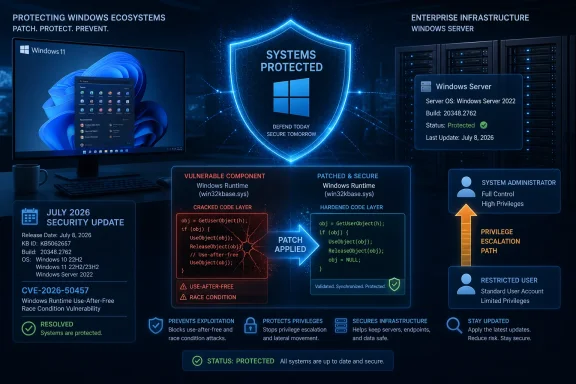 A Local Bug With System-Level Consequences
The CVSS vector for CVE-2026-50457 is AV:L/AC:L/PR:L/UI:N/S:U/C:H/I:H/A:H. In practical terms, an attacker must already be able to run code on the target machine, but Microsoft assesses the attack complexity as low once that condition is met.That distinction matters. CVE-2026-50457 is unlikely to be an organization’s initial breach vector, but it could become the second stage of an attack that begins with a malicious download, stolen user credentials, a compromised application, or another vulnerability that provides limited code execution. Malware operating as an ordinary user could potentially use the flaw to escape those restrictions and obtain more powerful privileges.
The lack of a user-interaction requirement also removes a common obstacle. Once an attacker has authenticated and placed suitable code on the machine, exploitation does not require another user to open a file, approve a prompt, or visit a crafted website.
Microsoft assigns high potential impact across all three core CVSS categories. An attacker who successfully elevates privileges could potentially access protected information, alter system configuration, tamper with security tools, install persistent components, or disrupt Windows. The exact privileges obtained and exploitation method have not been publicly documented, so those outcomes describe the practical risk of a successful privilege escalation rather than a confirmed exploit chain.
Windows Runtime is a foundational set of APIs and supporting infrastructure used by Windows components and applications. Microsoft has not identified the precise class, broker, service, or callable interface involved in CVE-2026-50457, limiting defenders’ ability to build a reliable component-specific workaround.
The Memory-Safety Failure Is Confirmed, but Details Remain Sparse
Microsoft identifies CWE-416, Use After Free, and CWE-362, Concurrent Execution Using Shared Resource with Improper Synchronization, for this vulnerability. Together, those classifications suggest that competing operations can mishandle the lifetime of an object, allowing one execution path to continue using memory that another path has already released.Use-after-free vulnerabilities are significant because the released memory may be reallocated and filled with attacker-controlled content. If vulnerable code subsequently treats that content as the original object, it may read invalid data, follow manipulated pointers, or perform operations the attacker can influence.
A race condition adds a timing requirement, although Microsoft still rates the attack complexity as low. That assessment indicates exploitation is not expected to depend on unusually narrow circumstances, extensive preparation, or conditions outside the attacker’s control.
The vulnerability record supplies enough information to confirm that the defect exists and that Microsoft has shipped a correction. It does not disclose the vulnerable function, affected binary, proof-of-concept technique, or the identity of the researcher who reported it.
That is where the confidence metric accompanying Microsoft’s CVSS data should be read carefully. The temporal vector uses RC:C, meaning report confidence confirmed: Microsoft, as the product vendor and assigning authority, has acknowledged the vulnerability and released fixes. It does not mean exploitation has been observed or that complete technical details are public.
As of July 15, CISA’s vulnerability record marked exploitation as “none” and the attack as not automatable. CVE-2026-50457 was also not identified among the publicly disclosed or actively exploited zero-days highlighted in reporting on Microsoft’s July 2026 Patch Tuesday release. Administrators should therefore treat it as a confirmed, patchable local privilege-escalation risk—not as evidence of an active campaign.
July Updates Establish the Safe Build Floor
Microsoft’s affected-version data provides concrete build thresholds. Systems below the listed build remain vulnerable, while the corresponding July security update or a later cumulative update supplies the correction.- Windows 11 24H2 should be updated to build 26100.8875 through KB5101650 or later.
- Windows 11 25H2 should be updated to build 26200.8875 through KB5101650 or later.
- Windows 11 26H1 should receive KB5101649, bringing the operating system to build 28000.2525.
- Windows 10 22H2 should reach build 19045.7548 through KB5099539 or later.
- Windows 10 21H2 servicing installations should reach build 19044.7548 through KB5099539 or later.
- Windows 10 version 1809 and Windows Server 2019 should reach build 17763.9020 through KB5099538 or later.
- Windows Server 2025 should reach build 26100.33158 through KB5099536 or later.
Windows Server 2022 and Windows 11 23H2 do not appear in Microsoft’s confirmed affected-product record for this CVE. Administrators should not infer vulnerability merely because a product received a July cumulative update; deployment and vulnerability scanners should match both the CVE’s product list and the installed build.
Windows 10 requires additional attention because general support for versions 21H2 and 22H2 has ended outside eligible servicing programs. Devices still receiving applicable Extended Security Updates or covered by editions such as Enterprise LTSC must be brought to the corrected build. An unmanaged Windows 10 PC that no longer receives security updates should not be assumed protected simply because Windows Update reports no ordinary optional updates.
Patch Status Matters More Than a Generic Mitigation
Microsoft has not published a workaround or configuration-based mitigation specific to CVE-2026-50457. Because the vulnerable interface has not been identified publicly, disabling an unrelated service or blocking an inbound port cannot be treated as a dependable substitute for installing the cumulative update.The immediate administrative task is therefore straightforward: verify the OS version, cumulative update, and build rather than relying solely on a successful Windows Update scan.
winver, the Settings app, PowerShell inventory, Microsoft Intune, Configuration Manager, Windows Server Update Services, and endpoint-management platforms can all expose the installed build at different scales.Organizations should prioritize shared workstations, remote desktop hosts, application servers, developer systems, and other machines where untrusted or lower-privileged code can run alongside privileged services. Local privilege-escalation flaws become especially valuable on systems where many users log on or where a compromised service account would otherwise have limited rights.
Application control, least-privilege user assignments, Microsoft Defender protections, and restrictions on executable content remain useful defensive layers. They can reduce an attacker’s opportunity to deliver and run the first-stage code needed to reach CVE-2026-50457, but they do not repair the Windows Runtime memory error.
The CVE was published amid an unusually large July Patch Tuesday release containing hundreds of Microsoft vulnerabilities, including other Windows Runtime privilege-escalation defects. That volume makes raw CVE counts a poor deployment guide. For CVE-2026-50457, the actionable test is whether each affected endpoint has reached its corrected build floor—and whether systems that cannot receive that build have a credible retirement or isolation plan.
References
- Primary source: MSRC
Published: 2026-07-14T07:00:00-07:00
Security Update Guide - Microsoft Security Response Center
 msrc.microsoft.com
- Related coverage: aha.org
