

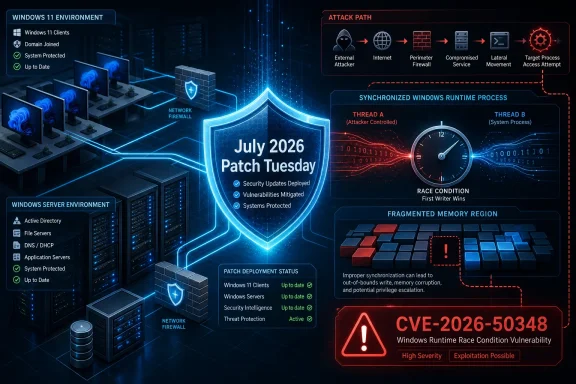
Detailed in Microsoft’s Security Update Guide and published as part of July 2026 Patch Tuesday, CVE-2026-50348 carries a CVSS 3.1 base score of 7.0. Microsoft had not identified public disclosure or active exploitation when the advisory was issued, and assessed exploitation as less likely.
That status lowers the immediate alarm level, but it does not make the update optional. The combination of remote reachability, no required authentication, and potential privilege escalation deserves attention wherever Windows systems expose services to untrusted networks.
A Race Condition Opens a Remote Path
Microsoft describes CVE-2026-50348 as improper synchronization during concurrent access to a shared resource in Windows Runtime. In practical terms, the vulnerability is a race condition: security depends on the order and timing of operations, but an attacker may be able to manipulate that timing and reach a state the software was not designed to permit.
The CVE record associates the vulnerability with both CWE-362, concurrent execution using a shared resource with improper synchronization, and CWE-416, use after free. That pairing suggests one thread or operation may continue using memory after another has released it, although Microsoft has not published enough implementation detail to identify the precise Windows Runtime interface involved.
A successful attack could produce limited confidentiality and integrity loss alongside a high availability impact. Microsoft’s CVSS vector is:
CVSS:3.1/AV:N/AC:H/PR:N/UI:N/S:U/C:L/I:L/A:H
The most significant property is AV:N, or network attack vector. An attacker does not need an existing account and does not need to persuade a user to open a document, click a link, or launch an application.
There is an important constraint: attack complexity is rated high. Exploitation likely depends on winning a timing-sensitive race or arranging system conditions that are not reliably present on every attempt. That helps explain why the score is 7.0 rather than Critical, but race conditions can become more dependable once researchers understand the affected code path.
Microsoft’s use of “elevation of privilege” is also broader than the familiar local scenario in which malware moves from a standard user account to SYSTEM. Here, the network vector means administrators should not assume that endpoint controls requiring prior local access fully contain the risk.
The Patch Reaches Across Windows Generations
The affected-product data published through the CVE record covers Windows 10 Version 1809, Windows 10 Version 21H2, Windows 10 Version 22H2, Windows 11 Version 24H2, Windows 11 Version 25H2, and Windows 11 version 26H1. Windows Server 2019, Windows Server 2022, and Windows Server 2025 are also represented, including Server Core installations where applicable.
The corrected build thresholds include:
- Windows 10 Version 1809 and Windows Server 2019 are updated to build 17763.9020.
- Windows 10 Version 21H2 and Version 22H2 move to builds 19044.7548 and 19045.7548.
- Windows Server 2022 moves to build 20348.5386.
- Windows 11 Version 24H2 moves to build 26100.8875.
- Windows 11 Version 25H2 moves to build 26200.8875.
- Windows 11 version 26H1 moves to build 28000.2269.
- Windows Server 2025 moves to build 26100.33158.
For Windows 11 Version 24H2 and 25H2, Microsoft distributes the correction through KB5101650. Windows Server 2025 receives build 26100.33158 through KB5099536. Because these are cumulative updates, installing the relevant July release also brings in the other operating-system security and reliability fixes included for that branch.
Administrators should validate the installed OS build rather than relying only on Windows Update history. A deployment tool can report an update as offered, downloaded, or installed even when a reboot remains outstanding or the installation has rolled back.
On individual machines, winver provides the clearest quick check. PowerShell inventory, Microsoft Intune, Windows Update for Business reports, Azure Update Manager, or an organization’s endpoint-management platform will be more useful across a fleet.
The presence of older Windows 10 editions in the affected list should not be read as renewed general support. Some releases remain eligible only through Long-Term Servicing Channel deployments, Extended Security Updates, or other specific servicing arrangements. A system outside its supported servicing channel may not receive the correction through ordinary Windows Update.
“Confirmed” Describes the Evidence, Not an Attack Wave
The text supplied with Microsoft’s advisory explains the CVSS report confidence metric, which is marked Confirmed. This means Microsoft considers the vulnerability’s existence and technical basis sufficiently established; it does not mean attackers have confirmed exploitation in customer environments.
That distinction matters because vulnerability dashboards often place “Confirmed” next to exploitability information, inviting an overly alarming interpretation. The National Vulnerability Database showed CVE-2026-50348 as awaiting its own enrichment on July 15, while retaining Microsoft’s score, description, weaknesses, and affected-version data.
At publication, Microsoft classified the vulnerability as not publicly disclosed and not exploited. The SANS Internet Storm Center’s July Patch Tuesday summary likewise listed no known disclosure or exploitation for this CVE.
Those assessments are snapshots taken at release. Microsoft can revise an advisory if proof-of-concept code appears, exploitation is detected, affected products change, or technical details are corrected. Security teams should therefore continue monitoring CVE-2026-50348 after deployment begins, particularly because remote attack paths attract more research attention than vulnerabilities requiring an established local account.
Confirmed report confidence increases certainty that the bug is real; it does not increase evidence that attacks are already underway.
Server Exposure Should Drive the Deployment Order
Microsoft’s “exploitation less likely” judgment supports measured rollout testing, not a prolonged deferral. The safest operational response is to prioritize systems according to network exposure and business impact.
Internet-facing Windows Server hosts should be near the front of the queue, followed by servers reachable from guest, partner, laboratory, operational-technology, or other weakly trusted network segments. Multi-user systems and infrastructure that cannot tolerate an availability loss also warrant early treatment because Microsoft scores the potential availability impact as high.
Workstations behind layered controls still need the update, but administrators can use normal deployment rings if no related exploitation appears. A sensible sequence is to patch representative Windows 11 and Windows Server test groups, confirm application and service health, and then expand rapidly to exposed and privileged systems.
Microsoft has not documented a separate workaround or mitigation that provides equivalent protection. Network segmentation, host firewalls, reduced service exposure, and endpoint detection remain useful defensive layers, but none repairs the synchronization error in Windows Runtime.
Organizations that cannot install the July update immediately should review inbound reachability and eliminate unnecessary access to affected hosts. They should also watch for abnormal service crashes, unexplained process behavior, or privilege changes, while recognizing that Microsoft has not published specific indicators of compromise for CVE-2026-50348.
The lack of public technical detail also limits signature-based detection. Until the vulnerable interface and exploitation sequence are better understood, installing the corrected cumulative update is the only complete vendor-backed fix.
CVE-2026-50348 is not one of July’s known zero-days, and its high attack complexity gives administrators some room to test. Its remote, unauthenticated path nevertheless makes build verification important: Windows 11 24H2 systems should reach 26100.8875, Windows 11 25H2 systems 26200.8875, and corresponding server builds should meet Microsoft’s July 14 thresholds before the vulnerability can be considered remediated.
References
- CVE-2026-50348 Windows Runtime Elevation of Privilege Vulnerability MSRC · 2026-07-14T07:00:00-07:00