

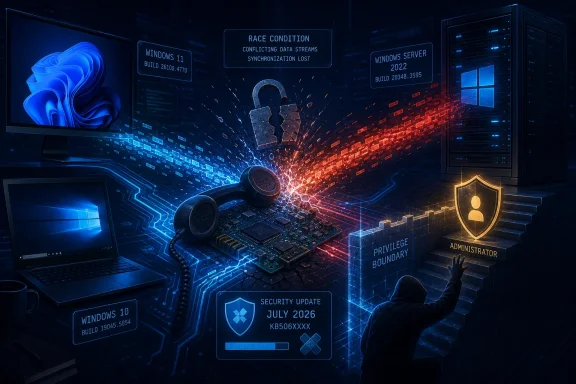
Detailed in Microsoft’s Security Update Guide and corroborated by the National Vulnerability Database, the flaw affects supported Windows 11 releases, several Windows 10 branches, and Windows Server installations stretching back to Windows Server 2012. Administrators should deploy the July security updates rather than treating the issue as relevant only to systems actively used for telephone or modem workloads.
Microsoft says the vulnerability was not publicly disclosed and was not known to be exploited when the advisory was published. Its exploitability assessment indicates that exploitation is less likely, but the potential result—high impact to confidentiality, integrity, and availability—makes the update a priority for endpoints on which an attacker could first obtain ordinary user access.
A Race Condition Opens the Privilege Boundary
The underlying problem is a race condition in the Windows Telephony Service. Microsoft describes it as concurrent execution involving a shared resource without proper synchronization, while the CVE record maps the flaw to both CWE-362, Concurrent Execution Using Shared Resource with Improper Synchronization, and CWE-416, Use After Free.
That combination points to a timing-sensitive memory-safety failure. One execution path can release or modify a resource while another path still expects it to remain valid, potentially allowing an attacker to manipulate the service’s behavior at a privileged boundary.
Microsoft has not published proof-of-concept code or the low-level sequence required to trigger the bug. That limits immediate attacker knowledge, but it also means defenders should not infer that the affected service must be visibly handling calls at the time of attack. Windows components and applications can interact with Telephony API infrastructure in ways that are not obvious from a machine’s day-to-day role.
Successful exploitation requires local access and low privileges. The CVSS vector is CVSS:3.1/AV:L/AC:H/PR:L/UI:N/S:U/C:H/I:H/A:H, meaning the attacker cannot exploit the vulnerability directly across the network, must already possess some authorization, and faces conditions beyond their direct control.
No victim interaction is required once those prerequisites are met. The high attack-complexity rating is the principal factor holding the score to 7.0 rather than placing it among more straightforward privilege-escalation vulnerabilities.
Local does not mean harmless. Attackers commonly combine an initial-access technique—such as stolen credentials, a malicious attachment, an exposed remote-management service, or exploitation of another application—with a local elevation flaw. The first vulnerability gets code running; the second helps that code escape the restrictions of the compromised account.
The Affected List Crosses Windows Generations
Microsoft’s CVE data identifies affected builds across current Windows 11 releases and older Windows editions still receiving security fixes through mainstream, extended, or specialized support channels. The listed client platforms include:
- Windows 11 version 24H2 builds earlier than 26100.8875 are affected.
- Windows 11 version 25H2 builds earlier than 26200.8875 are affected.
- Windows 11 version 26H1 builds earlier than 28000.2525 are affected.
- Windows 10 version 22H2 builds earlier than 19045.7548 are affected.
- Windows 10 version 21H2 builds earlier than 19044.7548 are affected.
- Windows 10 version 1809 builds earlier than 17763.9020 are affected.
- Windows 10 version 1607 builds earlier than 14393.9339 are affected.
The record includes x64 and ARM64 systems where those architectures are available, along with 32-bit installations for older Windows 10 versions. Windows Server 2012 and its Server Core installation are also explicitly represented, with builds before 9200.26226 listed as vulnerable.
The breadth of that inventory matters more than the Telephony name suggests. Windows 10 1607 and 1809 remain present in industrial systems, long-term servicing deployments, embedded workloads, and older enterprise environments. Windows Server 2012 survives in similarly stubborn corners despite its age, often behind application dependencies that make replacement difficult.
Organizations receiving Extended Security Updates or managing specialized Windows servicing channels must use the update packages appropriate to those programs. Installing a package intended for a mainstream Windows 11 endpoint is not a substitute for confirming the patched build and update status of every legacy branch.
Administrators should verify the resulting OS build rather than relying solely on an update deployment tool reporting success. A machine can accept a deployment job yet remain behind because of a pending restart, servicing-stack issue, supersedence problem, or failure later in the installation process.
“Confirmed” Describes the Evidence, Not Active Attacks
The report-confidence metric supplied with the advisory is Confirmed. In CVSS terminology, that means the vendor has validated the vulnerability or sufficient technical evidence exists to establish that it is real. It does not mean exploitation has been observed in the wild.
CISA’s Stakeholder-Specific Vulnerability Categorization data listed exploitation as none and assessed the issue as not readily automatable at publication. It nevertheless classified the potential technical impact as total, consistent with Microsoft’s CVSS assessment of high confidentiality, integrity, and availability impact following successful exploitation.
Those distinctions are important when assigning remediation priority. CVE-2026-50669 is not an unauthenticated remote-code-execution flaw exposed to arbitrary internet traffic, and the high-complexity requirement may make reliable weaponization difficult. It is also not a cosmetic service bug: successful privilege escalation could let an intruder disable security controls, access protected data, install persistent tooling, or interfere with system availability.
Security teams should therefore place the vulnerability in the privilege-escalation portion of their attack-path models. Machines with many interactive users, shared administrative workflows, developer tools, remote desktop access, or internet-facing software present more useful staging points than tightly controlled servers where untrusted users cannot execute code.
Endpoint detection systems may catch the behavior surrounding an attack without recognizing CVE-2026-50669 itself. Useful signals include unusual low-privilege processes interacting with telephony components, abrupt child processes running with elevated rights, unexpected service manipulation, and security-control changes immediately following activity under an ordinary account.
Patching Beats Disabling Telephony Blindly
Microsoft has supplied an official fix, and the advisory does not establish service disablement as a complete substitute. Administrators should avoid disabling Windows telephony components across an estate without testing because enterprise applications, communications software, legacy line-of-business tools, modem integrations, and call-management products may rely on the Telephony API or related services.
The practical response is to deploy the July 14, 2026 Windows security updates, restart systems where required, and confirm that each device has reached the corrected build for its release. Vulnerability scanners and configuration-management queries should be updated to check build thresholds, especially on systems whose Windows version is serviced outside the organization’s standard desktop update ring.
Priority should go to multi-user systems, administrative workstations, jump hosts, Remote Desktop Session Hosts, developer machines, and servers where non-administrative accounts can run software. These are the environments in which an attacker with an initial foothold is most likely to benefit from a local elevation primitive.
CVE-2026-50669 was not a known zero-day when Microsoft published it on July 14, but its presence across multiple Windows generations gives attackers a broad target population to study. The immediate milestone for defenders is concrete: bring Windows 11, Windows 10, and Windows Server systems to their July 2026 patched builds before technical details or reliable exploit code reduce the race condition’s current complexity advantage.
References
- CVE-2026-50669 Windows Telephony Server Elevation of Privilege Vulnerability MSRC · 2026-07-14T07:00:00-07:00