

CVE-2026-50679 exposes Windows 11 and Windows Server 2025 systems to a local privilege-escalation attack through a heap-based buffer overflow in the Windows Search component. Microsoft rated the vulnerability Important and addressed it in security updates released on July 14, 2026.
The flaw carries a CVSS 3.1 base score of 7.8. Microsoft’s Security Update Guide and the National Vulnerability Database describe an attack requiring local access and low privileges, but no user interaction. Successful exploitation could give an attacker high-impact access to system confidentiality, integrity, and availability.
Microsoft had not identified CVE-2026-50679 as publicly disclosed or exploited in the wild when the July updates shipped. The Zero Day Initiative’s July Patch Tuesday review likewise recorded no public disclosure and no active exploitation.
CVE-2026-50679 is classified as CWE-122, a heap-based buffer overflow. This type of memory-corruption bug occurs when software writes more data into a heap allocation than the allocated space can hold, potentially damaging adjacent data and altering program execution.
Microsoft’s public description remains deliberately brief. It identifies the vulnerable technology as the Microsoft Windows Search Component but does not disclose the malformed input, affected interface, or precise sequence needed to trigger the overflow. There is consequently not enough public information to reproduce the vulnerability or determine whether exploitation depends on indexing a particular file, invoking a local service interface, or reaching another Search-related code path.
The CVSS vector provides several useful boundaries. The attack is local rather than network-based, requires an attacker to possess low-level privileges, and does not require another user to click a file or approve a prompt. Attack complexity is rated low once those prerequisites have been met.
That makes CVE-2026-50679 a post-compromise escalation vulnerability, not a direct route into an otherwise protected PC. An attacker would first need a foothold through stolen credentials, malware, another vulnerability, or permitted local access. The Search flaw could then reportedly be used to move from a constrained account or process into a much more powerful security context.
This distinction lowers the immediate risk to an isolated home PC, but it does not make the flaw harmless. Privilege escalation is a standard link in multi-stage attacks because initial access frequently lands in a process without administrator or SYSTEM rights. A reliable local elevation primitive can turn that limited foothold into control of the device.
The documented fixed-build boundaries are:
Windows Server 2025 receives the relevant servicing through KB5099536, taking the operating system to Build 26100.33158. Server Core is not exempt simply because it lacks the conventional desktop shell; Microsoft explicitly includes it in the affected-product data.
Windows 11 26H1 requires closer inventory attention. The CVE record lists versions below Build 28000.2269 as affected, while Microsoft’s July cumulative release for 26H1 is KB5101649, Build 28000.2525. Because Microsoft’s published threshold points to an earlier build, administrators should rely on the current Security Update Guide and their servicing channel rather than assuming that every CVE first published in July necessarily requires a July-only binary change. Deploying the latest cumulative update remains the least ambiguous compliance position.
Windows 11 23H2 does not appear in Microsoft’s affected-product list for CVE-2026-50679, even though it received its own July cumulative update, KB5099414. Windows 10 and earlier supported server releases are likewise absent from the CVE record. That omission should guide scanner tuning, but administrators should confirm against Microsoft’s current product table if the advisory is modified.
In CVSS temporal terminology, report confidence ranges from unknown or uncorroborated information to confirmed vendor knowledge. CVE-2026-50679 is backed by Microsoft’s own acknowledgement, a defined weakness classification, an affected-version range, and security updates. The vulnerability’s existence is therefore not speculative.
That confidence also tells defenders that attackers have some useful public metadata. They know the vulnerable component, weakness class, local-access requirement, privilege prerequisite, impact profile, and patched build boundaries. Comparing pre-update and post-update Windows binaries could provide additional clues even though Microsoft has withheld exploitation details.
CISA’s initial Stakeholder-Specific Vulnerability Categorization data recorded no known exploitation and described exploitation as non-automatable. The Zero Day Initiative and SANS Internet Storm Center also listed the vulnerability as neither publicly disclosed nor exploited when the July 14 updates were released.
Those assessments are snapshots, not guarantees. Patch publication gives security researchers and attackers a concrete set of binaries to compare, and the risk can change if technical analysis or proof-of-concept code appears later.
Windows Server 2025 deserves particular attention. A local elevation flaw on a server can amplify the consequences of compromised service credentials, vulnerable management agents, or unauthorized interactive access. Server Core installations should remain in the deployment scope even if Windows Search seems irrelevant to the workload.
Administrators can validate remediation by checking the operating-system build rather than searching solely for a CVE-specific package. On Windows 11 24H2 and 25H2,
Enterprise teams should also confirm successful installation through Windows Update for Business reports, Microsoft Intune, Windows Server Update Services, Configuration Manager, or their third-party patch platform. A device merely being offered the update is not evidence that it installed successfully and rebooted into the corrected build.
Disabling Windows Search is not documented by Microsoft as a mitigation for CVE-2026-50679. Without details identifying the reachable code path, treating service shutdown or indexing-policy changes as equivalent to patching would be an unsupported assumption.
The practical action is straightforward: install the applicable cumulative update, verify the resulting OS build, and watch Microsoft’s advisory for revisions to exploitation status or affected versions. The unanswered issue is no longer whether the buffer overflow exists, but how quickly attackers can turn the limited public description and patched binaries into a dependable local elevation technique.
The flaw carries a CVSS 3.1 base score of 7.8. Microsoft’s Security Update Guide and the National Vulnerability Database describe an attack requiring local access and low privileges, but no user interaction. Successful exploitation could give an attacker high-impact access to system confidentiality, integrity, and availability.
Microsoft had not identified CVE-2026-50679 as publicly disclosed or exploited in the wild when the July updates shipped. The Zero Day Initiative’s July Patch Tuesday review likewise recorded no public disclosure and no active exploitation.
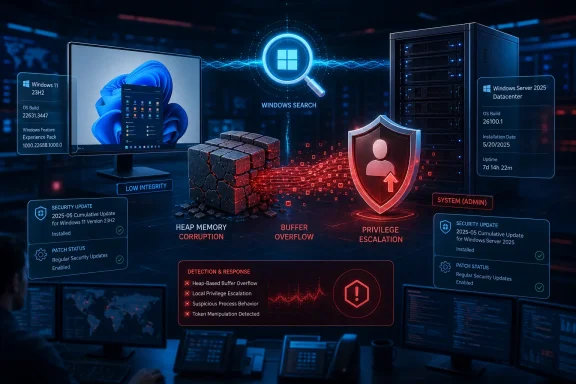 Search Becomes the Privilege Boundary
CVE-2026-50679 is classified as CWE-122, a heap-based buffer overflow. This type of memory-corruption bug occurs when software writes more data into a heap allocation than the allocated space can hold, potentially damaging adjacent data and altering program execution.Microsoft’s public description remains deliberately brief. It identifies the vulnerable technology as the Microsoft Windows Search Component but does not disclose the malformed input, affected interface, or precise sequence needed to trigger the overflow. There is consequently not enough public information to reproduce the vulnerability or determine whether exploitation depends on indexing a particular file, invoking a local service interface, or reaching another Search-related code path.
The CVSS vector provides several useful boundaries. The attack is local rather than network-based, requires an attacker to possess low-level privileges, and does not require another user to click a file or approve a prompt. Attack complexity is rated low once those prerequisites have been met.
That makes CVE-2026-50679 a post-compromise escalation vulnerability, not a direct route into an otherwise protected PC. An attacker would first need a foothold through stolen credentials, malware, another vulnerability, or permitted local access. The Search flaw could then reportedly be used to move from a constrained account or process into a much more powerful security context.
This distinction lowers the immediate risk to an isolated home PC, but it does not make the flaw harmless. Privilege escalation is a standard link in multi-stage attacks because initial access frequently lands in a process without administrator or SYSTEM rights. A reliable local elevation primitive can turn that limited foothold into control of the device.
The Affected Builds Narrow the Deployment Target
Microsoft’s CVE record identifies Windows 11 24H2, Windows 11 25H2, Windows 11 26H1, and Windows Server 2025 as affected. Both x64 and Arm64 editions are covered for Windows 11, while the Server 2025 listing includes the full installation and Server Core.The documented fixed-build boundaries are:
- Windows 11 24H2 must be updated to OS Build 26100.8875 or later.
- Windows 11 25H2 must be updated to OS Build 26200.8875 or later.
- Windows Server 2025 must be updated to OS Build 26100.33158 or later.
- Windows Server 2025 Server Core must also reach OS Build 26100.33158 or later.
- Microsoft’s published CVE data lists OS Build 28000.2269 as the boundary for Windows 11 26H1.
Windows Server 2025 receives the relevant servicing through KB5099536, taking the operating system to Build 26100.33158. Server Core is not exempt simply because it lacks the conventional desktop shell; Microsoft explicitly includes it in the affected-product data.
Windows 11 26H1 requires closer inventory attention. The CVE record lists versions below Build 28000.2269 as affected, while Microsoft’s July cumulative release for 26H1 is KB5101649, Build 28000.2525. Because Microsoft’s published threshold points to an earlier build, administrators should rely on the current Security Update Guide and their servicing channel rather than assuming that every CVE first published in July necessarily requires a July-only binary change. Deploying the latest cumulative update remains the least ambiguous compliance position.
Windows 11 23H2 does not appear in Microsoft’s affected-product list for CVE-2026-50679, even though it received its own July cumulative update, KB5099414. Windows 10 and earlier supported server releases are likewise absent from the CVE record. That omission should guide scanner tuning, but administrators should confirm against Microsoft’s current product table if the advisory is modified.
“Confirmed” Describes Evidence, Not Exploitation
The confidence language attached to the advisory can be easy to misread. It describes how certain Microsoft is that the vulnerability and its technical characterization are real; it does not indicate that attackers are already using it.In CVSS temporal terminology, report confidence ranges from unknown or uncorroborated information to confirmed vendor knowledge. CVE-2026-50679 is backed by Microsoft’s own acknowledgement, a defined weakness classification, an affected-version range, and security updates. The vulnerability’s existence is therefore not speculative.
That confidence also tells defenders that attackers have some useful public metadata. They know the vulnerable component, weakness class, local-access requirement, privilege prerequisite, impact profile, and patched build boundaries. Comparing pre-update and post-update Windows binaries could provide additional clues even though Microsoft has withheld exploitation details.
CISA’s initial Stakeholder-Specific Vulnerability Categorization data recorded no known exploitation and described exploitation as non-automatable. The Zero Day Initiative and SANS Internet Storm Center also listed the vulnerability as neither publicly disclosed nor exploited when the July 14 updates were released.
Those assessments are snapshots, not guarantees. Patch publication gives security researchers and attackers a concrete set of binaries to compare, and the risk can change if technical analysis or proof-of-concept code appears later.
Patch Priority Depends on the Foothold
CVE-2026-50679 does not warrant the same emergency response as an unauthenticated, network-reachable remote-code-execution flaw. It does warrant normal Patch Tuesday deployment without unnecessary delay, especially on multi-user systems and machines where attackers could combine it with phishing, browser exploitation, exposed remote-management tools, or weak application controls.Windows Server 2025 deserves particular attention. A local elevation flaw on a server can amplify the consequences of compromised service credentials, vulnerable management agents, or unauthorized interactive access. Server Core installations should remain in the deployment scope even if Windows Search seems irrelevant to the workload.
Administrators can validate remediation by checking the operating-system build rather than searching solely for a CVE-specific package. On Windows 11 24H2 and 25H2,
winver should report at least 26100.8875 or 26200.8875 after KB5101650 is installed. Windows Server 2025 should report Build 26100.33158 or later after KB5099536.Enterprise teams should also confirm successful installation through Windows Update for Business reports, Microsoft Intune, Windows Server Update Services, Configuration Manager, or their third-party patch platform. A device merely being offered the update is not evidence that it installed successfully and rebooted into the corrected build.
Disabling Windows Search is not documented by Microsoft as a mitigation for CVE-2026-50679. Without details identifying the reachable code path, treating service shutdown or indexing-policy changes as equivalent to patching would be an unsupported assumption.
The practical action is straightforward: install the applicable cumulative update, verify the resulting OS build, and watch Microsoft’s advisory for revisions to exploitation status or affected versions. The unanswered issue is no longer whether the buffer overflow exists, but how quickly attackers can turn the limited public description and patched binaries into a dependable local elevation technique.
References
- Primary source: MSRC
Published: 2026-07-14T07:00:00-07:00
Security Update Guide - Microsoft Security Response Center
 msrc.microsoft.com
- Related coverage: tomshardware.com
Windows Server vulnerability can grant system privileges with just a malformed packet — domain controllers are being exploited in the wild | Tom's Hardware
System administrators, run the May 12 patch immediately if you haven't already.www.tomshardware.com
