

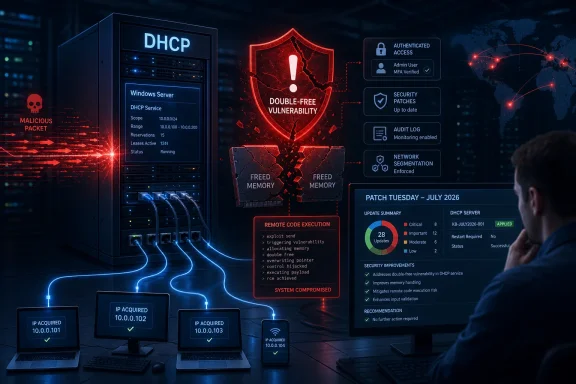
Detailed in Microsoft’s Security Update Guide, the vulnerability is network-accessible and requires no interaction from a user sitting at the server. A successful attacker could execute code in the context of the DHCP service, making patching a priority wherever the Windows Server DHCP role is installed—even though Microsoft currently assesses exploitation as unlikely.
The flaw was not publicly disclosed before the update and Microsoft has reported no exploitation in the wild. That reduces the immediate zero-day pressure, but it does not make an unpatched DHCP server a reasonable long-term risk.
A Double-Free Bug Sits Behind the RCE Rating
Available vulnerability records describe CVE-2026-50685 as a double free, a memory-management error that occurs when software attempts to release the same memory allocation more than once. Depending on the state of the process heap, that mistake can cause a crash or create conditions under which an attacker manipulates memory and redirects execution.
Microsoft’s CVSS assessment reflects a serious potential outcome but a constrained attack path. The vulnerability is reachable over a network, requires low privileges, needs no user interaction, and can have a high impact on confidentiality, integrity, and availability. Attack complexity is rated high, which helps explain the 7.5 score and Important classification despite the remote code execution impact.
The authorization requirement matters. CVE-2026-50685 is not described as a straightforward, unauthenticated Internet worm path in which any remote system can send one malicious DHCP packet and take over a server. An attacker must first obtain the required level of access and then successfully trigger a memory-corruption condition that Microsoft considers difficult to exploit reliably.
That distinction should shape prioritization, not provide an excuse to defer the update indefinitely. Compromised credentials, malicious insiders, and attackers who already have a foothold inside a Windows environment are all part of the threat model for an authorized network attack.
Microsoft has marked the vulnerability’s report confidence as confirmed. This means the company accepts that the flaw exists and that sufficient technical evidence is available to support the assessment. It does not mean that attacks have been confirmed, exploit code is public, or reliable exploitation is currently available.
DHCP Servers Carry More Operational Weight Than Their Count Suggests
Windows DHCP Server is commonly deployed on domain-connected infrastructure to assign IPv4 or IPv6 configuration, DNS server addresses, default gateways, and other network settings to clients. An outage can prevent new devices from joining the network and disrupt systems attempting to renew expired leases.
That operational role increases the consequence of both failed exploitation and rushed remediation. A malicious request that merely crashes the DHCP service could still cause a meaningful availability incident, while successful code execution could place an attacker on a trusted infrastructure server.
DHCP servers are also frequently less visible than domain controllers in security planning. They may run on dedicated Windows Server installations, share a system with DNS or other infrastructure roles, or remain in branch offices with slower maintenance schedules. Administrators should therefore inventory the installed DHCP Server role, rather than assuming that a list of prominent servers covers the exposure.
Microsoft’s affected-product information spans supported Windows Server generations, including deployments based on Windows Server 2012-era servicing through Windows Server 2025. The exact applicable update depends on the operating system version and servicing model, so administrators should use the product table in the Microsoft Security Update Guide or their normal update-management platform to map CVE-2026-50685 to each server.
The presence of Windows client products in third-party vulnerability feeds should not be read as evidence that every Windows 10 or Windows 11 workstation is operating a vulnerable DHCP server. The server role and affected component are the useful inventory points; ordinary use of the Windows DHCP client is a separate exposure addressed by other CVEs in the July release.
July’s DHCP Patch Load Is Broader Than One CVE
CVE-2026-50685 arrived in an unusually large July 2026 Patch Tuesday release containing several DHCP-related vulnerabilities. As reported by BleepingComputer and summarized by the SANS Internet Storm Center, Microsoft fixed multiple remote code execution, elevation-of-privilege, and denial-of-service defects affecting Windows DHCP Server and DHCP Client components.
Several of those DHCP server flaws carry Critical ratings and higher CVSS scores than CVE-2026-50685. That makes it inefficient to build a deployment decision around this CVE alone: the same cumulative Windows Server updates may close multiple DHCP attack paths at once.
Administrators should treat the July update as a component-level patching event. A server may be exposed to CVE-2026-50685’s authorized, high-complexity path while simultaneously being affected by a different DHCP flaw with fewer exploitation barriers.
This is also why comparing severity labels without reading the attack conditions can mislead. “Important” remote code execution still represents a potential server compromise; it simply reflects Microsoft’s judgment that one or more prerequisites reduce the likelihood or reliability of exploitation.
Patch the Role, Then Verify the Service
Organizations should deploy the applicable July 14 cumulative or security-only update through Windows Update, Windows Server Update Services, Microsoft Configuration Manager, Azure Update Manager, or their existing third-party patch platform. Internet-facing systems deserve immediate scrutiny, although DHCP servers normally should not be directly accessible from the public Internet.
Before deployment, administrators should identify failover pairs and split-scope configurations so both DHCP partners are not unnecessarily disrupted at the same time. Normal maintenance testing should include lease issuance, renewal, reservations, DHCP relay traffic, scope options, and failover synchronization after reboot.
A practical response should include the following checks:
- Confirm which Windows servers have the DHCP Server role or DHCP service installed and running.
- Review firewall and router access-control rules so DHCP management and relay traffic reach only expected systems.
- Install the July 2026 update matching each server’s supported Windows Server release and architecture.
- Reboot where required, then verify that the DHCP Server service is running and issuing leases.
- Confirm the installed OS build or update history rather than relying only on a patch-management “success” status.
- Monitor Microsoft Defender, SIEM, and Windows event data for unusual DHCP service crashes or suspicious access from authenticated accounts.
There is no publicly documented workaround that provides the same protection as Microsoft’s code fix. Disabling the DHCP Server service would remove exposure but also eliminate the function the server was deployed to provide, making it an emergency containment step rather than a practical mitigation for most networks.
The absence of known exploitation on July 15, 2026 gives administrators room for controlled testing, not an open-ended delay. CVE-2026-50685 is confirmed, remotely reachable, and capable of code execution, while July’s cumulative updates address several other DHCP weaknesses with more severe attack conditions. The sensible milestone is therefore not merely adding this CVE to a scanner report, but confirming that every active Windows DHCP server has received the July security update and resumed normal lease operations.