

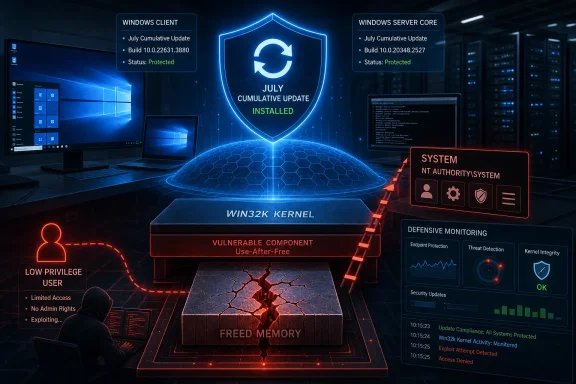
Detailed in Microsoft’s Security Update Guide, CVE-2026-50688 carries an Important severity rating and a CVSS 3.1 base score of 7.8. Microsoft assessed exploitation as less likely and reported that the vulnerability was neither publicly disclosed nor exploited in the wild when the update shipped.
That status lowers the immediate threat compared with July’s actively exploited vulnerabilities, but it does not make CVE-2026-50688 harmless. A successful exploit can turn an existing foothold on a Windows machine into a much more consequential compromise.
A Local Flaw With SYSTEM-Level Consequences
CVE-2026-50688 is classified as CWE-416, or use after free. This type of memory-safety defect occurs when software continues using memory after the associated object has been released, potentially allowing an attacker to manipulate the reclaimed space and redirect privileged execution.
Microsoft describes the issue as a use-after-free vulnerability in the Windows kernel that permits an authorized attacker to elevate privileges locally. Its Win32k designation places the defect in the Windows graphical and user-interface subsystem, an historically attractive target because it exposes complex kernel-mode functionality to user processes.
The CVSS score reflects a local attack with low complexity. An attacker must already possess low-level privileges on the target, but the exploit does not require another user to click a link, open a document, or approve a prompt. Successful exploitation can have a high impact on confidentiality, integrity, and availability.
In practical terms, CVE-2026-50688 is not an initial-access vulnerability. It cannot, by itself, compromise an arbitrary Windows PC across the internet. Instead, it can serve as the second stage of an intrusion after an attacker has obtained code execution through phishing, a malicious application, stolen credentials, a browser flaw, or another security weakness.
That distinction matters for defenders. Malware initially running as a standard user may face restrictions on protected files, security services, credential stores, and system configuration. A reliable privilege-escalation exploit can remove those restrictions, potentially enabling the attacker to disable defenses, establish persistence, access other users’ data, or install kernel-level components.
Privilege escalation is often the bridge between a limited infection and full system control.
The Patch Reaches Deep Into the Windows Estate
Microsoft’s affected-product data shows that CVE-2026-50688 spans multiple generations of Windows. The list includes Windows 10 Version 1607, Windows 10 Version 1809, Windows 10 Version 21H2, Windows 10 Version 22H2, Windows 11 Version 24H2, Windows 11 Version 25H2, and Windows 11 version 26H1.
Server editions are also affected, including Windows Server 2012, Windows Server 2012 R2, Windows Server 2016, Windows Server 2019, Windows Server 2022, and Windows Server 2025. Server Core installations are covered where applicable, underscoring that this is not merely a desktop-shell problem.
Administrators can use the patched build thresholds to verify remediation:
- Windows 11 versions 24H2 and 25H2 are protected by KB5101650, which advances them to OS builds 26100.8875 and 26200.8875.
- Windows 11 version 26H1 is protected by KB5101649, bringing the operating system to build 28000.2525.
- Windows 10 versions 21H2 and 22H2 are protected at builds 19044.7548 and 19045.7548.
- Windows Server 2022 is protected at build 20348.5386.
- Windows Server 2025 is protected by KB5099536 at build 26100.33158.
- Windows Server 2019 and Windows 10 Version 1809 are protected at build 17763.9020.
- Windows Server 2016 and Windows 10 Version 1607 are protected at build 14393.9339.
The inclusion of Windows 10 21H2 and 22H2 does not imply that every consumer installation remains eligible for ordinary support. Some entries apply through enterprise servicing channels or Extended Security Updates, so administrators must still confirm that each machine has a valid update path.
Windows Server 2012 and Server 2012 R2 similarly require attention to their Extended Security Update status. Systems that remain operational but lack entitlement to receive current fixes may continue exposing the vulnerable Win32k code even when standard Windows Update reports no applicable package.
“Confirmed” Describes the Evidence, Not Active Exploitation
The report-confidence language included in Microsoft’s advisory is easy to misread. A confirmed rating means Microsoft or sufficiently detailed technical reporting has established that the vulnerability exists. It does not mean attacks have been confirmed.
For CVE-2026-50688, Microsoft’s separate exploitability fields are the more useful indicators of current threat activity. At publication, the company marked the vulnerability as not publicly disclosed, not exploited, and “Exploitation Less Likely.”
That assessment suggests defenders are not facing a known working exploit circulating in public repositories or an observed campaign abusing the flaw. It also indicates that Microsoft does not expect reliable exploitation to be straightforward on the latest Windows releases.
Those judgments are snapshots, not guarantees. Reverse engineering begins as soon as Microsoft distributes replacement binaries, and security researchers routinely compare patched and unpatched Windows components to identify the corrected code. The advisory’s confirmation rating also indicates that credible technical knowledge exists, even if Microsoft has not published reproduction instructions.
The vulnerability arrived amid an unusually large July 2026 Patch Tuesday release. BleepingComputer counted 570 Microsoft vulnerabilities, including 254 elevation-of-privilege issues, while the Zero Day Initiative also listed CVE-2026-50688 as an Important, 7.8-rated Win32k flaw without public disclosure or known exploitation.
That volume creates a prioritization problem, especially for organizations unable to patch every system simultaneously. CVE-2026-50688 should sit below actively exploited July vulnerabilities in AD FS and SharePoint Server, but it belongs above routine low-impact issues on multi-user systems, administrator workstations, virtual desktop hosts, and endpoints already considered at elevated risk of malware execution.
Cumulative Updates Are the Only Practical Fix
Microsoft has not documented a separate workaround or mitigation for CVE-2026-50688. Because the flaw resides in core Windows code, disabling a peripheral feature or blocking a network port is not a substitute for updating the operating system.
For home users and unmanaged PCs, the appropriate action is to install the July 2026 cumulative update through Settings, Windows Update, and then restart the device. The build shown by winver should meet or exceed the corrected build for the installed Windows version.
Enterprise administrators should treat the update like other kernel-level security fixes: validate it against representative hardware and line-of-business software, deploy it through Windows Update for Business, Microsoft Intune, WSUS, Configuration Manager, or the Microsoft Update Catalog, and verify the resulting OS build rather than relying solely on a successful deployment status.
Endpoint detection can reduce exposure while testing proceeds, but it cannot prove that an attacker will never reach the vulnerable Win32k path. Useful interim controls include preventing standard users from installing or executing unapproved software, monitoring unusual child processes and privilege changes, enforcing application control, and limiting interactive sign-in on servers.
Server Core is not an escape route. Microsoft explicitly identifies Core installations among the affected Server releases, so administrators should not infer immunity from the absence of the full desktop experience.
CVE-2026-50688 is not one of July’s zero-days, and Microsoft’s current telemetry does not indicate active attacks. Its broad Windows reach and potential to convert local access into elevated control nevertheless make the July 14 cumulative update the meaningful security boundary: systems below the corrected builds remain exposed, while systems at or above them carry Microsoft’s Win32k fix.
References
- CVE-2026-50688 Windows Win32k Elevation of Privilege Vulnerability MSRC · 2026-07-14T07:00:00-07:00