

CVE-2026-53135 is a newly published Linux kernel vulnerability in AMD’s display driver, disclosed through kernel.org and added to NVD on June 25, 2026, affecting the
The vulnerable code sits in
The flaw has two parts. First, the function dereferences
That means a write to the debugfs node can walk straight into a NULL pointer and crash the kernel. The second problem is more prosaic but just as revealing: the function ignores the size supplied by the user and always tries to copy 36 bytes from user space. If the user buffer is shorter, the kernel reads past the end of what was provided.
The patch fixes both by returning
That distinction matters. Debugfs is not supposed to be a general application interface. It exists to expose internal kernel and driver state to developers, testers, and administrators, often with rougher edges than sysfs or formal ioctl APIs. On many systems it is mounted only for privileged users, and distributions can restrict access further.
Still, the phrase “debug interface” should not lull anyone into dismissal. Debug surfaces are routinely present on developer workstations, test benches, CI runners, lab machines, performance rigs, and enthusiast desktops. If a local user or script can write to the affected node, a kernel crash is not theoretical; it is the expected failure mode the patch is designed to prevent.
For ordinary desktop Linux users, the practical risk is likely denial of service rather than data theft. For administrators, the sharper concern is operational predictability. A GPU driver crash on a workstation used for CAD, media production, ML experiments, or display validation is still downtime, and downtime caused by a one-line-looking bounds mistake is not somehow less real.
It is not simple. A connector can exist before a full display route is committed. A monitor can be detected before a CRTC is assigned. A dock can briefly advertise one topology and then settle into another. Atomic modesetting was designed to make these transitions safer and more coherent, but it also means driver code must respect transitional states instead of assuming the world is fully assembled.
CVE-2026-53135 is a classic example of what happens when a debug path assumes the happy path. The connector is there, the display stack is mostly alive, and the developer wants to send or inspect a packet. But “mostly alive” is not a valid kernel invariant.
The buffer over-read is even less exotic. Kernel code that copies from user space must treat the user-provided length as a contract boundary. Ignoring that boundary and copying a fixed-size structure because that is what the handler expects is precisely the kind of bug hardening guidance has warned against for decades.
The patch, however, gives administrators enough to reason about impact. The affected file is specific. The function is specific. The trigger condition is specific. The remedy is specific. Systems need the relevant stable backport, not a speculative configuration ritual.
The affected record describes Linux kernels starting from the code introduction point around the 5.2 era, with stable branches marked unaffected once they include the relevant fixes. The user-provided record lists fixed points for long-term branches including 5.10.259, 5.15.210, and 6.1.176, while also mapping multiple stable Git commits for other maintained lines.
That is the kernel security process in miniature. Mainline takes the fix, stable maintainers backport it, distributions ingest it, and scanners try to translate Git commit ranges into package names that humans can act on. The hard part for admins is rarely understanding the C code; it is connecting the upstream fix to the actual kernel package booted on a machine.
This CVE is especially relevant where AMD GPUs are part of the Linux side of the estate. A Windows workstation that dual-boots into Linux for ML, rendering, kernel testing, Steam gaming, or display validation is still part of the operational footprint. So is a rack-mounted Linux host with AMD graphics used for media pipelines or remote desktops.
It is less relevant to WSL in the narrow sense. WSL users are not typically loading the host Linux kernel’s amdgpu display driver inside the WSL environment. But Windows-centric organizations that use WSL also tend to have developers who run native Linux somewhere else, and those machines are often the least centrally managed.
The right takeaway is not panic. It is inventory discipline. If your fleet tool flags CVE-2026-53135 on Linux assets, verify the running kernel and distribution package status before assuming exploitability. If the asset is Windows-only, this CVE should not apply. If the asset is a Linux workstation with AMD display hardware and debugfs exposed to privileged users, it deserves a normal kernel update cycle.
But debugfs still runs in kernel context. A write handler does not become harmless because the file lives under a debugging mount. If it dereferences a NULL pointer, the system can fall over. If it copies too much from user space, the kernel has crossed a boundary it should have respected.
This is why debugfs access policy matters. On a carefully managed production server, debugfs may be unmounted or restricted. On an enthusiast machine, it may be mounted by default because tools expect it. On a developer workstation, it may be wide open to root scripts that nobody audits because they are “just diagnostics.”
The uncomfortable truth is that root-triggered kernel crashes still matter. Local privilege is not a magic eraser for vulnerability classification, especially on shared lab machines, CI workers, jump boxes, or systems where privileged automation runs unreviewed. A bug that turns a diagnostic write into a kernel panic is a reliability defect with security consequences.
That does not make it uninteresting. It shows how modern vulnerability management is increasingly about the accumulation of small correctness failures. A missing NULL check here, a length mismatch there, and suddenly a display debug path becomes a denial-of-service condition.
For kernel developers, the lesson is direct. Transitional object states must be treated as normal states. Hot-plug paths, atomic commits, and display pipeline reconfiguration are not exceptional; they are routine events on laptops, docks, and multi-monitor desks. Code that assumes a connector implies a CRTC is code that will eventually meet reality.
For administrators, the lesson is more procedural. Do not wait for a CVSS score to decide whether a kernel update is worth scheduling. When a flaw is fixed upstream and backported to your maintained branch, the question is whether the update fits your maintenance window, not whether a database has finished assigning a number.
Rolling distributions will likely move quickly because kernel updates are part of the normal bargain. Enterprise distributions may backport the patch into older-looking kernel versions, which can confuse scanners that naïvely compare only upstream version numbers. A system can report a kernel version that appears old while still containing the fix.
That is why package changelogs and vendor advisories matter more than raw
The affected upstream ranges are useful for kernel builders and security teams, but most desktop users should not try to interpret commit hashes as patch instructions. Install the kernel update from your distribution, reboot into it, and confirm the running kernel changed. The reboot is not optional; a patched kernel sitting on disk does not protect the session still running the vulnerable one.
The buffer over-read is harder to characterize from the public description alone. The record says the handler reads past the user buffer when the supplied size is shorter than 36 bytes. That is a correctness failure, but the disclosed fix and description do not establish a data-exfiltration path or privilege escalation.
That uncertainty should be stated plainly. Not every over-read becomes Heartbleed. Context matters: what is read, where it is copied, whether it is exposed back to user space, and whether an attacker can shape adjacent memory. Based on the disclosed text, the clearly described impact is a crash condition, not a proven leak of secrets.
Security teams should therefore classify this as a patching item, not an emergency incident, unless local conditions change the calculus. Shared GPU workstations, untrusted local users, broad debugfs access, or exposed privileged automation all raise the priority. A single-user desktop behind normal permissions lowers it.
That combination is fertile ground for false alarms and confused dashboards. A vulnerability tool may flag every Linux kernel from 5.2 onward until it learns the distribution’s backport status. Another may suppress the finding because no CVSS exists yet. A third may show the CVE on systems that have AMDGPU compiled but no relevant AMD display hardware in use.
The best response is not to argue with the dashboard in the abstract. Confirm three facts: whether the running kernel includes the affected code path, whether the installed package contains the fix, and whether debugfs access makes triggering plausible. Those answers beat a red square with no context.
Administrators should also remember that kernel CVEs often arrive in batches. A distribution kernel update that fixes this issue may also fix dozens of unrelated flaws. Treating each one as a bespoke emergency can exhaust teams; treating the kernel update cadence as routine maintenance is healthier.
For enthusiasts building their own kernels, the relevant change is straightforward: ensure the stable backport for the AMD display debugfs write handler is present in the branch you are running. For everyone else, the answer is less romantic and more reliable: use your distribution’s kernel update.
After installation, reboot and verify that the new kernel is actually running. Many Linux systems accumulate patched kernels in
If you manage fleets, pair the update with a quick audit of debugfs policy. Production systems rarely need broad debugfs exposure. Developer and lab systems may need it, but they also deserve clear ownership because they are exactly where this class of bug tends to be reachable.
drm/amd/display debugfs path used for DisplayPort SDP message testing on systems using amdgpu. The bug is not a Windows vulnerability, but it matters to plenty of WindowsForum readers because AMD graphics, dual-boot workstations, WSL-adjacent Linux labs, and fleet vulnerability scanners increasingly share the same operational surface. The real story is not a spectacular remote exploit; it is a small debug interface that reminds us how often kernel reliability and security hinge on the unglamorous boundary between “developer-only” plumbing and production machines.
 A Debug Knob Becomes a Kernel-Space Footgun
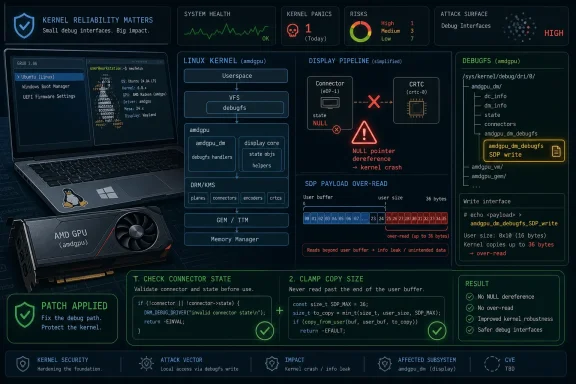
The vulnerable code sits in drivers/gpu/drm/amd/display/amdgpu_dm/amdgpu_dm_debugfs.c, specifically in the write handler for an SDP message debugfs node. SDP, or Secondary Data Packet, is part of the DisplayPort and HDMI display signaling world: the kind of low-level display metadata machinery most users never think about unless HDR, audio, color, or link training goes sideways.The flaw has two parts. First, the function dereferences
connector->base.state->crtc without proving that the connector actually has a valid CRTC attached at that moment. In the Direct Rendering Manager stack, a connector can be physically connected without yet being bound into a complete display pipeline, particularly during the awkward window after hot-plug and before the next atomic commit.That means a write to the debugfs node can walk straight into a NULL pointer and crash the kernel. The second problem is more prosaic but just as revealing: the function ignores the size supplied by the user and always tries to copy 36 bytes from user space. If the user buffer is shorter, the kernel reads past the end of what was provided.
The patch fixes both by returning
-ENODEV when the connector state or CRTC is missing, and by clamping the copy size to the smaller of the user-provided size and the internal buffer. In other words, this is not a complex mitigation. It is the sort of defensive check that looks obvious after the fact and invisible before the crash report.This Is Low Drama, Not Low Importance
There is no NVD CVSS score yet, and that absence should restrain the usual vulnerability theater. A bug without a score is not automatically minor, and a bug with a score is not automatically urgent. But the known facts point toward a local, availability-focused issue in a debugging interface rather than a broad remote compromise.That distinction matters. Debugfs is not supposed to be a general application interface. It exists to expose internal kernel and driver state to developers, testers, and administrators, often with rougher edges than sysfs or formal ioctl APIs. On many systems it is mounted only for privileged users, and distributions can restrict access further.
Still, the phrase “debug interface” should not lull anyone into dismissal. Debug surfaces are routinely present on developer workstations, test benches, CI runners, lab machines, performance rigs, and enthusiast desktops. If a local user or script can write to the affected node, a kernel crash is not theoretical; it is the expected failure mode the patch is designed to prevent.
For ordinary desktop Linux users, the practical risk is likely denial of service rather than data theft. For administrators, the sharper concern is operational predictability. A GPU driver crash on a workstation used for CAD, media production, ML experiments, or display validation is still downtime, and downtime caused by a one-line-looking bounds mistake is not somehow less real.
AMDGPU’s Display Stack Is Where Edge Cases Go to Multiply
Modern display drivers are among the most complicated parts of the desktop stack. They sit between hot-pluggable monitors, USB-C docks, firmware blobs, color pipelines, power management, refresh-rate switching, multi-plane overlays, and a compositor that expects the whole thing to behave as if plugging in a monitor were a simple event.It is not simple. A connector can exist before a full display route is committed. A monitor can be detected before a CRTC is assigned. A dock can briefly advertise one topology and then settle into another. Atomic modesetting was designed to make these transitions safer and more coherent, but it also means driver code must respect transitional states instead of assuming the world is fully assembled.
CVE-2026-53135 is a classic example of what happens when a debug path assumes the happy path. The connector is there, the display stack is mostly alive, and the developer wants to send or inspect a packet. But “mostly alive” is not a valid kernel invariant.
The buffer over-read is even less exotic. Kernel code that copies from user space must treat the user-provided length as a contract boundary. Ignoring that boundary and copying a fixed-size structure because that is what the handler expects is precisely the kind of bug hardening guidance has warned against for decades.
The Patch Tells Us More Than the CVE Score Can
Because NVD had not yet supplied CVSS scoring at publication time, vulnerability-management tools may initially present this record as incomplete. That is annoying, but not unusual. The Linux kernel’s CVE flow often names many resolved bugs, and NVD enrichment frequently lags the raw disclosure.The patch, however, gives administrators enough to reason about impact. The affected file is specific. The function is specific. The trigger condition is specific. The remedy is specific. Systems need the relevant stable backport, not a speculative configuration ritual.
The affected record describes Linux kernels starting from the code introduction point around the 5.2 era, with stable branches marked unaffected once they include the relevant fixes. The user-provided record lists fixed points for long-term branches including 5.10.259, 5.15.210, and 6.1.176, while also mapping multiple stable Git commits for other maintained lines.
That is the kernel security process in miniature. Mainline takes the fix, stable maintainers backport it, distributions ingest it, and scanners try to translate Git commit ranges into package names that humans can act on. The hard part for admins is rarely understanding the C code; it is connecting the upstream fix to the actual kernel package booted on a machine.
Windows Shops Should Still Read the Fine Print
Windows administrators can be forgiven for seeing “Linux kernel” and moving on. That would be a mistake in mixed environments. The modern Windows shop often has Linux in more places than its asset inventory admits: developer laptops, build systems, GPU test rigs, security appliances, containers hosts, dual-boot gaming machines, lab desktops, and cloud instances.This CVE is especially relevant where AMD GPUs are part of the Linux side of the estate. A Windows workstation that dual-boots into Linux for ML, rendering, kernel testing, Steam gaming, or display validation is still part of the operational footprint. So is a rack-mounted Linux host with AMD graphics used for media pipelines or remote desktops.
It is less relevant to WSL in the narrow sense. WSL users are not typically loading the host Linux kernel’s amdgpu display driver inside the WSL environment. But Windows-centric organizations that use WSL also tend to have developers who run native Linux somewhere else, and those machines are often the least centrally managed.
The right takeaway is not panic. It is inventory discipline. If your fleet tool flags CVE-2026-53135 on Linux assets, verify the running kernel and distribution package status before assuming exploitability. If the asset is Windows-only, this CVE should not apply. If the asset is a Linux workstation with AMD display hardware and debugfs exposed to privileged users, it deserves a normal kernel update cycle.
Debugfs Is a Privilege Boundary Even When We Pretend It Is Not
The kernel community has long treated debugfs as a place where developers can expose internals without promising stable ABI behavior. That flexibility is valuable. It lets driver teams inspect hardware state, force recovery paths, collect diagnostics, and validate features that would be painful to route through polished production interfaces.But debugfs still runs in kernel context. A write handler does not become harmless because the file lives under a debugging mount. If it dereferences a NULL pointer, the system can fall over. If it copies too much from user space, the kernel has crossed a boundary it should have respected.
This is why debugfs access policy matters. On a carefully managed production server, debugfs may be unmounted or restricted. On an enthusiast machine, it may be mounted by default because tools expect it. On a developer workstation, it may be wide open to root scripts that nobody audits because they are “just diagnostics.”
The uncomfortable truth is that root-triggered kernel crashes still matter. Local privilege is not a magic eraser for vulnerability classification, especially on shared lab machines, CI workers, jump boxes, or systems where privileged automation runs unreviewed. A bug that turns a diagnostic write into a kernel panic is a reliability defect with security consequences.
The Smallest Kernel Bugs Often Have the Clearest Lessons
There is a temptation to reserve attention for vulnerabilities with names, logos, and remote code execution. CVE-2026-53135 is the opposite kind of record. It is a patch-shaped CVE: narrow, technical, and unlikely to generate mainstream headlines.That does not make it uninteresting. It shows how modern vulnerability management is increasingly about the accumulation of small correctness failures. A missing NULL check here, a length mismatch there, and suddenly a display debug path becomes a denial-of-service condition.
For kernel developers, the lesson is direct. Transitional object states must be treated as normal states. Hot-plug paths, atomic commits, and display pipeline reconfiguration are not exceptional; they are routine events on laptops, docks, and multi-monitor desks. Code that assumes a connector implies a CRTC is code that will eventually meet reality.
For administrators, the lesson is more procedural. Do not wait for a CVSS score to decide whether a kernel update is worth scheduling. When a flaw is fixed upstream and backported to your maintained branch, the question is whether the update fits your maintenance window, not whether a database has finished assigning a number.
Distros Will Decide How Fast This Becomes Boring
Most users will not apply the upstream Git commit directly. They will receive the fix through Ubuntu, Debian, Fedora, Arch, openSUSE, Red Hat, SUSE, or another distribution’s kernel package. That packaging layer is where the vulnerability becomes either a solved problem or a lingering scanner item.Rolling distributions will likely move quickly because kernel updates are part of the normal bargain. Enterprise distributions may backport the patch into older-looking kernel versions, which can confuse scanners that naïvely compare only upstream version numbers. A system can report a kernel version that appears old while still containing the fix.
That is why package changelogs and vendor advisories matter more than raw
uname -r comparisons. If your scanner says a host is vulnerable but the distribution says the relevant CVE is fixed in the installed package, the distro’s backport metadata should carry significant weight. Conversely, if the host is running a self-built or vendor-pinned kernel, the burden shifts back to the operator.The affected upstream ranges are useful for kernel builders and security teams, but most desktop users should not try to interpret commit hashes as patch instructions. Install the kernel update from your distribution, reboot into it, and confirm the running kernel changed. The reboot is not optional; a patched kernel sitting on disk does not protect the session still running the vulnerable one.
The Risk Is Local, but the Failure Mode Is Loud
A NULL pointer dereference in kernel space is not subtle. If triggered, it can panic the system or destabilize the display stack depending on configuration and error handling. On a personal desktop, that means a crash. On a lab host, it can mean interrupted tests. On a remote workstation, it can mean a trip through out-of-band management or an angry user waiting for someone to power-cycle a box.The buffer over-read is harder to characterize from the public description alone. The record says the handler reads past the user buffer when the supplied size is shorter than 36 bytes. That is a correctness failure, but the disclosed fix and description do not establish a data-exfiltration path or privilege escalation.
That uncertainty should be stated plainly. Not every over-read becomes Heartbleed. Context matters: what is read, where it is copied, whether it is exposed back to user space, and whether an attacker can shape adjacent memory. Based on the disclosed text, the clearly described impact is a crash condition, not a proven leak of secrets.
Security teams should therefore classify this as a patching item, not an emergency incident, unless local conditions change the calculus. Shared GPU workstations, untrusted local users, broad debugfs access, or exposed privileged automation all raise the priority. A single-user desktop behind normal permissions lowers it.
Scanners Will Make This Look Stranger Than It Is
CVE records for the Linux kernel can look intimidating because they include commit ranges, multiple stable branch fixes, and sometimes incomplete scoring. CVE-2026-53135 is no exception. The NVD entry was newly received from kernel.org, the assessment fields were not yet populated, and the affected-record text includes both Git-level and semver-style data.That combination is fertile ground for false alarms and confused dashboards. A vulnerability tool may flag every Linux kernel from 5.2 onward until it learns the distribution’s backport status. Another may suppress the finding because no CVSS exists yet. A third may show the CVE on systems that have AMDGPU compiled but no relevant AMD display hardware in use.
The best response is not to argue with the dashboard in the abstract. Confirm three facts: whether the running kernel includes the affected code path, whether the installed package contains the fix, and whether debugfs access makes triggering plausible. Those answers beat a red square with no context.
Administrators should also remember that kernel CVEs often arrive in batches. A distribution kernel update that fixes this issue may also fix dozens of unrelated flaws. Treating each one as a bespoke emergency can exhaust teams; treating the kernel update cadence as routine maintenance is healthier.
The Practical Fix Is Update, Reboot, Verify
There is no meaningful user-side workaround that is better than taking the fixed kernel. Restricting or unmounting debugfs can reduce exposure in some environments, and that may be sensible for production systems. But the underlying bug is in the driver code, and the durable fix is the patched kernel.For enthusiasts building their own kernels, the relevant change is straightforward: ensure the stable backport for the AMD display debugfs write handler is present in the branch you are running. For everyone else, the answer is less romantic and more reliable: use your distribution’s kernel update.
After installation, reboot and verify that the new kernel is actually running. Many Linux systems accumulate patched kernels in
/boot while continuing to run the old image for days or weeks. In vulnerability management, “installed” and “active” are different states.If you manage fleets, pair the update with a quick audit of debugfs policy. Production systems rarely need broad debugfs exposure. Developer and lab systems may need it, but they also deserve clear ownership because they are exactly where this class of bug tends to be reachable.
The Kernel Patch Worth Knowing Before the Scanner Shouts
CVE-2026-53135 is small enough to summarize, but concrete enough to act on. The details matter because they keep the response proportional rather than performative.- The vulnerability affects the Linux kernel’s AMDGPU display debugfs code, not Microsoft Windows.
- The disclosed failure modes are a NULL pointer dereference during certain connector states and a fixed-size user copy that can read past a short buffer.
- The most obvious practical impact is local denial of service through a kernel crash, especially on systems where debugfs is accessible to privileged users or automation.
- The fix checks for missing connector state or CRTC assignment and clamps the copy size to the user-provided length.
- Administrators should rely on distribution kernel updates and backport metadata rather than raw upstream version comparisons alone.
- Systems need to be rebooted into the fixed kernel before the patch has any operational effect.
References
- Primary source: NVD / Linux Kernel
Published: 2026-06-28T01:41:59-07:00
NVD - CVE-2026-53135
 nvd.nist.gov
- Security advisory: MSRC
Published: 2026-06-28T01:41:59-07:00
Original feed URL
Security Update Guide - Microsoft Security Response Center
 msrc.microsoft.com
- Official source: nist.gov
National Vulnerability Database
NIST maintains the National Vulnerability Database (NVD), a repository of information on software and hardware flaws that can compromise computer security. This is a key piece of the nation’s cybersecurity infrastructure.www.nist.gov - Related coverage: kernel.org
- Related coverage: cve.imfht.com
CVE-2025-53135: DirectX Graphics Kernel Elevation of Privilege Vulnerability - Vulnerability Platform
[HIGH 7.0] Overview A race condition vulnerability exists in Windows DirectX. Due to improper synchronization mechanisms for shared resources during multithreade cve.imfht.com
- Related coverage: labs.cloudsecurityalliance.org
NVD Enrichment Triage: Enterprise Vulnerability Programs Must Adapt
PDF documentlabs.cloudsecurityalliance.org

