

CVE-2026-53313 was published by NVD on June 26, 2026, for a Linux kernel AMD display driver flaw in dc_dmub_srv error handling, where diagnostic logging can dereference a NULL service pointer and crash systems using affected amdgpu display paths rather than gracefully returning. That sounds small because the patch is small, but the lesson is not. The bug lives in the gap between defensive programming and defensive-looking programming, where a guard clause exists but the error path still steps on the thing it just admitted might not exist. For WindowsForum readers who also run Linux workstations, gaming rigs, lab boxes, or mixed fleet infrastructure, this is the kind of kernel CVE that reminds us why “not remotely exploitable” is not the same as “not operationally relevant.”
The defect sits in the Linux kernel’s AMD display stack, specifically in
The logic pattern is almost painfully familiar. The code checked whether
That is why this CVE is more interesting than its likely severity score will make it look once scoring arrives. It is not a sprawling memory corruption epic, not a speculative-execution monster, and not the sort of vulnerability that sends vendors into weekend emergency mode. It is a classic kernel reliability flaw: the error handling code believed it was describing a bad state, but in one branch it could make the bad state fatal.
The upstream fix is equally plain. First check whether
That tiny rearrangement is the whole story at the patch level. At the system level, however, it is a reminder that kernel display drivers are no longer boring plumbing; they sit at the intersection of firmware, hotplug events, USB-C alternate modes, GPU power management, docking stations, suspend/resume, diagnostics, and user-visible stability.
That matters because many affected systems are not servers in the traditional sense. They are developer workstations, Linux gaming PCs, CAD and media boxes, home-lab desktops, test benches, and increasingly handheld or small-form-factor machines running AMD APUs. These are systems where the GPU display path is not ornamental; it is the user’s interface to everything else.
The function names also hint at when this code may matter. Diagnostic logging and DPIA trace enablement are not hot paths in the way a compositor’s rendering loop is hot. They are more likely to become relevant when something is already wrong, when the driver wants to collect state, or when a display-related condition triggers tracing.
That is why the vulnerability has a faintly ironic shape. A subsystem reaches for diagnostics to understand or report a display microcontroller problem, then the diagnostic mechanism itself can hit a NULL pointer. The user does not experience that irony; the user experiences a crash.
For IT teams, that distinction is critical. A bug like this may not be the top patching priority in a headless Linux fleet, but it can be very visible in environments where Linux desktops are part of engineering, design, research, or security operations. The machine that crashes during a GPU/display error path is still unavailable, even if no attacker ever turns the bug into a polished exploit.
Kernel CVEs often sit in an awkward space for vulnerability management systems. A NULL pointer dereference may eventually land as a denial-of-service issue, and in many cases that is accurate. But the practical risk depends on triggerability: who can reach the bad path, under what hardware conditions, with what privileges, and whether the crash is local, remote-adjacent, or only realistically triggered by rare driver state.
For CVE-2026-53313, the available description points to a crash if
The affected-version metadata is also a reminder that kernel CVE records can be tricky to consume. The CVE record references affected git commit ranges and indicates the issue exists in Linux from the 5.14 line, with fixes represented by stable commits. For most users, the actionable version is not the upstream commit hash; it is the patched kernel package supplied by Ubuntu, Fedora, Debian, Arch, SUSE, Red Hat, or another distribution.
That is where scanners frequently overstate or understate reality. A scanner may see a kernel version that appears vulnerable upstream, while a distribution has backported the fix without changing to an obviously “new enough” mainline version. Conversely, a rolling or custom kernel may carry a vulnerable range longer than expected if it was built before the stable patch landed.
For defenders, that is a mixed blessing. On one hand, a CVE like this is admirably specific: it names the subsystem, the functions, the bad condition, and the fix. There is little mystery about what went wrong. On the other hand, vulnerability dashboards now fill with kernel CVEs that range from urgent privilege escalation bugs to obscure crash conditions in hardware-specific paths.
The temptation is to sort by CVSS and move on. That works poorly when the score is missing, delayed, disputed, or less meaningful than local context. A high-severity kernel bug in a disabled subsystem may matter less to one fleet than a medium denial-of-service issue in a display driver used by every workstation in a render lab.
CVE-2026-53313 is a good example of why asset context beats generic severity. A cloud VM without AMD display hardware is unlikely to care. A Linux desktop fleet running AMD GPUs, USB-C docks, multi-monitor setups, and frequent suspend/resume cycles should care more, especially if users have already reported amdgpu instability.
That does not make the vulnerability dramatic. It makes it operational. And operational bugs are the ones that consume help-desk time, interrupt builds, corrupt unsaved work, and convince users that “Linux graphics are flaky” even when the underlying issue is one bad branch in an error path.
C code in the kernel is full of contracts like this. A function receives a pointer, checks it, and then assumes later code respects the outcome of that check. The bug here is not that nobody thought about NULL; the code plainly did. The bug is that the code combined two checks into one condition and then executed a macro that only made sense for one of the two failure cases.
Macros make this pattern easier to miss.
That is a useful lesson beyond AMD and beyond Linux. Error reporting code often grows assumptions that normal code is forced to confront. Developers harden the obvious path, then an assertion, telemetry hook, tracing facility, or diagnostic helper reintroduces the same unsafe access under a different name.
The fix splits the cases because the cases are semantically different. “The service object does not exist” is not the same condition as “the service exists but its DMUB member is unavailable.” Treating them as one error may be tidy, but tidy code that cannot safely log one of its own branches is not robust code.
This particular CVE is not about WSL’s Linux userland in the ordinary sense. WSL does not expose a full native Linux DRM display stack in the way a bare-metal Linux desktop does. The more relevant audience is anyone running Linux directly on AMD hardware: dual-boot systems, Linux gaming machines, workstations, and test rigs.
It is also relevant to Windows administrators who manage hardware fleets where users may install Linux alongside Windows. If a machine has an AMD GPU or APU and users report Linux-side freezes around display events, kernel updates matter as much as Mesa, firmware, compositor, or desktop-environment changes.
There is a broader Windows comparison, too. Microsoft has spent years moving more graphics-driver failure handling into mechanisms that can reset the GPU stack without taking down the whole system. Linux has its own recovery mechanisms, but a kernel NULL dereference is still the sort of failure that can pierce through layers of recovery and leave the user staring at a dead session.
That is why cross-platform hardware bugs deserve cross-platform attention. The same GPU family can be rock-solid under one driver stack and fragile under another, not because the silicon changes, but because the surrounding assumptions do.
But availability is not a second-class security property. For a desktop user, a crash can destroy work. For a lab machine, it can interrupt a long-running experiment. For a kiosk, control room, or monitoring display, it can remove visibility at exactly the wrong time.
The risk also rises if the trigger is reachable from ordinary user activity. Display hotplugging, diagnostics, dock attachment, GPU resets, sleep/wake transitions, and firmware communication failures are not exotic events. The CVE text does not prove that an unprivileged user can reliably trigger the path, but it describes a condition that lives in a subsystem exposed to messy real-world hardware behavior.
Administrators should therefore resist two equal and opposite mistakes. The first is panic, treating every new kernel CVE as an emergency exploit. The second is dismissal, treating every missing-CVSS kernel CVE as harmless until a score appears.
The more mature response is to map the bug to the fleet. If affected systems do not use AMD display hardware, this falls down the list. If they do, and if they are already experiencing amdgpu display instability, the fix becomes more urgent even without exploit headlines.
That is why “am I on Linux 7.0.10 or later?” is not the whole question. Distribution kernels often carry thousands of patches, and enterprise distributions in particular backport fixes to older version lines. A Red Hat, Ubuntu, Debian, SUSE, or Fedora kernel may not line up neatly with upstream version comparisons.
For rolling distributions, the answer is usually simpler: update to the latest kernel once the fix has landed in the packaging stream. For long-term-support distributions, the right answer is to watch the vendor security tracker and install the relevant kernel update when it is issued.
Custom kernel builders have more work. If you track upstream stable, pull the fixed stable release or cherry-pick the relevant commit only if you know what you are doing. If you maintain an internal kernel tree with AMD display patches, this is the sort of small fix that should be easy to audit but still deserves testing on actual hardware.
The testing point matters. Display driver fixes can be deceptively low-risk in code review and still interact with specific monitors, docks, firmware revisions, and power states in ways that only hardware can expose. The fix here is logically safe, but a disciplined environment still validates new kernels against representative display setups.
For workstation fleets, endpoint telemetry can be more useful than generic scoring. Look for kernel logs involving amdgpu, DMUB, DMCUB, Display Core, GPU resets, and display timeout messages. If a subset of machines shows recurring display-driver errors, a CVE like this deserves higher priority there than on quiet systems.
For individual users, the practical advice is refreshingly mundane. Keep the kernel current through the distribution’s normal update channel, especially if you use AMD graphics on Linux. If you have been pinning a kernel to avoid another regression, check whether your pinned version sits in an affected range and whether your distribution has provided a targeted fix.
For administrators, the best mitigation is patching rather than configuration. There is no sensible sysadmin knob that makes unsafe error-path logging safe. Avoiding the affected path by disabling features or changing display behavior is speculative unless a vendor documents it.
The larger point is that vulnerability management needs hardware awareness. A Linux CVE in a filesystem, network stack, crypto API, or GPU driver has a very different blast radius depending on what the machine actually does. Treating all kernel CVEs as equal is not rigor; it is accounting.
The concrete lessons are narrow enough to act on and broad enough to remember.
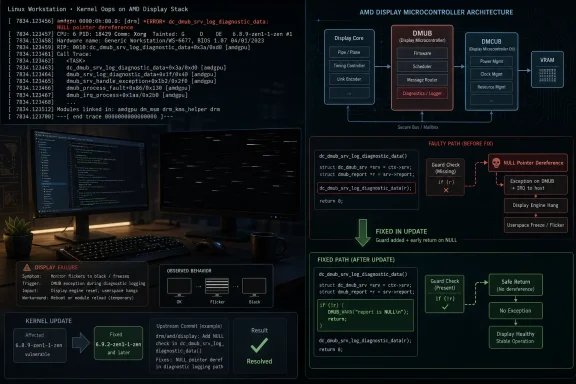 The Crash Was Hiding Inside the Crash Handler
The defect sits in the Linux kernel’s AMD display stack, specifically in drivers/gpu/drm/amd/display/dc/dc_dmub_srv.c, a file involved in the Display Core path that talks to AMD’s display microcontroller plumbing. The affected functions, dc_dmub_srv_log_diagnostic_data() and dc_dmub_srv_enable_dpia_trace(), were intended to deal with diagnostic and tracing paths, not to become the source of a new failure.The logic pattern is almost painfully familiar. The code checked whether
dc_dmub_srv or its dmub member was NULL, then entered the error block and called DC_LOG_ERROR(). The catch is that DC_LOG_ERROR() internally relies on dc_dmub_srv->ctx, so if dc_dmub_srv itself is NULL, the supposedly safe logging path can still dereference it.That is why this CVE is more interesting than its likely severity score will make it look once scoring arrives. It is not a sprawling memory corruption epic, not a speculative-execution monster, and not the sort of vulnerability that sends vendors into weekend emergency mode. It is a classic kernel reliability flaw: the error handling code believed it was describing a bad state, but in one branch it could make the bad state fatal.
The upstream fix is equally plain. First check whether
dc_dmub_srv is NULL and return immediately. Only after that should the code inspect dc_dmub_srv->dmub and emit an error log, because only then is the parent structure known to be valid.That tiny rearrangement is the whole story at the patch level. At the system level, however, it is a reminder that kernel display drivers are no longer boring plumbing; they sit at the intersection of firmware, hotplug events, USB-C alternate modes, GPU power management, docking stations, suspend/resume, diagnostics, and user-visible stability.
AMD Display Bugs Rarely Stay in the Graphics Lane
The vulnerable code is in the DRM AMD display subsystem, which immediately tells seasoned Linux users what kind of bug this is likely to feel like: not a clean application crash, but a kernel-side stumble that can show up as a frozen desktop, a black screen, a GPU reset, or a machine that needs a hard power cycle. In practice, display stack failures often look less like “security events” and more like the oldest support ticket in computing: the screen stopped responding.That matters because many affected systems are not servers in the traditional sense. They are developer workstations, Linux gaming PCs, CAD and media boxes, home-lab desktops, test benches, and increasingly handheld or small-form-factor machines running AMD APUs. These are systems where the GPU display path is not ornamental; it is the user’s interface to everything else.
The function names also hint at when this code may matter. Diagnostic logging and DPIA trace enablement are not hot paths in the way a compositor’s rendering loop is hot. They are more likely to become relevant when something is already wrong, when the driver wants to collect state, or when a display-related condition triggers tracing.
That is why the vulnerability has a faintly ironic shape. A subsystem reaches for diagnostics to understand or report a display microcontroller problem, then the diagnostic mechanism itself can hit a NULL pointer. The user does not experience that irony; the user experiences a crash.
For IT teams, that distinction is critical. A bug like this may not be the top patching priority in a headless Linux fleet, but it can be very visible in environments where Linux desktops are part of engineering, design, research, or security operations. The machine that crashes during a GPU/display error path is still unavailable, even if no attacker ever turns the bug into a polished exploit.
The Missing CVSS Score Is Not a Permission Slip
NVD listed no CVSS v4.0, v3.x, or v2.0 score at publication time, which is unsurprising for a newly received kernel CVE. That absence should not be read as reassurance. It means NVD had not yet completed enrichment, not that the bug has been proven harmless.Kernel CVEs often sit in an awkward space for vulnerability management systems. A NULL pointer dereference may eventually land as a denial-of-service issue, and in many cases that is accurate. But the practical risk depends on triggerability: who can reach the bad path, under what hardware conditions, with what privileges, and whether the crash is local, remote-adjacent, or only realistically triggered by rare driver state.
For CVE-2026-53313, the available description points to a crash if
dc_dmub_srv is NULL and logging tries to use its context. That is a narrower claim than “attackers can reliably crash any Linux machine with an AMD GPU.” The responsible reading is that affected kernels contain a kernel crash condition in AMD display error paths, and administrators should watch for distribution advisories and kernel updates rather than invent a threat model the record does not support.The affected-version metadata is also a reminder that kernel CVE records can be tricky to consume. The CVE record references affected git commit ranges and indicates the issue exists in Linux from the 5.14 line, with fixes represented by stable commits. For most users, the actionable version is not the upstream commit hash; it is the patched kernel package supplied by Ubuntu, Fedora, Debian, Arch, SUSE, Red Hat, or another distribution.
That is where scanners frequently overstate or understate reality. A scanner may see a kernel version that appears vulnerable upstream, while a distribution has backported the fix without changing to an obviously “new enough” mainline version. Conversely, a rolling or custom kernel may carry a vulnerable range longer than expected if it was built before the stable patch landed.
Linux Kernel CVEs Have Become More Literal
This case also fits a broader shift in how Linux kernel vulnerabilities are named and tracked. Since the kernel project became its own CVE Numbering Authority, more resolved kernel bugs have received CVE identifiers that read much like commit messages. The result is both more transparent and more noisy.For defenders, that is a mixed blessing. On one hand, a CVE like this is admirably specific: it names the subsystem, the functions, the bad condition, and the fix. There is little mystery about what went wrong. On the other hand, vulnerability dashboards now fill with kernel CVEs that range from urgent privilege escalation bugs to obscure crash conditions in hardware-specific paths.
The temptation is to sort by CVSS and move on. That works poorly when the score is missing, delayed, disputed, or less meaningful than local context. A high-severity kernel bug in a disabled subsystem may matter less to one fleet than a medium denial-of-service issue in a display driver used by every workstation in a render lab.
CVE-2026-53313 is a good example of why asset context beats generic severity. A cloud VM without AMD display hardware is unlikely to care. A Linux desktop fleet running AMD GPUs, USB-C docks, multi-monitor setups, and frequent suspend/resume cycles should care more, especially if users have already reported amdgpu instability.
That does not make the vulnerability dramatic. It makes it operational. And operational bugs are the ones that consume help-desk time, interrupt builds, corrupt unsaved work, and convince users that “Linux graphics are flaky” even when the underlying issue is one bad branch in an error path.
The Fix Is Small Because the Contract Was Simple
The corrected logic is not subtle. If the service pointer is NULL, return. If the service exists but thedmub member is missing, log an error using the valid service context. That is the kind of patch that looks obvious once written, which is precisely why it is worth examining.C code in the kernel is full of contracts like this. A function receives a pointer, checks it, and then assumes later code respects the outcome of that check. The bug here is not that nobody thought about NULL; the code plainly did. The bug is that the code combined two checks into one condition and then executed a macro that only made sense for one of the two failure cases.
Macros make this pattern easier to miss.
DC_LOG_ERROR() looks like logging, and logging feels harmless. But in kernel code, a logging macro is still code, and it may dereference state, acquire context, format device-specific data, or walk through driver structures.That is a useful lesson beyond AMD and beyond Linux. Error reporting code often grows assumptions that normal code is forced to confront. Developers harden the obvious path, then an assertion, telemetry hook, tracing facility, or diagnostic helper reintroduces the same unsafe access under a different name.
The fix splits the cases because the cases are semantically different. “The service object does not exist” is not the same condition as “the service exists but its DMUB member is unavailable.” Treating them as one error may be tidy, but tidy code that cannot safely log one of its own branches is not robust code.
Windows Users Should Still Pay Attention
At first glance, a Linux kernel CVE may seem outside the WindowsForum lane. But the old boundary between Windows and Linux users has collapsed for a lot of our audience. Windows admins run Linux in WSL, developers dual-boot, gamers test Proton and SteamOS-like environments, and homelabbers routinely mix Windows clients with Linux servers and workstations.This particular CVE is not about WSL’s Linux userland in the ordinary sense. WSL does not expose a full native Linux DRM display stack in the way a bare-metal Linux desktop does. The more relevant audience is anyone running Linux directly on AMD hardware: dual-boot systems, Linux gaming machines, workstations, and test rigs.
It is also relevant to Windows administrators who manage hardware fleets where users may install Linux alongside Windows. If a machine has an AMD GPU or APU and users report Linux-side freezes around display events, kernel updates matter as much as Mesa, firmware, compositor, or desktop-environment changes.
There is a broader Windows comparison, too. Microsoft has spent years moving more graphics-driver failure handling into mechanisms that can reset the GPU stack without taking down the whole system. Linux has its own recovery mechanisms, but a kernel NULL dereference is still the sort of failure that can pierce through layers of recovery and leave the user staring at a dead session.
That is why cross-platform hardware bugs deserve cross-platform attention. The same GPU family can be rock-solid under one driver stack and fragile under another, not because the silicon changes, but because the surrounding assumptions do.
The Real Risk Is Availability, Not Intrusion
Nothing in the public description indicates data theft, privilege escalation, or remote code execution. The obvious impact is availability: a kernel crash caused by a NULL pointer dereference. That should keep the story grounded.But availability is not a second-class security property. For a desktop user, a crash can destroy work. For a lab machine, it can interrupt a long-running experiment. For a kiosk, control room, or monitoring display, it can remove visibility at exactly the wrong time.
The risk also rises if the trigger is reachable from ordinary user activity. Display hotplugging, diagnostics, dock attachment, GPU resets, sleep/wake transitions, and firmware communication failures are not exotic events. The CVE text does not prove that an unprivileged user can reliably trigger the path, but it describes a condition that lives in a subsystem exposed to messy real-world hardware behavior.
Administrators should therefore resist two equal and opposite mistakes. The first is panic, treating every new kernel CVE as an emergency exploit. The second is dismissal, treating every missing-CVSS kernel CVE as harmless until a score appears.
The more mature response is to map the bug to the fleet. If affected systems do not use AMD display hardware, this falls down the list. If they do, and if they are already experiencing amdgpu display instability, the fix becomes more urgent even without exploit headlines.
Distribution Kernels Are the Patch Boundary That Matters
The CVE record points to upstream stable commits, but most users will not apply those commits directly. They will receive the correction through their distribution’s kernel package, sometimes as part of a stable update, sometimes as a security advisory, and sometimes through a backport that does not change the headline kernel version in an intuitive way.That is why “am I on Linux 7.0.10 or later?” is not the whole question. Distribution kernels often carry thousands of patches, and enterprise distributions in particular backport fixes to older version lines. A Red Hat, Ubuntu, Debian, SUSE, or Fedora kernel may not line up neatly with upstream version comparisons.
For rolling distributions, the answer is usually simpler: update to the latest kernel once the fix has landed in the packaging stream. For long-term-support distributions, the right answer is to watch the vendor security tracker and install the relevant kernel update when it is issued.
Custom kernel builders have more work. If you track upstream stable, pull the fixed stable release or cherry-pick the relevant commit only if you know what you are doing. If you maintain an internal kernel tree with AMD display patches, this is the sort of small fix that should be easy to audit but still deserves testing on actual hardware.
The testing point matters. Display driver fixes can be deceptively low-risk in code review and still interact with specific monitors, docks, firmware revisions, and power states in ways that only hardware can expose. The fix here is logically safe, but a disciplined environment still validates new kernels against representative display setups.
The Vulnerability Scanner Will Not Know Your Docking Station
Security tools tend to flatten vulnerabilities into rows: CVE ID, severity, asset, due date. That model works well enough for remote services and package versions. It works less well for a hardware-specific kernel path that may only matter when a laptop meets a particular dock, monitor chain, GPU firmware state, or suspend/resume pattern.For workstation fleets, endpoint telemetry can be more useful than generic scoring. Look for kernel logs involving amdgpu, DMUB, DMCUB, Display Core, GPU resets, and display timeout messages. If a subset of machines shows recurring display-driver errors, a CVE like this deserves higher priority there than on quiet systems.
For individual users, the practical advice is refreshingly mundane. Keep the kernel current through the distribution’s normal update channel, especially if you use AMD graphics on Linux. If you have been pinning a kernel to avoid another regression, check whether your pinned version sits in an affected range and whether your distribution has provided a targeted fix.
For administrators, the best mitigation is patching rather than configuration. There is no sensible sysadmin knob that makes unsafe error-path logging safe. Avoiding the affected path by disabling features or changing display behavior is speculative unless a vendor documents it.
The larger point is that vulnerability management needs hardware awareness. A Linux CVE in a filesystem, network stack, crypto API, or GPU driver has a very different blast radius depending on what the machine actually does. Treating all kernel CVEs as equal is not rigor; it is accounting.
The Small AMD Patch With Outsized Lessons
This CVE is not likely to become the defining Linux security story of 2026, and that is fine. Its value is as a clean specimen of a common failure mode: a null check that exists, an error path that appears safe, and a helper macro that quietly violates the premise of the branch it is called from.The concrete lessons are narrow enough to act on and broad enough to remember.
- Systems running Linux kernels with AMD display support should receive vendor kernel updates once the fix is available for their distribution.
- The absence of an NVD CVSS score at publication time should be treated as incomplete enrichment, not as evidence of low impact.
- Bare-metal Linux desktops, workstations, gaming systems, and lab machines with AMD GPUs or APUs are the most relevant assets to examine first.
- Distribution backports may fix the issue without moving to an obvious upstream kernel version, so package advisories matter more than raw version comparisons.
- Recurrent amdgpu, DMUB, DMCUB, or display timeout logs should raise the priority of this patch on affected hardware.
- The flaw is best understood as an availability risk unless future analysis shows a stronger exploit path.
References
- Primary source: NVD / Linux Kernel
Published: 2026-06-28T01:03:14-07:00
NVD - CVE-2026-53313
 nvd.nist.gov
- Security advisory: MSRC
Published: 2026-06-28T01:03:14-07:00
Original feed URL
Security Update Guide - Microsoft Security Response Center
 msrc.microsoft.com
- Official source: nist.gov
National Vulnerability Database
NIST maintains the National Vulnerability Database (NVD), a repository of information on software and hardware flaws that can compromise computer security. This is a key piece of the nation’s cybersecurity infrastructure.www.nist.gov - Related coverage: cvefeed.io
CVE-2024-26729 - drm/amd/display: Fix potential null pointer dereference in dc_dmub_srv
In the Linux kernel, the following vulnerability has been resolved: drm/amd/display: Fix potential null pointer dereference in dc_dmub_srv Fixes potential null pointer dereference warnings in the dc_dmub_srv_cmd_list_queue_execute() and dc_dmub_srv_is_hw_pwr_up() functions. In both functions...cvefeed.io - Related coverage: security.snyk.io
Integer Overflow or Wraparound in kernel-rt-core | CVE-2023-53313 | Snyk
Low severity (5.5) Integer Overflow or Wraparound in kernel-rt-core | CVE-2023-53313security.snyk.io - Related coverage: labs.cloudsecurityalliance.org
NVD Enrichment Triage: Enterprise Vulnerability Programs Must Adapt
PDF documentlabs.cloudsecurityalliance.org
