

CVE-2026-53176 is a newly published Linux kernel denial-of-service flaw, disclosed through Microsoft’s Security Update Guide and kernel vulnerability tracking on June 25, 2026, affecting the IB/isert driver used for iSCSI Extensions for RDMA target logins. The bug is not a Windows desktop emergency, but it matters to WindowsForum readers because modern Windows estates increasingly depend on Linux-backed storage, virtualization hosts, appliances, and cloud infrastructure. Its lesson is blunt: a 76-byte assumption in a kernel storage path can become a pre-authentication crash switch. For administrators, the practical question is not whether this is dramatic enough for headlines, but whether any exposed RDMA storage target in the environment is waiting for a malformed login packet.
The vulnerability sits in the Linux kernel’s
The flaw is narrow but ugly. During login handling, the vulnerable path calculates a login request payload length by subtracting
That negative value then travels into code that eventually feeds a copy operation. In C, signed-to-unsigned conversions are where small mistakes become spectacularly large ones. A negative length can be sign-extended into a huge
The result, according to the published vulnerability description, is a crash of the target node. That makes this a denial-of-service issue rather than a confirmed remote code execution bug. But “just a crash” is cold comfort when the crashed machine is a storage target serving virtual machines, databases, backup infrastructure, or cluster nodes.
That distinction changes the operational risk. A bug that requires authenticated access is often still serious, but it can be bounded by account hygiene, access reviews, and credential controls. A pre-authentication bug moves the first line of defense back to network reachability.
In other words, if the vulnerable target service is reachable by a hostile initiator, credentials may not save it. The security boundary becomes segmentation, filtering, exposure management, and patch state. That is a familiar pattern in infrastructure security: the most damaging bugs often do not need to break identity systems because they run before identity systems have a chance to matter.
This is also why storage networks are supposed to be boring. A well-designed RDMA or iSCSI fabric is not a general-purpose network with random clients wandering through it. It is a constrained plane where initiators and targets are known, paths are predictable, and anything unexpected is suspicious by default.
That would be a mistake in mixed environments. Windows shops increasingly rely on Linux even when their user endpoints, directory services, management tooling, and application desktops remain Microsoft-centered. Linux may sit underneath storage appliances, backup repositories, virtualization clusters, Kubernetes nodes, security sensors, network appliances, and cloud images.
The Windows connection is not that Windows 11 suddenly becomes vulnerable to this kernel flaw. The connection is that Windows workloads can be collateral damage when the Linux infrastructure below or beside them falls over. A Hyper-V-adjacent storage target, a backup appliance receiving Windows image backups, or a Linux-based SAN component does not need to run Windows to become a Windows outage.
Microsoft’s appearance in the story through the Security Update Guide also reflects the changed shape of enterprise software. Microsoft now tracks and communicates about vulnerabilities that affect components in its orbit, including open-source and Linux-adjacent technologies used across Azure, developer tooling, and customer environments. The old mental model — Microsoft issues Windows bulletins, Linux vendors issue Linux bulletins, and never the twain shall meet — no longer matches how infrastructure is actually built.
This is not a knock on the kernel developers so much as a reminder of what kernel programming demands. The code sits at the intersection of hardware completion queues, protocol framing, signed integer arithmetic, and memory copying. Each piece may be reasonable in isolation. The failure emerges when one assumption — “the received length is at least the header length” — is not enforced at the boundary.
The published description says the upper bound was already safe because the posted login buffer cannot deliver more than the expected receive payload size, and the existing clamp handles the maximum. Only the lower bound was missing. That is a tidy vulnerability shape: the top of the range had a guardrail, the bottom of the range had a cliff.
Security teams should resist the urge to treat such bugs as trivial because the patch is small. In systems software, small patches often address large trust failures. A one-line guard can be the difference between a rejected packet and a crashed node.
But specialized does not mean obscure in the environments where it exists. RDMA storage is used precisely where performance and reliability matter. The organizations likely to use it are also likely to run dense virtualization, large databases, high-performance computing, or storage-heavy platforms where a target crash is more than a nuisance.
This creates an uncomfortable asymmetry. The vulnerable population may be small compared with the installed base of Linux systems, but the impact on any one affected environment can be high. A consumer laptop is almost certainly irrelevant. A storage target in a lab, data center, or cloud-adjacent deployment is not.
The right response is targeted urgency. Do not panic-patch every Linux machine because a kernel CVE appeared. Do identify where iSER target functionality is enabled, where RDMA storage networks are reachable, and whether those systems have received the stable kernel fix.
For defenders, the hard part is triage. A new kernel CVE can describe anything from a local edge case in an uncommon driver to a remotely reachable flaw in a widely deployed network path. Treating every kernel CVE as equally urgent is impossible. Treating the flood as background noise is dangerous.
This bug deserves attention because it combines several traits administrators should care about: remote reachability, pre-authentication triggerability, kernel crash impact, and relevance to storage targets. It does not currently read like a universal Internet-scale catastrophe. It does read like a serious availability risk for the wrong exposed system.
That nuance is exactly what modern vulnerability management often loses. Severity scoring, when available, compresses the problem into a number. Real risk depends on topology. A system with no iSER target exposure is not meaningfully threatened by this bug; a production storage node reachable by untrusted initiators is in a different category entirely.
But patching the code does not answer the bigger architectural question: why can unexpected initiators reach a storage target at all? Storage protocols often assume a relatively trusted network, yet modern infrastructure repeatedly violates that assumption through flat networks, temporary lab exceptions, misconfigured VLANs, hurried cloud peering, and undocumented appliance access.
For Windows administrators, the same pattern appears in SMB, WinRM, RDP, iSCSI, and management APIs. A protocol designed for controlled administrative or storage use becomes risky when placed in a broader reachability zone. The bug may be Linux-specific, but the design lesson is platform-neutral.
This is why segmentation remains one of the few security controls that still ages well. Authentication is essential, but pre-authentication parsing bugs are an eternal category. If a packet parser must look at untrusted input before it can decide whether the sender is allowed in, the surrounding network should make the set of possible senders as small as practical.
That is where vulnerabilities like CVE-2026-53176 can linger. Appliances often package kernels behind product version numbers, and customers may not know whether the affected code is present, compiled, loaded, or reachable. Vendors may take time to publish advisories, especially when the affected subsystem is optional or platform-specific.
Administrators should not assume an appliance is safe because it does not advertise “Linux” on the front panel. They should also avoid assuming it is vulnerable merely because it uses Linux internally. The key questions are narrower: does it implement iSER target functionality, does it use a vulnerable kernel build, and can an untrusted or semi-trusted initiator reach the login path?
This is one of the reasons software bills of materials and vendor security portals matter. They are not paperwork for auditors alone. In moments like this, they are how infrastructure teams avoid guessing what is inside the black box.
But availability is the first promise infrastructure makes. A storage target crash can stop workloads just as surely as an attacker with root can. In heavily consolidated environments, the difference between a denial-of-service and a broader incident can be academic to the business units staring at downed applications.
CVE-2026-53176 is a useful corrective because it is not flashy. There is no public claim in the available record that it allows data theft or arbitrary code execution. The stated impact is crashing the target node. Yet for a system whose job is to serve storage, crashing is a primary failure mode.
The security industry’s language sometimes understates that. “DoS” can sound like a nuisance attack from an earlier Internet era. In infrastructure, a reliable unauthenticated crash path against a storage component is closer to a remote outage button.
If the answer is yes, the next step is patch verification. Kernel stable branches have received fixes, and distributions or appliance vendors should carry those fixes into their own update channels. The important detail is not merely that a package exists, but that the running kernel on the target node contains the lower-bound check.
Network controls should be reviewed in parallel. The vulnerable path is reached during login, before authentication, so limiting which initiators can reach the target is a meaningful mitigation. That includes switch-level isolation, host firewalls where applicable, fabric zoning, ACLs, and any storage-network controls that restrict initiator access.
Monitoring should also be tuned for symptoms rather than fantasies. A successful trigger is expected to crash or fault the target node, so defenders should look for unexplained kernel oops events, storage target resets, failed iSER login attempts, and availability blips around RDMA storage services. If logs show malformed or unusually short login traffic, that is not noise worth ignoring.
That gap is where infrastructure risk hides. A Windows workload can depend on a Linux storage layer, a Linux backup target, a Linux reverse proxy, a Linux monitoring collector, or a Linux-based appliance. When the Linux component fails, the incident lands on the Windows operations team anyway because the affected application, file share, or virtual desktop pool is what users see.
CVE-2026-53176 is a prompt to ask whether Linux kernel vulnerabilities are flowing into the same risk process as Windows updates. If not, patch governance is split along organizational lines that attackers and outages do not respect. The system graph matters more than the operating system logo.
Microsoft’s increasingly broad vulnerability ecosystem makes that point harder to avoid. The company’s customers do not live in pure Windows anymore, and Microsoft does not either. Azure, WSL, AKS, Defender, SQL on Linux, and cross-platform developer tooling have all blurred the old boundaries.
From there, signed arithmetic did what signed arithmetic does when assumptions fail. A negative length was preserved through a signed minimum operation and then converted into a very large copy length. The destination buffer was 8192 bytes. The crash followed.
That chain is useful because it explains both the exploitability and the fix. Attackers do not need a sophisticated race or a heap grooming strategy to understand the class of bug. Defenders do not need to reverse-engineer the entire RDMA stack to understand the patch intent. The vulnerable condition is a missing lower-bound check in pre-authentication login parsing.
Still, simplicity should not be confused with certainty about every deployment. Kernel CVE records describe upstream code and stable fixes, while distributions may backport patches without changing kernel version numbers in obvious ways. Appliance vendors may document the issue under their own advisories. Verification should follow vendor guidance, not just a quick glance at
Delay matters because denial-of-service bugs are often easier to rediscover from a patch than memory-corruption bugs that require elaborate exploitation. Once the fix says “reject login PDUs shorter than the header length,” the shape of the malformed input is not hard to infer. That does not mean widespread exploitation is inevitable, but it does mean defenders should not treat the patch as obscure forever.
The publication date also matters. This record entered public vulnerability channels on June 25, 2026. By June 28, administrators should assume motivated researchers and attackers have had enough time to understand the basic trigger, even if they have not built a polished tool.
That is not a call for drama. It is a call for boring speed. Find the affected targets, patch them, restrict reachability, and move on before a narrow kernel bug becomes an avoidable outage.
The most concrete lessons are straightforward:
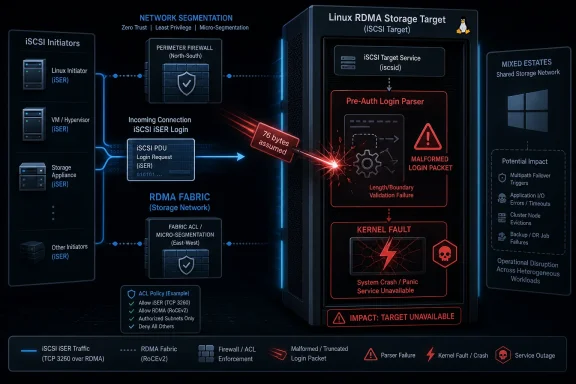 A Tiny Login Packet Becomes a Kernel-Sized Problem
The vulnerability sits in the Linux kernel’s IB/isert code, the target-side implementation for iSER, or iSCSI Extensions for RDMA. iSER is one of those technologies that rarely appears in consumer-facing security advice but can be deeply important in storage-heavy environments: it allows iSCSI traffic to ride over RDMA transports, reducing CPU overhead and latency for systems that need fast block storage.The flaw is narrow but ugly. During login handling, the vulnerable path calculates a login request payload length by subtracting
ISER_HEADERS_LEN from the received work completion byte length. The expected header size is 76 bytes. If a remote initiator sends a login PDU shorter than that, the subtraction can go negative.That negative value then travels into code that eventually feeds a copy operation. In C, signed-to-unsigned conversions are where small mistakes become spectacularly large ones. A negative length can be sign-extended into a huge
size_t, causing a copy into an 8 KB login request buffer to run wildly out of bounds and fault the kernel.The result, according to the published vulnerability description, is a crash of the target node. That makes this a denial-of-service issue rather than a confirmed remote code execution bug. But “just a crash” is cold comfort when the crashed machine is a storage target serving virtual machines, databases, backup infrastructure, or cluster nodes.
The Dangerous Part Happens Before Authentication
The most important phrase in this vulnerability is not “integer underflow” or “memcpy.” It is before authentication. The login phase that reaches this vulnerable code path occurs before iSCSI authentication has been completed, so an attacker does not need valid storage credentials to trigger the vulnerable path.That distinction changes the operational risk. A bug that requires authenticated access is often still serious, but it can be bounded by account hygiene, access reviews, and credential controls. A pre-authentication bug moves the first line of defense back to network reachability.
In other words, if the vulnerable target service is reachable by a hostile initiator, credentials may not save it. The security boundary becomes segmentation, filtering, exposure management, and patch state. That is a familiar pattern in infrastructure security: the most damaging bugs often do not need to break identity systems because they run before identity systems have a chance to matter.
This is also why storage networks are supposed to be boring. A well-designed RDMA or iSCSI fabric is not a general-purpose network with random clients wandering through it. It is a constrained plane where initiators and targets are known, paths are predictable, and anything unexpected is suspicious by default.
This Is a Linux Bug With Windows Consequences
At first glance, CVE-2026-53176 looks like Linux-only plumbing. The affected file is in the Linux kernel tree, the subsystem is InfiniBand/iSER, and the fix is a kernel-side bounds check. That might tempt Windows administrators to scroll past it.That would be a mistake in mixed environments. Windows shops increasingly rely on Linux even when their user endpoints, directory services, management tooling, and application desktops remain Microsoft-centered. Linux may sit underneath storage appliances, backup repositories, virtualization clusters, Kubernetes nodes, security sensors, network appliances, and cloud images.
The Windows connection is not that Windows 11 suddenly becomes vulnerable to this kernel flaw. The connection is that Windows workloads can be collateral damage when the Linux infrastructure below or beside them falls over. A Hyper-V-adjacent storage target, a backup appliance receiving Windows image backups, or a Linux-based SAN component does not need to run Windows to become a Windows outage.
Microsoft’s appearance in the story through the Security Update Guide also reflects the changed shape of enterprise software. Microsoft now tracks and communicates about vulnerabilities that affect components in its orbit, including open-source and Linux-adjacent technologies used across Azure, developer tooling, and customer environments. The old mental model — Microsoft issues Windows bulletins, Linux vendors issue Linux bulletins, and never the twain shall meet — no longer matches how infrastructure is actually built.
The Bug Is Embarrassingly Simple, Which Is Why It Matters
The fix described for CVE-2026-53176 is conceptually simple: reject any login PDU shorter thanISER_HEADERS_LEN before doing the subtraction. That is the kind of bounds check developers learn early and still miss in production kernel code.This is not a knock on the kernel developers so much as a reminder of what kernel programming demands. The code sits at the intersection of hardware completion queues, protocol framing, signed integer arithmetic, and memory copying. Each piece may be reasonable in isolation. The failure emerges when one assumption — “the received length is at least the header length” — is not enforced at the boundary.
The published description says the upper bound was already safe because the posted login buffer cannot deliver more than the expected receive payload size, and the existing clamp handles the maximum. Only the lower bound was missing. That is a tidy vulnerability shape: the top of the range had a guardrail, the bottom of the range had a cliff.
Security teams should resist the urge to treat such bugs as trivial because the patch is small. In systems software, small patches often address large trust failures. A one-line guard can be the difference between a rejected packet and a crashed node.
RDMA Makes the Blast Radius More Specialized, Not Harmless
The affected subsystem is not something every Linux box exposes. iSER depends on RDMA-capable infrastructure, and many ordinary servers will never load or use the relevant target path. That specialization matters, and it should keep the response proportional.But specialized does not mean obscure in the environments where it exists. RDMA storage is used precisely where performance and reliability matter. The organizations likely to use it are also likely to run dense virtualization, large databases, high-performance computing, or storage-heavy platforms where a target crash is more than a nuisance.
This creates an uncomfortable asymmetry. The vulnerable population may be small compared with the installed base of Linux systems, but the impact on any one affected environment can be high. A consumer laptop is almost certainly irrelevant. A storage target in a lab, data center, or cloud-adjacent deployment is not.
The right response is targeted urgency. Do not panic-patch every Linux machine because a kernel CVE appeared. Do identify where iSER target functionality is enabled, where RDMA storage networks are reachable, and whether those systems have received the stable kernel fix.
The CVE Arrives in a Noisy Year for Kernel Security
CVE-2026-53176 lands amid a broader swell of Linux kernel vulnerability reporting. Since the Linux kernel project became a CVE Numbering Authority, kernel fixes have increasingly been mapped into CVE records. That has improved visibility, but it has also made the vulnerability stream feel relentless.For defenders, the hard part is triage. A new kernel CVE can describe anything from a local edge case in an uncommon driver to a remotely reachable flaw in a widely deployed network path. Treating every kernel CVE as equally urgent is impossible. Treating the flood as background noise is dangerous.
This bug deserves attention because it combines several traits administrators should care about: remote reachability, pre-authentication triggerability, kernel crash impact, and relevance to storage targets. It does not currently read like a universal Internet-scale catastrophe. It does read like a serious availability risk for the wrong exposed system.
That nuance is exactly what modern vulnerability management often loses. Severity scoring, when available, compresses the problem into a number. Real risk depends on topology. A system with no iSER target exposure is not meaningfully threatened by this bug; a production storage node reachable by untrusted initiators is in a different category entirely.
The Patch Fixes the Code, Not the Architecture
The kernel-side remediation is straightforward: reject too-short login PDUs before calculating the payload length. That prevents the negative length from existing in the first place, which is cleaner than trying to sanitize it later.But patching the code does not answer the bigger architectural question: why can unexpected initiators reach a storage target at all? Storage protocols often assume a relatively trusted network, yet modern infrastructure repeatedly violates that assumption through flat networks, temporary lab exceptions, misconfigured VLANs, hurried cloud peering, and undocumented appliance access.
For Windows administrators, the same pattern appears in SMB, WinRM, RDP, iSCSI, and management APIs. A protocol designed for controlled administrative or storage use becomes risky when placed in a broader reachability zone. The bug may be Linux-specific, but the design lesson is platform-neutral.
This is why segmentation remains one of the few security controls that still ages well. Authentication is essential, but pre-authentication parsing bugs are an eternal category. If a packet parser must look at untrusted input before it can decide whether the sender is allowed in, the surrounding network should make the set of possible senders as small as practical.
Appliances May Be the Slow Part of the Fix
The easy case is a Linux server managed by a team that controls its kernel packages. Identify the affected kernel branch, apply the vendor update, reboot or live-patch if supported, and verify the running kernel. The harder case is a storage appliance or embedded platform that includes Linux but exposes updates only through a vendor firmware channel.That is where vulnerabilities like CVE-2026-53176 can linger. Appliances often package kernels behind product version numbers, and customers may not know whether the affected code is present, compiled, loaded, or reachable. Vendors may take time to publish advisories, especially when the affected subsystem is optional or platform-specific.
Administrators should not assume an appliance is safe because it does not advertise “Linux” on the front panel. They should also avoid assuming it is vulnerable merely because it uses Linux internally. The key questions are narrower: does it implement iSER target functionality, does it use a vulnerable kernel build, and can an untrusted or semi-trusted initiator reach the login path?
This is one of the reasons software bills of materials and vendor security portals matter. They are not paperwork for auditors alone. In moments like this, they are how infrastructure teams avoid guessing what is inside the black box.
Availability Bugs Deserve More Respect
Security culture still tends to rank vulnerabilities by whether they grant code execution or privilege escalation. That instinct is understandable. Remote code execution is terrifying, and local privilege escalation can turn a foothold into a breach.But availability is the first promise infrastructure makes. A storage target crash can stop workloads just as surely as an attacker with root can. In heavily consolidated environments, the difference between a denial-of-service and a broader incident can be academic to the business units staring at downed applications.
CVE-2026-53176 is a useful corrective because it is not flashy. There is no public claim in the available record that it allows data theft or arbitrary code execution. The stated impact is crashing the target node. Yet for a system whose job is to serve storage, crashing is a primary failure mode.
The security industry’s language sometimes understates that. “DoS” can sound like a nuisance attack from an earlier Internet era. In infrastructure, a reliable unauthenticated crash path against a storage component is closer to a remote outage button.
The Operational Playbook Is Narrow but Urgent
The best response starts with exposure discovery, not mass alarm. Administrators should determine whether they operate Linux systems using the iSER target path, especially systems with InfiniBand or RDMA-backed storage roles. If the answer is no, the vulnerability can be tracked through normal kernel update processes.If the answer is yes, the next step is patch verification. Kernel stable branches have received fixes, and distributions or appliance vendors should carry those fixes into their own update channels. The important detail is not merely that a package exists, but that the running kernel on the target node contains the lower-bound check.
Network controls should be reviewed in parallel. The vulnerable path is reached during login, before authentication, so limiting which initiators can reach the target is a meaningful mitigation. That includes switch-level isolation, host firewalls where applicable, fabric zoning, ACLs, and any storage-network controls that restrict initiator access.
Monitoring should also be tuned for symptoms rather than fantasies. A successful trigger is expected to crash or fault the target node, so defenders should look for unexplained kernel oops events, storage target resets, failed iSER login attempts, and availability blips around RDMA storage services. If logs show malformed or unusually short login traffic, that is not noise worth ignoring.
Windows Shops Should Audit Their Linux Dependencies
The most useful exercise for WindowsForum readers may be less about this single CVE and more about inventory discipline. Many Windows-first organizations have excellent visibility into domain controllers, Intune-managed endpoints, Exchange remnants, SQL Server instances, and Windows Server patch levels. Their Linux dependencies are often less consistently mapped.That gap is where infrastructure risk hides. A Windows workload can depend on a Linux storage layer, a Linux backup target, a Linux reverse proxy, a Linux monitoring collector, or a Linux-based appliance. When the Linux component fails, the incident lands on the Windows operations team anyway because the affected application, file share, or virtual desktop pool is what users see.
CVE-2026-53176 is a prompt to ask whether Linux kernel vulnerabilities are flowing into the same risk process as Windows updates. If not, patch governance is split along organizational lines that attackers and outages do not respect. The system graph matters more than the operating system logo.
Microsoft’s increasingly broad vulnerability ecosystem makes that point harder to avoid. The company’s customers do not live in pure Windows anymore, and Microsoft does not either. Azure, WSL, AKS, Defender, SQL on Linux, and cross-platform developer tooling have all blurred the old boundaries.
The 76-Byte Rule Administrators Should Remember
The concrete details are compact enough to keep on a whiteboard. A login PDU shorter than 76 bytes should never be treated as a valid basis for subtracting a 76-byte header. The vulnerable code did that subtraction without first proving the received length was large enough.From there, signed arithmetic did what signed arithmetic does when assumptions fail. A negative length was preserved through a signed minimum operation and then converted into a very large copy length. The destination buffer was 8192 bytes. The crash followed.
That chain is useful because it explains both the exploitability and the fix. Attackers do not need a sophisticated race or a heap grooming strategy to understand the class of bug. Defenders do not need to reverse-engineer the entire RDMA stack to understand the patch intent. The vulnerable condition is a missing lower-bound check in pre-authentication login parsing.
Still, simplicity should not be confused with certainty about every deployment. Kernel CVE records describe upstream code and stable fixes, while distributions may backport patches without changing kernel version numbers in obvious ways. Appliance vendors may document the issue under their own advisories. Verification should follow vendor guidance, not just a quick glance at
uname.The Real Risk Is Reachability Plus Delay
Every vulnerability response eventually collapses into two variables: who can reach the bug, and how long the bug remains present. CVE-2026-53176 is no different. A vulnerable but isolated test system is a low priority. A vulnerable storage target reachable from a broad server VLAN is a different problem.Delay matters because denial-of-service bugs are often easier to rediscover from a patch than memory-corruption bugs that require elaborate exploitation. Once the fix says “reject login PDUs shorter than the header length,” the shape of the malformed input is not hard to infer. That does not mean widespread exploitation is inevitable, but it does mean defenders should not treat the patch as obscure forever.
The publication date also matters. This record entered public vulnerability channels on June 25, 2026. By June 28, administrators should assume motivated researchers and attackers have had enough time to understand the basic trigger, even if they have not built a polished tool.
That is not a call for drama. It is a call for boring speed. Find the affected targets, patch them, restrict reachability, and move on before a narrow kernel bug becomes an avoidable outage.
The Storage Fabric Is Where This CVE Either Dies or Spreads
This vulnerability will not be equally important to every WindowsForum reader, and that is exactly the point. Its severity is determined less by the CVE label than by the storage fabric around it. A disciplined environment can turn CVE-2026-53176 into a routine kernel update; a flat or poorly inventoried one can turn it into a surprise infrastructure incident.The most concrete lessons are straightforward:
- Systems that do not run Linux iSER target functionality are unlikely to be directly affected by this specific flaw.
- Systems that expose vulnerable Linux iSER targets should be patched promptly because the crash path is reachable before iSCSI authentication.
- Network segmentation and initiator allow-listing are meaningful mitigations because credentials are not required to reach the vulnerable login parser.
- Appliance owners should check vendor advisories rather than assuming the absence of a visible Linux shell means the issue is irrelevant.
- Windows administrators should include Linux-backed storage, backup, virtualization, and appliance layers in vulnerability management because Windows workloads often depend on them.
References
- Primary source: MSRC
Published: 2026-06-28T01:51:37-07:00
Security Update Guide - Microsoft Security Response Center
 msrc.microsoft.com
- Related coverage: sentinelone.com
CVE-2026-23276: Linux Kernel Tunnel DOS Vulnerability
CVE-2026-23276 is a denial of service vulnerability in Linux kernel tunnel functions. Learn about its impact, affected versions, and mitigation methods.www.sentinelone.com
- Official source: microsoft.com
MSRC - Microsoft Security Response Center
The Microsoft Security Response Center is part of the defender community and on the front line of security response evolution. For over twenty years, we have been engaged with security researchers working to protect customers and the broader ecosystem.www.microsoft.com
- Related coverage: threatprotect.qualys.com

