

CVE-2026-53183 is a newly published Linux kernel vulnerability, disclosed through kernel.org and added to NVD on June 25, 2026, that fixes an MPTCP receive-window accounting bug capable of letting incoming network traffic exceed the receiver’s configured buffer size. The issue carries a kernel.org CVSS 3.1 score of 7.5, rated High, because it is network-reachable and can affect availability without authentication or user interaction. The practical story is narrower than the number suggests, but not trivial: this is a denial-of-service class kernel networking flaw in a feature built precisely for complex multi-path networks.
The interesting part is not that Linux has another kernel CVE. The interesting part is that this one lives in the seam between two layers that both believed they were enforcing the same invariant. MPTCP and TCP each tried to keep the receive window from moving backward; together, under out-of-order conditions, they could manufacture breathing room that the receiver did not actually have.
Most vulnerability headlines are written around attacker intent: remote code execution, privilege escalation, credential theft, sandbox escape. CVE-2026-53183 is less cinematic and more operationally familiar. It is a resource-management bug in the Linux networking stack, and its worst credible outcome is availability loss.
That does not make it boring. Availability bugs in the kernel networking path are exactly the kind of flaw that can turn a neat protocol edge case into a production incident, especially when the affected code sits below applications, containers, and service frameworks. If the host kernel is wrong about how much data it can safely accept, every layer above it inherits the mistake.
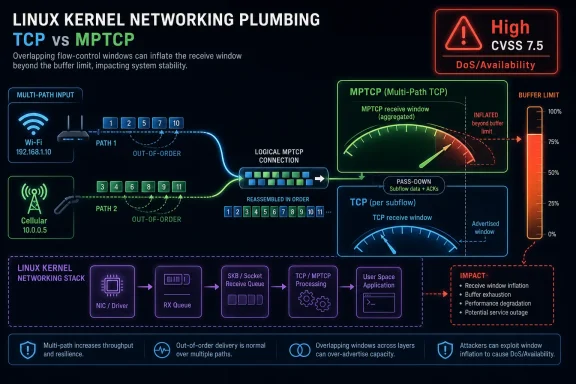
The bug is in Multipath TCP, or MPTCP, the Linux-supported extension that lets one logical TCP connection use multiple network paths. To applications, the connection still looks like a normal stream. Under the hood, the kernel can move data across subflows, such as Wi-Fi plus cellular, multiple WAN links, or parallel routed paths between endpoints.
That design is why the vulnerability matters. MPTCP’s appeal is that it makes network complexity look simple to the application. CVE-2026-53183 is a reminder that the complexity does not disappear; it moves into the transport stack, where a small accounting mismatch can become a kernel-level exposure.
MPTCP complicates this because there are two views of progress. There is the TCP-level view of each subflow, and there is the MPTCP-level view of the logical byte stream that must be reassembled across those subflows. Data may arrive in order on one subflow while still being out of order in the larger MPTCP sequence space.
The CVE description points to exactly that split. In an MPTCP connection, the TCP header’s
On paper, that sounds like belt-and-suspenders engineering. In the vulnerable behavior, it became a kind of double-entry bookkeeping error. When incoming data was acknowledged at the TCP level but still out of order at the MPTCP level, or sitting in backlog, the TCP side could be pushed into advertising more room than the receiver’s MPTCP state really justified.
The phrase from the disclosure that deserves attention is “artificial inflating.” This was not a case where a malicious sender simply ignored the advertised window. The receiver could end up creating the conditions for excess traffic even when the sender behaved normally.
That abstraction is powerful, and Linux has been steadily making it more ordinary. MPTCP support entered the upstream kernel years ago, and modern distributions commonly include the relevant kernel pieces even if not every application uses them by default. Administrators can configure path managers, endpoints, and policy through kernel interfaces rather than patching applications.
But the abstraction has a price. A conventional TCP connection has one sequence space and one set of receive-buffer pressures. MPTCP adds a logical data sequence layer above subflows that each still behave like TCP connections. The receiver must decide what to acknowledge, what to buffer, what to reassemble, and what to advertise, while keeping both the subflow and aggregate connection honest.
CVE-2026-53183 lives in that translation layer. The disclosure names
The fix is conceptually small: allow the TCP subflow receive window to shrink regardless of the current network namespace setting. The impact of that small change is larger than it sounds. It lets the subflow reflect actual buffer pressure instead of being trapped by a “do not move backward” rule that makes sense in normal TCP but becomes misleading when MPTCP’s aggregate sequence space is lagging.
For defenders, that makes triage slightly uncomfortable. We often classify network DoS issues by imagining hostile traffic patterns: spoofed floods, malformed packets, intentionally abusive connection behavior. Here, the bad condition arises from legitimate MPTCP dynamics such as out-of-order arrival and backlog interaction.
Out-of-order data is not exotic in MPTCP. It is one of the protocol’s routine hazards. If data can travel over multiple paths, those paths may have different latency, jitter, congestion, and loss characteristics. A receiver that uses MPTCP is implicitly agreeing to handle reordering more often than a vanilla single-path TCP receiver would.
That is why this bug is best understood as a pressure amplification issue. The attacker, or even just a peer in an unlucky network pattern, does not need to invent a new packet language. The vulnerable receiver can end up letting more data in than its receive buffer policy intended, because the subflow-level window is prevented from shrinking at the moment when shrinking is the honest thing to do.
The result is availability risk, not data compromise. The kernel.org CVSS vector assigns no confidentiality or integrity impact, but high availability impact. That is a sensible reading: this is about memory pressure, buffering, and the receiver’s ability to keep operating under network load.
But the affected population is not “every Linux box on the Internet” in any useful sense. The bug is in MPTCP, and the risk is most relevant where MPTCP is enabled, exposed, or used by applications and network architectures. Many Linux systems ship kernels with MPTCP support available, but availability in the kernel is not the same as real-world exposure in every deployment.
That distinction matters for WindowsForum readers because Linux kernel CVEs increasingly appear in Windows-adjacent environments. WSL2, Linux containers on Windows hosts, Hyper-V guests, Azure images, edge appliances, VPN concentrators, NAS devices, Kubernetes nodes, and mixed-platform development systems all bring Linux kernels into environments that may otherwise be managed by Windows teams. The security dashboard may say “Linux kernel,” but the operational owner may be a Windows admin responsible for the platform it sits on.
Still, teams should resist both extremes. It would be wrong to dismiss CVE-2026-53183 because MPTCP is not a mainstream desktop feature. It would also be wrong to treat every Linux VM as equally exposed. The right question is not “Do we run Linux?” but “Do any of our Linux kernels accept or initiate MPTCP connections in a reachable context?”
That question can be surprisingly hard to answer in large environments. Kernel features may be enabled even when unused. Containers share host kernels. Appliances may expose limited shells or no shell at all. Vendor firmware may lag upstream stable kernels. This is where a High CVSS score becomes a forcing function for asset clarity rather than a proof of imminent compromise.
That list should not be read like a normal application upgrade recommendation. Linux distributions rarely map one-to-one to upstream version numbers, especially for enterprise kernels. Red Hat, SUSE, Ubuntu, Debian, Oracle, and appliance vendors commonly backport security fixes into kernels whose version strings may look old by upstream standards.
The right operational move is to check the vendor advisory or package changelog for the kernel build actually deployed. A system reporting a kernel version lower than an upstream fixed number may still contain the patch if the distribution backported it. Conversely, a custom or vendor-frozen kernel may remain exposed even if the version family appears close to a fixed branch.
This is particularly important in container-heavy environments. Updating a container image will not fix a host-kernel MPTCP bug unless that image also controls the kernel, which ordinary containers do not. Kubernetes nodes, Docker hosts, and container platforms need host kernel updates or node image updates, not merely rebuilt application images.
For virtualization, the same rule applies with a different boundary. A Linux guest needs its guest kernel patched. A Windows host running Linux guests is not patched by a Windows cumulative update. If the Linux workload is in WSL2, the relevant kernel is Microsoft-distributed and should be updated through the WSL servicing path rather than through a traditional Linux distribution kernel package.
The modern vulnerability-management pipeline is increasingly assembled from partial authorities. The CNA publishes the CVE and initial scoring. NVD ingests it and may enrich it later with CPEs, CWE mappings, or its own analysis. Linux distributions decide how the upstream patch maps to supported packages. Cloud providers and appliance vendors decide when their images or firmware are remediated.
For defenders, the lesson is uncomfortable but necessary: NVD is not a complete operational answer. It is a starting point. A newly published CVE may have enough information to act on before NVD enrichment is complete, especially when the upstream project has already landed stable commits.
The kernel.org source is especially important here because the Linux kernel CVE process often treats “the vulnerability has been resolved” as the core advisory statement. The patch is the primary artifact. The CVE prose explains the failure mode, but it does not necessarily provide exploit code, detection logic, or a polished enterprise risk narrative.
That is why scanner output may vary in the first days after publication. Some tools will flag based on CVE metadata. Others will wait for distribution OVAL data, package advisories, or CPE enrichment. A mismatch between tools is not proof that one is broken; it may simply reveal which part of the vulnerability intelligence pipeline each tool trusts most.
Developer workstations may run WSL2 for build chains, test harnesses, and container tooling. CI systems may spin up Linux runners on Windows-managed infrastructure. Security appliances, SD-WAN boxes, storage devices, and observability collectors may embed Linux kernels. Cloud deployments may mix Windows Server workloads with Linux sidecars, proxies, ingress controllers, and service mesh components.
MPTCP itself is not uniformly present in all those places as an active feature, but the kernel patching lesson is broader. The riskiest Linux systems in a Windows estate are often the ones nobody thinks of as Linux systems. They are “the gateway,” “the appliance,” “the node image,” “the developer VM,” or “the container host.”
That naming problem leads directly to patching delays. Windows Update gives administrators a familiar cadence and a relatively centralized mechanism. Linux kernel remediation in a mixed estate may involve distribution repositories, cloud image refreshes, live-patching subscriptions, appliance firmware, node drains, maintenance windows, and reboot coordination.
CVE-2026-53183 is not a reason to panic across that entire estate. It is a reason to verify that the estate has an answer when the next kernel networking CVE is less conditional. If a team cannot quickly identify where MPTCP-capable kernels are running, it likely cannot quickly identify exposure to other transport-stack flaws either.
That said, the public CVE text does not establish a turnkey exploit. It describes a resolved kernel flaw and the mechanism by which traffic can exceed the receiver’s configured buffer size. Responsible triage should distinguish between theoretical reachability, plausible exploitation, and observed exploitation.
Network placement matters. A backend service reachable only from trusted internal nodes has a different exposure profile than a public MPTCP-enabled endpoint. Systems that do not enable or negotiate MPTCP are not in the same risk bucket as systems built around multipath transport. Rate limiting, connection controls, memory limits, and service isolation may reduce blast radius even before a kernel update lands.
The absence of confidentiality and integrity impact also matters. This is not the bug that lets an attacker read secrets from kernel memory or rewrite application data. Its danger is in disruption. For some environments, disruption is enough: edge routers, mobile gateways, high-availability proxies, and systems carrying latency-sensitive traffic may all have low tolerance for transport-layer instability.
The more subtle issue is that availability bugs often become more interesting when combined with automation. A single affected host may recover after pressure eases. A fleet behind auto-scaling, health checks, or failover logic may react in ways that magnify the incident: draining nodes, shifting traffic, restarting workloads, and increasing load on neighboring systems.
That is the engineering trade-off at the heart of the patch. The system has to preserve protocol correctness while avoiding a lie about buffer availability. In this case, the old constraint created a worse outcome under MPTCP-specific ordering conditions. The patch favors making the subflow reflect current receive-buffer reality.
This is the kind of kernel bug that tends to look obvious after the fact. Of course the MPTCP aggregate receive window and the TCP subflow window can diverge. Of course out-of-order aggregate data can leave bytes acknowledged at one layer but not consumable at another. Of course a no-shrink invariant can inflate the receiver’s apparent capacity.
But protocol stacks are full of these “of course” moments because they are built from invariants that were once locally correct. TCP’s rule made sense. MPTCP’s rule made sense. Their interaction under backlog and out-of-order conditions did not.
That is why mature networking code still produces CVEs. The bug is not necessarily a sign of sloppy development. It is a sign that adding features to a decades-old transport architecture creates state combinations that are hard to exhaustively reason about until real-world behavior or careful review exposes them.
The first practical check is inventory. Systems running kernels older than the affected introduction point are outside the described vulnerable range, while modern kernels in affected branches need vendor confirmation. The presence of
The second check is exposure. Public-facing services that intentionally use MPTCP deserve faster action than a lab VM with no reachable MPTCP listener. Network appliances, gateways, VPN-related infrastructure, and hosts with multiple active uplinks are more plausible candidates for MPTCP relevance than single-purpose internal servers.
The third check is change control. Kernel updates often require reboots, and reboots are where theoretical vulnerability management meets production reality. Clustered services should drain nodes cleanly. Appliances should be matched to vendor firmware. Cloud images should be refreshed rather than patched once and forgotten.
The fourth check is monitoring. Until fixes are deployed, teams should watch for unusual receive-buffer pressure, network memory pressure, connection churn, and service instability on systems that may negotiate MPTCP. The CVE text does not hand defenders a perfect signature, so operational telemetry matters more than brittle packet matching.
The concrete takeaways are these:
The interesting part is not that Linux has another kernel CVE. The interesting part is that this one lives in the seam between two layers that both believed they were enforcing the same invariant. MPTCP and TCP each tried to keep the receive window from moving backward; together, under out-of-order conditions, they could manufacture breathing room that the receiver did not actually have.
 A High-Severity Bug Hiding in Flow-Control Plumbing
Most vulnerability headlines are written around attacker intent: remote code execution, privilege escalation, credential theft, sandbox escape. CVE-2026-53183 is less cinematic and more operationally familiar. It is a resource-management bug in the Linux networking stack, and its worst credible outcome is availability loss.That does not make it boring. Availability bugs in the kernel networking path are exactly the kind of flaw that can turn a neat protocol edge case into a production incident, especially when the affected code sits below applications, containers, and service frameworks. If the host kernel is wrong about how much data it can safely accept, every layer above it inherits the mistake.
The bug is in Multipath TCP, or MPTCP, the Linux-supported extension that lets one logical TCP connection use multiple network paths. To applications, the connection still looks like a normal stream. Under the hood, the kernel can move data across subflows, such as Wi-Fi plus cellular, multiple WAN links, or parallel routed paths between endpoints.
That design is why the vulnerability matters. MPTCP’s appeal is that it makes network complexity look simple to the application. CVE-2026-53183 is a reminder that the complexity does not disappear; it moves into the transport stack, where a small accounting mismatch can become a kernel-level exposure.
The Receive Window Was Supposed to Be the Brake
TCP’s receive window is one of the protocol’s oldest safety valves. A receiver advertises how much data it is prepared to accept, and the sender is expected to stay within that boundary. It is not a security boundary in the way a sandbox or authentication check is, but it is a critical part of how TCP prevents an eager sender from overwhelming a receiver.MPTCP complicates this because there are two views of progress. There is the TCP-level view of each subflow, and there is the MPTCP-level view of the logical byte stream that must be reassembled across those subflows. Data may arrive in order on one subflow while still being out of order in the larger MPTCP sequence space.
The CVE description points to exactly that split. In an MPTCP connection, the TCP header’s
window field refers to the MPTCP-level receive next value, and the right edge of that window is not supposed to move backward. Separately, the TCP stack enforces its own rule that the TCP-level receive-window edge should not move backward.On paper, that sounds like belt-and-suspenders engineering. In the vulnerable behavior, it became a kind of double-entry bookkeeping error. When incoming data was acknowledged at the TCP level but still out of order at the MPTCP level, or sitting in backlog, the TCP side could be pushed into advertising more room than the receiver’s MPTCP state really justified.
The phrase from the disclosure that deserves attention is “artificial inflating.” This was not a case where a malicious sender simply ignored the advertised window. The receiver could end up creating the conditions for excess traffic even when the sender behaved normally.
MPTCP Turns One Stream Into a Coordination Problem
MPTCP exists because networks are no longer as simple as the original TCP mental model. A phone may have Wi-Fi and cellular. A branch office may have multiple uplinks. A server may sit behind routing fabrics where path diversity is real and valuable. MPTCP tries to let a single connection exploit that diversity without forcing applications to become network schedulers.That abstraction is powerful, and Linux has been steadily making it more ordinary. MPTCP support entered the upstream kernel years ago, and modern distributions commonly include the relevant kernel pieces even if not every application uses them by default. Administrators can configure path managers, endpoints, and policy through kernel interfaces rather than patching applications.
But the abstraction has a price. A conventional TCP connection has one sequence space and one set of receive-buffer pressures. MPTCP adds a logical data sequence layer above subflows that each still behave like TCP connections. The receiver must decide what to acknowledge, what to buffer, what to reassemble, and what to advertise, while keeping both the subflow and aggregate connection honest.
CVE-2026-53183 lives in that translation layer. The disclosure names
net/mptcp/options.c, which is where MPTCP option generation helps encode the protocol’s view of state into packets. That placement matters because the bug is not in a user-facing daemon or a configuration parser. It is in the kernel’s packet-level expression of flow-control state.The fix is conceptually small: allow the TCP subflow receive window to shrink regardless of the current network namespace setting. The impact of that small change is larger than it sounds. It lets the subflow reflect actual buffer pressure instead of being trapped by a “do not move backward” rule that makes sense in normal TCP but becomes misleading when MPTCP’s aggregate sequence space is lagging.
The Sender Does Not Need to Cheat for the Receiver to Lose
The most important sentence in the CVE description is that incoming traffic can exceed the receiver receive-buffer size “even when the sender is not misbehaving.” That is the difference between a simple abuse case and a protocol-accounting flaw. The sender may be obeying the window it sees; the receiver may be the one advertising a window that has become too generous.For defenders, that makes triage slightly uncomfortable. We often classify network DoS issues by imagining hostile traffic patterns: spoofed floods, malformed packets, intentionally abusive connection behavior. Here, the bad condition arises from legitimate MPTCP dynamics such as out-of-order arrival and backlog interaction.
Out-of-order data is not exotic in MPTCP. It is one of the protocol’s routine hazards. If data can travel over multiple paths, those paths may have different latency, jitter, congestion, and loss characteristics. A receiver that uses MPTCP is implicitly agreeing to handle reordering more often than a vanilla single-path TCP receiver would.
That is why this bug is best understood as a pressure amplification issue. The attacker, or even just a peer in an unlucky network pattern, does not need to invent a new packet language. The vulnerable receiver can end up letting more data in than its receive buffer policy intended, because the subflow-level window is prevented from shrinking at the moment when shrinking is the honest thing to do.
The result is availability risk, not data compromise. The kernel.org CVSS vector assigns no confidentiality or integrity impact, but high availability impact. That is a sensible reading: this is about memory pressure, buffering, and the receiver’s ability to keep operating under network load.
The CVSS Score Is Loud, But the Blast Radius Is Conditional
A 7.5 High rating will trigger dashboards, tickets, and in some shops a weekend conversation. The vector is the standard nightmare shorthand for remotely reachable denial of service: network attack vector, low attack complexity, no privileges, no user interaction, unchanged scope, no data theft, no data tampering, high availability impact. It is exactly the sort of score vulnerability-management platforms are designed to elevate.But the affected population is not “every Linux box on the Internet” in any useful sense. The bug is in MPTCP, and the risk is most relevant where MPTCP is enabled, exposed, or used by applications and network architectures. Many Linux systems ship kernels with MPTCP support available, but availability in the kernel is not the same as real-world exposure in every deployment.
That distinction matters for WindowsForum readers because Linux kernel CVEs increasingly appear in Windows-adjacent environments. WSL2, Linux containers on Windows hosts, Hyper-V guests, Azure images, edge appliances, VPN concentrators, NAS devices, Kubernetes nodes, and mixed-platform development systems all bring Linux kernels into environments that may otherwise be managed by Windows teams. The security dashboard may say “Linux kernel,” but the operational owner may be a Windows admin responsible for the platform it sits on.
Still, teams should resist both extremes. It would be wrong to dismiss CVE-2026-53183 because MPTCP is not a mainstream desktop feature. It would also be wrong to treat every Linux VM as equally exposed. The right question is not “Do we run Linux?” but “Do any of our Linux kernels accept or initiate MPTCP connections in a reachable context?”
That question can be surprisingly hard to answer in large environments. Kernel features may be enabled even when unused. Containers share host kernels. Appliances may expose limited shells or no shell at all. Vendor firmware may lag upstream stable kernels. This is where a High CVSS score becomes a forcing function for asset clarity rather than a proof of imminent compromise.
Version Data Tells a Backport Story, Not a Single Upgrade Path
The affected-version data attached to the CVE shows the familiar shape of a Linux kernel stable fix. The issue traces back to a git commit and is corrected across multiple stable branches, with fixed points listed for long-term and current series. The record indicates that versions before 5.19 are unaffected, while affected kernel lines become safe at branch-specific fixed releases such as 6.1.176, 6.6.143, 6.12.94, 6.18.36, 7.0.13, and the 7.1 line.That list should not be read like a normal application upgrade recommendation. Linux distributions rarely map one-to-one to upstream version numbers, especially for enterprise kernels. Red Hat, SUSE, Ubuntu, Debian, Oracle, and appliance vendors commonly backport security fixes into kernels whose version strings may look old by upstream standards.
The right operational move is to check the vendor advisory or package changelog for the kernel build actually deployed. A system reporting a kernel version lower than an upstream fixed number may still contain the patch if the distribution backported it. Conversely, a custom or vendor-frozen kernel may remain exposed even if the version family appears close to a fixed branch.
This is particularly important in container-heavy environments. Updating a container image will not fix a host-kernel MPTCP bug unless that image also controls the kernel, which ordinary containers do not. Kubernetes nodes, Docker hosts, and container platforms need host kernel updates or node image updates, not merely rebuilt application images.
For virtualization, the same rule applies with a different boundary. A Linux guest needs its guest kernel patched. A Windows host running Linux guests is not patched by a Windows cumulative update. If the Linux workload is in WSL2, the relevant kernel is Microsoft-distributed and should be updated through the WSL servicing path rather than through a traditional Linux distribution kernel package.
NVD Is the Bulletin Board, Not the Judge
The NVD entry for CVE-2026-53183 is still marked as recently received, with NVD’s own severity assessment not yet provided at the time reflected in the record. The CVSS score currently visible comes from the CNA, kernel.org. That is not unusual for newly published kernel CVEs, and it should not be mistaken for a gap in the vulnerability itself.The modern vulnerability-management pipeline is increasingly assembled from partial authorities. The CNA publishes the CVE and initial scoring. NVD ingests it and may enrich it later with CPEs, CWE mappings, or its own analysis. Linux distributions decide how the upstream patch maps to supported packages. Cloud providers and appliance vendors decide when their images or firmware are remediated.
For defenders, the lesson is uncomfortable but necessary: NVD is not a complete operational answer. It is a starting point. A newly published CVE may have enough information to act on before NVD enrichment is complete, especially when the upstream project has already landed stable commits.
The kernel.org source is especially important here because the Linux kernel CVE process often treats “the vulnerability has been resolved” as the core advisory statement. The patch is the primary artifact. The CVE prose explains the failure mode, but it does not necessarily provide exploit code, detection logic, or a polished enterprise risk narrative.
That is why scanner output may vary in the first days after publication. Some tools will flag based on CVE metadata. Others will wait for distribution OVAL data, package advisories, or CPE enrichment. A mismatch between tools is not proof that one is broken; it may simply reveal which part of the vulnerability intelligence pipeline each tool trusts most.
Windows Shops Should Care Because Linux Is Now Infrastructure Glue
A decade ago, a Linux kernel MPTCP CVE might have been filed mentally under “networking people’s problem.” In 2026, that boundary is gone. Windows-heavy organizations routinely run Linux in places that are easy to forget because they do not look like traditional servers.Developer workstations may run WSL2 for build chains, test harnesses, and container tooling. CI systems may spin up Linux runners on Windows-managed infrastructure. Security appliances, SD-WAN boxes, storage devices, and observability collectors may embed Linux kernels. Cloud deployments may mix Windows Server workloads with Linux sidecars, proxies, ingress controllers, and service mesh components.
MPTCP itself is not uniformly present in all those places as an active feature, but the kernel patching lesson is broader. The riskiest Linux systems in a Windows estate are often the ones nobody thinks of as Linux systems. They are “the gateway,” “the appliance,” “the node image,” “the developer VM,” or “the container host.”
That naming problem leads directly to patching delays. Windows Update gives administrators a familiar cadence and a relatively centralized mechanism. Linux kernel remediation in a mixed estate may involve distribution repositories, cloud image refreshes, live-patching subscriptions, appliance firmware, node drains, maintenance windows, and reboot coordination.
CVE-2026-53183 is not a reason to panic across that entire estate. It is a reason to verify that the estate has an answer when the next kernel networking CVE is less conditional. If a team cannot quickly identify where MPTCP-capable kernels are running, it likely cannot quickly identify exposure to other transport-stack flaws either.
The Exploit Story Is About Pressure, Not Precision
There is no need to imagine a Hollywood-grade exploit chain to understand the risk. A remote peer that can establish MPTCP connections to a vulnerable system may be able to create receive-buffer pressure through traffic patterns that exploit the mismatch between MPTCP-level and TCP-level window behavior. The availability outcome could range from degraded service to memory pressure severe enough to affect the host or workload.That said, the public CVE text does not establish a turnkey exploit. It describes a resolved kernel flaw and the mechanism by which traffic can exceed the receiver’s configured buffer size. Responsible triage should distinguish between theoretical reachability, plausible exploitation, and observed exploitation.
Network placement matters. A backend service reachable only from trusted internal nodes has a different exposure profile than a public MPTCP-enabled endpoint. Systems that do not enable or negotiate MPTCP are not in the same risk bucket as systems built around multipath transport. Rate limiting, connection controls, memory limits, and service isolation may reduce blast radius even before a kernel update lands.
The absence of confidentiality and integrity impact also matters. This is not the bug that lets an attacker read secrets from kernel memory or rewrite application data. Its danger is in disruption. For some environments, disruption is enough: edge routers, mobile gateways, high-availability proxies, and systems carrying latency-sensitive traffic may all have low tolerance for transport-layer instability.
The more subtle issue is that availability bugs often become more interesting when combined with automation. A single affected host may recover after pressure eases. A fleet behind auto-scaling, health checks, or failover logic may react in ways that magnify the incident: draining nodes, shifting traffic, restarting workloads, and increasing load on neighboring systems.
The Fix Admits That Old TCP Rules Need Context
The kernel fix’s core idea is almost philosophical: sometimes the receive window must be allowed to shrink. Classic TCP implementations are cautious about moving the right edge of the receive window backward because doing so can confuse senders and violate assumptions about advertised capacity. But MPTCP’s layered accounting means that refusing to shrink can be less honest than shrinking.That is the engineering trade-off at the heart of the patch. The system has to preserve protocol correctness while avoiding a lie about buffer availability. In this case, the old constraint created a worse outcome under MPTCP-specific ordering conditions. The patch favors making the subflow reflect current receive-buffer reality.
This is the kind of kernel bug that tends to look obvious after the fact. Of course the MPTCP aggregate receive window and the TCP subflow window can diverge. Of course out-of-order aggregate data can leave bytes acknowledged at one layer but not consumable at another. Of course a no-shrink invariant can inflate the receiver’s apparent capacity.
But protocol stacks are full of these “of course” moments because they are built from invariants that were once locally correct. TCP’s rule made sense. MPTCP’s rule made sense. Their interaction under backlog and out-of-order conditions did not.
That is why mature networking code still produces CVEs. The bug is not necessarily a sign of sloppy development. It is a sign that adding features to a decades-old transport architecture creates state combinations that are hard to exhaustively reason about until real-world behavior or careful review exposes them.
Administrators Need a Narrow, Boring Response
The best response to CVE-2026-53183 is not dramatic. Identify affected Linux kernels, determine whether MPTCP is enabled or used, prioritize exposed systems, apply vendor kernel updates, and reboot or live-patch where supported. If that sounds mundane, good. Kernel networking vulnerabilities are exactly where boring patch discipline earns its keep.The first practical check is inventory. Systems running kernels older than the affected introduction point are outside the described vulnerable range, while modern kernels in affected branches need vendor confirmation. The presence of
/proc/sys/net/mptcp settings, MPTCP-enabled applications, or endpoint configuration can help administrators determine whether the feature is active, but absence of obvious application use should not replace package-level patching on exposed servers.The second check is exposure. Public-facing services that intentionally use MPTCP deserve faster action than a lab VM with no reachable MPTCP listener. Network appliances, gateways, VPN-related infrastructure, and hosts with multiple active uplinks are more plausible candidates for MPTCP relevance than single-purpose internal servers.
The third check is change control. Kernel updates often require reboots, and reboots are where theoretical vulnerability management meets production reality. Clustered services should drain nodes cleanly. Appliances should be matched to vendor firmware. Cloud images should be refreshed rather than patched once and forgotten.
The fourth check is monitoring. Until fixes are deployed, teams should watch for unusual receive-buffer pressure, network memory pressure, connection churn, and service instability on systems that may negotiate MPTCP. The CVE text does not hand defenders a perfect signature, so operational telemetry matters more than brittle packet matching.
The Patch List Is Short; the Operational Tail Is Not
CVE-2026-53183 is easy to summarize and harder to operationalize. It is a Linux kernel MPTCP bug, fixed upstream, rated High by the CNA, and centered on receive-window inflation. But the systems that need attention may be hidden behind distribution backports, vendor kernels, container hosts, WSL2 instances, and appliances.The concrete takeaways are these:
- Systems that do not use or expose MPTCP are less likely to be practically exploitable, but they should still receive normal vendor kernel security updates.
- The vulnerable behavior can arise even when the sender follows the advertised receive window, which makes this a receiver-side accounting flaw rather than simple malicious sender misbehavior.
- The visible CVSS 7.5 score reflects high availability impact, not confidentiality or integrity compromise.
- Distribution advisories and package changelogs are more reliable than raw upstream version comparisons for enterprise Linux kernels.
- Container image rebuilds do not remediate a host kernel networking flaw unless the host kernel itself is updated.
- Windows administrators should include WSL2, Linux guests, container hosts, and embedded appliances in their exposure review.
References
- Primary source: NVD / Linux Kernel
Published: 2026-06-28T01:46:50-07:00
NVD - CVE-2026-53183
 nvd.nist.gov
- Security advisory: MSRC
Published: 2026-06-28T01:46:50-07:00
Original feed URL
Security Update Guide - Microsoft Security Response Center
 msrc.microsoft.com
- Official source: nist.gov
National Vulnerability Database
NIST maintains the National Vulnerability Database (NVD), a repository of information on software and hardware flaws that can compromise computer security. This is a key piece of the nation’s cybersecurity infrastructure.www.nist.gov - Related coverage: cve.circl.lu
Vulnerability-Lookup
Vulnerability-Lookup - Fast vulnerability lookup correlation from different sources.cve.circl.lu - Related coverage: security.snyk.io
Time-of-check Time-of-use (TOCTOU) in kernel-tools-libs | CVE-2023-53183 | Snyk
Medium severity (4.7) Time-of-check Time-of-use (TOCTOU) in kernel-tools-libs | CVE-2023-53183security.snyk.io - Related coverage: labs.cloudsecurityalliance.org
CSA research note ai vuln discovery velocity disclosure crisis 20260524 csa styled
PDF documentlabs.cloudsecurityalliance.org
- Related coverage: docs.kernel.org

Multipath TCP (MPTCP) — The Linux Kernel documentation
docs.kernel.org
- Related coverage: mptcp.dev

MPTCP | Multipath TCP for Linux
Multipath TCP (MPTCP) for Linux, an extension to TCP that enhances connection redundancy and performance by utilizing multiple underlying TCP sessions simultaneously. This site provides installation guides, debugging tools, FAQs, and a list of apps supporting MPTCP, aimed at facilitating the...
www.mptcp.dev
- Related coverage: mptcp-apps.github.io
- Related coverage: kernel.org
- Related coverage: mptcpd.mptcp.dev
