

CVE-2026-54125, a newly patched Windows Runtime elevation-of-privilege vulnerability, can let a locally authenticated attacker gain higher permissions through a race condition. Microsoft addressed the flaw in the cumulative Windows security updates released on July 14, 2026, covering supported Windows 11, Windows 10, and Windows Server installations.
Detailed in Microsoft’s Security Update Guide, CVE-2026-54125 carries a CVSS 3.1 score of 7.8 out of 10, placing it in the High severity range. Microsoft describes exploitation as local, low complexity, requiring low privileges, and requiring no interaction from another user.
Administrators should deploy the July cumulative updates rather than wait for additional technical disclosure. Microsoft has not identified active exploitation, and CISA’s initial assessment records no known exploitation, but the vulnerability’s potential impact includes a complete loss of confidentiality, integrity, and availability on a compromised machine.
Microsoft attributes CVE-2026-54125 to improper synchronization when Windows Runtime operations concurrently access a shared resource. The vulnerability is classified under CWE-362, Concurrent Execution Using Shared Resource with Improper Synchronization, and CWE-416, Use After Free.
A race condition occurs when the security or stability of an operation depends on precisely timed events. If one thread releases or alters an object while another thread continues to use it, an attacker may be able to manipulate the resulting gap and redirect normal execution.
Microsoft’s description does not identify the affected Windows Runtime service, process, object, or API. No public proof-of-concept code or exploitation procedure had been documented when the advisory was published on July 14.
The available information nevertheless establishes several important boundaries. This is not a remote, unauthenticated entry point: an attacker must already be authorized to execute code locally and possess low-level privileges. The CVSS vector also indicates that exploitation does not depend on a victim opening a file, clicking a link, accepting a User Account Control prompt, or otherwise interacting with the attack.
That combination makes CVE-2026-54125 more useful as a second stage than as an initial compromise method. Malware delivered through phishing, a malicious installer, a compromised account, or another vulnerability could potentially use the flaw to move from an ordinary user context into a more powerful security context.
Successful elevation could then allow the attacker to disable defenses, access protected information, alter system configuration, establish persistence, or interfere with other accounts. The precise privilege level obtained has not been publicly specified, so claims that exploitation provides SYSTEM access should be treated as unconfirmed unless Microsoft or a vulnerability researcher publishes further details.
For current Windows 11 systems, the principal patched build thresholds are:
The server and Windows 10 update paths depend on the deployed release. Windows Server 2025 reaches build 26100.33158 through KB5099536, while Windows Server 2022 receives build 20348.5386 through KB5099540. Windows Server 2019 and Windows 10 Enterprise LTSC 2019 reach build 17763.9020 with KB5099538.
Windows 10 21H2 and 22H2 receive KB5099539, producing builds 19044.7548 and 19045.7548. Those entries require particular attention because ordinary Windows 10 22H2 support ended on October 14, 2025; eligible PCs must be enrolled in Extended Security Updates, while supported LTSC editions continue under their own servicing lifecycles.
The fixed build is the more reliable compliance check than the KB number alone. Servicing channels, replacement packages, and later cumulative updates can change which package appears in management consoles, but any later cumulative build should incorporate the security correction.
Administrators can verify the installed build by running
For enterprise defenders, “local” should not be read as “low priority.” Elevation flaws are regularly paired with initial-access techniques that leave malicious code confined to a standard account. Once that boundary is crossed, credential theft, security-tool tampering, lateral-movement preparation, and durable persistence become considerably easier.
The low-complexity assessment also matters. It indicates that Microsoft does not expect exploitation to require unusually restrictive environmental conditions, although race-condition exploits can still require careful timing and may behave differently across processors, workloads, and virtualization configurations.
CISA’s Stakeholder-Specific Vulnerability Categorization data assigns the flaw a total technical impact while describing it as not readily automatable and recording no exploitation. That supports a measured response: CVE-2026-54125 is not currently presented as an emergency zero-day, but it is a credible privilege-escalation weakness with a vendor-confirmed fix.
The confidence question is therefore largely settled at the existence level. Microsoft, acting as the CVE Numbering Authority, has acknowledged the flaw, supplied the affected-product ranges, assigned two weakness classifications, and shipped corrected builds. What remains limited is public technical knowledge about the vulnerable code path and the mechanics required to trigger it.
Initial deployment should prioritize shared workstations, remote desktop and virtual desktop environments, developer machines, administrative jump hosts, and servers where multiple users or applications execute under separate trust levels. Security teams should also look for endpoint alerts showing an ordinary process unexpectedly spawning privileged children, accessing protected credential material, modifying security services, or creating persistence shortly after suspicious code execution.
Restricting users to standard accounts remains valuable because it limits immediate administrative access, but it does not remove this vulnerability; the published attack requirements explicitly begin with a low-privileged local account. Application control through Windows Defender Application Control or AppLocker, endpoint detection and response, and credential protections can reduce opportunities for an attacker to reach or benefit from the vulnerable path.
Microsoft has not published a registry workaround, Group Policy mitigation, or component-disablement procedure for CVE-2026-54125. Installing the July 14 cumulative security update is the corrective action.
The next meaningful development will be any revision to Microsoft’s exploitability assessment or publication of technical research showing which Windows Runtime operation is vulnerable. Until then, administrators should treat build 26100.8875, 26200.8875, 28000.2525, and the corresponding server and Windows 10 builds as the minimum secure baselines for their respective July 2026 branches.
Detailed in Microsoft’s Security Update Guide, CVE-2026-54125 carries a CVSS 3.1 score of 7.8 out of 10, placing it in the High severity range. Microsoft describes exploitation as local, low complexity, requiring low privileges, and requiring no interaction from another user.
Administrators should deploy the July cumulative updates rather than wait for additional technical disclosure. Microsoft has not identified active exploitation, and CISA’s initial assessment records no known exploitation, but the vulnerability’s potential impact includes a complete loss of confidentiality, integrity, and availability on a compromised machine.
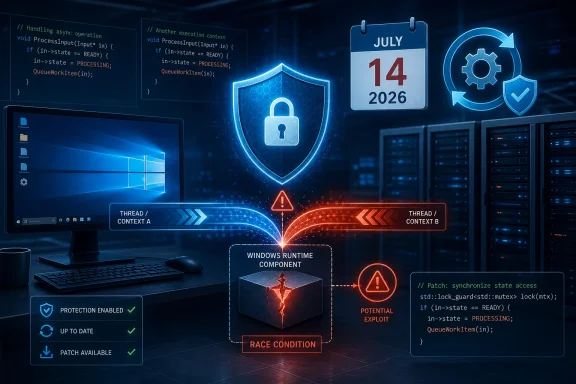 A Race Condition Opens the Path to Higher Privileges
Microsoft attributes CVE-2026-54125 to improper synchronization when Windows Runtime operations concurrently access a shared resource. The vulnerability is classified under CWE-362, Concurrent Execution Using Shared Resource with Improper Synchronization, and CWE-416, Use After Free.A race condition occurs when the security or stability of an operation depends on precisely timed events. If one thread releases or alters an object while another thread continues to use it, an attacker may be able to manipulate the resulting gap and redirect normal execution.
Microsoft’s description does not identify the affected Windows Runtime service, process, object, or API. No public proof-of-concept code or exploitation procedure had been documented when the advisory was published on July 14.
The available information nevertheless establishes several important boundaries. This is not a remote, unauthenticated entry point: an attacker must already be authorized to execute code locally and possess low-level privileges. The CVSS vector also indicates that exploitation does not depend on a victim opening a file, clicking a link, accepting a User Account Control prompt, or otherwise interacting with the attack.
That combination makes CVE-2026-54125 more useful as a second stage than as an initial compromise method. Malware delivered through phishing, a malicious installer, a compromised account, or another vulnerability could potentially use the flaw to move from an ordinary user context into a more powerful security context.
Successful elevation could then allow the attacker to disable defenses, access protected information, alter system configuration, establish persistence, or interfere with other accounts. The precise privilege level obtained has not been publicly specified, so claims that exploitation provides SYSTEM access should be treated as unconfirmed unless Microsoft or a vulnerability researcher publishes further details.
July’s Cumulative Updates Carry the Fix
CVE-2026-54125 affects a broad span of Windows releases. Microsoft’s CVE record lists Windows 11 versions 24H2, 25H2, and 26H1 alongside Windows 10 versions 1809, 21H2, and 22H2. Windows Server 2019, Windows Server 2022, and Windows Server 2025 are also affected, including relevant Server Core installations.For current Windows 11 systems, the principal patched build thresholds are:
- Windows 11 24H2 is protected at OS build 26100.8875 or later.
- Windows 11 25H2 is protected at OS build 26200.8875 or later.
- Windows 11 26H1 is protected at OS build 28000.2525 or later.
The server and Windows 10 update paths depend on the deployed release. Windows Server 2025 reaches build 26100.33158 through KB5099536, while Windows Server 2022 receives build 20348.5386 through KB5099540. Windows Server 2019 and Windows 10 Enterprise LTSC 2019 reach build 17763.9020 with KB5099538.
Windows 10 21H2 and 22H2 receive KB5099539, producing builds 19044.7548 and 19045.7548. Those entries require particular attention because ordinary Windows 10 22H2 support ended on October 14, 2025; eligible PCs must be enrolled in Extended Security Updates, while supported LTSC editions continue under their own servicing lifecycles.
The fixed build is the more reliable compliance check than the KB number alone. Servicing channels, replacement packages, and later cumulative updates can change which package appears in management consoles, but any later cumulative build should incorporate the security correction.
Administrators can verify the installed build by running
winver, checking the Windows Update history, querying endpoint-management inventory, or using PowerShell and established vulnerability-management tooling. A device remaining below its branch-specific fixed build should be considered exposed.High Impact Does Not Mean Remote Compromise
The vulnerability’s 7.8 score reflects the damage available after successful exploitation, not ease of access from the internet. Its CVSS vector isAV:L/AC:L/PR:L/UI:N/S:U/C:H/I:H/A:H: local attack vector, low attack complexity, low privileges required, no user interaction, unchanged scope, and high impact across confidentiality, integrity, and availability.For enterprise defenders, “local” should not be read as “low priority.” Elevation flaws are regularly paired with initial-access techniques that leave malicious code confined to a standard account. Once that boundary is crossed, credential theft, security-tool tampering, lateral-movement preparation, and durable persistence become considerably easier.
The low-complexity assessment also matters. It indicates that Microsoft does not expect exploitation to require unusually restrictive environmental conditions, although race-condition exploits can still require careful timing and may behave differently across processors, workloads, and virtualization configurations.
CISA’s Stakeholder-Specific Vulnerability Categorization data assigns the flaw a total technical impact while describing it as not readily automatable and recording no exploitation. That supports a measured response: CVE-2026-54125 is not currently presented as an emergency zero-day, but it is a credible privilege-escalation weakness with a vendor-confirmed fix.
The confidence question is therefore largely settled at the existence level. Microsoft, acting as the CVE Numbering Authority, has acknowledged the flaw, supplied the affected-product ranges, assigned two weakness classifications, and shipped corrected builds. What remains limited is public technical knowledge about the vulnerable code path and the mechanics required to trigger it.
Patch Rings Should Move, Not Stall
Organizations can keep their normal staged deployment process, but CVE-2026-54125 gives little justification for skipping July’s cumulative update. Internet exposure is not the controlling factor because exploitation takes place after code reaches a Windows endpoint or server.Initial deployment should prioritize shared workstations, remote desktop and virtual desktop environments, developer machines, administrative jump hosts, and servers where multiple users or applications execute under separate trust levels. Security teams should also look for endpoint alerts showing an ordinary process unexpectedly spawning privileged children, accessing protected credential material, modifying security services, or creating persistence shortly after suspicious code execution.
Restricting users to standard accounts remains valuable because it limits immediate administrative access, but it does not remove this vulnerability; the published attack requirements explicitly begin with a low-privileged local account. Application control through Windows Defender Application Control or AppLocker, endpoint detection and response, and credential protections can reduce opportunities for an attacker to reach or benefit from the vulnerable path.
Microsoft has not published a registry workaround, Group Policy mitigation, or component-disablement procedure for CVE-2026-54125. Installing the July 14 cumulative security update is the corrective action.
The next meaningful development will be any revision to Microsoft’s exploitability assessment or publication of technical research showing which Windows Runtime operation is vulnerable. Until then, administrators should treat build 26100.8875, 26200.8875, 28000.2525, and the corresponding server and Windows 10 builds as the minimum secure baselines for their respective July 2026 branches.
References
- Primary source: MSRC
Published: 2026-07-14T07:00:00-07:00
Security Update Guide - Microsoft Security Response Center
 msrc.microsoft.com
- Related coverage: aha.org
