

Microsoft has fixed CVE-2026-54987, an Important-rated Windows Overlay Filter elevation-of-privilege vulnerability carrying a CVSS 3.1 score of 7.8. The correction arrived in the July 14, 2026 Windows security updates and should be treated as a post-compromise risk: an attacker who already has limited local access could potentially use the flaw to obtain substantially greater control of a vulnerable PC or server.
The Microsoft Security Response Center confirmed the vulnerability through its Security Update Guide. Zero Day Initiative’s July Patch Tuesday review lists CVE-2026-54987 as neither publicly disclosed nor known to be exploited when the updates were released, while BleepingComputer identifies it as one of three Windows Overlay Filter vulnerabilities addressed this month.
That combination lowers the immediate emergency level, but it does not make the update optional. Local privilege-escalation flaws remain valuable links in attack chains because they can turn an initial foothold—obtained through phishing, stolen credentials, a malicious installer, or another vulnerability—into system-level access.
CVE-2026-54987 is not described as a remote, unauthenticated route into Windows. Its 7.8 CVSS score is characteristic of a vulnerability requiring an attacker to execute code locally with limited privileges before attempting escalation, without requiring additional interaction from the signed-in user.
The security boundary at issue is the Windows Overlay Filter, a file-system filtering component. Overlay technologies can present a combined view of files originating from different underlying locations or layers, allowing Windows to redirect or virtualize file operations without applications needing to understand the storage arrangement.
Microsoft has not published enough technical detail to identify the precise programming error, vulnerable function, or exploitation sequence behind CVE-2026-54987. There is no public proof-of-concept identified in Microsoft’s advisory, and the company has not described observed attacks using the flaw.
That limited disclosure is normal for newly patched Windows kernel and file-system vulnerabilities. Holding back implementation details gives organizations time to deploy updates before reverse engineering of the patch reveals the difference between vulnerable and corrected code.
The practical impact is nevertheless clear. Successful privilege escalation can allow an attacker to escape the restrictions of an ordinary account and operate with elevated rights, potentially including SYSTEM privileges depending on the underlying bug and exploit.
From that position, malicious code may be able to:
A vulnerability can be firmly confirmed by Microsoft while still having few public technical details. In this case, Microsoft has assigned the CVE, classified its impact, scored it, identified the affected Windows component, and shipped security updates. The existence of the flaw is therefore not speculative.
What remains uncertain outside Microsoft is how the Overlay Filter is manipulated, which objects or file operations trigger the vulnerable behavior, and what reliability constraints an exploit would face. A high-confidence vendor confirmation tells administrators that remediation is warranted; it does not mean working exploit code is already circulating.
The absence of known exploitation on July 14 is also a point-in-time assessment rather than a guarantee. Threat actors routinely examine cumulative updates to identify patched functions and reconstruct vulnerabilities, a process commonly called patch diffing. A local privilege-escalation bug can become more attractive once researchers determine how reliably it grants elevated execution across supported Windows builds.
That is why the first few weeks after Patch Tuesday matter. A flaw that was private at publication can become publicly understood after the update binaries receive sustained analysis.
Microsoft has not said whether the three issues share a root cause or were found during the same investigation. Their simultaneous release does, however, give administrators another reason not to isolate CVE-2026-54987 from the cumulative update that contains its fix.
This is particularly relevant when security teams use risk-based patching to prioritize only vulnerabilities with remote attack vectors. Filtering exclusively for remote code execution can leave a substantial collection of local escalation flaws unaddressed, even though those flaws are frequently required to complete real-world attack chains.
The July release is unusually large. BleepingComputer counted 570 vulnerabilities fixed by Microsoft that month, including 254 elevation-of-privilege issues, while Microsoft’s broader release data can produce different totals depending on whether third-party CVEs and product groupings are included. CVE-2026-54987 may not dominate that list, but its placement inside a foundational Windows component makes it relevant to endpoint and server teams.
The scale of July’s release also creates a deployment problem. Administrators must test for application and driver regressions without allowing the number of vulnerabilities to become an excuse for an open-ended delay.
For example, Windows 11 version 23H2 receives its July security fixes through KB5099414, which moves the operating system to build 22631.7376. Other Windows 11, Windows 10, and Windows Server releases have their own July packages and build numbers, so inventory data must be matched against Microsoft’s deployment information rather than assuming one KB applies across the estate.
Organizations using Windows Update for Business, Microsoft Intune, Windows Autopatch, Configuration Manager, or WSUS should verify installation through update compliance reporting. A successful policy assignment does not prove that a device downloaded the package, completed its restart, and reached the expected build.
Security teams should prioritize systems where an initial foothold would carry the greatest operational value. That includes administrator workstations, jump hosts, shared-session servers, developer machines, virtual desktop infrastructure, and systems used to manage identity, backups, virtualization, or endpoint security.
Internet exposure is not the main criterion for this vulnerability because the attack vector is local. The more useful questions are whether untrusted users can run code on the system, whether applications process content from outside the organization, and whether the machine stores credentials capable of unlocking other resources.
Detection should instead concentrate on behavior associated with privilege escalation. Useful signals include an ordinary user process unexpectedly spawning a SYSTEM-level child process, new services or scheduled tasks created shortly after suspicious code execution, attempts to stop Microsoft Defender, unexpected driver loading, and privileged changes originating from user-writable directories.
Microsoft Defender for Endpoint and other EDR platforms can help reconstruct the sequence around a suspected escalation. Analysts should preserve process trees, token and integrity-level information, file-system activity, service creation events, PowerShell logging, and authentication events rather than investigating a single alert in isolation.
Application control remains valuable before and after patching. Windows Defender Application Control or AppLocker can reduce the ability of an attacker to execute the first-stage payload needed to reach a local vulnerability, although neither should be presented as a substitute for Microsoft’s update.
Least privilege also limits opportunity. Users who cannot freely install software, launch unsigned tools, or access administrative credentials present a narrower path toward exploitation, but a successful kernel or privileged-component exploit is specifically designed to defeat the boundary that least privilege creates.
CVE-2026-54987 was not a known zero-day when Microsoft published the fix on July 14, 2026, and no public exploit was identified at release. Its confirmed 7.8-rated privilege-escalation impact, however, makes the July cumulative updates the meaningful security boundary: once researchers have had time to compare patched and unpatched Overlay Filter code, administrators will want vulnerable builds out of production rather than waiting for Microsoft’s exploitation assessment to change.
The Microsoft Security Response Center confirmed the vulnerability through its Security Update Guide. Zero Day Initiative’s July Patch Tuesday review lists CVE-2026-54987 as neither publicly disclosed nor known to be exploited when the updates were released, while BleepingComputer identifies it as one of three Windows Overlay Filter vulnerabilities addressed this month.
That combination lowers the immediate emergency level, but it does not make the update optional. Local privilege-escalation flaws remain valuable links in attack chains because they can turn an initial foothold—obtained through phishing, stolen credentials, a malicious installer, or another vulnerability—into system-level access.
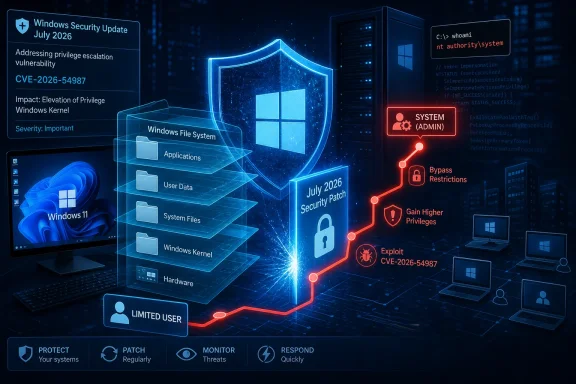 A Local Flaw With System-Wide Consequences
CVE-2026-54987 is not described as a remote, unauthenticated route into Windows. Its 7.8 CVSS score is characteristic of a vulnerability requiring an attacker to execute code locally with limited privileges before attempting escalation, without requiring additional interaction from the signed-in user.The security boundary at issue is the Windows Overlay Filter, a file-system filtering component. Overlay technologies can present a combined view of files originating from different underlying locations or layers, allowing Windows to redirect or virtualize file operations without applications needing to understand the storage arrangement.
Microsoft has not published enough technical detail to identify the precise programming error, vulnerable function, or exploitation sequence behind CVE-2026-54987. There is no public proof-of-concept identified in Microsoft’s advisory, and the company has not described observed attacks using the flaw.
That limited disclosure is normal for newly patched Windows kernel and file-system vulnerabilities. Holding back implementation details gives organizations time to deploy updates before reverse engineering of the patch reveals the difference between vulnerable and corrected code.
The practical impact is nevertheless clear. Successful privilege escalation can allow an attacker to escape the restrictions of an ordinary account and operate with elevated rights, potentially including SYSTEM privileges depending on the underlying bug and exploit.
From that position, malicious code may be able to:
- Disable or interfere with endpoint security software.
- Access files and registry locations unavailable to standard users.
- Create privileged accounts or scheduled tasks for persistence.
- Extract credentials and authentication material from the system.
- Tamper with services, drivers, or protected operating-system settings.
- Use the compromised endpoint as a staging point for lateral movement.
Confidence Is High Even While Technical Detail Is Low
The advisory text supplied with the CVE highlights the report confidence metric, which measures certainty that a vulnerability exists and confidence in the available technical information. That metric should not be confused with severity or exploitability.A vulnerability can be firmly confirmed by Microsoft while still having few public technical details. In this case, Microsoft has assigned the CVE, classified its impact, scored it, identified the affected Windows component, and shipped security updates. The existence of the flaw is therefore not speculative.
What remains uncertain outside Microsoft is how the Overlay Filter is manipulated, which objects or file operations trigger the vulnerable behavior, and what reliability constraints an exploit would face. A high-confidence vendor confirmation tells administrators that remediation is warranted; it does not mean working exploit code is already circulating.
The absence of known exploitation on July 14 is also a point-in-time assessment rather than a guarantee. Threat actors routinely examine cumulative updates to identify patched functions and reconstruct vulnerabilities, a process commonly called patch diffing. A local privilege-escalation bug can become more attractive once researchers determine how reliably it grants elevated execution across supported Windows builds.
That is why the first few weeks after Patch Tuesday matter. A flaw that was private at publication can become publicly understood after the update binaries receive sustained analysis.
July’s Overlay Filter Fixes Form a Small Cluster
CVE-2026-54987 did not arrive alone. Microsoft’s July release also includes CVE-2026-50435, another Important-rated, CVSS 7.8 elevation-of-privilege vulnerability in Windows Overlay Filter, and CVE-2026-50409, an Important-rated information-disclosure vulnerability scored at 5.5.Microsoft has not said whether the three issues share a root cause or were found during the same investigation. Their simultaneous release does, however, give administrators another reason not to isolate CVE-2026-54987 from the cumulative update that contains its fix.
This is particularly relevant when security teams use risk-based patching to prioritize only vulnerabilities with remote attack vectors. Filtering exclusively for remote code execution can leave a substantial collection of local escalation flaws unaddressed, even though those flaws are frequently required to complete real-world attack chains.
The July release is unusually large. BleepingComputer counted 570 vulnerabilities fixed by Microsoft that month, including 254 elevation-of-privilege issues, while Microsoft’s broader release data can produce different totals depending on whether third-party CVEs and product groupings are included. CVE-2026-54987 may not dominate that list, but its placement inside a foundational Windows component makes it relevant to endpoint and server teams.
The scale of July’s release also creates a deployment problem. Administrators must test for application and driver regressions without allowing the number of vulnerabilities to become an excuse for an open-ended delay.
Cumulative Updates Are the Supported Remediation
Microsoft distributes the Overlay Filter correction through the applicable July 2026 cumulative security update for each supported Windows release. Administrators do not need to locate a standalone CVE-specific installer; they need the current cumulative package approved for the operating-system version and architecture on each device.For example, Windows 11 version 23H2 receives its July security fixes through KB5099414, which moves the operating system to build 22631.7376. Other Windows 11, Windows 10, and Windows Server releases have their own July packages and build numbers, so inventory data must be matched against Microsoft’s deployment information rather than assuming one KB applies across the estate.
Organizations using Windows Update for Business, Microsoft Intune, Windows Autopatch, Configuration Manager, or WSUS should verify installation through update compliance reporting. A successful policy assignment does not prove that a device downloaded the package, completed its restart, and reached the expected build.
Security teams should prioritize systems where an initial foothold would carry the greatest operational value. That includes administrator workstations, jump hosts, shared-session servers, developer machines, virtual desktop infrastructure, and systems used to manage identity, backups, virtualization, or endpoint security.
Internet exposure is not the main criterion for this vulnerability because the attack vector is local. The more useful questions are whether untrusted users can run code on the system, whether applications process content from outside the organization, and whether the machine stores credentials capable of unlocking other resources.
Detection Must Focus on the Attack Chain
Microsoft has not published CVE-specific indicators of compromise for CVE-2026-54987. Defenders therefore cannot rely on a distinctive filename, event ID, or command line that proves this particular Overlay Filter vulnerability was exploited.Detection should instead concentrate on behavior associated with privilege escalation. Useful signals include an ordinary user process unexpectedly spawning a SYSTEM-level child process, new services or scheduled tasks created shortly after suspicious code execution, attempts to stop Microsoft Defender, unexpected driver loading, and privileged changes originating from user-writable directories.
Microsoft Defender for Endpoint and other EDR platforms can help reconstruct the sequence around a suspected escalation. Analysts should preserve process trees, token and integrity-level information, file-system activity, service creation events, PowerShell logging, and authentication events rather than investigating a single alert in isolation.
Application control remains valuable before and after patching. Windows Defender Application Control or AppLocker can reduce the ability of an attacker to execute the first-stage payload needed to reach a local vulnerability, although neither should be presented as a substitute for Microsoft’s update.
Least privilege also limits opportunity. Users who cannot freely install software, launch unsigned tools, or access administrative credentials present a narrower path toward exploitation, but a successful kernel or privileged-component exploit is specifically designed to defeat the boundary that least privilege creates.
CVE-2026-54987 was not a known zero-day when Microsoft published the fix on July 14, 2026, and no public exploit was identified at release. Its confirmed 7.8-rated privilege-escalation impact, however, makes the July cumulative updates the meaningful security boundary: once researchers have had time to compare patched and unpatched Overlay Filter code, administrators will want vulnerable builds out of production rather than waiting for Microsoft’s exploitation assessment to change.
References
- Primary source: MSRC
Published: 2026-07-14T07:00:00-07:00
Security Update Guide - Microsoft Security Response Center
 msrc.microsoft.com
