

Microsoft’s July 14 security updates fix CVE-2026-56181, a Windows Network Address Translation (NAT) spoofing vulnerability that could let an unauthenticated attacker on an adjacent network impersonate traffic or endpoints. The practical response is straightforward: patch Windows 11 24H2, 25H2, and 26H1 systems, along with Windows Server 2025 and Server Core, to the July 2026 cumulative-update level.
Microsoft’s Security Update Guide classifies the flaw as an origin validation error in Windows NAT. The National Vulnerability Database, which received the record from Microsoft on July 14, assigns a CVSS 3.1 score of 8.3—High—and describes the attacker position as adjacent-network rather than internet-wide. That distinction matters: this is not a drive-by web bug or a remotely wormable TCP/IP flaw, but it can be highly relevant on shared LANs, Wi-Fi segments, branch networks, virtual switches, and poorly separated server environments.
Microsoft’s public advisory does not provide a technical proof of concept, packet recipe, or a detailed explanation of which NAT path mishandles origin validation. That limits the useful certainty available to defenders today. It also means administrators should resist filling in the blanks with assumptions about Hyper-V, Internet Connection Sharing, WinNAT, Windows containers, VPN products, or any particular firewall configuration until Microsoft supplies more detail.
For Windows 11 installations, the patched builds are delivered through the July 14 cumulative updates:
There is one awkward detail in the initial CVE data: the affected-version range published through the NVD lists Windows 11 25H2 builds as beginning at 26200.0 but ending below 26100.8875. That comparison clearly does not line up numerically with 25H2’s 26200 build train. Administrators should not try to interpret that malformed range literally; use Microsoft’s cumulative-update KB and resulting build number as the deployment target.
For managed fleets, that means confirming successful installation rather than merely approving the July security rollup in WSUS, Microsoft Configuration Manager, Intune, or another patch platform. A device that has downloaded the package but remains pending restart is not at the protected build level.
That is an unusual combination worth treating seriously without overstating it. A high CVSS score here does not mean every laptop on a home network faces the same immediate danger as an internet-facing server exposed to remote code execution. Instead, the concern is whether an attacker can gain or share a suitable network vantage point and use the NAT component’s bad origin checks to make traffic appear to come from somewhere trusted.
The riskiest environments are likely to be those where network placement itself conveys trust. Think guest and corporate devices sharing Layer 2 infrastructure, lab networks with lightly controlled virtual networking, edge servers that perform NAT functions, remote-access staging networks, and multi-tenant or developer environments where virtual adapters and address translation are used extensively.
A conventional Windows endpoint whose NAT-related functionality is not actively exposed may have a lower operational priority than a Server 2025 host providing NAT for a lab, a gateway VM, or containerized workloads. But the OS-level scope means endpoint teams should still patch across the stated Windows versions; this is not an advisory that should be dismissed solely because a machine is not acting as a traditional router.
The vulnerability was published on July 14, 2026, alongside Microsoft’s monthly security releases. Neither Microsoft’s advisory nor the NVD record currently points to public disclosure before patch release, active exploitation, or publicly available exploit code. NVD has also marked the entry as awaiting enrichment, so additional metadata or analysis may appear later.
For now, the absence of a proof of concept should reduce panic, not reduce patch urgency. NAT is security-sensitive plumbing: it sits at a boundary where a mistaken assumption about where traffic originated can undermine controls that depend on address, interface, or network-zone trust.
Microsoft’s related support notice applies broadly, including Windows 10 LTSC editions, Windows 11 versions 23H2 through 26H1, and Windows Server through Server 2025. The company describes TDI as the underlying driver layer used for network communication, a legacy area where specialized security, inspection, monitoring, or connectivity software may still have hooks.
Microsoft has not publicly tied that TDI hardening change specifically to CVE-2026-56181. It would be a mistake to say the NAT spoofing fix is definitively responsible for every networking behavior change in the July release. Still, organizations with third-party network agents, older VPN stacks, packet-inspection products, bespoke transport drivers, or line-of-business software should include connectivity tests in their rollout plan.
The sensible sequence is to deploy promptly to a representative set of devices that reflects real network roles, confirm OS build and restart status, then validate application connectivity and any third-party network driver dependencies. For systems that supply NAT services, add tests for expected inbound and outbound flows, DNS resolution, VPN connectivity, container networking, and failover behavior.
The key milestone is not a future workaround or a configuration toggle. It is reaching the July 14 patched builds—then verifying that the systems which depend most heavily on Windows networking continue to behave as designed.
Microsoft’s Security Update Guide classifies the flaw as an origin validation error in Windows NAT. The National Vulnerability Database, which received the record from Microsoft on July 14, assigns a CVSS 3.1 score of 8.3—High—and describes the attacker position as adjacent-network rather than internet-wide. That distinction matters: this is not a drive-by web bug or a remotely wormable TCP/IP flaw, but it can be highly relevant on shared LANs, Wi-Fi segments, branch networks, virtual switches, and poorly separated server environments.
Microsoft’s public advisory does not provide a technical proof of concept, packet recipe, or a detailed explanation of which NAT path mishandles origin validation. That limits the useful certainty available to defenders today. It also means administrators should resist filling in the blanks with assumptions about Hyper-V, Internet Connection Sharing, WinNAT, Windows containers, VPN products, or any particular firewall configuration until Microsoft supplies more detail.
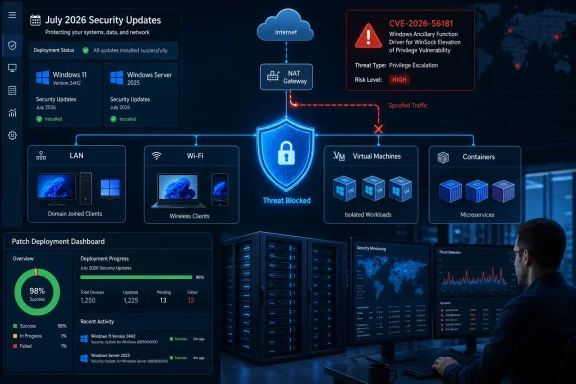 The July builds are the remediation line
For Windows 11 installations, the patched builds are delivered through the July 14 cumulative updates:- Windows 11 version 24H2 is remediated by KB5101650, bringing the OS to build 26100.8875.
- Windows 11 version 25H2 is remediated by KB5101650, bringing the OS to build 26200.8875.
- Windows 11 version 26H1 is remediated by KB5101649, bringing the OS to build 28000.2525.
- Windows Server 2025, including Server Core, is remediated by the July 14 update that reaches build 26100.33158.
There is one awkward detail in the initial CVE data: the affected-version range published through the NVD lists Windows 11 25H2 builds as beginning at 26200.0 but ending below 26100.8875. That comparison clearly does not line up numerically with 25H2’s 26200 build train. Administrators should not try to interpret that malformed range literally; use Microsoft’s cumulative-update KB and resulting build number as the deployment target.
For managed fleets, that means confirming successful installation rather than merely approving the July security rollup in WSUS, Microsoft Configuration Manager, Intune, or another patch platform. A device that has downloaded the package but remains pending restart is not at the protected build level.
Why “adjacent network” changes the risk calculation
The CVSS vector isAV:A/AC:H/PR:N/UI:N/S:C/C:H/I:H/A:H. In plain terms, Microsoft assesses that an attacker does not need an account or user interaction, but does need to be in a nearby network position and must overcome high attack complexity. Successful exploitation can cross a security boundary—hence the scope changed rating—and could have substantial confidentiality, integrity, and availability consequences.That is an unusual combination worth treating seriously without overstating it. A high CVSS score here does not mean every laptop on a home network faces the same immediate danger as an internet-facing server exposed to remote code execution. Instead, the concern is whether an attacker can gain or share a suitable network vantage point and use the NAT component’s bad origin checks to make traffic appear to come from somewhere trusted.
The riskiest environments are likely to be those where network placement itself conveys trust. Think guest and corporate devices sharing Layer 2 infrastructure, lab networks with lightly controlled virtual networking, edge servers that perform NAT functions, remote-access staging networks, and multi-tenant or developer environments where virtual adapters and address translation are used extensively.
A conventional Windows endpoint whose NAT-related functionality is not actively exposed may have a lower operational priority than a Server 2025 host providing NAT for a lab, a gateway VM, or containerized workloads. But the OS-level scope means endpoint teams should still patch across the stated Windows versions; this is not an advisory that should be dismissed solely because a machine is not acting as a traditional router.
No public exploitation signal—yet
CISA’s SSVC data added to the NVD entry records exploitation as “none” and automation as “no,” while describing the potential technical impact as total. That is useful triage information, but it is a snapshot from the disclosure date, not a guarantee that weaponization will not follow.The vulnerability was published on July 14, 2026, alongside Microsoft’s monthly security releases. Neither Microsoft’s advisory nor the NVD record currently points to public disclosure before patch release, active exploitation, or publicly available exploit code. NVD has also marked the entry as awaiting enrichment, so additional metadata or analysis may appear later.
For now, the absence of a proof of concept should reduce panic, not reduce patch urgency. NAT is security-sensitive plumbing: it sits at a boundary where a mistaken assumption about where traffic originated can undermine controls that depend on address, interface, or network-zone trust.
Test the networking change, not just the NAT fix
The July updates bring a separate compatibility consideration for IT teams. Microsoft says the updates enforce TDI transport registration requirements, and applications using sockets over unregistered third-party Transport Driver Interface transports may stop working after the security update is installed. Registered transports are not affected.Microsoft’s related support notice applies broadly, including Windows 10 LTSC editions, Windows 11 versions 23H2 through 26H1, and Windows Server through Server 2025. The company describes TDI as the underlying driver layer used for network communication, a legacy area where specialized security, inspection, monitoring, or connectivity software may still have hooks.
Microsoft has not publicly tied that TDI hardening change specifically to CVE-2026-56181. It would be a mistake to say the NAT spoofing fix is definitively responsible for every networking behavior change in the July release. Still, organizations with third-party network agents, older VPN stacks, packet-inspection products, bespoke transport drivers, or line-of-business software should include connectivity tests in their rollout plan.
The sensible sequence is to deploy promptly to a representative set of devices that reflects real network roles, confirm OS build and restart status, then validate application connectivity and any third-party network driver dependencies. For systems that supply NAT services, add tests for expected inbound and outbound flows, DNS resolution, VPN connectivity, container networking, and failover behavior.
The key milestone is not a future workaround or a configuration toggle. It is reaching the July 14 patched builds—then verifying that the systems which depend most heavily on Windows networking continue to behave as designed.
References
- Primary source: MSRC
Published: 2026-07-14T07:00:00-07:00
Security Update Guide - Microsoft Security Response Center
 msrc.microsoft.com
