

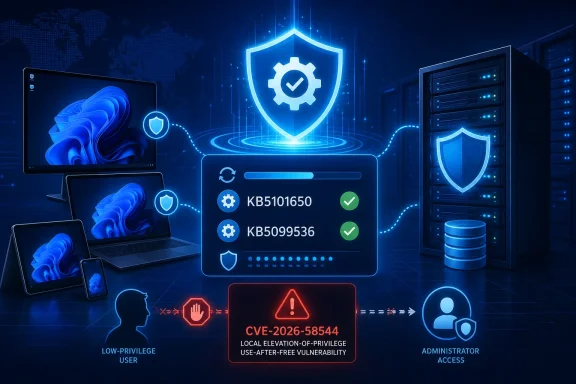
Microsoft’s Security Update Guide describes the issue narrowly: an authorized attacker needs local access and low-level privileges already established on the target. That makes this a post-compromise concern rather than a route for an unauthenticated attacker to break into a Windows system from the internet. But in an enterprise intrusion, the difference matters less than it sounds: local privilege escalation is often the next move after a phishing payload, stolen VPN credential, malicious installer, or foothold obtained through a separate vulnerability.
The immediate action is straightforward. Install the July 2026 cumulative update appropriate to the affected platform, then confirm the device has reached the corrected build.
July’s cumulative updates carry the fix
According to Microsoft’s affected-product data, CVE-2026-58544 applies to current Windows 11 and Windows Server 2025 releases:
| Product | Fixed build | July 14 update |
|---|---|---|
| Windows 11, version 24H2 | 26100.8875 | KB5101650 |
| Windows 11, version 25H2 | 26200.8875 | KB5101650 |
| Windows 11, version 26H1 | 28000.2525 | KB5101649 |
| Windows Server 2025, including Server Core | 26100.33158 | KB5099536 |
Microsoft’s KB5101650 documentation confirms that Windows 11 24H2 moves to build 26100.8875 and Windows 11 25H2 to build 26200.8875. Microsoft’s KB5099536 release notes likewise identify build 26100.33158 as the July security baseline for Windows Server 2025.
For managed environments, that means checking Windows Update for Business, WSUS, Configuration Manager, and endpoint-management deployment rings rather than treating a successful download as proof of remediation. Devices can be offered an update but remain exposed until the cumulative update completes and the required restart occurs.
Windows Server container users have a separate task. Microsoft’s July Server Core, Nano Server, and Windows Server 2025 container images were rebuilt at version 10.0.26100.33158, carrying KB5099536. Updating the host alone does not refresh containers already built from an older vulnerable base image; teams need to pull the current image tag, rebuild dependent images, and redeploy workloads.
A local flaw with total impact after exploitation
The CVSS vector explains why Microsoft’s score sits at 7.0 rather than the higher values often associated with remotely reachable Windows bugs. Exploitation requires local access, low privileges, no user interaction, and high attack complexity. NIST’s National Vulnerability Database records the vulnerability as CWE-416, the standard classification for a use-after-free condition.
A use-after-free bug occurs when software continues using memory after that memory has been released or reassigned. Whether that becomes reliable privilege escalation depends on control of memory layout and other environmental conditions, which helps explain the high-complexity assessment. Microsoft has not published proof-of-concept code, technical exploitation details, or a workaround.
Still, the potential outcome is serious. The CVSS metrics assign high impact to confidentiality, integrity, and availability. In practical Windows terms, a successful attacker could potentially move from an ordinary user context toward administrative or SYSTEM-level control, depending on the service boundary involved and the exploit’s reliability.
That is why “local only” should not be read as “low priority.” A standard user account on a shared workstation, a compromised service account on an application server, or an attacker operating from a remote-management session may all satisfy the initial-access requirement. Least-privilege controls, application allowlisting, attack-surface reduction rules, and endpoint detection remain useful layers, but none replaces installing the fix.
Do not mistake the CVSS score for the whole decision
The July 2026 review from Trend Micro’s Zero Day Initiative lists CVE-2026-58544 as Important, with no known public disclosure and no known active exploitation. NVD also records CISA’s SSVC assessment as exploitation “none,” automation “no,” and technical impact “total.”
Those are meaningful risk signals, but they are not a reason to defer indefinitely. “No known exploitation” means that Microsoft, CISA, and public reporting had not identified active abuse as of July 14; it does not guarantee attackers have not privately researched the bug. Likewise, “not automatable” suggests exploitation is not expected to become a one-click or broad scanning operation, not that a determined intruder cannot use it after gaining a foothold.
The sensible priority is therefore contextual:
- Internet-facing systems are not directly exposed by this specific flaw, but servers that host sensitive workloads should receive the update through the normal expedited security ring.
- Shared workstations, jump hosts, developer endpoints, and systems used by administrators deserve particular attention because an initial low-privilege compromise can be more valuable there.
- Organizations that cannot patch immediately should focus on detecting unusual local process launches, unexpected administrative-token creation, suspicious service manipulation, and lateral movement from accounts that should not administer the device.
The lack of a published workaround also narrows the choices. Microsoft’s patch is the mitigation; operational controls can reduce the chance of reaching the vulnerable code from an already compromised endpoint, but they do not remove the underlying defect.
The version data deserves a careful read
One unusual detail in Microsoft’s CVE product data is its reported affected range for Windows 11 version 25H2: it references builds beginning with 10.0.26200.0 but a fixed threshold written as 10.0.26100.8875. That comparison crosses the 24H2 and 25H2 build branches and can look inconsistent if read literally.
Microsoft’s July 14 KB5101650 release documentation resolves the operational question: the shared cumulative update brings 24H2 to 26100.8875 and 25H2 to 26200.8875. Administrators should use the OS build displayed by winver, Settings, inventory tooling, or their update-compliance platform—not a literal cross-branch comparison in the CVE metadata—to validate that Windows 11 devices are patched.
That distinction is particularly relevant for enterprises using feature-update enablement packages and mixed 24H2/25H2 fleets. Both releases share the KB5101650 servicing event, but their final build numbers remain different.
CVE-2026-58544 is not the headline-grabbing kind of Windows vulnerability that demands an emergency network shutdown. It is the more common and operationally important kind: a flaw that can turn a minor endpoint compromise into a much more consequential one. For Windows 11 24H2 and 25H2, the target is KB5101650; for Windows Server 2025, it is KB5099536. The next milestone is simple—verify those builds are actually installed across the fleet.