

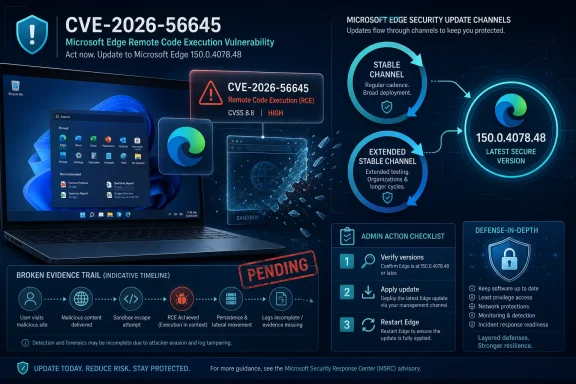
Microsoft has listed CVE-2026-56645 as a Microsoft Edge, Chromium-based, remote code execution vulnerability in its Security Update Guide, while Edge security release notes show the browser received Stable channel security updates on July 2, 2026, with CVE identifiers still pending publication. That gap is the story. The bug may be real enough to merit an MSRC entry, but the public evidence trail is still thin enough that defenders should treat it as a confirmed patch-management event rather than a fully explained exploit case. For Windows users and enterprise admins, the practical answer is simple: update Edge first, argue about root cause later.
The CVE label does important work. It tells administrators that Microsoft has acknowledged a discrete vulnerability in Edge, that the issue has security relevance, and that the affected technology is the Chromium-based browser now embedded deeply across Windows estates. But the label does not, by itself, tell us whether attackers are exploiting the flaw, whether the root cause sits in upstream Chromium or Microsoft’s Edge-specific code, or whether exploitation requires a particularly brittle chain of conditions.
That distinction matters because remote code execution in a browser is one of those phrases that compresses too much into too few words. In the worst version, a malicious page gives an attacker code execution in the browser process and a usable path toward escaping containment. In the more common version, the attacker still needs user interaction, a renderer bug, favorable mitigations, and sometimes a second vulnerability to reach the operating system in a meaningful way.
Microsoft’s own Edge security release notes, maintained on Microsoft Learn, show a rapid cadence of browser security updates through late June and July 2026. The July 2 entry says Edge Stable version 150.0.4078.48 incorporates the latest security updates from the Chromium project, while also noting that CVEs will be added as soon as available. That is not unusual in browser land, where fixes often ship before every identifier and advisory field is fully populated.
It is, however, a reminder that CVE pages are not miniature postmortems. They are operational signals. MSRC’s Security Update Guide is built to move patching decisions, not satisfy every technical curiosity on disclosure day.
That is especially true for Chromium-based Edge. Microsoft inherits a large volume of upstream Chromium security work, but it also ships Microsoft-specific integration, identity, sync, enterprise policy, PDF handling, SmartScreen flows, update plumbing, and Windows-facing behaviors. When a Microsoft Edge-specific CVE appears, admins cannot assume it is simply “Chrome with a different icon.”
The update trail reinforces the point. Microsoft Learn lists frequent Stable, Extended Stable, Android, and iOS Edge security releases across 2026, including several entries that explicitly call out Edge-specific security fixes. On July 2, Microsoft pushed Edge Stable 150.0.4078.48; days earlier, it shipped 149.0.4022.98 and 149.0.4022.96 in late June. That tempo is the modern browser security model: constant movement, small windows of exposure, and little patience for quarterly patch rituals.
For enterprises, this is why Edge update controls deserve the same seriousness as Windows Update rings. A workstation can be “fully patched” by operating-system standards and still be carrying a vulnerable browser runtime if update policy, network filtering, or application control prevents Edge from moving.
Report confidence is the difference between a rumor, a plausible research finding, and a vendor-acknowledged defect. When Microsoft publishes a CVE page for Edge, confidence in the existence of the issue rises because the vendor responsible for the affected product is putting its name behind the advisory. But confidence in the mechanics of exploitation may still be much lower if the advisory does not disclose root cause, proof-of-concept details, exploit prerequisites, or affected code paths.
That nuance is useful for defenders. High confidence in existence means patching should proceed. Lower confidence in public technical detail means defenders should be careful about overfitting detections to speculative write-ups or third-party summaries. A SIEM rule built around a guessed JavaScript engine trigger is much weaker than inventorying Edge versions and enforcing update compliance.
It also matters for attackers. Sparse advisory language does not prevent exploitation, but it slows copycat activity when no working exploit or root-cause analysis is public. Conversely, once credible technical research appears, the risk profile can change quickly even if Microsoft’s original severity rating stays the same.
A browser RCE can still be devastating in targeted attacks. The browser is where users authenticate, open documents, approve prompts, paste credentials, and interact with cloud applications. Even code execution constrained inside a renderer can be useful if it enables data theft, session abuse, or a foothold for a second-stage exploit. The modern endpoint is less a castle than a crowded airport terminal, and the browser is the arrivals hall.
But defenders should resist the reflex to describe every Edge RCE as instant machine compromise. Microsoft has not publicly provided enough detail on CVE-2026-56645, based on the visible advisory path, to say whether exploitation escapes the browser sandbox, whether it requires a malicious page, or whether mitigations such as enhanced security mode materially reduce exposure. Those distinctions are not pedantry; they determine urgency, compensating controls, and incident-response scope.
The right posture is therefore deliberately boring. Patch Edge. Verify the version. Confirm update policy health. Watch for MSRC revisions. Do not wait for exploit code to prove that a browser RCE deserves attention.
This creates a strange public timeline. Sometimes Google, Chromium, Microsoft, and downstream vendors reveal overlapping pieces of the same risk at different speeds. Sometimes a CVE appears in one place before another release note catches up. Sometimes a browser update says CVEs will be added later, which can look sloppy to outsiders but is often a reflection of coordinated disclosure moving faster than documentation.
For admins, the lesson is not to become amateur CVE archaeologists. The lesson is to keep Edge on a supported update channel and monitor the official Microsoft release notes and MSRC guidance. If a security release lands and CVEs are pending, the absence of a complete list should not be interpreted as absence of risk.
This is particularly true in managed environments that delay browser updates for compatibility testing. The web platform is now an attack surface that changes weekly. A seven-day delay may be reasonable in some app-heavy enterprises; a thirty-day delay can become a bet that no one weaponizes a bug before the change window opens.
CVE-2026-56645 should push administrators back to basics. Do you know which Edge versions are running across your fleet? Can you distinguish Stable from Extended Stable? Are updates blocked by proxy inspection, application control, golden images, or stale VDI pools? Are WebView2 runtimes being updated where line-of-business applications depend on them?
The messy cases are usually not the obvious laptops. They are kiosks, jump boxes, conference-room PCs, shared workstations, lab machines, and nonpersistent desktops that reset to a vulnerable image every morning. Browser RCE risk loves forgotten endpoints because those systems often have relaxed monitoring and real user interaction.
Security teams should also avoid assuming that “we use Chrome” means Edge risk disappears. Edge remains present on Windows, can be invoked by links, embedded experiences, help content, WebView2-based applications, and user preference drift. In Windows environments, Edge is part of the substrate even when it is not the favored browser.
MSRC advisories often land in the middle of that tension. The public page gives the official existence proof, product impact, and remediation path. It may not give exploit primitives, vulnerable functions, crash traces, or reproduction steps. That can be frustrating for defenders trying to prioritize thousands of CVEs, but it is also a deliberate choice in an ecosystem where browser bugs can move from patch diff to exploit in short order.
The right criticism is not that Microsoft withholds exploit-ready detail. The stronger criticism is that organizations still rely too heavily on advisory prose rather than update compliance. If your Edge fleet is automatically current, a sparse advisory is less of a crisis. If your patching depends on a human reading every CVE and ranking it by gut feel, sparse detail becomes a dangerous bottleneck.
This is where report confidence earns its place. It does not tell you everything, but it tells you whether the vulnerability is vendor-acknowledged and whether available details are credible. For CVE-2026-56645, the Microsoft-origin signal is enough to justify action even if the public technical story remains incomplete.
The challenge is that Edge’s own release notes do not yet visibly tie CVE-2026-56645 to that July 2 build in the public text available at publication time. That leaves a narrow but important uncertainty: the CVE page exists, but the release-note mapping may still be catching up. Microsoft’s July 2 note explicitly says CVEs will be added as soon as available, which is the kind of documentation lag security teams see routinely with browser releases.
In practice, that uncertainty should not delay remediation. If you are below the latest Stable build, update. If you are on Extended Stable, confirm the corresponding security release for that channel. If you manage mobile Edge, check the Android and iOS entries separately because Microsoft’s release notes list mobile versions on their own cadence.
The version-first approach also avoids the trap of arguing from CVSS alone. A high-severity RCE with no public exploit may be less urgent than an actively exploited medium bug in a particular environment, but a current browser closes both debates. Browser patching is one of the few areas where “just update” is not lazy advice; it is the operating model.
But it should not be used as a reason to defer updates for CVE-2026-56645. Microsoft has not publicly said, in the visible release-note material, that enhanced security mode mitigates this specific CVE. Even when enhanced security mode helps against a class of browser exploitation, it is not a universal shield against every Edge-specific flaw or every post-exploitation path.
The more useful way to think about it is defense in depth. Keep Edge updated, then consider enhanced security mode for users who browse untrusted sites, handle sensitive data, or face elevated targeting. For administrators, that means testing compatibility with internal web apps rather than discovering breakage during an incident.
Security tooling should take the same layered view. Endpoint protection, exploit prevention, DNS filtering, web isolation, and conditional access can all reduce risk, but none of them replace the vendor fix. The browser changes too quickly for perimeter controls to be the only line of defense.
That lag is where vulnerabilities live. Microsoft can ship a patched Edge build, MSRC can publish a CVE, and management consoles can show an update available, yet the exploitable process remains in memory until the browser restarts. In consumer contexts, Edge eventually nags and restarts. In enterprise contexts, the social contract around forced restarts is much more political.
CVE-2026-56645 is a useful reminder that browser update success should be measured as running patched code, not merely downloading patched bits. Inventory should distinguish installed version from active process version where possible. Help desks should know how to tell users to relaunch Edge without sounding like they are asking for a reboot of the entire machine.
The same concern applies to WebView2 applications. If an app embeds the runtime and stays open continuously, patch availability does not necessarily mean the vulnerable component is no longer loaded. For organizations with always-on desktop apps, that detail can matter more than the headline CVE score.
The most concrete takeaways are also the least glamorous:
 Microsoft Has Named the Risk Before Explaining the Machine
The CVE label does important work. It tells administrators that Microsoft has acknowledged a discrete vulnerability in Edge, that the issue has security relevance, and that the affected technology is the Chromium-based browser now embedded deeply across Windows estates. But the label does not, by itself, tell us whether attackers are exploiting the flaw, whether the root cause sits in upstream Chromium or Microsoft’s Edge-specific code, or whether exploitation requires a particularly brittle chain of conditions.That distinction matters because remote code execution in a browser is one of those phrases that compresses too much into too few words. In the worst version, a malicious page gives an attacker code execution in the browser process and a usable path toward escaping containment. In the more common version, the attacker still needs user interaction, a renderer bug, favorable mitigations, and sometimes a second vulnerability to reach the operating system in a meaningful way.
Microsoft’s own Edge security release notes, maintained on Microsoft Learn, show a rapid cadence of browser security updates through late June and July 2026. The July 2 entry says Edge Stable version 150.0.4078.48 incorporates the latest security updates from the Chromium project, while also noting that CVEs will be added as soon as available. That is not unusual in browser land, where fixes often ship before every identifier and advisory field is fully populated.
It is, however, a reminder that CVE pages are not miniature postmortems. They are operational signals. MSRC’s Security Update Guide is built to move patching decisions, not satisfy every technical curiosity on disclosure day.
The Browser Patch Is Now the Windows Patch
Edge is not just another application installed on Windows. It is the default browser on Windows 11, a WebView2 runtime anchor for countless desktop apps, and a managed enterprise component with its own update channels, policies, and security baselines. A vulnerability in Edge therefore lands somewhere between “browser bug” and “platform hygiene problem.”That is especially true for Chromium-based Edge. Microsoft inherits a large volume of upstream Chromium security work, but it also ships Microsoft-specific integration, identity, sync, enterprise policy, PDF handling, SmartScreen flows, update plumbing, and Windows-facing behaviors. When a Microsoft Edge-specific CVE appears, admins cannot assume it is simply “Chrome with a different icon.”
The update trail reinforces the point. Microsoft Learn lists frequent Stable, Extended Stable, Android, and iOS Edge security releases across 2026, including several entries that explicitly call out Edge-specific security fixes. On July 2, Microsoft pushed Edge Stable 150.0.4078.48; days earlier, it shipped 149.0.4022.98 and 149.0.4022.96 in late June. That tempo is the modern browser security model: constant movement, small windows of exposure, and little patience for quarterly patch rituals.
For enterprises, this is why Edge update controls deserve the same seriousness as Windows Update rings. A workstation can be “fully patched” by operating-system standards and still be carrying a vulnerable browser runtime if update policy, network filtering, or application control prevents Edge from moving.
Report Confidence Is the Quiet Metric That Decides How Loudly to Shout
The user-supplied MSRC text describes a confidence metric: how certain we are that the vulnerability exists and how credible the known technical details are. It is easy to skip that field in favor of CVSS, exploitability, or severity. That is a mistake.Report confidence is the difference between a rumor, a plausible research finding, and a vendor-acknowledged defect. When Microsoft publishes a CVE page for Edge, confidence in the existence of the issue rises because the vendor responsible for the affected product is putting its name behind the advisory. But confidence in the mechanics of exploitation may still be much lower if the advisory does not disclose root cause, proof-of-concept details, exploit prerequisites, or affected code paths.
That nuance is useful for defenders. High confidence in existence means patching should proceed. Lower confidence in public technical detail means defenders should be careful about overfitting detections to speculative write-ups or third-party summaries. A SIEM rule built around a guessed JavaScript engine trigger is much weaker than inventorying Edge versions and enforcing update compliance.
It also matters for attackers. Sparse advisory language does not prevent exploitation, but it slows copycat activity when no working exploit or root-cause analysis is public. Conversely, once credible technical research appears, the risk profile can change quickly even if Microsoft’s original severity rating stays the same.
RCE Is a Severity Class, Not a Complete Threat Model
Remote code execution sounds final. In a browser, it is often only the first stage of a longer fight against sandboxing, site isolation, memory protections, exploit mitigations, and endpoint detection. That does not make it harmless; it makes it more operationally complex.A browser RCE can still be devastating in targeted attacks. The browser is where users authenticate, open documents, approve prompts, paste credentials, and interact with cloud applications. Even code execution constrained inside a renderer can be useful if it enables data theft, session abuse, or a foothold for a second-stage exploit. The modern endpoint is less a castle than a crowded airport terminal, and the browser is the arrivals hall.
But defenders should resist the reflex to describe every Edge RCE as instant machine compromise. Microsoft has not publicly provided enough detail on CVE-2026-56645, based on the visible advisory path, to say whether exploitation escapes the browser sandbox, whether it requires a malicious page, or whether mitigations such as enhanced security mode materially reduce exposure. Those distinctions are not pedantry; they determine urgency, compensating controls, and incident-response scope.
The right posture is therefore deliberately boring. Patch Edge. Verify the version. Confirm update policy health. Watch for MSRC revisions. Do not wait for exploit code to prove that a browser RCE deserves attention.
The Chromium Supply Chain Makes Speed More Important Than Drama
Microsoft Edge’s security story is inseparable from Chromium’s. Microsoft Learn repeatedly describes Edge security updates as incorporating the latest security updates from the Chromium project. That dependency is a strength when upstream fixes move quickly, but it also means Edge inherits the disclosure rhythm of a massive open-source browser engine used across the industry.This creates a strange public timeline. Sometimes Google, Chromium, Microsoft, and downstream vendors reveal overlapping pieces of the same risk at different speeds. Sometimes a CVE appears in one place before another release note catches up. Sometimes a browser update says CVEs will be added later, which can look sloppy to outsiders but is often a reflection of coordinated disclosure moving faster than documentation.
For admins, the lesson is not to become amateur CVE archaeologists. The lesson is to keep Edge on a supported update channel and monitor the official Microsoft release notes and MSRC guidance. If a security release lands and CVEs are pending, the absence of a complete list should not be interpreted as absence of risk.
This is particularly true in managed environments that delay browser updates for compatibility testing. The web platform is now an attack surface that changes weekly. A seven-day delay may be reasonable in some app-heavy enterprises; a thirty-day delay can become a bet that no one weaponizes a bug before the change window opens.
Edge’s Enterprise Controls Are Only Useful If Someone Checks Them
Microsoft gives organizations a mature set of tools for managing Edge updates: policies, update rings, Stable and Extended Stable channels, and integration with broader endpoint management. The problem is not that controls do not exist. The problem is that browser patching is still too often treated as a consumer-app nuisance rather than an enterprise security dependency.CVE-2026-56645 should push administrators back to basics. Do you know which Edge versions are running across your fleet? Can you distinguish Stable from Extended Stable? Are updates blocked by proxy inspection, application control, golden images, or stale VDI pools? Are WebView2 runtimes being updated where line-of-business applications depend on them?
The messy cases are usually not the obvious laptops. They are kiosks, jump boxes, conference-room PCs, shared workstations, lab machines, and nonpersistent desktops that reset to a vulnerable image every morning. Browser RCE risk loves forgotten endpoints because those systems often have relaxed monitoring and real user interaction.
Security teams should also avoid assuming that “we use Chrome” means Edge risk disappears. Edge remains present on Windows, can be invoked by links, embedded experiences, help content, WebView2-based applications, and user preference drift. In Windows environments, Edge is part of the substrate even when it is not the favored browser.
Sparse Advisories Are a Feature and a Frustration
There is a persistent tension in vulnerability disclosure. Defenders want enough information to assess risk and build detections. Vendors want to avoid handing attackers a roadmap before patches have propagated. Researchers want credit and technical clarity. Users want all of this translated into whether they need to restart the browser before lunch.MSRC advisories often land in the middle of that tension. The public page gives the official existence proof, product impact, and remediation path. It may not give exploit primitives, vulnerable functions, crash traces, or reproduction steps. That can be frustrating for defenders trying to prioritize thousands of CVEs, but it is also a deliberate choice in an ecosystem where browser bugs can move from patch diff to exploit in short order.
The right criticism is not that Microsoft withholds exploit-ready detail. The stronger criticism is that organizations still rely too heavily on advisory prose rather than update compliance. If your Edge fleet is automatically current, a sparse advisory is less of a crisis. If your patching depends on a human reading every CVE and ranking it by gut feel, sparse detail becomes a dangerous bottleneck.
This is where report confidence earns its place. It does not tell you everything, but it tells you whether the vulnerability is vendor-acknowledged and whether available details are credible. For CVE-2026-56645, the Microsoft-origin signal is enough to justify action even if the public technical story remains incomplete.
The Version Number Is the Evidence That Matters Most
For WindowsForum readers, the most useful artifact is not the CVE prose. It is the installed version of Edge. Microsoft Learn says the latest Edge Stable release as of July 2, 2026 is 150.0.4078.48, and that release incorporates the latest Chromium security updates. That version number gives admins something concrete to audit.The challenge is that Edge’s own release notes do not yet visibly tie CVE-2026-56645 to that July 2 build in the public text available at publication time. That leaves a narrow but important uncertainty: the CVE page exists, but the release-note mapping may still be catching up. Microsoft’s July 2 note explicitly says CVEs will be added as soon as available, which is the kind of documentation lag security teams see routinely with browser releases.
In practice, that uncertainty should not delay remediation. If you are below the latest Stable build, update. If you are on Extended Stable, confirm the corresponding security release for that channel. If you manage mobile Edge, check the Android and iOS entries separately because Microsoft’s release notes list mobile versions on their own cadence.
The version-first approach also avoids the trap of arguing from CVSS alone. A high-severity RCE with no public exploit may be less urgent than an actively exploited medium bug in a particular environment, but a current browser closes both debates. Browser patching is one of the few areas where “just update” is not lazy advice; it is the operating model.
Enhanced Security Mode Is a Mitigation, Not a Patch Substitute
Microsoft has previously used Edge release notes to highlight enhanced security mode for some exploited Chromium vulnerabilities. That feature can disable or reduce certain just-in-time compilation behaviors and apply additional protections on unfamiliar sites, depending on configuration. It is a meaningful layer for high-risk users and organizations with appetite for stricter browsing controls.But it should not be used as a reason to defer updates for CVE-2026-56645. Microsoft has not publicly said, in the visible release-note material, that enhanced security mode mitigates this specific CVE. Even when enhanced security mode helps against a class of browser exploitation, it is not a universal shield against every Edge-specific flaw or every post-exploitation path.
The more useful way to think about it is defense in depth. Keep Edge updated, then consider enhanced security mode for users who browse untrusted sites, handle sensitive data, or face elevated targeting. For administrators, that means testing compatibility with internal web apps rather than discovering breakage during an incident.
Security tooling should take the same layered view. Endpoint protection, exploit prevention, DNS filtering, web isolation, and conditional access can all reduce risk, but none of them replace the vendor fix. The browser changes too quickly for perimeter controls to be the only line of defense.
The Real Risk Is the Lag Between Release and Restart
Modern browsers update quietly, but they do not always finish the job quietly. Users keep windows open for days. Virtual desktops suspend sessions. Kiosks run in locked-down modes. Some enterprises disable automatic updates to preserve compatibility and then forget that they have accepted responsibility for every emergency release.That lag is where vulnerabilities live. Microsoft can ship a patched Edge build, MSRC can publish a CVE, and management consoles can show an update available, yet the exploitable process remains in memory until the browser restarts. In consumer contexts, Edge eventually nags and restarts. In enterprise contexts, the social contract around forced restarts is much more political.
CVE-2026-56645 is a useful reminder that browser update success should be measured as running patched code, not merely downloading patched bits. Inventory should distinguish installed version from active process version where possible. Help desks should know how to tell users to relaunch Edge without sounding like they are asking for a reboot of the entire machine.
The same concern applies to WebView2 applications. If an app embeds the runtime and stays open continuously, patch availability does not necessarily mean the vulnerable component is no longer loaded. For organizations with always-on desktop apps, that detail can matter more than the headline CVE score.
The Signal for Windows Admins Is Narrow but Actionable
The public record around CVE-2026-56645 is not rich enough to support dramatic claims about active exploitation, exploit chains, or root-cause specifics. It is rich enough to support an operational decision: treat the Microsoft advisory as credible, update Edge, and watch for revisions. That is not a hedge; it is the correct response to a vendor-acknowledged browser RCE with incomplete public technical detail.The most concrete takeaways are also the least glamorous:
- Microsoft has listed CVE-2026-56645 as a remote code execution vulnerability affecting Chromium-based Microsoft Edge.
- Microsoft’s Edge security release notes show Edge Stable version 150.0.4078.48 was released on July 2, 2026 with the latest Chromium security updates, while CVE details were still marked as pending.
- Administrators should verify actual Edge versions across endpoints instead of relying on general Windows patch status.
- Extended Stable, mobile Edge, kiosk, VDI, and WebView2-dependent systems need separate attention because their update behavior can differ from ordinary desktop browsing.
- The current public information supports urgent patch validation, but it does not yet support confident claims about active exploitation or the vulnerability’s root cause.
- Enhanced security settings may reduce browser exploit risk in general, but they should not be treated as a substitute for applying the relevant Edge security update.
References
- Primary source: MSRC
Published: 2026-07-03T07:00:00-07:00
Security Update Guide - Microsoft Security Response Center
 msrc.microsoft.com
- Related coverage: thehackerwire.com
CVE-2026-45495: Microsoft Edge (Chromium-based) Remote Code Execution Vul… – TheHackerWire
{ "title": "Microsoft Edge (Chromium) RCE via CVE-2026-45495", "content": "SummaryCVE-2026-45495 details a Remote Code Execution (RCE) vulnerability affectin...www.thehackerwire.com
- Related coverage: hkcert.org
Microsoft Edge Multiple Vulnerabilities
Multiple vulnerabilities were identified in Microsoft Edge. A remote attacker could exploit some of these vulnerabilities to trigger remote code execution, denial of service condition, elevation of privilege, security restriction bypass and sensitive infowww.hkcert.org - Related coverage: cve.circl.lu
Vulnerability-Lookup
Vulnerability-Lookup - Fast vulnerability lookup correlation from different sources.cve.circl.lu - Related coverage: dbugs.ptsecurity.com
CVE-2026-45495 — DoS in Microsoft Edge | dbugs
Details on CVE-2026-45495: DoS in Microsoft Edge. Includes CVSS score, affected versions, and references.dbugs.ptsecurity.com - Related coverage: sentinelone.com
CVE-2026-45495: Microsoft Edge Chromium RCE Vulnerability
CVE-2026-45495 is a remote code execution vulnerability in Microsoft Edge Chromium. Learn about its impact, affected versions, and mitigation methods.www.sentinelone.com
- Related coverage: dataproof.co.za
- Related coverage: rapid7.com
Rapid7 Vulnerability Database
Rapid7's VulnDB is curated repository of vetted computer software exploits and exploitable vulnerabilities.www.rapid7.com - Related coverage: thecybrdef.com
Microsoft Edge RCE Flaw CVE-2026-45495 Puts Millions at Risk
A high-severity remote code execution vulnerability in Microsoft Edge is actively rated "Exploitation More Likely," putting hundreds of millions of users at immediate risk if they haven't patched to the latest browser version.thecybrdef.com - Related coverage: www2.gov.bc.ca
- Related coverage: mphasis.com
- Related coverage: hivepro.com
