

Microsoft released CVE-2026-57985 on July 3, 2026, describing it as an Important-severity Microsoft Edge Chromium-based remote code execution vulnerability caused by improper input validation and fixed in Edge version 150.0.4078.48, based on Chromium 150.0.7871.47. The dry phrasing hides a familiar browser-security tension: this is not a panic-grade zero-day, but it is exactly the sort of web-exposed flaw that enterprise patch programs are designed to absorb quickly. Microsoft’s own Security Update Guide says exploitation is unlikely, not publicly disclosed, and not seen in the wild, yet the company also marks the report confidence as confirmed. That combination is the story: attackers may not have a public recipe today, but defenders have enough certainty to treat the fix as real work rather than advisory noise.
The browser is no longer just a document viewer with delusions of grandeur. It is the front door to identity, SaaS, password managers, autofill, single sign-on, device posture checks, and the soft interior of corporate work. A remote code execution bug in that layer deserves attention even when the severity label stops short of “Critical.”
Microsoft’s bulletin for CVE-2026-57985 gives the vulnerability a CVSS 3.1 base score of 7.6 and a temporal score of 6.6. In Microsoft’s taxonomy, the maximum severity is Important, not Critical, because exploitation requires user interaction and the listed impact profile is not a clean worst-case compromise across confidentiality, integrity, and availability. But “Important” has always been a somewhat misleading word in browser land; the attack surface is enormous, user exposure is routine, and the difference between unlikely exploitation and active exploitation can be one proof-of-concept away.
The company attributes the underlying weakness to CWE-20, improper input validation. That is a broad bucket, but it is not an empty one. In browser vulnerabilities, input validation mistakes can sit at the junction between content parsing, scripting, UI features, data handling, and memory-sensitive code paths. The MSRC executive summary is concise: improper input validation in Microsoft Edge allows an unauthorized attacker to execute code over a network.
The more interesting part is in Microsoft’s exploitation explanation. The attack can be staged through a malicious website designed to trigger the vulnerability in Edge, or through a specially crafted file, but the attacker cannot simply force the victim to render the content. The victim must be convinced to act, typically by opening an attachment, clicking through a lure, or visiting an attacker-controlled page.
That is precisely why this bug sits in the uncomfortable middle. It is not a wormable network service flaw. It is also not a harmless corner case buried behind administrative permissions. It is a browser bug that asks the oldest question in security: can the attacker get a human to do something predictable?
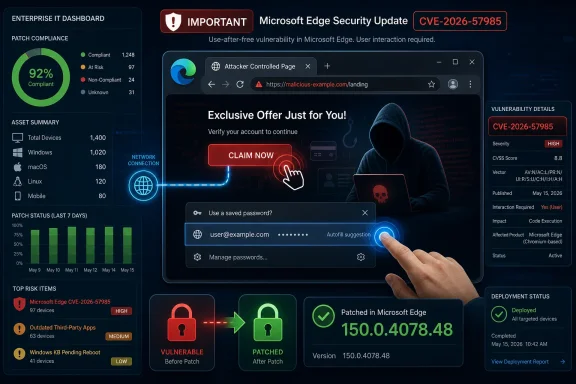
For administrators, that is the practical translation. An attacker does not need an account on the target system. The attack is not scored as requiring unusual preconditions. But it does require a user to participate, which in this case means visiting attacker-controlled content and, according to Microsoft’s own FAQ, performing two tap gestures that cause autofill to activate.
That last detail is unusually specific and unusually important. It suggests the exploit path is not merely “open a page and get owned,” but is instead tied to a browser interaction sequence involving autofill. Microsoft says information in the victim’s browser associated with the vulnerable URL can be read by malicious JavaScript and sent to the attacker. That is narrower than a blanket system takeover, but still serious in an era where the browser often contains session material, identity state, and user-specific data that can unlock the next stage of an intrusion.
The “Integrity: High” portion of the CVSS vector is the part that should make defenders slow down. Low confidentiality and low availability might imply a bug that mostly leaks or disrupts. High integrity means Microsoft is scoring the potential for meaningful modification or malicious action within the affected component’s security authority. When the affected component is a browser, that can become strategically valuable even if the bug does not immediately hand over the whole machine.
Microsoft also lists the scope as unchanged. In CVSS terms, that means the vulnerability is scored as affecting resources under the same security authority rather than jumping cleanly into another component’s authority. That keeps the score below the sort of catastrophic browser-sandbox-escape scenarios that dominate emergency patch meetings. But it does not make the issue trivial, especially when the browser is the place where privileged web sessions live.
That is distinct from exploit availability. Microsoft also marks exploit code maturity as unproven, meaning there is no publicly available exploit code or the exploit is still theoretical from the public’s point of view. The company says the vulnerability was not publicly disclosed before the advisory and was not known to be exploited at publication time. Those are reassuring facts, but they sit beside the more durable fact that Microsoft believes the bug is real and has shipped an official fix.
This is where vulnerability management often goes sideways. Teams look at “not exploited,” “exploitation unlikely,” and “Important,” then push the update into the same holding pen as nuisance bugs. But the report-confidence metric is a reminder that the advisory is not rumor triage. Microsoft has enough evidence to assign a CVE, publish a vector, credit a reporter, describe exploitation mechanics, and ship a new Edge build.
The acknowledgement line credits Kugelblitz with Microsoft. That suggests coordinated handling rather than a drive-by public disclosure, and it helps explain the clean temporal posture: no public disclosure, no observed exploitation, official fix available. The good news is that defenders are being handed the patch before public weaponization. The bad news is that attackers read the same advisories.
Browser bugs often become more interesting after patches ship. Diffing updated code, watching Chromium and Edge release notes, and correlating CVE language with changed components can give skilled researchers a path from advisory to proof of concept. Microsoft’s “exploitation unlikely” assessment should be read as a point-in-time judgment, not a permanent property of the flaw.
Autofill has always lived in an awkward security neighborhood. It is a user-experience feature that handles names, addresses, payment-adjacent data, credentials-adjacent flows, and identity hints across pages the user may or may not fully understand. It relies on browser heuristics, page structure, user gestures, and origin boundaries to decide when data should appear and where it should go.
Microsoft’s language says malicious JavaScript could read information in the victim’s browser associated with the vulnerable URL and send it to the attacker. That wording matters. It does not say arbitrary local files can be read. It does not say saved passwords are necessarily exposed. It does say browser-associated information can cross a line it should not cross when the vulnerability is successfully triggered.
That is the kind of bug that fits modern phishing operations well. Attackers do not always need a spectacular exploit chain if they can steal session-adjacent data, manipulate browser state, or use a targeted interaction to gain enough leverage for credential theft, payment fraud, or further social engineering. A two-tap requirement may sound like a speed bump, but human-driven attacks are built around speed bumps.
The risk is also different on touch-heavy devices. Microsoft’s reference to tap gestures implies the trigger may be particularly relevant to tablets, convertibles, or touch-enabled Windows devices, though the advisory lists the affected product broadly as Microsoft Edge Chromium-based rather than a platform-specific Windows-only component. In mixed fleets, administrators should avoid assuming the bug matters only to traditional desktops.
The release information for CVE-2026-57985 says Edge 150.0.4078.48, released July 3, 2026, is based on Chromium 150.0.7871.47. That matters because browser security fixes often arrive as a mixture of upstream Chromium updates and Microsoft-specific changes. Administrators should track the Edge build number, not just the Chromium milestone, because the patched product in Microsoft’s advisory is Edge itself.
This is especially important in environments where Edge updates are controlled rather than left to consumer-style automatic updating. Many enterprises use management tooling to stage browser releases, test compatibility with internal applications, and control rollout rings. That discipline is sensible, but it can turn a fast browser security update into a slow enterprise change if the process is too rigid.
Edge’s release cadence also creates a perception problem. Browser updates are frequent enough that users tune them out. Security teams cannot afford to do the same. A single Edge update may contain low-drama fixes, Chromium sync changes, policy updates, and a vulnerability that attackers can turn into a targeted campaign once enough technical detail leaks into the ecosystem.
The fix vehicle here is straightforward: update Edge to 150.0.4078.48 or later. The hard part is proving that the update actually landed everywhere. Edge exists across user profiles, shared machines, virtual desktop images, persistent and non-persistent endpoints, servers used for admin browsing, and lab machines that everyone forgets until an incident response team inventories them.
Exploitability labels are snapshots of known conditions. They account for public exploit code, observed exploitation, and technical judgment at the time the advisory is published. They do not account for every private researcher, criminal reverse engineer, brokered vulnerability shop, or opportunistic attacker who begins working from the patch diff after release.
There is a second reason not to overread the label: browser exploitation does not need to be universal to matter. A phishing campaign aimed at a narrow set of users can succeed with a bug that is awkward, gesture-dependent, or unreliable. In targeted attacks, the exploit only has to work often enough against the right people.
For home users, the advice is boring and correct: let Edge update, restart the browser, and avoid treating browser prompts as background noise. For IT teams, the advice is more operational: verify the installed Edge build, confirm update policies are not stuck, and watch for machines that have not restarted browser processes after update installation. Browser updates can be present on disk while users continue running old processes until restart.
Enterprises should also review whether autofill policies align with risk tolerance. Microsoft gives administrators extensive Edge policy controls, and many organizations already restrict password saving or payment data storage. CVE-2026-57985 is not, by itself, an argument for disabling every convenience feature. It is an argument for remembering that convenience features become part of the attack surface.
CVE-2026-57985’s stated confidentiality impact is low, but that does not mean the data involved is worthless. “Low” in CVSS is a scoring category, not a business impact assessment for a particular organization. A small amount of browser-associated information can be enough to sharpen a phishing lure, target a user’s internal application, or confirm that an attacker has reached the right victim.
The advisory’s high integrity rating is arguably more interesting than the read component. Browser integrity is about whether web content, browser-managed state, or user-mediated actions can be manipulated in a way that breaks expected trust. If malicious content can cause the browser to do something with user data that the user did not intend, that is not merely a privacy bug; it is a trust-boundary failure.
This is why security teams should resist the temptation to rank browser CVEs only by whether they promise full system compromise. The modern attack chain is modular. A browser bug that helps steal data, alter page interactions, or weaponize autofill may be combined with credential phishing, OAuth consent abuse, malicious extensions, or endpoint persistence obtained through another path.
Microsoft’s advisory does not claim such a chain exists for CVE-2026-57985. The responsible reading is narrower: the vulnerability is confirmed, fixed, not publicly exploited at release, and requires user interaction. The strategic reading is broader: attackers increasingly exploit the gray zone between user intent and browser automation, and autofill sits directly in that zone.
That means Edge update compliance deserves the same seriousness as OS patch compliance. A fully patched Windows build with a lagging browser is not a fully patched endpoint in any practical sense. The attack path in CVE-2026-57985 begins with content delivered over the network and ends in browser-mediated code execution. That is not mitigated by admiring last month’s cumulative update report.
For managed environments, the first task is inventory. Security teams should know which devices are running Edge below 150.0.4078.48 and why. The “why” matters because browser patch failures often reveal larger operational problems: disabled update services, broken management baselines, stale VDI images, offline devices, or application-compatibility exceptions that have become permanent.
The second task is rollout. Because Microsoft marks the remediation level as an official fix, there is no need to wait for a workaround strategy unless an organization has a known application dependency that breaks on the new build. Even then, the right answer is a short exception with compensating controls, not an indefinite freeze.
The third task is user-risk reduction. Since exploitation requires social engineering or user action, awareness still matters, but awareness should not be the main control. Users will click things. They will open files. They will interact with pages. The job of IT is to keep the browser patched enough that predictable behavior is not catastrophic.
That is not a full technical root-cause analysis. It does not name the exact Edge component. It does not provide proof-of-concept code. It does not say whether the bug is Edge-only or tied to a Chromium feature Microsoft customizes. From a defender’s perspective, that ambiguity can be irritating.
But sparse disclosure is also part of the coordinated vulnerability bargain. Microsoft is giving customers a patch before public exploitation, while limiting the amount of implementation detail that would help attackers move faster. The advisory is designed to answer operational questions, not to teach exploitation.
The result is a familiar asymmetry. Administrators must act on incomplete details while attackers may eventually gain more precise details by reverse engineering the fix. That is why the confirmed report-confidence metric is so important. It tells defenders that the uncertainty is not about whether the vulnerability exists; it is about how much of the technical path Microsoft is willing to disclose publicly.
The MSRC page’s revision history lists version 1.0 with information published on July 3, 2026. If Microsoft later revises exploitability, affected builds, or mitigation guidance, that would change the operational picture. For now, the advisory is clean: one product row, one fixed build number, and no public exploitation.
For consumer Edge, automatic updates typically do the heavy lifting. The weak point is restart behavior. Users can keep an old browser process alive, suspend laptops, or ignore update prompts. The patch may be downloaded, but the vulnerable code may continue running until the browser is relaunched.
For enterprises, the situation depends on policy. Some organizations allow Edge to update rapidly while controlling only major OS updates. Others bind browser releases to testing rings. The first model reduces exposure but can surprise application owners. The second model reduces surprise but can accumulate risk if security releases are treated like feature releases.
The better pattern is staged velocity. Security updates for browsers should move through a fast ring, a short validation ring, and broad deployment quickly, with narrow rollback paths for genuine breakage. If a business-critical web app fails on a patched browser, that is a business continuity problem; leaving a confirmed RCE unpatched across the fleet is also a business continuity problem.
CVE-2026-57985 is not a reason to abandon testing. It is a reason to test like the browser is exposed to the Internet, because it is.
 Microsoft’s Quiet Edge Patch Still Lands in a Dangerous Place
The browser is no longer just a document viewer with delusions of grandeur. It is the front door to identity, SaaS, password managers, autofill, single sign-on, device posture checks, and the soft interior of corporate work. A remote code execution bug in that layer deserves attention even when the severity label stops short of “Critical.”Microsoft’s bulletin for CVE-2026-57985 gives the vulnerability a CVSS 3.1 base score of 7.6 and a temporal score of 6.6. In Microsoft’s taxonomy, the maximum severity is Important, not Critical, because exploitation requires user interaction and the listed impact profile is not a clean worst-case compromise across confidentiality, integrity, and availability. But “Important” has always been a somewhat misleading word in browser land; the attack surface is enormous, user exposure is routine, and the difference between unlikely exploitation and active exploitation can be one proof-of-concept away.
The company attributes the underlying weakness to CWE-20, improper input validation. That is a broad bucket, but it is not an empty one. In browser vulnerabilities, input validation mistakes can sit at the junction between content parsing, scripting, UI features, data handling, and memory-sensitive code paths. The MSRC executive summary is concise: improper input validation in Microsoft Edge allows an unauthorized attacker to execute code over a network.
The more interesting part is in Microsoft’s exploitation explanation. The attack can be staged through a malicious website designed to trigger the vulnerability in Edge, or through a specially crafted file, but the attacker cannot simply force the victim to render the content. The victim must be convinced to act, typically by opening an attachment, clicking through a lure, or visiting an attacker-controlled page.
That is precisely why this bug sits in the uncomfortable middle. It is not a wormable network service flaw. It is also not a harmless corner case buried behind administrative permissions. It is a browser bug that asks the oldest question in security: can the attacker get a human to do something predictable?
The CVSS Vector Tells a More Useful Story Than the Severity Label
The vector string Microsoft published for CVE-2026-57985 is more revealing than the one-word severity banner: CVSS:3.1/AV:N/AC:L/PR:N/UI:R/S:U/C:L/I:H/A:L/E:U/RL:O/RC:C. That string says the bug is network-reachable, low complexity, requires no privileges, requires user interaction, has unchanged scope, and carries low confidentiality impact, high integrity impact, and low availability impact.For administrators, that is the practical translation. An attacker does not need an account on the target system. The attack is not scored as requiring unusual preconditions. But it does require a user to participate, which in this case means visiting attacker-controlled content and, according to Microsoft’s own FAQ, performing two tap gestures that cause autofill to activate.
That last detail is unusually specific and unusually important. It suggests the exploit path is not merely “open a page and get owned,” but is instead tied to a browser interaction sequence involving autofill. Microsoft says information in the victim’s browser associated with the vulnerable URL can be read by malicious JavaScript and sent to the attacker. That is narrower than a blanket system takeover, but still serious in an era where the browser often contains session material, identity state, and user-specific data that can unlock the next stage of an intrusion.
The “Integrity: High” portion of the CVSS vector is the part that should make defenders slow down. Low confidentiality and low availability might imply a bug that mostly leaks or disrupts. High integrity means Microsoft is scoring the potential for meaningful modification or malicious action within the affected component’s security authority. When the affected component is a browser, that can become strategically valuable even if the bug does not immediately hand over the whole machine.
Microsoft also lists the scope as unchanged. In CVSS terms, that means the vulnerability is scored as affecting resources under the same security authority rather than jumping cleanly into another component’s authority. That keeps the score below the sort of catastrophic browser-sandbox-escape scenarios that dominate emergency patch meetings. But it does not make the issue trivial, especially when the browser is the place where privileged web sessions live.
“Confirmed” Is the Word That Matters Most
The user-provided MSRC text explains the report confidence metric, and it is the key to understanding why this advisory should not be dismissed just because exploitation is currently assessed as unlikely. Report confidence measures how certain the vendor is that the vulnerability exists and how credible the technical details are. Microsoft marks CVE-2026-57985 as confirmed.That is distinct from exploit availability. Microsoft also marks exploit code maturity as unproven, meaning there is no publicly available exploit code or the exploit is still theoretical from the public’s point of view. The company says the vulnerability was not publicly disclosed before the advisory and was not known to be exploited at publication time. Those are reassuring facts, but they sit beside the more durable fact that Microsoft believes the bug is real and has shipped an official fix.
This is where vulnerability management often goes sideways. Teams look at “not exploited,” “exploitation unlikely,” and “Important,” then push the update into the same holding pen as nuisance bugs. But the report-confidence metric is a reminder that the advisory is not rumor triage. Microsoft has enough evidence to assign a CVE, publish a vector, credit a reporter, describe exploitation mechanics, and ship a new Edge build.
The acknowledgement line credits Kugelblitz with Microsoft. That suggests coordinated handling rather than a drive-by public disclosure, and it helps explain the clean temporal posture: no public disclosure, no observed exploitation, official fix available. The good news is that defenders are being handed the patch before public weaponization. The bad news is that attackers read the same advisories.
Browser bugs often become more interesting after patches ship. Diffing updated code, watching Chromium and Edge release notes, and correlating CVE language with changed components can give skilled researchers a path from advisory to proof of concept. Microsoft’s “exploitation unlikely” assessment should be read as a point-in-time judgment, not a permanent property of the flaw.
Autofill Is a Convenience Feature With Security Gravity
The most concrete exploitation detail in Microsoft’s FAQ is that the victim must visit an attacker-controlled page and perform two tap gestures that cause autofill to activate. That makes CVE-2026-57985 feel less like a generic parser bug and more like a browser feature interaction problem. Autofill is convenient because it turns stored user data into quick form completion; it is risky because the browser is making trust decisions on the user’s behalf.Autofill has always lived in an awkward security neighborhood. It is a user-experience feature that handles names, addresses, payment-adjacent data, credentials-adjacent flows, and identity hints across pages the user may or may not fully understand. It relies on browser heuristics, page structure, user gestures, and origin boundaries to decide when data should appear and where it should go.
Microsoft’s language says malicious JavaScript could read information in the victim’s browser associated with the vulnerable URL and send it to the attacker. That wording matters. It does not say arbitrary local files can be read. It does not say saved passwords are necessarily exposed. It does say browser-associated information can cross a line it should not cross when the vulnerability is successfully triggered.
That is the kind of bug that fits modern phishing operations well. Attackers do not always need a spectacular exploit chain if they can steal session-adjacent data, manipulate browser state, or use a targeted interaction to gain enough leverage for credential theft, payment fraud, or further social engineering. A two-tap requirement may sound like a speed bump, but human-driven attacks are built around speed bumps.
The risk is also different on touch-heavy devices. Microsoft’s reference to tap gestures implies the trigger may be particularly relevant to tablets, convertibles, or touch-enabled Windows devices, though the advisory lists the affected product broadly as Microsoft Edge Chromium-based rather than a platform-specific Windows-only component. In mixed fleets, administrators should avoid assuming the bug matters only to traditional desktops.
Edge’s Chromium Base Cuts Both Ways
Microsoft Edge’s Chromium foundation is an enormous security advantage and a structural complication. The advantage is that Edge benefits from the scale, scrutiny, fuzzing, and engineering velocity of the Chromium ecosystem. The complication is that Edge is not merely Chrome with a different logo; Microsoft layers in enterprise controls, identity integration, autofill behavior, policy management, and Windows integration that can create Edge-specific exposure.The release information for CVE-2026-57985 says Edge 150.0.4078.48, released July 3, 2026, is based on Chromium 150.0.7871.47. That matters because browser security fixes often arrive as a mixture of upstream Chromium updates and Microsoft-specific changes. Administrators should track the Edge build number, not just the Chromium milestone, because the patched product in Microsoft’s advisory is Edge itself.
This is especially important in environments where Edge updates are controlled rather than left to consumer-style automatic updating. Many enterprises use management tooling to stage browser releases, test compatibility with internal applications, and control rollout rings. That discipline is sensible, but it can turn a fast browser security update into a slow enterprise change if the process is too rigid.
Edge’s release cadence also creates a perception problem. Browser updates are frequent enough that users tune them out. Security teams cannot afford to do the same. A single Edge update may contain low-drama fixes, Chromium sync changes, policy updates, and a vulnerability that attackers can turn into a targeted campaign once enough technical detail leaks into the ecosystem.
The fix vehicle here is straightforward: update Edge to 150.0.4078.48 or later. The hard part is proving that the update actually landed everywhere. Edge exists across user profiles, shared machines, virtual desktop images, persistent and non-persistent endpoints, servers used for admin browsing, and lab machines that everyone forgets until an incident response team inventories them.
“Exploitation Unlikely” Is Not a Patch Exemption
Microsoft’s exploitability assessment says exploitation is unlikely at the time of publication. That is useful context, and it should prevent overreaction. It does not justify deferral in environments where browser updates can be deployed safely.Exploitability labels are snapshots of known conditions. They account for public exploit code, observed exploitation, and technical judgment at the time the advisory is published. They do not account for every private researcher, criminal reverse engineer, brokered vulnerability shop, or opportunistic attacker who begins working from the patch diff after release.
There is a second reason not to overread the label: browser exploitation does not need to be universal to matter. A phishing campaign aimed at a narrow set of users can succeed with a bug that is awkward, gesture-dependent, or unreliable. In targeted attacks, the exploit only has to work often enough against the right people.
For home users, the advice is boring and correct: let Edge update, restart the browser, and avoid treating browser prompts as background noise. For IT teams, the advice is more operational: verify the installed Edge build, confirm update policies are not stuck, and watch for machines that have not restarted browser processes after update installation. Browser updates can be present on disk while users continue running old processes until restart.
Enterprises should also review whether autofill policies align with risk tolerance. Microsoft gives administrators extensive Edge policy controls, and many organizations already restrict password saving or payment data storage. CVE-2026-57985 is not, by itself, an argument for disabling every convenience feature. It is an argument for remembering that convenience features become part of the attack surface.
The Real Risk Is the Browser as an Identity Warehouse
The industry still talks about browsers as clients, but in many enterprises the browser is closer to an identity warehouse with rendering capabilities. It stores session cookies, federated sign-in state, autofill entries, device trust signals, extension permissions, cached application data, and the habits of the user. That makes even constrained browser bugs operationally valuable.CVE-2026-57985’s stated confidentiality impact is low, but that does not mean the data involved is worthless. “Low” in CVSS is a scoring category, not a business impact assessment for a particular organization. A small amount of browser-associated information can be enough to sharpen a phishing lure, target a user’s internal application, or confirm that an attacker has reached the right victim.
The advisory’s high integrity rating is arguably more interesting than the read component. Browser integrity is about whether web content, browser-managed state, or user-mediated actions can be manipulated in a way that breaks expected trust. If malicious content can cause the browser to do something with user data that the user did not intend, that is not merely a privacy bug; it is a trust-boundary failure.
This is why security teams should resist the temptation to rank browser CVEs only by whether they promise full system compromise. The modern attack chain is modular. A browser bug that helps steal data, alter page interactions, or weaponize autofill may be combined with credential phishing, OAuth consent abuse, malicious extensions, or endpoint persistence obtained through another path.
Microsoft’s advisory does not claim such a chain exists for CVE-2026-57985. The responsible reading is narrower: the vulnerability is confirmed, fixed, not publicly exploited at release, and requires user interaction. The strategic reading is broader: attackers increasingly exploit the gray zone between user intent and browser automation, and autofill sits directly in that zone.
Administrators Should Treat Edge Like a Tier-One Security Control
One mistake in Windows fleet management is treating Edge as a user application rather than a security control. It is both. The browser is the runtime for SaaS work, the authentication surface for Microsoft 365, the interface for admin portals, and often the only path through which sensitive business data is viewed.That means Edge update compliance deserves the same seriousness as OS patch compliance. A fully patched Windows build with a lagging browser is not a fully patched endpoint in any practical sense. The attack path in CVE-2026-57985 begins with content delivered over the network and ends in browser-mediated code execution. That is not mitigated by admiring last month’s cumulative update report.
For managed environments, the first task is inventory. Security teams should know which devices are running Edge below 150.0.4078.48 and why. The “why” matters because browser patch failures often reveal larger operational problems: disabled update services, broken management baselines, stale VDI images, offline devices, or application-compatibility exceptions that have become permanent.
The second task is rollout. Because Microsoft marks the remediation level as an official fix, there is no need to wait for a workaround strategy unless an organization has a known application dependency that breaks on the new build. Even then, the right answer is a short exception with compensating controls, not an indefinite freeze.
The third task is user-risk reduction. Since exploitation requires social engineering or user action, awareness still matters, but awareness should not be the main control. Users will click things. They will open files. They will interact with pages. The job of IT is to keep the browser patched enough that predictable behavior is not catastrophic.
Microsoft’s Disclosure Is Sparse, But Sparse Is Not the Same as Empty
MSRC advisories often frustrate defenders because they provide just enough detail to prioritize but not enough to satisfy curiosity. CVE-2026-57985 is no exception. We get the weakness class, CVSS vector, exploitability status, affected product, fixed build, release date, acknowledgment, and a few FAQ details about attacker-controlled pages, files, autofill activation, and malicious JavaScript.That is not a full technical root-cause analysis. It does not name the exact Edge component. It does not provide proof-of-concept code. It does not say whether the bug is Edge-only or tied to a Chromium feature Microsoft customizes. From a defender’s perspective, that ambiguity can be irritating.
But sparse disclosure is also part of the coordinated vulnerability bargain. Microsoft is giving customers a patch before public exploitation, while limiting the amount of implementation detail that would help attackers move faster. The advisory is designed to answer operational questions, not to teach exploitation.
The result is a familiar asymmetry. Administrators must act on incomplete details while attackers may eventually gain more precise details by reverse engineering the fix. That is why the confirmed report-confidence metric is so important. It tells defenders that the uncertainty is not about whether the vulnerability exists; it is about how much of the technical path Microsoft is willing to disclose publicly.
The MSRC page’s revision history lists version 1.0 with information published on July 3, 2026. If Microsoft later revises exploitability, affected builds, or mitigation guidance, that would change the operational picture. For now, the advisory is clean: one product row, one fixed build number, and no public exploitation.
The July 3 Timing Rewards Teams That Automate the Boring Work
There is something almost cruel about a browser RCE advisory landing on July 3 for U.S. administrators heading into a holiday weekend. Security does not respect calendars, and browser update pipelines are supposed to exist precisely because no one wants an emergency meeting every time a web-facing client needs a fix. This is a case where mature automation should make the news less dramatic.For consumer Edge, automatic updates typically do the heavy lifting. The weak point is restart behavior. Users can keep an old browser process alive, suspend laptops, or ignore update prompts. The patch may be downloaded, but the vulnerable code may continue running until the browser is relaunched.
For enterprises, the situation depends on policy. Some organizations allow Edge to update rapidly while controlling only major OS updates. Others bind browser releases to testing rings. The first model reduces exposure but can surprise application owners. The second model reduces surprise but can accumulate risk if security releases are treated like feature releases.
The better pattern is staged velocity. Security updates for browsers should move through a fast ring, a short validation ring, and broad deployment quickly, with narrow rollback paths for genuine breakage. If a business-critical web app fails on a patched browser, that is a business continuity problem; leaving a confirmed RCE unpatched across the fleet is also a business continuity problem.
CVE-2026-57985 is not a reason to abandon testing. It is a reason to test like the browser is exposed to the Internet, because it is.
The Patch Is Small, the Lesson Is Larger
The concrete response to CVE-2026-57985 is not complicated, which is exactly why the broader lesson matters. Microsoft has shipped an official Edge fix, marked exploitation as unlikely, and confirmed the vulnerability. The organizations that handle this well will not be the ones that debate the word “Important” for a week; they will be the ones that verify browser update reality quickly and move on.- Microsoft released CVE-2026-57985 on July 3, 2026, for Microsoft Edge Chromium-based, with the fixed Edge build listed as 150.0.4078.48.
- The vulnerability is an improper input validation flaw that Microsoft says can allow an unauthorized attacker to execute code over a network.
- Exploitation requires user interaction, including visiting attacker-controlled content and, according to Microsoft’s FAQ, performing tap gestures that cause autofill to activate.
- Microsoft says the vulnerability was not publicly disclosed and not exploited at publication time, while rating exploitation as unlikely.
- The report confidence is confirmed, which means defenders should treat the bug as real even though public exploit code is not currently known.
- Enterprises should verify Edge build compliance, restart stale browser sessions, and ensure managed update policies are not delaying security releases unnecessarily.
References
- Primary source: MSRC
Published: 2026-07-03T07:00:00-07:00
Security Update Guide - Microsoft Security Response Center
 msrc.microsoft.com
