

Microsoft published CVE-2026-56646 on July 3, 2026, as an Important Microsoft Edge Chromium-based spoofing vulnerability fixed in Edge 150.0.4078.48, describing a network-reachable flaw that requires user interaction and can expose sensitive information to an unauthorized attacker. The interesting part is not that Edge has another Chromium-era security update; that is now background radiation for anyone running a modern browser estate. The interesting part is the shape of the bug: a supposedly modest spoofing issue that turns on autofill, touch gestures, and the fragile trust users place in browser interface cues. Microsoft’s own Security Update Guide makes this less a panic story than a prioritization story, but it is still one administrators should not sleep through.
CVE-2026-56646 lands in the category security teams often file under “important, not catastrophic.” Microsoft rates it Important, assigns it a CVSS 3.1 base score of 6.5, and says exploitation is unlikely at the time of publication. It is not publicly disclosed, Microsoft says it has not been exploited in the wild, and the temporal score drops to 5.7 because an official fix is available and exploit code maturity is listed as unproven.
That combination can tempt organizations into treating the advisory as routine browser churn. In many environments, Edge updates automatically, Chromium ships fixes frequently, and security teams have learned to reserve adrenaline for actively exploited zero-days. But the CVSS vector tells a more operationally useful story than the severity label alone.
The vulnerability is network exploitable, low complexity, requires no privileges, and requires user interaction. Its impact is confidentiality, not integrity or availability. In plainer English: an attacker does not need an account or local access, but does need to persuade the user to visit an attacker-controlled page and perform the required actions.
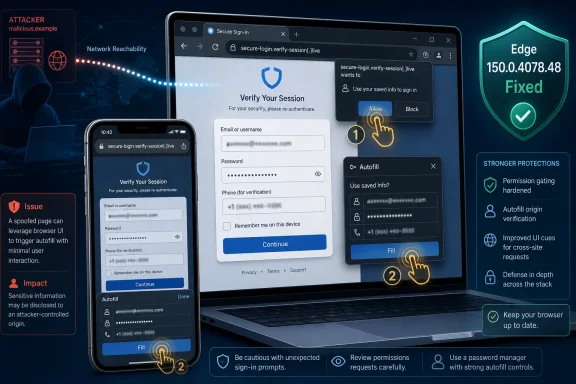
Microsoft’s FAQ supplies the most concrete detail: the user must visit an attacker-controlled webpage and perform two tap gestures that cause autofill to activate. That makes CVE-2026-56646 a browser trust problem in the most literal sense. The user is not just clicking a bad link; the browser’s own convenience machinery becomes part of the attack surface.
That bargain becomes uncomfortable when the feature being abused is not an obscure rendering bug or a memory-safety failure, but a mainstream user-experience feature. Microsoft describes the weakness as CWE-200, exposure of sensitive information to an unauthorized actor. For a spoofing vulnerability, that matters: the attacker’s win is not necessarily taking over the browser, but convincing the browser or the user to reveal something the attacker should not see.
The “two tap gestures” requirement is a useful detail because it separates this bug from the fantasy category of zero-click browser compromise. It also does not make the issue harmless. Mobile and touch-first interfaces are built around rapid, semi-conscious gestures, and adversarial pages can be designed to make users do predictable things without realizing what state the browser has entered.
That is why spoofing bugs deserve more respect than they often get. They are not always technically glamorous, but they exploit the seam between code and cognition. If a user believes they are tapping through a benign interface while the browser is activating autofill in a way that exposes protected data, the compromise is still real even if no shell pops and no process crashes.
In CVSS language, Report Confidence measures both confidence in the existence of the vulnerability and the credibility of the technical details. Microsoft’s page says the metric is Confirmed when detailed reports exist, functional reproduction is possible, source code is available for independent verification, or the author or vendor has confirmed the issue. Here, the assigning CNA is Microsoft, and the advisory itself carries Microsoft’s confirmation.
That does not mean attackers have weaponized the flaw. Microsoft separately says exploit code maturity is Unproven and exploitation is unlikely. But it does mean defenders should not mistake a lack of public exploit code for uncertainty about whether the bug exists.
This distinction is important in enterprise patch triage. “Unproven” lowers immediate exploit pressure; “Confirmed” raises confidence that the patch addresses a real condition. The correct response is not emergency shutdown, but neither is dismissal. It is disciplined deployment.
The confidentiality impact is rated High. That is the part that should stop admins from equating “spoofing” with mere cosmetic trickery. A spoofing vulnerability can be a fake padlock, a misleading origin display, a deceptive permission flow, or a manipulated browser UI path; in this case, Microsoft’s summary says exposure of sensitive information allows spoofing over a network.
There is no integrity impact and no availability impact in Microsoft’s scoring. That means this is not a bug that lets an attacker modify data or knock systems offline, at least under the CVSS model Microsoft published. The risk is narrower, but sharper: disclosure.
In practical terms, CVE-2026-56646 sits near the boundary between browser exploitation and social engineering. The attacker needs a page, a user, and gestures. The defender needs a patched browser, sane update telemetry, and enough skepticism about autofill behavior to avoid reducing the issue to “just user interaction.”
That sounds easy, and in consumer scenarios it often is. Edge updates through its own update mechanism, and many users will receive the fixed build without thinking about it. In managed environments, however, the browser update story can be messier than the marketing version suggests.
Enterprises commonly pin versions, delay channels, stage rollouts, route updates through management tooling, or maintain separate policies for Stable, Extended Stable, Beta, Dev, and kiosk-style deployments. Virtual desktops and persistent images can lag behind live endpoints. Servers used for administrative workflows may have browsers installed but rarely opened long enough to trigger expected update checks.
The result is a paradox of modern browser security: patch availability is fast, but patch certainty is uneven. Microsoft can ship the fix on July 3; administrators still need to prove that Edge 150.0.4078.48 or later is actually present where users browse sensitive sites, access internal portals, or use saved identity data.
The broader point is that coordinated vulnerability disclosure still matters. Browser vendors, especially those downstream of Chromium, often patch issues with minimal public detail because too much specificity can accelerate exploitation before users update. That leaves administrators reading between fields: CVSS metrics, exploitability assessment, acknowledgements, affected builds, and terse executive summaries.
CVE-2026-56646 is a good example of that compressed disclosure style. We get enough to prioritize the issue: Edge, spoofing, autofill activation, two tap gestures, network vector, no privileges, confirmed report, official fix. We do not get a step-by-step attack narrative, and that is probably appropriate while the update is still rolling out.
For defenders, the lack of public exploit code should not be confused with lack of attacker imagination. Autofill-related browser bugs have an intuitive appeal because they map directly to data theft. If the underlying interaction can be reproduced reliably, criminals do not need a kernel exploit to turn it into a credential-harvesting campaign or targeted lure.
Users click, tap, swipe, approve, dismiss, expand, and retry all day. Attackers know this. A page that requires two taps is not asking for an exotic sequence; it is asking for behavior that can be induced with copy, layout, timing, or mobile-first design.
That is especially relevant because the advisory references tap gestures rather than keyboard input or desktop-only behavior. Touch interfaces compress intention. A tap can mean “continue,” “close,” “select,” “focus,” “accept,” or “try again,” depending on what the interface appears to be doing. If spoofing changes the user’s perception of what they are interacting with, the user-interaction requirement becomes part of the exploit design rather than a reliable mitigation.
Admins should therefore avoid writing this off as a training issue. Yes, user awareness helps. But the fix is the browser update, not a memo telling employees to tap more carefully. The purpose of a secure browser is to prevent hostile pages from turning ordinary gestures into data exposure events.
In a corporate setting, the risk depends heavily on browser configuration. Some organizations disable password saving but allow address autofill. Some permit enterprise sync across managed devices. Others rely on third-party password managers while leaving browser autofill partially enabled. The attack surface is not identical from one fleet to another.
That variability is why asset inventory alone is insufficient. Knowing which devices run Edge is the first step. Knowing which Edge policies are applied, which autofill categories are enabled, whether profiles are managed, and whether sensitive internal apps trigger browser-stored values is the better risk picture.
For highly regulated environments, this advisory is also a reminder that browsers are data stores. They are not merely windows into web apps. If sensitive information can be exposed through a browser feature, then browser configuration belongs in the same governance conversation as endpoint protection and identity policy.
But “unlikely” is not the same as “not worth patching.” Microsoft also says the attack complexity is low and privileges are not required. The gap between unlikely exploitation and practical exploitation can narrow quickly once researchers, adversaries, or opportunistic criminals infer enough from the patch.
Browser fixes are especially prone to this dynamic because patches can be diffed. Attackers often compare old and new builds to identify changed code paths. Even when Microsoft does not publish a full technical breakdown, the update itself can become a map for skilled reverse engineers.
That is why browser patch SLAs should be measured in days, not quarters. The rational response to CVE-2026-56646 is not emergency incident response, but accelerated routine hygiene. If an organization cannot move Edge security updates promptly when exploitation is “unlikely,” it will struggle badly when exploitation is confirmed.
On individual systems, users can check Edge’s About page, which typically triggers an update check. In managed estates, administrators should rely on their endpoint management, vulnerability management, or inventory tooling rather than user self-reporting. The important thing is to validate installed version, not merely update policy intent.
There is also a timing issue. A machine can be assigned the right policy and still be out of date because it has not checked in, has update services blocked, is pinned to a channel, or has been offline. Browser update compliance needs the same discipline organizations already apply to operating system patching.
Security teams should also look for unmanaged Edge installations on systems that otherwise appear locked down. Developer workstations, test VMs, lab machines, jump boxes, and “temporary” admin desktops often become exception zones. Attackers do not care whether a vulnerable browser was outside the official baseline.
Microsoft’s Security Update Guide lists this as a Microsoft Edge Chromium-based vulnerability, and the release notes route through Edge-specific security update documentation. The fix is an Edge build, not a generic Chrome instruction. Administrators should resist the lazy assumption that Chromium sameness erases vendor-specific exposure.
This is particularly relevant for enterprises that run multiple Chromium-based browsers side by side. A Chrome patch does not prove Edge is patched. An Edge policy does not govern Brave, Vivaldi, or other Chromium derivatives. Browser monoculture has become browser family culture, and the differences still matter.
Edge also has a distinct role in Windows environments because it is deeply present even where it is not the default browser. Windows search flows, webview-adjacent experiences, administrative habits, and user fallback behavior can all bring Edge into use. Treating it as dormant because Chrome is the corporate default is a familiar inventory mistake.
That gray zone is expanding. Passkeys, federated sign-in, password managers, payment autofill, browser-based enterprise SSO, and profile sync all ask users to trust subtle interface cues. A spoofing bug in that world is not a mere visual nuisance. It can become a way to redirect trust from the browser to the attacker.
The industry has spent years telling users to look for signs: the right domain, the browser’s password prompt, the expected autofill behavior, the familiar login flow. But if the browser can be manipulated into presenting or activating those signs incorrectly, the advice collapses. Security cannot rest on user perception alone.
For Microsoft, this is exactly the kind of issue that justifies rapid Edge servicing independent of Windows feature releases. For administrators, it is a reason to keep browser updates outside slow operating system maintenance cycles wherever possible. The browser is now too privileged, too exposed, and too frequently targeted to wait.
 Microsoft’s Browser Patch Has a Small Label and a Larger Lesson
CVE-2026-56646 lands in the category security teams often file under “important, not catastrophic.” Microsoft rates it Important, assigns it a CVSS 3.1 base score of 6.5, and says exploitation is unlikely at the time of publication. It is not publicly disclosed, Microsoft says it has not been exploited in the wild, and the temporal score drops to 5.7 because an official fix is available and exploit code maturity is listed as unproven.That combination can tempt organizations into treating the advisory as routine browser churn. In many environments, Edge updates automatically, Chromium ships fixes frequently, and security teams have learned to reserve adrenaline for actively exploited zero-days. But the CVSS vector tells a more operationally useful story than the severity label alone.
The vulnerability is network exploitable, low complexity, requires no privileges, and requires user interaction. Its impact is confidentiality, not integrity or availability. In plainer English: an attacker does not need an account or local access, but does need to persuade the user to visit an attacker-controlled page and perform the required actions.
Microsoft’s FAQ supplies the most concrete detail: the user must visit an attacker-controlled webpage and perform two tap gestures that cause autofill to activate. That makes CVE-2026-56646 a browser trust problem in the most literal sense. The user is not just clicking a bad link; the browser’s own convenience machinery becomes part of the attack surface.
Autofill Is No Longer Just a Convenience Feature
Autofill has always been a bargain. Users get fewer forms to complete, fewer passwords to type, and less friction on mobile devices. Browsers get stickier because they become identity brokers, password managers, address books, and payment-adjacent assistants.That bargain becomes uncomfortable when the feature being abused is not an obscure rendering bug or a memory-safety failure, but a mainstream user-experience feature. Microsoft describes the weakness as CWE-200, exposure of sensitive information to an unauthorized actor. For a spoofing vulnerability, that matters: the attacker’s win is not necessarily taking over the browser, but convincing the browser or the user to reveal something the attacker should not see.
The “two tap gestures” requirement is a useful detail because it separates this bug from the fantasy category of zero-click browser compromise. It also does not make the issue harmless. Mobile and touch-first interfaces are built around rapid, semi-conscious gestures, and adversarial pages can be designed to make users do predictable things without realizing what state the browser has entered.
That is why spoofing bugs deserve more respect than they often get. They are not always technically glamorous, but they exploit the seam between code and cognition. If a user believes they are tapping through a benign interface while the browser is activating autofill in a way that exposes protected data, the compromise is still real even if no shell pops and no process crashes.
“Confirmed” Is the Quiet Word That Raises the Floor
The user-supplied MSRC metric description points to the most important temporal signal in this advisory: Report Confidence. Microsoft lists CVE-2026-56646 as Confirmed. That means the vulnerability is not merely rumored, inferred from a partial report, or described in loose terms by a third party.In CVSS language, Report Confidence measures both confidence in the existence of the vulnerability and the credibility of the technical details. Microsoft’s page says the metric is Confirmed when detailed reports exist, functional reproduction is possible, source code is available for independent verification, or the author or vendor has confirmed the issue. Here, the assigning CNA is Microsoft, and the advisory itself carries Microsoft’s confirmation.
That does not mean attackers have weaponized the flaw. Microsoft separately says exploit code maturity is Unproven and exploitation is unlikely. But it does mean defenders should not mistake a lack of public exploit code for uncertainty about whether the bug exists.
This distinction is important in enterprise patch triage. “Unproven” lowers immediate exploit pressure; “Confirmed” raises confidence that the patch addresses a real condition. The correct response is not emergency shutdown, but neither is dismissal. It is disciplined deployment.
The CVSS Vector Says This Is a Phishing-Adjacent Browser Bug
The vector string for CVE-2026-56646 is doing a lot of work: AV:N/AC:L/PR:N/UI:R/S:U/C:H/I:N/A:N/E:U/RL:O/RC:C. Security teams can read that as a compact operational profile. The attack comes over the network, is not considered technically complex, needs no prior privileges, and depends on user action.The confidentiality impact is rated High. That is the part that should stop admins from equating “spoofing” with mere cosmetic trickery. A spoofing vulnerability can be a fake padlock, a misleading origin display, a deceptive permission flow, or a manipulated browser UI path; in this case, Microsoft’s summary says exposure of sensitive information allows spoofing over a network.
There is no integrity impact and no availability impact in Microsoft’s scoring. That means this is not a bug that lets an attacker modify data or knock systems offline, at least under the CVSS model Microsoft published. The risk is narrower, but sharper: disclosure.
In practical terms, CVE-2026-56646 sits near the boundary between browser exploitation and social engineering. The attacker needs a page, a user, and gestures. The defender needs a patched browser, sane update telemetry, and enough skepticism about autofill behavior to avoid reducing the issue to “just user interaction.”
Edge’s Chromium Cadence Makes the Fix Simple and the Inventory Hard
Microsoft lists the fixed Edge build as 150.0.4078.48, released on July 3, 2026 and based on Chromium 150.0.7871.47. That is the number administrators should care about when checking whether managed endpoints have moved past exposure. The patch is not buried in an optional Windows cumulative update; it is an Edge security update.That sounds easy, and in consumer scenarios it often is. Edge updates through its own update mechanism, and many users will receive the fixed build without thinking about it. In managed environments, however, the browser update story can be messier than the marketing version suggests.
Enterprises commonly pin versions, delay channels, stage rollouts, route updates through management tooling, or maintain separate policies for Stable, Extended Stable, Beta, Dev, and kiosk-style deployments. Virtual desktops and persistent images can lag behind live endpoints. Servers used for administrative workflows may have browsers installed but rarely opened long enough to trigger expected update checks.
The result is a paradox of modern browser security: patch availability is fast, but patch certainty is uneven. Microsoft can ship the fix on July 3; administrators still need to prove that Edge 150.0.4078.48 or later is actually present where users browse sensitive sites, access internal portals, or use saved identity data.
The Research Credit Matters Because This Was Not a Ghost Advisory
Microsoft credits Orange Tsai of DEVCORE for reporting the issue. That name will be familiar to many security professionals because Orange Tsai has been associated with high-impact vulnerability research across enterprise software. The credit does not tell us the exploit path in full, and Microsoft has not published a proof of concept in the advisory, but it does add credibility to the report’s provenance.The broader point is that coordinated vulnerability disclosure still matters. Browser vendors, especially those downstream of Chromium, often patch issues with minimal public detail because too much specificity can accelerate exploitation before users update. That leaves administrators reading between fields: CVSS metrics, exploitability assessment, acknowledgements, affected builds, and terse executive summaries.
CVE-2026-56646 is a good example of that compressed disclosure style. We get enough to prioritize the issue: Edge, spoofing, autofill activation, two tap gestures, network vector, no privileges, confirmed report, official fix. We do not get a step-by-step attack narrative, and that is probably appropriate while the update is still rolling out.
For defenders, the lack of public exploit code should not be confused with lack of attacker imagination. Autofill-related browser bugs have an intuitive appeal because they map directly to data theft. If the underlying interaction can be reproduced reliably, criminals do not need a kernel exploit to turn it into a credential-harvesting campaign or targeted lure.
User Interaction Is Not a Safety Boundary
The phrase “user interaction required” has become one of the most misunderstood comfort blankets in vulnerability management. It is true that UI:R is less severe than a true zero-click vulnerability. It is also true that modern attacks routinely manufacture user interaction at scale.Users click, tap, swipe, approve, dismiss, expand, and retry all day. Attackers know this. A page that requires two taps is not asking for an exotic sequence; it is asking for behavior that can be induced with copy, layout, timing, or mobile-first design.
That is especially relevant because the advisory references tap gestures rather than keyboard input or desktop-only behavior. Touch interfaces compress intention. A tap can mean “continue,” “close,” “select,” “focus,” “accept,” or “try again,” depending on what the interface appears to be doing. If spoofing changes the user’s perception of what they are interacting with, the user-interaction requirement becomes part of the exploit design rather than a reliable mitigation.
Admins should therefore avoid writing this off as a training issue. Yes, user awareness helps. But the fix is the browser update, not a memo telling employees to tap more carefully. The purpose of a secure browser is to prevent hostile pages from turning ordinary gestures into data exposure events.
Confidentiality Bugs Hit Hardest Where Browsers Remember Too Much
The CVSS confidentiality rating is High, and that should focus attention on what Edge knows. Modern browsers remember names, addresses, phone numbers, emails, credentials, passkeys metadata, payment-related form data, enterprise portal states, and session-adjacent information. Not all of that is equally exposed by any given autofill bug, but the category is inherently sensitive.In a corporate setting, the risk depends heavily on browser configuration. Some organizations disable password saving but allow address autofill. Some permit enterprise sync across managed devices. Others rely on third-party password managers while leaving browser autofill partially enabled. The attack surface is not identical from one fleet to another.
That variability is why asset inventory alone is insufficient. Knowing which devices run Edge is the first step. Knowing which Edge policies are applied, which autofill categories are enabled, whether profiles are managed, and whether sensitive internal apps trigger browser-stored values is the better risk picture.
For highly regulated environments, this advisory is also a reminder that browsers are data stores. They are not merely windows into web apps. If sensitive information can be exposed through a browser feature, then browser configuration belongs in the same governance conversation as endpoint protection and identity policy.
Microsoft’s “Exploitation Unlikely” Is a Signal, Not a Permission Slip
Microsoft’s exploitability assessment says exploitation is unlikely at publication. That is useful. It tells patch teams this is not, on the evidence available July 3, 2026, an actively burning Edge zero-day.But “unlikely” is not the same as “not worth patching.” Microsoft also says the attack complexity is low and privileges are not required. The gap between unlikely exploitation and practical exploitation can narrow quickly once researchers, adversaries, or opportunistic criminals infer enough from the patch.
Browser fixes are especially prone to this dynamic because patches can be diffed. Attackers often compare old and new builds to identify changed code paths. Even when Microsoft does not publish a full technical breakdown, the update itself can become a map for skilled reverse engineers.
That is why browser patch SLAs should be measured in days, not quarters. The rational response to CVE-2026-56646 is not emergency incident response, but accelerated routine hygiene. If an organization cannot move Edge security updates promptly when exploitation is “unlikely,” it will struggle badly when exploitation is confirmed.
The Windows Admin’s Real Job Is Verification
For WindowsForum’s audience, the operational question is straightforward: how do you know the fix landed? The answer varies by environment, but the target version does not. Edge 150.0.4078.48 is the fixed build Microsoft lists for this advisory.On individual systems, users can check Edge’s About page, which typically triggers an update check. In managed estates, administrators should rely on their endpoint management, vulnerability management, or inventory tooling rather than user self-reporting. The important thing is to validate installed version, not merely update policy intent.
There is also a timing issue. A machine can be assigned the right policy and still be out of date because it has not checked in, has update services blocked, is pinned to a channel, or has been offline. Browser update compliance needs the same discipline organizations already apply to operating system patching.
Security teams should also look for unmanaged Edge installations on systems that otherwise appear locked down. Developer workstations, test VMs, lab machines, jump boxes, and “temporary” admin desktops often become exception zones. Attackers do not care whether a vulnerable browser was outside the official baseline.
This Edge Bug Is a Reminder That Chromium Does Not Make Browsers Interchangeable
Edge is Chromium-based, but this advisory is specifically for Microsoft Edge. That distinction matters. Chromium provides the engine foundation, yet each browser layers its own services, UI decisions, sync features, enterprise policies, branding, update pipelines, and integration points.Microsoft’s Security Update Guide lists this as a Microsoft Edge Chromium-based vulnerability, and the release notes route through Edge-specific security update documentation. The fix is an Edge build, not a generic Chrome instruction. Administrators should resist the lazy assumption that Chromium sameness erases vendor-specific exposure.
This is particularly relevant for enterprises that run multiple Chromium-based browsers side by side. A Chrome patch does not prove Edge is patched. An Edge policy does not govern Brave, Vivaldi, or other Chromium derivatives. Browser monoculture has become browser family culture, and the differences still matter.
Edge also has a distinct role in Windows environments because it is deeply present even where it is not the default browser. Windows search flows, webview-adjacent experiences, administrative habits, and user fallback behavior can all bring Edge into use. Treating it as dormant because Chrome is the corporate default is a familiar inventory mistake.
The Patch Is Easy; the Trust Model Is the Hard Part
The technical remediation is simple: deploy the fixed Edge release. The conceptual remediation is harder: stop treating browser interface trust as a solved problem. CVE-2026-56646 shows how much security now lives in the gray zone between page content, browser UI, autofill state, and user expectation.That gray zone is expanding. Passkeys, federated sign-in, password managers, payment autofill, browser-based enterprise SSO, and profile sync all ask users to trust subtle interface cues. A spoofing bug in that world is not a mere visual nuisance. It can become a way to redirect trust from the browser to the attacker.
The industry has spent years telling users to look for signs: the right domain, the browser’s password prompt, the expected autofill behavior, the familiar login flow. But if the browser can be manipulated into presenting or activating those signs incorrectly, the advice collapses. Security cannot rest on user perception alone.
For Microsoft, this is exactly the kind of issue that justifies rapid Edge servicing independent of Windows feature releases. For administrators, it is a reason to keep browser updates outside slow operating system maintenance cycles wherever possible. The browser is now too privileged, too exposed, and too frequently targeted to wait.
The Practical Read on CVE-2026-56646 Is Faster Browser Hygiene, Not Panic
The advisory does not justify alarmist claims of mass exploitation, and Microsoft’s own assessment argues against that. It does justify a short, focused verification cycle: confirm Edge version, review autofill exposure where policy allows it, and make sure managed update rings are not leaving browser security fixes behind.- Microsoft released CVE-2026-56646 on July 3, 2026, and lists Edge 150.0.4078.48 as the fixed version.
- The vulnerability is rated Important with a CVSS 3.1 base score of 6.5 and a temporal score of 5.7.
- Microsoft says the issue is not publicly disclosed, has not been exploited, and is unlikely to be exploited at the time of publication.
- Exploitation requires user interaction: visiting an attacker-controlled webpage and performing two tap gestures that cause autofill to activate.
- The confidentiality impact is rated High, while integrity and availability impacts are rated None.
- The Report Confidence metric is Confirmed, which means defenders should treat the vulnerability as real even though exploit code is listed as unproven.
References
- Primary source: MSRC
Published: 2026-07-03T07:00:00-07:00
Security Update Guide - Microsoft Security Response Center
 msrc.microsoft.com
