

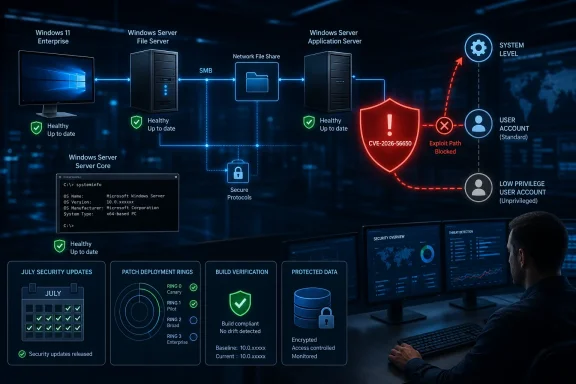
Microsoft published the advisory on July 14. The National Vulnerability Database record, which reproduces Microsoft’s CVE data, assigns the flaw a CVSS 3.1 score of 7.8, rated High, and describes it as a heap-based buffer overflow. Microsoft’s vector requires local access and low privileges, does not require user interaction, and indicates complete compromise of confidentiality, integrity, and availability is possible after successful exploitation.
That combination makes CVE-2026-56650 a classic post-compromise risk. It is not a wormable network entry point, and the available data does not describe an unauthenticated remote attack. But malware, a malicious standard user, or an attacker who has landed with limited credentials could potentially use it to cross the boundary into SYSTEM-level control.
The Fix Reaches Far Beyond Current Windows 11 PCs
Microsoft’s affected-product data covers a notably wide Windows estate. That includes Windows 10 version 1607, Windows 10 version 1809, Windows 10 21H2, Windows 10 22H2, Windows 11 24H2, Windows 11 25H2, and Windows 11 version 26H1. Both x64 and ARM64 systems appear in the current Windows 10 and Windows 11 coverage where applicable.
On the server side, the advisory covers Windows Server 2012, Windows Server 2012 R2, Windows Server 2016, Windows Server 2019, Windows Server 2022, and Windows Server 2025. Microsoft also lists Server Core variants for Windows Server 2012, 2012 R2, 2016, 2019, and 2025.
That scope matters because it makes this an infrastructure patching issue, not merely a desktop update. Organizations commonly keep older Windows Server releases in line-of-business roles, virtual machine templates, management tiers, and branch-office deployments long after newer client builds dominate endpoint fleets. The presence of Server Core in the affected list also means systems without a conventional desktop experience are not exempt.
The build cutoffs published in Microsoft’s data provide a useful verification point after deployment. The patched levels include Windows 10 22H2 build 19045.7548, Windows 11 24H2 build 26100.8875, Windows 11 26H1 build 28000.2525, Windows Server 2022 build 20348.5386, and Windows Server 2025 build 26100.33158. For older environments, the relevant floors include build 14393.9339 for Windows 10 1607 and Windows Server 2016, build 17763.9020 for Windows 10 1809 and Windows Server 2019, and build 9600.23291 for Windows Server 2012 R2.
A Heap Overflow With an Unusually Clear Privilege-Escalation Outcome
The public technical description remains brief. Microsoft identifies two weakness categories: CWE-122, heap-based buffer overflow, and CWE-197, numeric truncation error. In practical terms, that pairing suggests a data-size or arithmetic handling problem can result in memory being allocated or processed incorrectly, creating a route to corrupt memory in the file-system component.
It is important not to extrapolate beyond that. Neither Microsoft nor NIST’s National Vulnerability Database has published exploit code, a proof of concept, the affected driver name, triggering file format, or a reproducible attack sequence. Administrators should therefore avoid assuming that ordinary SMB exposure or a particular shared-folder configuration is the vulnerability’s direct trigger.
Still, the impact rating deserves attention. Elevation-of-privilege flaws are often the second stage of an intrusion: an attacker gains a foothold through phishing, a stolen VPN credential, a browser compromise, or a vulnerable third-party application, then uses a local Windows weakness to defeat least-privilege controls. A working exploit for CVE-2026-56650 could turn a constrained user-context compromise into broad control over a workstation or server.
That is especially consequential on shared systems and management infrastructure. Terminal servers, jump hosts, developer workstations, build agents, and server administration tools routinely place multiple identities and sensitive credentials on the same machine. In such environments, local privilege escalation is not a minor cleanup item; it can become the mechanism that turns one compromised account into a larger domain or cloud incident.
There Is No Public Evidence of Exploitation — Yet
Microsoft’s severity data marks the attack as local, low-complexity, low-privilege, and requiring no user interaction. Those details make the vulnerability technically attractive once an attacker already has access. They do not, on their own, establish that it is being used in attacks.
The NVD record currently says it is awaiting further enrichment, meaning NIST has not yet supplied its own CVSS assessment or expanded analysis. A CISA-added Stakeholder-Specific Vulnerability Categorization entry dated July 10 lists exploitation as “none,” automatable exploitation as “no,” and technical impact as “total.” That is a helpful prioritization signal, but it should not be mistaken for a permanent all-clear: CVE exploitation status can change rapidly after Patch Tuesday releases provide researchers and attackers with an opportunity to compare patched and unpatched code.
For Windows admins, the distinction is useful. This is not an emergency firewall-rule event in the same sense as a pre-authentication, network-reachable remote-code-execution bug. It is, however, a high-impact local escalation issue that belongs in the normal expedited deployment ring, particularly wherever users can execute code locally or where endpoint security alerts have already indicated suspicious activity.
Patch the Systems Attackers Can Already Reach
The July update should be prioritized for devices where a low-privilege foothold is realistic: user endpoints, virtual desktop infrastructure, Remote Desktop Session Host servers, application servers with local service accounts, and administrative workstations. Domain controllers are not specifically singled out in the public description, but any supported Windows server should receive the applicable cumulative update if it falls within Microsoft’s affected version list.
A sensible deployment sequence is to validate the relevant July cumulative update in a representative pilot group, check line-of-business applications and endpoint protection compatibility, then move promptly through production rings. This is also a useful moment to identify stale Windows Server 2012 and 2012 R2 systems, because their update paths and support arrangements may differ from fully supported releases even when a security fix is available.
Administrators should confirm installation through their usual management platform and verify OS build numbers rather than relying only on a deployment job’s success state. WSUS, Microsoft Configuration Manager, Microsoft Intune, Windows Update for Business, and endpoint-management products can all report compliance differently when a reboot is pending, a servicing stack issue intervenes, or a device has missed prerequisite updates.
Endpoint teams should also continue reducing the value of a local foothold. Application control, restricted local administrator membership, credential isolation, timely removal of unused remote-access tools, and monitoring for unexpected privilege changes will not replace the patch, but they can limit what an attacker can do before and after an attempted escalation.
The most important fact about CVE-2026-56650 is not that it sits in something called the Windows Network File System. It is that Microsoft rates a low-privilege local exploit as capable of total system impact across a long list of Windows releases. The July 2026 cumulative update is therefore the practical mitigation, and the next meaningful milestone will be whether public technical research or exploitation evidence emerges after organizations have had time to deploy it.
References
- CVE-2026-56650 Windows Network File System Elevation of Privilege Vulnerability MSRC · 2026-07-14T07:00:00-07:00