Microsoft’s advisory for CVE-2026-57983 identifies a Microsoft Edge, Chromium-based, security feature bypass vulnerability, but the publicly visible record as of July 3, 2026, exposes more about confidence and disclosure posture than about exploit mechanics. That distinction matters because “security feature bypass” is one of the most abused phrases in vulnerability triage: it can describe anything from a nuisance prompt bypass to a meaningful weakening of Windows’ defense stack. The practical question for Windows admins is not whether Edge should be patched — it should — but how much operational panic the current public evidence justifies. Right now, this looks like a case where Microsoft is confirming the existence of a flaw while withholding, or not yet publishing, the kind of detail that would let defenders and attackers reason about it with equal precision.
The anchor fact is the MSRC entry itself: Microsoft has assigned CVE-2026-57983 to Microsoft Edge Chromium and classifies it as a security feature bypass. The user-supplied MSRC language focuses on a metric that measures confidence in the vulnerability’s existence and the credibility of the technical details, which is exactly the kind of scoring nuance that often gets lost when CVEs are flattened into severity numbers.
That language is not describing the exploit path. It is describing how much the industry can trust what is currently known. In plain English, Microsoft is distinguishing between “we know this bug exists” and “the world has enough technical detail to reproduce it.”
That is a meaningful difference. A confirmed vendor advisory raises the confidence floor, but the absence of public root-cause detail lowers the immediate usefulness of the record for defenders trying to build detections, compensating controls, or threat-hunting logic. It also lowers the usefulness for opportunistic attackers, at least until reverse engineering fills the gap.
The vulnerability’s product scope also matters. Edge is not merely a browser application that sits on the taskbar; it is a Chromium-based component deeply integrated into enterprise workflows, identity prompts, web apps, update channels, and in some Windows configurations, system-adjacent experiences. A bypass in Edge can be narrower than a Windows kernel bug and still matter because browsers are where user trust, web content, and enterprise policy collide.
That is why the category can look underwhelming on paper and still be operationally important. A bypass of a warning prompt, sandbox boundary, download reputation check, site isolation assumption, authentication guardrail, or enterprise policy enforcement point can turn a blocked attack into a viable one. The bypass may not be the burglar; it may be the unlocked side door.
For Microsoft Edge, the possible design space is broad. Chromium contains the renderer, browser process, sandboxing model, network stack, extension architecture, and web platform machinery. Microsoft’s Edge-specific layer adds update services, enterprise policy, SmartScreen integration, identity features, Windows integration, and management hooks. A CVE bearing the Edge Chromium label does not automatically tell us which layer failed.
That ambiguity is exactly why the confidence metric matters. A confirmed vulnerability with limited public details should be treated as real but not overinterpreted. The responsible reading is: patch promptly, watch for Microsoft’s update notes, but do not invent an exploit narrative that the advisory does not support.
Microsoft’s own Edge security release notes routinely say that Stable Channel releases incorporate the latest Chromium security updates, and the company separately identifies Edge-specific fixes when the issue is in Microsoft’s layer rather than upstream Chromium. In January 2026, for example, Microsoft documented Edge Stable Channel version 144.0.3719.82 as including an Edge-specific security fix for CVE-2026-21223. That release-note pattern matters because it shows how Microsoft separates the Chromium conveyor belt from Edge-only repairs.
CVE-2026-57983 should be read through that same operational lens. If the fix lands through Edge Stable, it may arrive outside the traditional Patch Tuesday rhythm that Windows administrators still use as their mental calendar. Browser security is increasingly evergreen, which is good for consumers and messy for enterprises with staged validation pipelines.
The enterprise challenge is not “should we update Edge?” It is whether the organization’s Edge update controls, rings, and telemetry prove that the update actually reached endpoints. In many environments, the browser is nominally auto-updated but practically delayed by frozen VDI images, disconnected networks, app compatibility exceptions, kiosk builds, or well-intentioned update deferral policies.
A vulnerability can be highly credible but hard to exploit. It can also be loosely described yet easy to rediscover once a patch diff appears. Public confidence tells us how firm the fact pattern is; exploitability tells us how easy it is to weaponize that fact pattern.
This distinction is more than academic. Security teams often rank vulnerabilities by CVSS base score, EPSS probability, exploit maturity, and whether exploitation has been observed in the wild. But report confidence answers a different question: how much should we trust the current description?
For CVE-2026-57983, the prudent stance is to treat Microsoft’s acknowledgement as authoritative for existence, while admitting that public technical knowledge remains thin unless Microsoft publishes more detail or credible researchers corroborate the mechanism. That is not a reason to ignore the CVE. It is a reason to resist theater.
That does not mean every Edge CVE becomes a working exploit. Most do not. But the window after a fix is released can be awkward: defenders know they need to patch, attackers may begin learning why, and lagging endpoints become progressively more attractive.
This is where enterprise patch latency becomes the real exposure. A missing technical write-up may slow attackers on day one, but it does not protect an organization that leaves old Edge builds in place for weeks. Once fixed and vulnerable versions are available for comparison, the advisory’s initial ambiguity becomes less comforting.
The better security posture is boring: confirm the fixed Edge version, push it through rings quickly, measure adoption, and treat outliers as security exceptions rather than help-desk trivia. Browser updates should be validated, not debated into irrelevance.
A security feature bypass in that zone could be far more consequential than a garden-variety web compatibility bug. If a protection assumes that Edge will enforce a policy, gate a risky file, isolate a site, respect a management boundary, or preserve a user-warning workflow, then bypassing that protection may have enterprise consequences even without direct code execution.
That is the quiet danger of this class of vulnerability. Users rarely notice when a security feature works, and they almost never notice when it has been bypassed. The absence of a crash, prompt, or obvious compromise can make these bugs feel theoretical until they are chained with something louder.
For WindowsForum readers, the lesson is familiar: endpoint security is a stack, not a single wall. If one layer silently stops doing its job, the layer beneath it is suddenly carrying more weight than the design intended.
As of this writing, the public signal around CVE-2026-57983 appears limited compared with high-profile exploited zero-days. Microsoft’s MSRC entry is the authoritative origin named by the user, but broad third-party reporting and detailed technical analysis are not yet the center of gravity. That supports a measured response rather than an alarmist one.
Measured does not mean slow. It means the response should match the evidence: update Edge, verify deployment, monitor for revised MSRC details, and avoid making claims about exploit chains that have not been published. The worst version of security communication is the one that combines vague facts with dramatic certainty.
If Microsoft later updates the advisory with exploitation status, CVSS vectors, fixed build numbers, acknowledgements, or more technical description, the risk picture could change quickly. Until then, the absence of detail should be handled as uncertainty, not safety.
For Microsoft 365 and Entra-heavy organizations, Edge often participates in identity, conditional access experiences, profile sync, cloud app usage, and data protection workflows. A vulnerable browser can undermine controls that look, on paper, like cloud policy. The endpoint remains where policy becomes behavior.
That means inventory matters. Administrators should know which Edge channel is deployed, which versions are present, where Extended Stable is used, whether update policies defer security fixes, and whether servers, kiosks, VDI pools, and lab machines are drifting. Security teams that cannot answer those questions are not really managing Edge; they are hoping Microsoft’s updater wins every race.
There is also a communications challenge. Users understand “your browser needs an update” as a nuisance. IT needs to recast that message: browser updates are now front-line security maintenance. If the organization would not knowingly run an unpatched VPN gateway, it should not casually run stale browsers on privileged admin workstations.
That is why defenders should evaluate CVE-2026-57983 not only by its standalone score, but by where Edge sits in their environment’s attack paths. A consumer laptop, a developer workstation with cloud secrets, a help-desk machine with remote support tools, and a domain admin jump box do not carry the same risk even if the Edge version is identical.
This is where vulnerability management becomes contextual. The same browser CVE may be routine on a low-privilege training-room PC and urgent on an administrator’s daily driver. Patch priority should follow exposure, privilege, and business function, not just severity labels.
Security teams should also resist the temptation to wait for exploit confirmation before acting. By the time a browser bypass is publicly tied to exploitation, the easiest patch window has often passed. The goal is not to predict every exploit; it is to remove cheap opportunities before they become incident-response tickets.
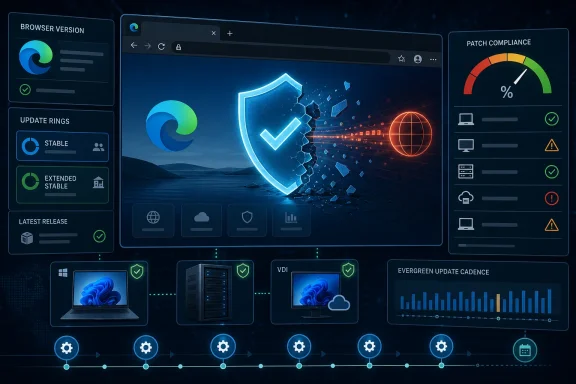 Microsoft Confirms the Flaw, but Not the Story Around It
The anchor fact is the MSRC entry itself: Microsoft has assigned CVE-2026-57983 to Microsoft Edge Chromium and classifies it as a security feature bypass. The user-supplied MSRC language focuses on a metric that measures confidence in the vulnerability’s existence and the credibility of the technical details, which is exactly the kind of scoring nuance that often gets lost when CVEs are flattened into severity numbers.That language is not describing the exploit path. It is describing how much the industry can trust what is currently known. In plain English, Microsoft is distinguishing between “we know this bug exists” and “the world has enough technical detail to reproduce it.”
That is a meaningful difference. A confirmed vendor advisory raises the confidence floor, but the absence of public root-cause detail lowers the immediate usefulness of the record for defenders trying to build detections, compensating controls, or threat-hunting logic. It also lowers the usefulness for opportunistic attackers, at least until reverse engineering fills the gap.
The vulnerability’s product scope also matters. Edge is not merely a browser application that sits on the taskbar; it is a Chromium-based component deeply integrated into enterprise workflows, identity prompts, web apps, update channels, and in some Windows configurations, system-adjacent experiences. A bypass in Edge can be narrower than a Windows kernel bug and still matter because browsers are where user trust, web content, and enterprise policy collide.
“Security Feature Bypass” Is a Warning Label, Not a Diagnosis
Security feature bypass vulnerabilities are frequently misunderstood because they do not always grant code execution, administrator rights, or data theft by themselves. Their danger is usually indirect. They remove, weaken, or sidestep a protection that another attack chain expected to encounter.That is why the category can look underwhelming on paper and still be operationally important. A bypass of a warning prompt, sandbox boundary, download reputation check, site isolation assumption, authentication guardrail, or enterprise policy enforcement point can turn a blocked attack into a viable one. The bypass may not be the burglar; it may be the unlocked side door.
For Microsoft Edge, the possible design space is broad. Chromium contains the renderer, browser process, sandboxing model, network stack, extension architecture, and web platform machinery. Microsoft’s Edge-specific layer adds update services, enterprise policy, SmartScreen integration, identity features, Windows integration, and management hooks. A CVE bearing the Edge Chromium label does not automatically tell us which layer failed.
That ambiguity is exactly why the confidence metric matters. A confirmed vulnerability with limited public details should be treated as real but not overinterpreted. The responsible reading is: patch promptly, watch for Microsoft’s update notes, but do not invent an exploit narrative that the advisory does not support.
The Browser Patch Cadence Has Changed the Risk Conversation
A decade ago, many organizations treated browser updates as annoying desktop churn. That posture is now indefensible. Edge and Chrome ship on rapid channels because browsers have become the most continuously attacked application class in the modern endpoint stack.Microsoft’s own Edge security release notes routinely say that Stable Channel releases incorporate the latest Chromium security updates, and the company separately identifies Edge-specific fixes when the issue is in Microsoft’s layer rather than upstream Chromium. In January 2026, for example, Microsoft documented Edge Stable Channel version 144.0.3719.82 as including an Edge-specific security fix for CVE-2026-21223. That release-note pattern matters because it shows how Microsoft separates the Chromium conveyor belt from Edge-only repairs.
CVE-2026-57983 should be read through that same operational lens. If the fix lands through Edge Stable, it may arrive outside the traditional Patch Tuesday rhythm that Windows administrators still use as their mental calendar. Browser security is increasingly evergreen, which is good for consumers and messy for enterprises with staged validation pipelines.
The enterprise challenge is not “should we update Edge?” It is whether the organization’s Edge update controls, rings, and telemetry prove that the update actually reached endpoints. In many environments, the browser is nominally auto-updated but practically delayed by frozen VDI images, disconnected networks, app compatibility exceptions, kiosk builds, or well-intentioned update deferral policies.
Confidence Is Not the Same Thing as Exploitability
The user-supplied text describes a metric that measures confidence in the vulnerability’s existence and in the credibility of known technical details. That is adjacent to exploitability, but it is not identical to exploitability.A vulnerability can be highly credible but hard to exploit. It can also be loosely described yet easy to rediscover once a patch diff appears. Public confidence tells us how firm the fact pattern is; exploitability tells us how easy it is to weaponize that fact pattern.
This distinction is more than academic. Security teams often rank vulnerabilities by CVSS base score, EPSS probability, exploit maturity, and whether exploitation has been observed in the wild. But report confidence answers a different question: how much should we trust the current description?
For CVE-2026-57983, the prudent stance is to treat Microsoft’s acknowledgement as authoritative for existence, while admitting that public technical knowledge remains thin unless Microsoft publishes more detail or credible researchers corroborate the mechanism. That is not a reason to ignore the CVE. It is a reason to resist theater.
Where Attackers Usually Get Their Detail
When a vendor publishes a sparse advisory, attackers do not stop. They diff patches, compare binaries, monitor crash reports, inspect Chromium commits, and look for newly added tests or changed policy checks. Browser vulnerabilities are especially vulnerable to this kind of after-the-fact reconstruction because the update stream is frequent and the codebase is heavily scrutinized.That does not mean every Edge CVE becomes a working exploit. Most do not. But the window after a fix is released can be awkward: defenders know they need to patch, attackers may begin learning why, and lagging endpoints become progressively more attractive.
This is where enterprise patch latency becomes the real exposure. A missing technical write-up may slow attackers on day one, but it does not protect an organization that leaves old Edge builds in place for weeks. Once fixed and vulnerable versions are available for comparison, the advisory’s initial ambiguity becomes less comforting.
The better security posture is boring: confirm the fixed Edge version, push it through rings quickly, measure adoption, and treat outliers as security exceptions rather than help-desk trivia. Browser updates should be validated, not debated into irrelevance.
Edge’s Windows Integration Raises the Stakes
Microsoft Edge is Chromium-based, but it is not simply Google Chrome with a different icon. Microsoft has layered in Windows authentication experiences, enterprise controls, SmartScreen, Microsoft Defender integrations, Application Guard history, update services, sync behavior, and policy enforcement. That Microsoft-specific surface is often where Edge CVEs become especially interesting to Windows administrators.A security feature bypass in that zone could be far more consequential than a garden-variety web compatibility bug. If a protection assumes that Edge will enforce a policy, gate a risky file, isolate a site, respect a management boundary, or preserve a user-warning workflow, then bypassing that protection may have enterprise consequences even without direct code execution.
That is the quiet danger of this class of vulnerability. Users rarely notice when a security feature works, and they almost never notice when it has been bypassed. The absence of a crash, prompt, or obvious compromise can make these bugs feel theoretical until they are chained with something louder.
For WindowsForum readers, the lesson is familiar: endpoint security is a stack, not a single wall. If one layer silently stops doing its job, the layer beneath it is suddenly carrying more weight than the design intended.
The Public Record Is Thin, and That Is Itself News
One of the more frustrating aspects of modern vulnerability management is that public records often arrive in layers. A CVE identifier appears first. A vendor advisory follows. NVD enrichment may lag. Security vendors may mirror the record, sometimes adding little beyond the title. Later, technical blogs, proof-of-concept code, or exploitation reports may transform a dull advisory into a priority incident.As of this writing, the public signal around CVE-2026-57983 appears limited compared with high-profile exploited zero-days. Microsoft’s MSRC entry is the authoritative origin named by the user, but broad third-party reporting and detailed technical analysis are not yet the center of gravity. That supports a measured response rather than an alarmist one.
Measured does not mean slow. It means the response should match the evidence: update Edge, verify deployment, monitor for revised MSRC details, and avoid making claims about exploit chains that have not been published. The worst version of security communication is the one that combines vague facts with dramatic certainty.
If Microsoft later updates the advisory with exploitation status, CVSS vectors, fixed build numbers, acknowledgements, or more technical description, the risk picture could change quickly. Until then, the absence of detail should be handled as uncertainty, not safety.
Admins Should Treat the Browser as Managed Infrastructure
The days when browsers could be left to user-driven updates are over. Edge is now part of the managed endpoint baseline, and security fixes should be tracked with the same seriousness as Windows cumulative updates.For Microsoft 365 and Entra-heavy organizations, Edge often participates in identity, conditional access experiences, profile sync, cloud app usage, and data protection workflows. A vulnerable browser can undermine controls that look, on paper, like cloud policy. The endpoint remains where policy becomes behavior.
That means inventory matters. Administrators should know which Edge channel is deployed, which versions are present, where Extended Stable is used, whether update policies defer security fixes, and whether servers, kiosks, VDI pools, and lab machines are drifting. Security teams that cannot answer those questions are not really managing Edge; they are hoping Microsoft’s updater wins every race.
There is also a communications challenge. Users understand “your browser needs an update” as a nuisance. IT needs to recast that message: browser updates are now front-line security maintenance. If the organization would not knowingly run an unpatched VPN gateway, it should not casually run stale browsers on privileged admin workstations.
The Real Risk Is the Chain, Not the Individual CVE
Security feature bypasses rarely live alone in serious incidents. They become useful when paired with phishing, malicious downloads, token theft, browser sandbox escapes, extension abuse, or post-exploitation tradecraft. Their value is catalytic.That is why defenders should evaluate CVE-2026-57983 not only by its standalone score, but by where Edge sits in their environment’s attack paths. A consumer laptop, a developer workstation with cloud secrets, a help-desk machine with remote support tools, and a domain admin jump box do not carry the same risk even if the Edge version is identical.
This is where vulnerability management becomes contextual. The same browser CVE may be routine on a low-privilege training-room PC and urgent on an administrator’s daily driver. Patch priority should follow exposure, privilege, and business function, not just severity labels.
Security teams should also resist the temptation to wait for exploit confirmation before acting. By the time a browser bypass is publicly tied to exploitation, the easiest patch window has often passed. The goal is not to predict every exploit; it is to remove cheap opportunities before they become incident-response tickets.
The Edge Advisory Leaves a Short, Practical Checklist
The useful response to CVE-2026-57983 is not panic, and it is not shrugging. It is disciplined browser hygiene backed by verification. The sparse public detail makes operational basics more important, not less.- Organizations should confirm which Microsoft Edge builds are currently deployed across workstations, servers, kiosks, and virtual desktop images.
- Administrators should review Edge update policies to ensure security releases are not being delayed by broad deferral rules or stale management baselines.
- Security teams should monitor Microsoft’s MSRC and Edge release notes for any change in exploitability, affected versions, fixed versions, or exploitation-in-the-wild language.
- High-privilege endpoints should receive browser updates faster than general-purpose user devices because a bypass in the browser can amplify other attack stages.
- Teams should avoid writing detections around imagined exploit mechanics until Microsoft or credible researchers publish enough technical detail to support them.
- Browser patch compliance should be measured as an endpoint security control, not treated as a best-effort user convenience.
References
- Primary source: MSRC
Published: 2026-07-03T07:00:00-07:00
Security Update Guide - Microsoft Security Response Center
 msrc.microsoft.com
- Related coverage: wiz.io
CVE-2025-57983 Impact, Exploitability, and Mitigation Steps | Wiz
Understand the critical aspects of CVE-2025-57983 with a detailed vulnerability assessment, exploitation potential, affected technologies, and remediation guidance.www.wiz.io - Related coverage: thewindowsupdate.com
- Related coverage: sentinelone.com
CVE-2026-45492: Microsoft Edge Chromium Auth Bypass Flaw
CVE-2026-45492 is an authentication bypass vulnerability in Microsoft Edge Chromium. Learn about its impact, affected versions, and mitigation methods.www.sentinelone.com
- Related coverage: hkcert.org
Microsoft Edge Multiple Vulnerabilities
Multiple vulnerabilities were identified in Microsoft Edge. A remote attacker could exploit some of these vulnerabilities to trigger remote code execution, denial of service condition, elevation of privilege, security restriction bypass and sensitive infowww.hkcert.org - Official source: learn.microsoft.com
Release notes for Microsoft Edge Security Updates | Microsoft Learn
Release notes for Microsoft Edge Security Updateslearn.microsoft.com

- Related coverage: rapid7.com
Rapid7 Vulnerability Database
Rapid7's VulnDB is curated repository of vetted computer software exploits and exploitable vulnerabilities.www.rapid7.com - Related coverage: stack.watch
- Related coverage: www2.gov.bc.ca
- Related coverage: buildings.honeywell.com
The purpose of this document is to identify the patches that have been delivered by Microsoft® which have been tested against Pro-Watch
PDF documentbuildings.honeywell.com