

Microsoft published CVE-2026-58287 on July 3, 2026, as an Important-severity Microsoft Edge Chromium-based remote code execution vulnerability, fixed in Edge 150.0.4078.48 and described by MSRC as a confirmed use-after-free flaw requiring user interaction rather than silent drive-by compromise. The advisory is not a five-alarm zero-day bulletin, but it is also not routine browser housekeeping. Its most important signal is the tension between “exploitation unlikely” and “report confidence confirmed”: Microsoft is saying the bug is real, the fix is available, and the known path to weaponization is constrained.
That distinction matters because browser vulnerabilities live in a strange risk economy. A flaw can be technically severe, operationally awkward, and still worth patching immediately because the browser is where identity, enterprise SaaS, password managers, autofill, file handlers, and user trust all collide. CVE-2026-58287 is a reminder that Edge’s Chromium foundation gives Microsoft speed, but not immunity.
The Microsoft Security Response Center describes CVE-2026-58287 as a use-after-free vulnerability in Microsoft Edge Chromium-based that could allow an unauthorized attacker to execute code over a network. MSRC assigns it a CVSS 3.1 base score of 8.3, with high impacts for confidentiality, integrity, and availability. Yet Microsoft labels the maximum severity “Important,” not “Critical,” because the exploit path is not automatic.
That split is the story. The raw impact is remote code execution, the phrase that sets off alarms in every vulnerability management dashboard. But the surrounding conditions make this less like a wormable network service bug and more like a carefully staged browser exploitation scenario.
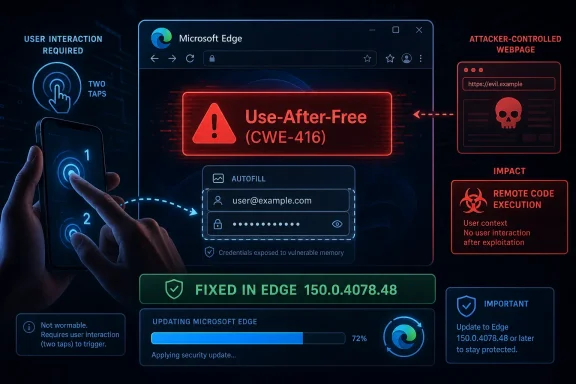
Microsoft says exploitation requires user interaction. More specifically, its advisory describes a path involving deceptive or invisible form elements, two sequential taps, a user visiting attacker-controlled content, and autofill activation. That is a very different operational picture from an unauthenticated server-side RCE exposed to the open Internet.
Still, defenders should not let “Important” become a sedative. Modern browser exploitation is rarely about a single bug in isolation. Attackers chain weaknesses, abuse trust decisions, and use social engineering to turn required clicks into predictable clicks.
This is the uncomfortable middle ground of vulnerability response. CVE-2026-58287 is not publicly disclosed according to MSRC, not observed as exploited, and assessed as “Exploitation Unlikely.” At the same time, Microsoft has confirmed the bug, assigned a weakness class, published a fix, and credited Kugelblitz with Microsoft in the acknowledgements.
For IT teams, that combination should translate into disciplined urgency rather than panic. There is no evidence in Microsoft’s advisory that emergency browser isolation or network shutdowns are warranted. There is plenty of evidence that letting Edge lag behind the fixed build is unnecessary risk.
The report confidence metric is often overlooked because it sounds academic. In practice, it tells defenders whether they are dealing with rumor, partial disclosure, or a vendor-validated flaw. Here, the answer is vendor validation.
That makes this a browser-and-human vulnerability, not merely a browser vulnerability. The exploit path depends on presentation, timing, and persuasion. If that sounds less dangerous than a zero-click flaw, it is. If it sounds harmless, it is not.
User interaction requirements have a way of shrinking in the real world. Attackers do not need to “force” a victim to act if they can make the action look routine. A fake login page, a document workflow, a delivery notification, a benefits portal, or a device enrollment prompt can all create the setting in which taps and autofill behavior feel normal.
The autofill angle is particularly notable because it sits at the intersection of convenience and credential risk. Browser autofill is designed to reduce friction, and attackers love features that reduce friction. Even when the vulnerability is memory-safety related rather than a simple data leak, the user experience around autofill can become part of the exploit choreography.
The persistence of use-after-free flaws in browsers is not evidence that Chromium is uniquely sloppy. It is evidence that browsers are some of the most complex software stacks ever shipped to consumers. They parse hostile input by design, run untrusted code by design, render a moving web platform by design, and sit inches away from credentials, files, and enterprise sessions.
Edge inherits Chromium’s strengths and its attack surface. Microsoft’s browser adds enterprise management, Windows integration, SmartScreen, Microsoft account plumbing, and policy controls. But the rendering and web-platform substrate remains part of the larger Chromium security ecosystem.
That reality cuts both ways. Chromium’s update machinery and researcher attention can make fixes move quickly. But it also means Edge administrators cannot treat the browser as a static Windows component that only matters on Patch Tuesday.
Attack vector “Network” means the attacker can reach the vulnerable component remotely. Privileges required “None” means the attacker does not need an account on the target system before attempting exploitation. User interaction “Required” means the victim must do something. Attack complexity “High” means the exploit depends on conditions beyond the attacker’s direct control.
Scope “Changed” is the part that deserves attention from security architects. Microsoft’s advisory uses the standard CVSS meaning: successful exploitation can affect resources beyond the security authority of the vulnerable component. In a browser context, that is exactly why RCE bugs matter even when the first step appears constrained.
The high confidentiality, integrity, and availability impacts are the reminder that successful exploitation is serious. The barriers are before exploitation. After exploitation, the potential consequences are broad.
Exploitability assessments age quickly. A bug that is awkward on Friday can become more understandable after researchers diff the patched build, analyze the changed code, or reproduce the crash. The advisory says exploit code maturity is unproven, but the existence of an official fix also creates a comparison target for anyone trying to understand what changed.
This is especially true for browser bugs because the patch itself often narrows the search space. Attackers and researchers can compare old and new versions, inspect Chromium-related changes where available, and infer the vulnerable code path. Even when Microsoft’s Edge-specific changes are not immediately obvious, the release provides a starting gun for reverse engineering.
None of that means CVE-2026-58287 will become a widely exploited bug. It means “unlikely” should guide triage, not justify inertia. Enterprises should patch on their normal accelerated browser schedule, not wait for proof-of-concept code to appear.
The enterprise trap is assuming that “auto-update” equals “updated.” Browsers can download updates and still require a restart to complete installation. Users can leave sessions open for days. Kiosk systems, VDI images, lab machines, and tightly managed endpoints can drift from the current channel without anyone noticing until a scanner complains.
Edge is also not just an icon on the taskbar. It is embedded into workflows across Microsoft 365, identity prompts, web apps, and sometimes legacy intranet compatibility modes. In many organizations, it is the default portal into the business.
That makes browser version visibility a first-class security requirement. Asset management that can tell you Windows build numbers but not current browser builds is incomplete. CVE-2026-58287 is a good excuse to verify that the telemetry is real.
Enterprise administrators have several policy levers around password management, form fill, profile synchronization, and browser data handling. The right answer is not always to disable everything. In many environments, breaking autofill can push users toward worse habits, including password reuse, local notes, or unmanaged extensions.
But organizations should at least know what posture they have chosen. If Edge is allowed to save and autofill credentials, administrators should understand where those credentials sync, how device compliance affects access, and whether phishing-resistant authentication is in place for sensitive apps. If autofill is disabled, they should ensure the alternative is usable enough that users do not route around it.
The vulnerability itself is patched in Edge 150.0.4078.48. The broader lesson is that browser features are part of the attack surface. They deserve policy review, not folklore.
For CVE-2026-58287, there is no indication from Microsoft that attackers can compromise Edge users without interaction. There is no public disclosure noted in the advisory, no exploitation observed, and no public exploit maturity. That should keep incident-response teams from over-rotating.
But browser RCE has a unique blast radius because browsers sit at the trust boundary of almost every modern endpoint. A successful exploit may become an initial access vector, especially when paired with social engineering and post-exploitation tooling. The user is the gateway, but the endpoint is still the prize.
The sane response is not alarmism; it is fast hygiene. Confirm the fixed build. Restart the browser. Watch for laggards. Tighten phishing defenses. Move on, but do not ignore it.
Microsoft’s own fields make the response path clear.
That distinction matters because browser vulnerabilities live in a strange risk economy. A flaw can be technically severe, operationally awkward, and still worth patching immediately because the browser is where identity, enterprise SaaS, password managers, autofill, file handlers, and user trust all collide. CVE-2026-58287 is a reminder that Edge’s Chromium foundation gives Microsoft speed, but not immunity.
 Microsoft’s Quiet Edge Patch Carries a Loud Signal
The Microsoft Security Response Center describes CVE-2026-58287 as a use-after-free vulnerability in Microsoft Edge Chromium-based that could allow an unauthorized attacker to execute code over a network. MSRC assigns it a CVSS 3.1 base score of 8.3, with high impacts for confidentiality, integrity, and availability. Yet Microsoft labels the maximum severity “Important,” not “Critical,” because the exploit path is not automatic.That split is the story. The raw impact is remote code execution, the phrase that sets off alarms in every vulnerability management dashboard. But the surrounding conditions make this less like a wormable network service bug and more like a carefully staged browser exploitation scenario.
Microsoft says exploitation requires user interaction. More specifically, its advisory describes a path involving deceptive or invisible form elements, two sequential taps, a user visiting attacker-controlled content, and autofill activation. That is a very different operational picture from an unauthenticated server-side RCE exposed to the open Internet.
Still, defenders should not let “Important” become a sedative. Modern browser exploitation is rarely about a single bug in isolation. Attackers chain weaknesses, abuse trust decisions, and use social engineering to turn required clicks into predictable clicks.
“Confirmed” Is the Word That Should Stop the Skimming
The user-provided MSRC text explains the CVSS report confidence metric, and in this advisory Microsoft marks report confidence as “Confirmed.” That does not mean attackers are exploiting it in the wild. It means the existence of the vulnerability and the credibility of the technical details are not speculative.This is the uncomfortable middle ground of vulnerability response. CVE-2026-58287 is not publicly disclosed according to MSRC, not observed as exploited, and assessed as “Exploitation Unlikely.” At the same time, Microsoft has confirmed the bug, assigned a weakness class, published a fix, and credited Kugelblitz with Microsoft in the acknowledgements.
For IT teams, that combination should translate into disciplined urgency rather than panic. There is no evidence in Microsoft’s advisory that emergency browser isolation or network shutdowns are warranted. There is plenty of evidence that letting Edge lag behind the fixed build is unnecessary risk.
The report confidence metric is often overlooked because it sounds academic. In practice, it tells defenders whether they are dealing with rumor, partial disclosure, or a vendor-validated flaw. Here, the answer is vendor validation.
The Attack Path Runs Through the User, Not Around Them
CVE-2026-58287 requires the user to participate. Microsoft’s FAQ says an attacker could host a specially crafted website and convince a user to view it, or entice a user through email, instant message, or an attachment. The advisory also says the user must visit the attacker-controlled webpage and perform the two tap gestures that cause autofill to activate.That makes this a browser-and-human vulnerability, not merely a browser vulnerability. The exploit path depends on presentation, timing, and persuasion. If that sounds less dangerous than a zero-click flaw, it is. If it sounds harmless, it is not.
User interaction requirements have a way of shrinking in the real world. Attackers do not need to “force” a victim to act if they can make the action look routine. A fake login page, a document workflow, a delivery notification, a benefits portal, or a device enrollment prompt can all create the setting in which taps and autofill behavior feel normal.
The autofill angle is particularly notable because it sits at the intersection of convenience and credential risk. Browser autofill is designed to reduce friction, and attackers love features that reduce friction. Even when the vulnerability is memory-safety related rather than a simple data leak, the user experience around autofill can become part of the exploit choreography.
Use-After-Free Remains the Browser Bug That Refuses to Retire
Microsoft identifies the weakness as CWE-416, use after free. In plain terms, this class of bug occurs when software continues to use memory after it has been freed, creating an opportunity for corruption, crashes, or code execution depending on control, layout, and mitigations. Browser engines have spent years hardening against this family of bugs, and attackers have spent the same years learning how to work around those defenses.The persistence of use-after-free flaws in browsers is not evidence that Chromium is uniquely sloppy. It is evidence that browsers are some of the most complex software stacks ever shipped to consumers. They parse hostile input by design, run untrusted code by design, render a moving web platform by design, and sit inches away from credentials, files, and enterprise sessions.
Edge inherits Chromium’s strengths and its attack surface. Microsoft’s browser adds enterprise management, Windows integration, SmartScreen, Microsoft account plumbing, and policy controls. But the rendering and web-platform substrate remains part of the larger Chromium security ecosystem.
That reality cuts both ways. Chromium’s update machinery and researcher attention can make fixes move quickly. But it also means Edge administrators cannot treat the browser as a static Windows component that only matters on Patch Tuesday.
The CVSS Vector Tells a More Nuanced Story Than the Score
The CVSS vector for CVE-2026-58287 is AV:N/AC:H/PR:N/UI:R/S:C/C:H/I:H/A:H, with temporal modifiers showing exploit code maturity as unproven, remediation level as official fix, and report confidence as confirmed. That string looks like vulnerability-management wallpaper until each part is translated into operational risk.Attack vector “Network” means the attacker can reach the vulnerable component remotely. Privileges required “None” means the attacker does not need an account on the target system before attempting exploitation. User interaction “Required” means the victim must do something. Attack complexity “High” means the exploit depends on conditions beyond the attacker’s direct control.
Scope “Changed” is the part that deserves attention from security architects. Microsoft’s advisory uses the standard CVSS meaning: successful exploitation can affect resources beyond the security authority of the vulnerable component. In a browser context, that is exactly why RCE bugs matter even when the first step appears constrained.
The high confidentiality, integrity, and availability impacts are the reminder that successful exploitation is serious. The barriers are before exploitation. After exploitation, the potential consequences are broad.
“Exploitation Unlikely” Is Not a Permission Slip
Microsoft’s exploitability assessment says exploitation is unlikely at the time of original publication. That is useful information, but it is not a patch deferral policy. It is a snapshot, not a guarantee.Exploitability assessments age quickly. A bug that is awkward on Friday can become more understandable after researchers diff the patched build, analyze the changed code, or reproduce the crash. The advisory says exploit code maturity is unproven, but the existence of an official fix also creates a comparison target for anyone trying to understand what changed.
This is especially true for browser bugs because the patch itself often narrows the search space. Attackers and researchers can compare old and new versions, inspect Chromium-related changes where available, and infer the vulnerable code path. Even when Microsoft’s Edge-specific changes are not immediately obvious, the release provides a starting gun for reverse engineering.
None of that means CVE-2026-58287 will become a widely exploited bug. It means “unlikely” should guide triage, not justify inertia. Enterprises should patch on their normal accelerated browser schedule, not wait for proof-of-concept code to appear.
Edge’s Update Model Is a Security Control, Not a Convenience Feature
Microsoft lists Edge version 150.0.4078.48, released July 3, 2026, as the version information for this security release, based on Chromium 150.0.7871.47. For most consumer systems, Edge’s update mechanisms should make the fix relatively uneventful. For managed fleets, the details depend on update channels, policy controls, restart behavior, and how aggressively admins enforce browser currency.The enterprise trap is assuming that “auto-update” equals “updated.” Browsers can download updates and still require a restart to complete installation. Users can leave sessions open for days. Kiosk systems, VDI images, lab machines, and tightly managed endpoints can drift from the current channel without anyone noticing until a scanner complains.
Edge is also not just an icon on the taskbar. It is embedded into workflows across Microsoft 365, identity prompts, web apps, and sometimes legacy intranet compatibility modes. In many organizations, it is the default portal into the business.
That makes browser version visibility a first-class security requirement. Asset management that can tell you Windows build numbers but not current browser builds is incomplete. CVE-2026-58287 is a good excuse to verify that the telemetry is real.
The Autofill Detail Should Make Administrators Revisit Policy Choices
Microsoft’s mention of autofill activation is not a full exploit write-up, but it is enough to put browser convenience controls back in the spotlight. Autofill is one of those features that lives in the gray zone between productivity and exposure. Users like it, help desks like fewer password-reset tickets, and attackers like predictable UI behavior.Enterprise administrators have several policy levers around password management, form fill, profile synchronization, and browser data handling. The right answer is not always to disable everything. In many environments, breaking autofill can push users toward worse habits, including password reuse, local notes, or unmanaged extensions.
But organizations should at least know what posture they have chosen. If Edge is allowed to save and autofill credentials, administrators should understand where those credentials sync, how device compliance affects access, and whether phishing-resistant authentication is in place for sensitive apps. If autofill is disabled, they should ensure the alternative is usable enough that users do not route around it.
The vulnerability itself is patched in Edge 150.0.4078.48. The broader lesson is that browser features are part of the attack surface. They deserve policy review, not folklore.
Windows Defenders Should Separate Browser RCE From Server RCE
Remote code execution is an overloaded term. A server-side RCE in WSUS, Exchange, SharePoint, or a VPN appliance can often be attacked directly by scanning the Internet. A browser RCE typically needs a delivery mechanism, a user, and a lure. Both are serious, but they create different response priorities.For CVE-2026-58287, there is no indication from Microsoft that attackers can compromise Edge users without interaction. There is no public disclosure noted in the advisory, no exploitation observed, and no public exploit maturity. That should keep incident-response teams from over-rotating.
But browser RCE has a unique blast radius because browsers sit at the trust boundary of almost every modern endpoint. A successful exploit may become an initial access vector, especially when paired with social engineering and post-exploitation tooling. The user is the gateway, but the endpoint is still the prize.
The sane response is not alarmism; it is fast hygiene. Confirm the fixed build. Restart the browser. Watch for laggards. Tighten phishing defenses. Move on, but do not ignore it.
The Real Patch Window Is the Time Before Curiosity Turns Into Exploit Code
The public advisory gives defenders enough to act but not enough for attackers to immediately copy and paste a working exploit. That is the best moment to patch: after the vendor has confirmed the issue and shipped the fix, but before public exploit maturity changes the tempo.Microsoft’s own fields make the response path clear.
- CVE-2026-58287 affects Microsoft Edge Chromium-based and was released by MSRC on July 3, 2026.
- The fixed Edge build listed by Microsoft is 150.0.4078.48, based on Chromium 150.0.7871.47.
- Microsoft classifies the vulnerability as Important, with a CVSS 3.1 base score of 8.3 and remote code execution impact.
- The vulnerability is a confirmed use-after-free issue, but Microsoft says it was not publicly disclosed or exploited at publication time.
- Exploitation requires user interaction, including visiting attacker-controlled content and performing gestures that activate autofill.
- Administrators should verify browser update completion, not merely assume that Edge auto-update has finished the job.
References
- Primary source: MSRC
Published: 2026-07-03T07:00:00-07:00
Security Update Guide - Microsoft Security Response Center
 msrc.microsoft.com
