

Microsoft published CVE-2026-58286 on July 3, 2026, as a high-severity spoofing vulnerability in Chromium-based Microsoft Edge, fixed by updating Stable or Extended Stable Edge to version 150.0.4078.48 or later on supported desktop platforms. The important part is not that Edge has another CVE; modern browsers collect those like barnacles. The important part is that this one sits in the uncomfortable middle ground where the vendor confirms the bug, the score is high, and the public technical detail is deliberately thin. For administrators, that combination should trigger a fast browser update cycle, not a week of speculation about exploit code that Microsoft has not published.
The Microsoft Security Response Center advisory is the anchor here: CVE-2026-58286 is real, Microsoft has assigned it to Edge, and the fix is tied to the July 2026 Edge 150 Stable release. Third-party vulnerability trackers including SecurityVulnerability.io and Feedly’s CVE feed have echoed the same core description: improper access control in Microsoft Edge allows an unauthorized attacker to perform spoofing over a network.
That phrasing is precise enough to be useful and vague enough to be frustrating. “Spoofing” in Microsoft’s taxonomy can cover a range of sins, from misleading browser UI to confusing a user or service about the origin, identity, or trust state of content. It does not automatically mean remote code execution, credential theft, or a sandbox escape, but it also should not be waved away as cosmetic.
The CVSS 3.1 score reported by vulnerability aggregators is 8.1, with network attack vector, no privileges required, no user interaction, high attack complexity, and changed scope. That is an unusual shape for a browser spoofing bug: it suggests Microsoft believes the issue is serious, remotely reachable, and potentially trust-boundary crossing, while also believing exploitation is not straightforward.
That last point matters. A high score with high attack complexity is not the same operational signal as a trivial drive-by browser exploit. It is a warning that the underlying condition may be narrow, state-dependent, or chained with other behavior, not a reason to leave old builds in place.
That is why spoofing bugs deserve more respect than the name often gets. A browser that can be persuaded to misrepresent identity, origin, or trust state can become an accomplice in phishing, session confusion, consent capture, or policy bypass. The exploit may not “own the box” in the dramatic sense, but it can still defeat the human and administrative assumptions layered on top of the browser.
Chromium-based Edge is also not just a consumer browser anymore. It is a managed enterprise surface, an identity client, a WebView2 dependency, a PDF viewer, a password manager front end, a cloud app gateway, and a compliance object. In many Windows shops, Edge sits at the intersection of Microsoft Entra ID, Intune policy, Defender reputation checks, SharePoint, Office web apps, and line-of-business web applications.
That makes spoofing a category with enterprise blast radius. If a flaw can cause Edge to show or route trust incorrectly, the exposure is not limited to a user clicking a suspicious link at home. It may touch SSO workflows, managed app access, cloud document handling, or the browser controls organizations rely on to make web use auditable.
The vector details tell a story. Network attack vector and no privileges required are the pieces defenders hate. No user interaction, if accurately represented, raises the stakes further because it implies the vulnerable condition does not depend on the victim manually accepting a prompt or performing a complex sequence.
The balancing factor is attack complexity. Microsoft and CVSS scorers reserve that for vulnerabilities that require specific conditions, race timing, environmental assumptions, or a less reliable setup. In practical terms, CVE-2026-58286 may be the kind of flaw that is difficult to weaponize generically but quite meaningful in a targeted scenario.
That is why the right response is urgency without theater. There is no public basis, as of July 4, 2026, to claim this is being exploited in the wild. There is also no good basis for leaving Edge below 150.0.4078.48 simply because the proof-of-concept is not sitting on GitHub.
That creates a tension administrators know well. The more opaque the advisory, the harder it is to explain urgency to application owners. The more detailed the advisory, the faster attackers can reproduce the bug.
For CVE-2026-58286, Microsoft has acknowledged the vulnerability and shipped an Edge build that addresses it. That moves the issue out of rumor territory. The existence of the vulnerability is no longer speculative, even if the root cause and exploit method remain unpublished.
The level of attacker knowledge is harder to measure. Publicly, there is a short description and version boundary. Privately, Microsoft, the reporter if there was one, and perhaps Chromium-adjacent engineers know more. Attackers can diff browser builds, watch Chromium commits, and compare behavior across versions; thin advisories slow that work but do not stop it.
Edge 150 is listed as the last version supporting macOS 12 Monterey, with Edge 151 and later requiring macOS 13 Ventura or newer. For WindowsForum readers, that is not just an Apple footnote. Mixed-platform shops often manage Edge as a cross-platform standard browser, and security exceptions for older macOS fleets can complicate the same reporting dashboards used to track Windows compliance.
The release also advances Microsoft’s migration of Edge Workspaces to a V2 architecture. Microsoft says saved Workspaces are moving from OneDrive and SharePoint storage to the Edge Sync service, while collaboration and sharing functionality is being removed. That is not directly part of CVE-2026-58286, but it is exactly the kind of side effect that makes browser patching harder in real enterprises.
There are also policy-level changes, including controls for non-Microsoft account sign-in, stricter MIME type checking for worker scripts, and socket pool size randomization for proxies. Edge 150 is not merely “the CVE build.” It is a browser release with security fixes, feature movement, policy churn, and WebView2 implications arriving in the same package.
Microsoft’s Edge 150 release notes call out a new enterprise WebView2 runtime downgrade capability through the DowngradeVersion policy. On paper, that is a regression-management feature: if a WebView2 update breaks a business-critical app, administrators can temporarily redirect selected applications to an older runtime. In practice, it also highlights the trade-off administrators face every time a browser runtime carries security fixes.
Downgrading WebView2 may be rational during an outage. It may also reintroduce exposure if the older runtime remains vulnerable to a browser-class flaw. That does not mean “never downgrade.” It means every downgrade needs an expiration date, a named owner, and a risk note attached to the incident.
CVE-2026-58286 makes that point sharper. If the fixed boundary is Edge 150.0.4078.48, then any runtime or browser instance held below that line should be treated as an exception. Exceptions are sometimes necessary; invisible exceptions are where organizations get burned.
Enterprises are different. Administrators may pin versions, stage updates through rings, block update services, package Edge through software distribution, or defer changes because a web app vendor certified only a particular build. Those practices are not irrational. They are how large Windows environments avoid turning every browser release into a help-desk event.
But browser security has compressed the acceptable delay. Chromium and Edge now ship security fixes on a cadence that does not respect traditional monthly patch rituals. Waiting for the next Patch Tuesday can be too slow when the browser is the front door for identity, SaaS, document handling, and unmanaged internet content.
The right model is not “always update instantly everywhere.” It is ringed speed. Canary or pilot devices first, broad deployment next, and exception handling for the small number of machines with demonstrable compatibility problems. If an organization cannot move Edge quickly, CVE-2026-58286 is another reminder that the browser update process is itself a security control.
That makes detection awkward. You may not get a clean crash signature, blocked exploit alert, or obvious malware payload. You may see a suspicious login, an unexpected consent grant, an odd redirect chain, or a help-desk report that “the page looked normal.”
For defenders, this argues for looking around the browser rather than inside the CVE. Review authentication anomalies, risky sign-ins, conditional access failures, unusual OAuth consent events, and Defender or proxy telemetry tied to web sessions. If a spoofing flaw is abused, the artifact may be behavioral, not a neat exploit trace.
It also argues for hardening that does not depend on perfect browser presentation. Phishing-resistant MFA, strict app consent governance, safe-link rewriting, download reputation controls, and identity-aware logging all reduce the damage when a browser UI or origin signal becomes unreliable. A patched browser is necessary; layered trust is what keeps a spoof from becoming a breach.
The alternative, however, is not obviously better. A full technical root-cause note on publication day would help defenders write more precise detections, but it would also help attackers build exploits faster. Microsoft is balancing disclosure, patch adoption, and exploit economics.
The practical answer is to read the advisory as a minimum viable warning. It tells us the vendor accepts the vulnerability, the affected product is Edge, the fixed version is available, and the severity is high. It does not tell us enough to safely downgrade the risk.
That distinction is where some vulnerability programs fail. They treat missing exploit detail as missing risk. In reality, missing exploit detail often means defenders have less ability to compensate and should lean harder on patching.
CVE-2026-58286 is described as a Microsoft Edge Chromium-based vulnerability, not merely a generic Chromium CVE mirrored into Edge. That distinction matters, although public details remain limited. Edge’s value proposition over Chrome is precisely the extra Microsoft layer; that layer can also be where Edge-specific bugs live.
This is the trade Microsoft made, and largely the right one. A Chromium-based Edge is easier for developers to target and easier for Microsoft to update rapidly than the old EdgeHTML model. But the cost is that Edge must be treated as a living application platform, not as a static Windows component.
Windows administrators who still think of the browser as “included with the OS” are behind the curve. Edge is now closer to Teams, Office, and Defender in operational terms: evergreen, policy-heavy, cloud-connected, and constantly changing.
That sounds simple until inventory enters the room. Many organizations have Edge Stable, Extended Stable, Beta, WebView2 Evergreen Runtime, offline installers, and legacy app servers all reporting in different tools. Some devices report the browser version but not the WebView2 runtime. Others show stale software inventory because the user has not restarted the browser.
A serious response to CVE-2026-58286 should therefore start with measurement. Query the installed Edge version, the update channel, and WebView2 runtime where relevant. Check whether update policies are blocking the current build. Confirm that the browser has restarted after update, because a downloaded browser update is not the same as a running patched process.
For Windows endpoints, administrators should also watch the difference between machine-wide and per-user browser state. Edge’s update infrastructure is generally robust, but managed environments have many ways to create drift: golden images, nonpersistent VDI, firewall rules, stale enterprise MSI packages, and well-intentioned scripts that disabled update tasks years ago.
That is a quiet admission that browser patch awareness has become its own problem. Microsoft cannot assume administrators will manually monitor release notes, MSRC advisories, Chromium posts, and third-party CVE feeds quickly enough. The browser has become too important, and the cadence too fast, for passive awareness.
If this alerting matures, it could become one of the more useful Edge management features. A severity-threshold alert tied to fleet compliance would help security teams separate routine browser churn from releases that need escalation. It would also give desktop engineering teams better evidence when they ask application owners to accept an accelerated rollout.
CVE-2026-58286 is exactly the kind of case that benefits from that model. It is high severity, vendor-confirmed, and fixed in a current release, but not accompanied by enough public detail to produce elegant compensating controls. That is when alerting should push organizations toward the simple thing: get current.
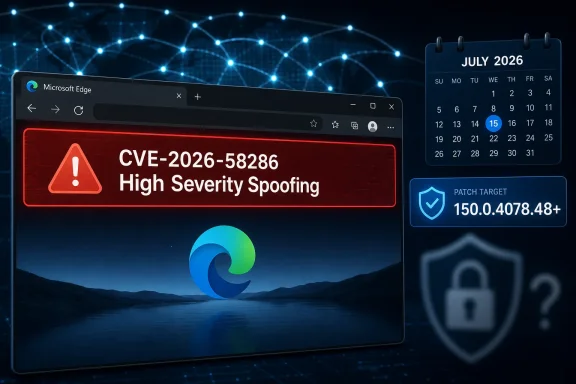 Microsoft Confirms the Bug, but Not the Playbook
The Microsoft Security Response Center advisory is the anchor here: CVE-2026-58286 is real, Microsoft has assigned it to Edge, and the fix is tied to the July 2026 Edge 150 Stable release. Third-party vulnerability trackers including SecurityVulnerability.io and Feedly’s CVE feed have echoed the same core description: improper access control in Microsoft Edge allows an unauthorized attacker to perform spoofing over a network.That phrasing is precise enough to be useful and vague enough to be frustrating. “Spoofing” in Microsoft’s taxonomy can cover a range of sins, from misleading browser UI to confusing a user or service about the origin, identity, or trust state of content. It does not automatically mean remote code execution, credential theft, or a sandbox escape, but it also should not be waved away as cosmetic.
The CVSS 3.1 score reported by vulnerability aggregators is 8.1, with network attack vector, no privileges required, no user interaction, high attack complexity, and changed scope. That is an unusual shape for a browser spoofing bug: it suggests Microsoft believes the issue is serious, remotely reachable, and potentially trust-boundary crossing, while also believing exploitation is not straightforward.
That last point matters. A high score with high attack complexity is not the same operational signal as a trivial drive-by browser exploit. It is a warning that the underlying condition may be narrow, state-dependent, or chained with other behavior, not a reason to leave old builds in place.
Edge’s Security Model Makes “Spoofing” a Loaded Word
Browser security is built around presentation as much as execution. Users and applications make decisions based on what the browser claims: which origin is loaded, whether a login page is genuine, whether a permission prompt belongs to a trusted site, whether a downloaded file came from where it appears to have come from, and whether a web app is operating inside the boundary the user expects.That is why spoofing bugs deserve more respect than the name often gets. A browser that can be persuaded to misrepresent identity, origin, or trust state can become an accomplice in phishing, session confusion, consent capture, or policy bypass. The exploit may not “own the box” in the dramatic sense, but it can still defeat the human and administrative assumptions layered on top of the browser.
Chromium-based Edge is also not just a consumer browser anymore. It is a managed enterprise surface, an identity client, a WebView2 dependency, a PDF viewer, a password manager front end, a cloud app gateway, and a compliance object. In many Windows shops, Edge sits at the intersection of Microsoft Entra ID, Intune policy, Defender reputation checks, SharePoint, Office web apps, and line-of-business web applications.
That makes spoofing a category with enterprise blast radius. If a flaw can cause Edge to show or route trust incorrectly, the exposure is not limited to a user clicking a suspicious link at home. It may touch SSO workflows, managed app access, cloud document handling, or the browser controls organizations rely on to make web use auditable.
The 8.1 Score Says “Move,” Not “Panic”
Security teams have learned, often painfully, that CVSS is not a patching calendar. A 9.8 with no known exploitation may wait behind a 7.5 with active ransomware use; a “medium” browser bug can matter more than a “critical” component nobody runs. Still, CVE-2026-58286’s reported 8.1 score should not be dismissed.The vector details tell a story. Network attack vector and no privileges required are the pieces defenders hate. No user interaction, if accurately represented, raises the stakes further because it implies the vulnerable condition does not depend on the victim manually accepting a prompt or performing a complex sequence.
The balancing factor is attack complexity. Microsoft and CVSS scorers reserve that for vulnerabilities that require specific conditions, race timing, environmental assumptions, or a less reliable setup. In practical terms, CVE-2026-58286 may be the kind of flaw that is difficult to weaponize generically but quite meaningful in a targeted scenario.
That is why the right response is urgency without theater. There is no public basis, as of July 4, 2026, to claim this is being exploited in the wild. There is also no good basis for leaving Edge below 150.0.4078.48 simply because the proof-of-concept is not sitting on GitHub.
The Missing Details Are a Feature of the Advisory System, Not a Comfort
The user-provided MSRC language about confidence in vulnerability existence and technical detail gets to the heart of the problem. Security advisories are not exploit write-ups. They are designed to tell defenders enough to act while withholding enough to avoid giving attackers a recipe.That creates a tension administrators know well. The more opaque the advisory, the harder it is to explain urgency to application owners. The more detailed the advisory, the faster attackers can reproduce the bug.
For CVE-2026-58286, Microsoft has acknowledged the vulnerability and shipped an Edge build that addresses it. That moves the issue out of rumor territory. The existence of the vulnerability is no longer speculative, even if the root cause and exploit method remain unpublished.
The level of attacker knowledge is harder to measure. Publicly, there is a short description and version boundary. Privately, Microsoft, the reporter if there was one, and perhaps Chromium-adjacent engineers know more. Attackers can diff browser builds, watch Chromium commits, and compare behavior across versions; thin advisories slow that work but do not stop it.
The Edge 150 Release Was Already an Enterprise Change Window
Microsoft Learn’s Edge release notes identify version 150.0.4078.48 as the July 2, 2026 Stable release, with security updates from the Chromium project landing alongside feature and policy changes. That matters because defenders are not applying a single-purpose hotfix. They are moving a browser platform release that also changes administrative behavior in ways IT teams may notice.Edge 150 is listed as the last version supporting macOS 12 Monterey, with Edge 151 and later requiring macOS 13 Ventura or newer. For WindowsForum readers, that is not just an Apple footnote. Mixed-platform shops often manage Edge as a cross-platform standard browser, and security exceptions for older macOS fleets can complicate the same reporting dashboards used to track Windows compliance.
The release also advances Microsoft’s migration of Edge Workspaces to a V2 architecture. Microsoft says saved Workspaces are moving from OneDrive and SharePoint storage to the Edge Sync service, while collaboration and sharing functionality is being removed. That is not directly part of CVE-2026-58286, but it is exactly the kind of side effect that makes browser patching harder in real enterprises.
There are also policy-level changes, including controls for non-Microsoft account sign-in, stricter MIME type checking for worker scripts, and socket pool size randomization for proxies. Edge 150 is not merely “the CVE build.” It is a browser release with security fixes, feature movement, policy churn, and WebView2 implications arriving in the same package.
WebView2 Turns a Browser Patch Into an Application Dependency
The Edge conversation is no longer confined to people who open the blue-green icon. WebView2 has made Edge’s runtime part of the Windows application substrate. Internal tools, vendor dashboards, authentication flows, help panes, embedded admin consoles, and desktop apps increasingly depend on the Evergreen WebView2 runtime.Microsoft’s Edge 150 release notes call out a new enterprise WebView2 runtime downgrade capability through the DowngradeVersion policy. On paper, that is a regression-management feature: if a WebView2 update breaks a business-critical app, administrators can temporarily redirect selected applications to an older runtime. In practice, it also highlights the trade-off administrators face every time a browser runtime carries security fixes.
Downgrading WebView2 may be rational during an outage. It may also reintroduce exposure if the older runtime remains vulnerable to a browser-class flaw. That does not mean “never downgrade.” It means every downgrade needs an expiration date, a named owner, and a risk note attached to the incident.
CVE-2026-58286 makes that point sharper. If the fixed boundary is Edge 150.0.4078.48, then any runtime or browser instance held below that line should be treated as an exception. Exceptions are sometimes necessary; invisible exceptions are where organizations get burned.
The Real Patch Gap Is Between Auto-Update and Managed Reality
For consumers, Edge usually updates itself. The browser checks in, downloads a new build, and applies it after restart. Many users will be protected before they ever read the CVE number.Enterprises are different. Administrators may pin versions, stage updates through rings, block update services, package Edge through software distribution, or defer changes because a web app vendor certified only a particular build. Those practices are not irrational. They are how large Windows environments avoid turning every browser release into a help-desk event.
But browser security has compressed the acceptable delay. Chromium and Edge now ship security fixes on a cadence that does not respect traditional monthly patch rituals. Waiting for the next Patch Tuesday can be too slow when the browser is the front door for identity, SaaS, document handling, and unmanaged internet content.
The right model is not “always update instantly everywhere.” It is ringed speed. Canary or pilot devices first, broad deployment next, and exception handling for the small number of machines with demonstrable compatibility problems. If an organization cannot move Edge quickly, CVE-2026-58286 is another reminder that the browser update process is itself a security control.
Spoofing Bugs Hit Humans, Policies, and Logs Differently
Remote code execution is easy to explain because the nightmare is concrete. Spoofing is harder because the damage often comes through misplaced trust. A user may trust the wrong page. A policy may trust the wrong origin. A log may tell a partial story because the browser’s representation of the event was part of the failure.That makes detection awkward. You may not get a clean crash signature, blocked exploit alert, or obvious malware payload. You may see a suspicious login, an unexpected consent grant, an odd redirect chain, or a help-desk report that “the page looked normal.”
For defenders, this argues for looking around the browser rather than inside the CVE. Review authentication anomalies, risky sign-ins, conditional access failures, unusual OAuth consent events, and Defender or proxy telemetry tied to web sessions. If a spoofing flaw is abused, the artifact may be behavioral, not a neat exploit trace.
It also argues for hardening that does not depend on perfect browser presentation. Phishing-resistant MFA, strict app consent governance, safe-link rewriting, download reputation controls, and identity-aware logging all reduce the damage when a browser UI or origin signal becomes unreliable. A patched browser is necessary; layered trust is what keeps a spoof from becoming a breach.
Microsoft’s Advisory Style Leaves Room for Misreadings
MSRC advisories are sometimes criticized for being too terse, and CVE-2026-58286 is a good example of why that criticism persists. “Improper access control” plus “spoofing over a network” is enough to classify the issue, but not enough to tell an administrator whether the most likely abuse case is phishing, UI confusion, origin misbinding, permission manipulation, or service impersonation.The alternative, however, is not obviously better. A full technical root-cause note on publication day would help defenders write more precise detections, but it would also help attackers build exploits faster. Microsoft is balancing disclosure, patch adoption, and exploit economics.
The practical answer is to read the advisory as a minimum viable warning. It tells us the vendor accepts the vulnerability, the affected product is Edge, the fixed version is available, and the severity is high. It does not tell us enough to safely downgrade the risk.
That distinction is where some vulnerability programs fail. They treat missing exploit detail as missing risk. In reality, missing exploit detail often means defenders have less ability to compensate and should lean harder on patching.
Edge’s Chromium Base Is Strength and Exposure
Microsoft’s switch to Chromium gave Edge compatibility, performance, and access to a huge security research ecosystem. It also tied Edge’s security rhythm to Chromium’s relentless vulnerability pipeline. Some bugs come from upstream Chromium. Others are Edge-specific, living in Microsoft’s integrations, enterprise features, identity hooks, UI layers, or platform-specific code.CVE-2026-58286 is described as a Microsoft Edge Chromium-based vulnerability, not merely a generic Chromium CVE mirrored into Edge. That distinction matters, although public details remain limited. Edge’s value proposition over Chrome is precisely the extra Microsoft layer; that layer can also be where Edge-specific bugs live.
This is the trade Microsoft made, and largely the right one. A Chromium-based Edge is easier for developers to target and easier for Microsoft to update rapidly than the old EdgeHTML model. But the cost is that Edge must be treated as a living application platform, not as a static Windows component.
Windows administrators who still think of the browser as “included with the OS” are behind the curve. Edge is now closer to Teams, Office, and Defender in operational terms: evergreen, policy-heavy, cloud-connected, and constantly changing.
The Version Number Is the Control Point
The cleanest operational fact in this story is the version boundary. If Edge is at 150.0.4078.48 or later, the advisory says the fix is present. If it is below that, the device should be considered exposed unless Microsoft provides a separate channel-specific statement.That sounds simple until inventory enters the room. Many organizations have Edge Stable, Extended Stable, Beta, WebView2 Evergreen Runtime, offline installers, and legacy app servers all reporting in different tools. Some devices report the browser version but not the WebView2 runtime. Others show stale software inventory because the user has not restarted the browser.
A serious response to CVE-2026-58286 should therefore start with measurement. Query the installed Edge version, the update channel, and WebView2 runtime where relevant. Check whether update policies are blocking the current build. Confirm that the browser has restarted after update, because a downloaded browser update is not the same as a running patched process.
For Windows endpoints, administrators should also watch the difference between machine-wide and per-user browser state. Edge’s update infrastructure is generally robust, but managed environments have many ways to create drift: golden images, nonpersistent VDI, firewall rules, stale enterprise MSI packages, and well-intentioned scripts that disabled update tasks years ago.
The Security Update Alert Is Microsoft Admitting the Old Model Broke
One of the more interesting Edge 150 additions is not the vulnerability fix itself but Microsoft’s preview of Security Update Alerts in the Edge management service. Microsoft says administrators can choose a severity threshold and receive alerts when a new Edge update includes security fixes that meet or exceed it, including zero-day fixes.That is a quiet admission that browser patch awareness has become its own problem. Microsoft cannot assume administrators will manually monitor release notes, MSRC advisories, Chromium posts, and third-party CVE feeds quickly enough. The browser has become too important, and the cadence too fast, for passive awareness.
If this alerting matures, it could become one of the more useful Edge management features. A severity-threshold alert tied to fleet compliance would help security teams separate routine browser churn from releases that need escalation. It would also give desktop engineering teams better evidence when they ask application owners to accept an accelerated rollout.
CVE-2026-58286 is exactly the kind of case that benefits from that model. It is high severity, vendor-confirmed, and fixed in a current release, but not accompanied by enough public detail to produce elegant compensating controls. That is when alerting should push organizations toward the simple thing: get current.
The July Edge Fix Draws a Bright Line for Admins
The concrete lesson from CVE-2026-58286 is that browser risk now moves faster than many enterprise approval processes. One short paragraph is enough to state the operational position: treat Edge 150.0.4078.48 as the baseline, verify it rather than assuming auto-update did the work, and keep exceptions rare, named, and temporary.- Microsoft published CVE-2026-58286 on July 3, 2026, and the fixed Edge Stable release is version 150.0.4078.48 from July 2, 2026.
- The vulnerability is a high-severity spoofing issue described as improper access control in Chromium-based Microsoft Edge.
- Public technical detail remains limited, but Microsoft’s acknowledgement and patch availability are enough to make this a real remediation item.
- Organizations should inventory both Edge and WebView2 runtime exposure where embedded browser components are used by business applications.
- Devices held below the fixed version for compatibility reasons should be tracked as explicit security exceptions with an owner and review date.
- Security teams should monitor identity, proxy, browser, and endpoint telemetry for suspicious web-session behavior rather than expecting a clean exploit signature.
References
- Primary source: MSRC
Published: 2026-07-03T07:00:00-07:00
Security Update Guide - Microsoft Security Response Center
 msrc.microsoft.com
- Related coverage: securityvulnerability.io
CVE-2026-58286 : Improper Access Control in Microsoft Edge by Microsoft
Uncover details about a spoofing vulnerability in Microsoft Edge (Chromium-based) that allows unauthorized access. Learn more about CVE-2026-58286.securityvulnerability.io - Related coverage: threats.kaspersky.com
Kaspersky Threats — KLA90868
threats.kaspersky.com
- Related coverage: datacomm.com
- Related coverage: hkcert.org
Microsoft Edge Multiple Vulnerabilities
Multiple vulnerabilities were identified in Microsoft Edge. A remote attacker could exploit some of these vulnerabilities to trigger remote code execution, denial of service condition, security restriction bypass, data manipulation, sensitive informationwww.hkcert.org - Related coverage: www2.gov.bc.ca
- Related coverage: manuals.supernaeyeglass.com
- Related coverage: buildings.honeywell.com
The purpose of this document is to identify the patches that have been delivered by Microsoft® which have been tested against Pro-Watch
PDF documentbuildings.honeywell.com
- Related coverage: techspot.com
Microsoft Edge Download Free - 150.0.4078.48 | TechSpot
Download Microsoft Edge - Edge browser lets you enjoy extended battery life and get to what you are looking for quickly.www.techspot.com - Official source: developer.microsoft.com

Microsoft Edge WebDriver | Microsoft Edge Developer
developer.microsoft.com
- Related coverage: windowsforum.com
CVE-2026-57992: Edge Stable 150.0.4078.48 RCE Patch Gap for Windows | Windows Forum
Microsoft has listed CVE-2026-57992 as a Microsoft Edge Chromium-based remote code execution vulnerability in the Security Update Guide, with Edge Stable...windowsforum.com - Official source: catalog.update.microsoft.com
- Official source: learn.microsoft.com
Microsoft Edge release notes for Stable Channel | Microsoft Learn
Microsoft Edge release note for the Stable Channellearn.microsoft.com - Related coverage: ik1-439-51743.vs.sakura.ne.jp
