

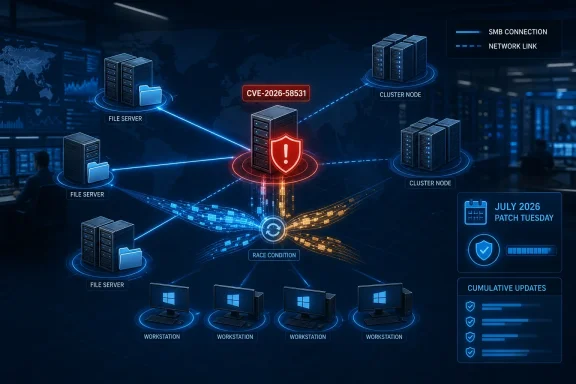
Microsoft’s advisory describes the issue as a race condition in Windows SMB: concurrent activity involving a shared resource is not synchronized safely, potentially enabling a suitably positioned, authorized attacker to elevate privileges. The National Vulnerability Database record, which was published on July 14, identifies both CWE-362, improper synchronization, and CWE-416, use-after-free, as associated weakness categories.
That combination matters. A race condition is not typically a simple “send one packet, get SYSTEM” flaw; successful exploitation depends on repeatedly hitting a narrow timing window. But SMB is one of the Windows components most commonly exposed inside enterprise networks, connecting workstations, file servers, application servers, backup platforms, and clustered infrastructure. A flaw that begins with ordinary credentials and ends with elevated access can be highly useful in lateral movement chains.
The network vector does not make this an unauthenticated SMB worm
CVE-2026-58531 is an elevation-of-privilege vulnerability, not remote code execution. Microsoft’s CVSS vector requires low privileges and lists high attack complexity, with no user interaction required. In practical terms, an attacker needs valid access first, then needs to successfully exploit a timing-sensitive condition in SMB.
That distinction should prevent a repeat of the broad panic that follows every SMB bulletin. This is not described as an unauthenticated pre-authentication bug, and there is no indication that it can be used in the fashion of historic SMB worms. Administrators should not confuse “over a network” with “unauthenticated from anywhere.”
Still, the impact rating remains substantial because the vulnerability’s confidentiality, integrity, and availability components are all scored High. The successful attacker outcome is not merely access to a particular share; it is a potential privilege boundary failure on the target Windows system.
Qualys, in its July Patch Tuesday analysis, characterized the issue as one that could permit an authenticated attacker to gain SYSTEM privileges. That is consistent with the severity assigned to the flaw, although Microsoft’s public description remains deliberately narrow and does not disclose the affected SMB code path, exploit method, or a proof of concept.
The July cumulative updates are the fix
Microsoft published the vulnerability on Tuesday, July 14, as part of its July 2026 Patch Tuesday release. BleepingComputer’s Patch Tuesday coverage lists CVE-2026-58531 among the Important Windows SMB vulnerabilities fixed in the unusually large release, while the NVD shows Microsoft as the originating CVE Numbering Authority.
Affected Windows releases span a wide range of supported client and server products. Third-party vulnerability data reflecting Microsoft’s affected-product metadata identifies Windows 10 version 1607, Windows 10 versions 21H2 and 22H2, Windows 11 versions 24H2 and 25H2, Windows 11 version 26H1, and multiple Windows Server generations, including Windows Server 2012 R2, Windows Server 2016, Windows Server 2019, Windows Server 2022, and Windows Server 2025.
For administrators, the operational instruction is straightforward: deploy the July 14 cumulative security update appropriate to each servicing branch and restart affected systems where required. Examples include:
- Windows 11 version 24H2 and Windows 11 version 25H2 receive the July update through KB5101650.
- Windows Server 2022 and Azure Stack HCI 22H2 receive the July update through KB5099540, which raises the OS build to 20348.5386.
- Windows Server 2025 receives the July security update through KB5099536.
- Windows 11 version 23H2 receives its July security update through KB5099414.
Those KB numbers should be used as deployment references, not as a substitute for checking the update catalog for the exact edition, architecture, and servicing channel. Environments using Windows Update for Business, Windows Server Update Services, Microsoft Configuration Manager, or third-party patch tools should confirm that the July cumulative updates have reached devices successfully and that systems have restarted.
The build thresholds reported in the affected-product record are also useful for vulnerability scanners and asset-management teams. Windows 11 24H2 systems are affected below build 26100.8875, while Windows 11 25H2 systems are listed below the corresponding patched July level. Windows 10 22H2 is affected below build 19045.7548. Those values make a useful validation target after update rings complete.
Why SMB still needs its own patching priority
SMB is often treated as a solved perimeter problem: block TCP 445 at the internet edge, disable SMBv1, require signing where feasible, and move on. Those remain sound controls, but they are not a fix for CVE-2026-58531.
The vulnerability’s access requirement changes the defensive focus. The meaningful exposure lies in internal zones where users, managed endpoints, service accounts, and application identities can already communicate with systems offering SMB. File servers, print infrastructure, Hyper-V hosts, failover-cluster members, remote desktop servers, engineering shares, and backup repositories deserve particular attention.
An attacker who has already acquired a low-privilege domain account or compromised a standard workstation may have access to enough internal SMB services to probe for an elevation path. Network segmentation, least-privilege share permissions, privileged access workstations, and credential hygiene reduce the opportunities available to that attacker. They do not remove the vulnerable SMB implementation from an unpatched host.
The race-condition classification also has an operational consequence: defenders should avoid assuming that failed exploit attempts are harmless or easily visible. Timing-dependent attacks can generate repeated file operations, sessions, or authentication activity that blends into ordinary SMB traffic. Endpoint telemetry for unusual access attempts, unexpected service creation, privilege changes, and credential use across peer systems may offer more useful detection value than looking for a single distinctive network signature.
No workaround means patch validation is the decision point
Microsoft has not published a mitigation or workaround for CVE-2026-58531. Disabling SMB broadly is rarely realistic in Windows estates and can disrupt file access, domain operations, cluster communications, line-of-business applications, and management tooling. Restricting SMB exposure can reduce risk in selected network segments, but it cannot be presented as complete remediation.
The practical priority order is therefore clear: patch internet-adjacent and highly privileged servers first, then file servers and remote-access infrastructure, then user endpoints and lower-risk internal systems. Organizations should also validate systems that may be outside standard servicing workflows, including Server Core deployments, Azure Stack HCI nodes, legacy Windows Server installations under extended support, gold images, and isolated recovery environments.
Microsoft’s advisory currently provides no public exploitation report, no public proof of concept, and no technical detail sufficient to reproduce the flaw. That lowers the immediate likelihood of commodity exploitation, but it should not be mistaken for a reason to defer deployment. The window between a Patch Tuesday disclosure and reverse engineering is often when a low-privilege, network-reachable flaw becomes most valuable to attackers.
For Windows administrators, the measurable outcome is simple: inventory the July 14, 2026 cumulative-update deployment, verify patched build numbers, and investigate every SMB-capable server that remains outside the approved patch ring.
References
- CVE-2026-58531 Windows SMB Elevation of Privilege Vulnerability MSRC · 2026-07-14T07:00:00-07:00