

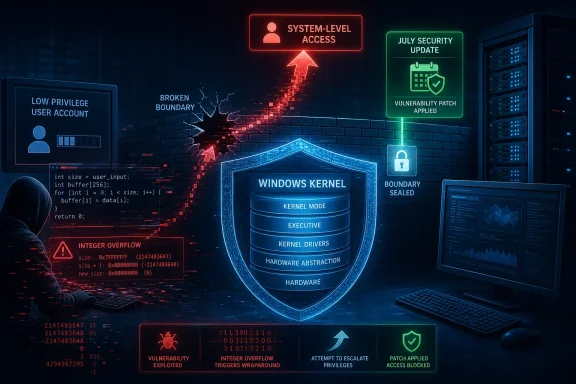
Microsoft’s Security Update Guide describes the issue as an integer overflow or wraparound in the Windows Kernel. In practical terms, an attacker must already have code execution or an interactive foothold on the machine, but successful exploitation can turn a standard-user context into a SYSTEM-level compromise. That makes this the sort of vulnerability commonly used after phishing, malicious installers, browser exploits, or stolen low-privilege credentials have provided initial access.
The National Vulnerability Database, which has ingested Microsoft’s CVE record but has not completed its own enrichment, confirms the same core details: local attack vector, low attack complexity, low privileges required, no user interaction, and complete impact to confidentiality, integrity, and availability. Microsoft published the advisory on July 14, 2026.
A Local Bug With System-Level Consequences
CVE-2026-58532 is not a remote code execution bug. It does not, by itself, let an internet-based attacker compromise an unpatched server simply by reaching an exposed service. The CVSS vector requires local access and low privileges, a meaningful limitation that helps explain why Microsoft assigned an Important rather than Critical severity rating.
That distinction should not cause administrators to dismiss it. Kernel privilege-escalation vulnerabilities are force multipliers: they remove the boundary that separates a compromised user account, application sandbox, or service account from the operating system’s most powerful execution context. Once an attacker reaches SYSTEM, they can typically tamper with security tooling, access protected files, create persistence, extract credentials, and interfere with recovery efforts.
The underlying weakness is classified as CWE-190, integer overflow or wraparound. These defects occur when an arithmetic operation produces a result outside the range a variable can represent, potentially causing a value to wrap to an unexpected number. In kernel code, where size calculations, memory allocation, and object boundaries must be exact, an arithmetic mistake can become a security boundary failure.
Microsoft has not publicly identified the precise kernel component, supplied proof-of-concept code, or described a reliable exploitation path. That restraint is normal for a newly patched Windows kernel flaw and means defenders should avoid filling the gaps with assumptions about a particular driver or subsystem.
No Public Exploitation Flag, But Patch Timing Still Matters
CISA’s structured vulnerability record currently lists exploitation as “none” and automation as “no” for CVE-2026-58532. BleepingComputer’s July Patch Tuesday coverage also lists the flaw among Microsoft’s Important Windows Kernel fixes, rather than among the month’s publicly exploited zero-days.
That is useful context, but it is not a reason to defer deployment indefinitely. “No exploitation detected” means no confirmed exploitation has been reported through that tracking process; it does not mean attackers cannot develop an exploit after studying the patch. The release of a fix frequently gives vulnerability researchers and threat actors a clearer starting point for comparing patched and unpatched kernel code.
The advisory’s confidence should also be read carefully. Microsoft is the CVE numbering authority and vendor for the affected software, and the issue has a concrete weakness classification, impact statement, CVSS vector, fixed builds, and mapped updates. This is a confirmed vendor vulnerability, not an uncorroborated report. What remains limited is public technical detail and known attacker tooling.
For endpoint teams, the correct operational reading is straightforward: prioritize it alongside the rest of July’s Windows security release, particularly where users can execute untrusted software, local administrator rights are tightly controlled, or workstations routinely access privileged infrastructure.
Windows 10, Windows 11, and Server Builds in Scope
According to Microsoft’s affected-product data, CVE-2026-58532 spans a broad set of supported and extended-support Windows releases. The July update brings affected versions to the following minimum builds:
- Windows 10 version 1607 and Windows Server 2016 require build 14393.9339 or later.
- Windows 10 version 1809 and Windows Server 2019 require build 17763.9020 or later.
- Windows 10 version 21H2 requires build 19044.7548 or later, while Windows 10 version 22H2 requires build 19045.7548 or later.
- Windows 11 versions 24H2 and 25H2 require the July cumulative update that reaches build 26100.8875 or later; version 25H2 is also identified as build 26200.8875 in Microsoft’s release notes.
- Windows 11 version 26H1 requires build 28000.2525 or later.
- Windows Server 2022 requires build 20348.5386 or later, and Windows Server 2025 requires build 26100.33158 or later.
- Windows Server 2012 and Windows Server 2012 R2 are also listed, subject to their applicable Extended Security Update servicing arrangements.
For mainstream Windows 11 deployments, Microsoft’s July 14 cumulative update is KB5101650 for Windows 11 24H2 and 25H2. Microsoft Support says that package takes those releases to builds 26100.8875 and 26200.8875, respectively. Windows Server 2025 receives the fix in KB5099536, which advances the platform to build 26100.33158.
The wide product coverage matters because it complicates inventory work. A fleet that mixes Windows 11, legacy Windows 10 machines, Server Core installations, and older domain infrastructure should not rely on one KB number as proof of remediation. Compliance checks should validate the installed cumulative update or resulting OS build against the release applicable to each servicing channel.
Deployment Needs to Include Recovery Planning
Microsoft’s July updates include more than this one vulnerability, and the Windows 11 and Server 2025 release notes carry additional operational considerations. Microsoft documents a known issue affecting some third-party applications that use OLE Automation to launch Office apps or open Office documents; the July releases address reports associated with the prior month’s updates.
The same July release family also continues Microsoft’s Secure Boot certificate transition work. That is separate from CVE-2026-58532, but it is a reason to preserve normal safeguards around cumulative-update deployment: test representative hardware, ensure BitLocker recovery material is escrowed, validate remote-access paths, and confirm that endpoint-management reporting captures post-restart build numbers.
Administrators using WSUS, Microsoft Configuration Manager, Windows Update for Business, or third-party patch tooling should approve the relevant July security updates promptly, first in a pilot ring if their change controls require it. Systems that cannot be patched immediately should be prioritized for reduced local execution risk: remove unnecessary local administrator rights, restrict interactive access, isolate exposed management servers, and investigate unexpected service or driver installations.
Those steps are compensating controls, not a substitute for the update. Because this flaw sits in the Windows Kernel, endpoint protection can help detect post-compromise activity but cannot reliably restore a privilege boundary once a successful kernel exploit has run.
CVE-2026-58532 is currently a patched, locally exploitable privilege-escalation vulnerability with no confirmed public exploitation. The next meaningful change will be whether Microsoft, CISA, or security researchers disclose more technical detail—or whether threat activity turns a routine July deployment task into an incident-response concern.
References
- CVE-2026-58532 Windows Kernel Elevation of Privilege Vulnerability MSRC · 2026-07-14T07:00:00-07:00