

Microsoft’s July 14, 2026 security updates fix CVE-2026-58533, a Windows Remote Desktop Client information disclosure vulnerability that can expose data when a user interacts with a malicious Remote Desktop Protocol endpoint. The flaw affects a broad span of supported Windows client and server releases, including Windows 10, Windows 11, Windows Server 2012 through Windows Server 2025, and Server Core installations.
Microsoft rates the issue Important with a CVSS 3.1 base score of 6.5. The immediate priority for IT teams is straightforward: deploy the July cumulative or security updates across systems that initiate RDP sessions, not only the servers that accept them. That distinction matters. This is a client-side issue, meaning a workstation, admin jump box, or server can be exposed while its operator is connecting out to a remote machine.
Microsoft’s Security Response Center published the advisory on July 14. The National Vulnerability Database describes the underlying issue as use of an uninitialized resource in Windows RDP that allows an unauthorized attacker to disclose information over a network. Microsoft has acknowledged the flaw, so the vulnerability’s existence and core technical classification are established even though public technical detail remains limited.
RDP security discussions often begin with exposed TCP port 3389, weak password controls, Network Level Authentication, and gateway placement. Those remain important controls, but CVE-2026-58533 is a different operational problem: patching only machines that host remote sessions does not fully address risk if administrators and support staff use unpatched Windows systems to connect to potentially untrusted hosts.
The CVSS vector indicates network reachability, low attack complexity, no attacker privileges, and required user interaction. In practical terms, an attacker would need to persuade or induce a target to initiate an RDP connection to a hostile or compromised endpoint. That may be less immediately alarming than a wormable RDP server flaw, but it is meaningful in environments where help-desk teams, managed service providers, developers, and infrastructure administrators routinely connect to systems outside a tightly controlled estate.
The assessed impact is confidentiality only: the published scoring assigns high confidentiality impact, with no integrity or availability impact. That means the advisory does not describe remote code execution, privilege elevation, ransomware-style disruption, or a route to modify data. It does describe a potential data exposure from the connecting machine, which can still be serious when an RDP client is used from privileged administrative workstations.
Neither Microsoft’s advisory nor the NVD entry currently provides a public proof of concept, packet sequence, affected RDP feature, or a detailed account of what information could be disclosed. That limits the value of speculation. Administrators should resist turning “information disclosure” into claims about credential theft, NTLM relay, clipboard leakage, or arbitrary memory extraction unless Microsoft or credible researchers provide evidence for those specific outcomes.
There is, however, enough public information to make sensible patching decisions. The NVD’s record reflects Microsoft’s 6.5 Medium CVSS score and confirms that user interaction is required. CISA’s SSVC assessment, added to the CVE record on July 14, lists exploitation as “none,” automation as “no,” and technical impact as “partial.” In other words, there is no indication of active exploitation or a readily automatable attack path at publication time.
That status should shape prioritization, not create complacency. An RDP client flaw becomes more consequential where privileged operators regularly connect to external vendor systems, customer networks, labs, acquisition environments, cloud VMs, or recovery infrastructure. A hardened RDP server does not protect an unpatched administrator workstation from a malicious server it elects to trust.
The published fixed-build thresholds include:
Windows 11 version 25H2 is also listed as affected in Microsoft’s product data. Because servicing and build reporting can vary across branches, enterprises should use their deployed July 14 update package and compliance tooling rather than relying only on a manually interpreted version threshold.
For administrators using Windows Server 2022, the July update is KB5099540, which brings the OS to build 20348.5386. Windows 11 version 26H1’s July update is KB5101649, reaching build 28000.2525. Those are useful anchor points, but they are not substitutes for checking the appropriate update catalog entry for each supported release, architecture, and servicing channel.
Organizations should also review whether RDP is being used for workflows that do not require it. Remote Desktop Gateway, VPN access controls, device compliance policies, and segmented admin networks reduce the likelihood that an operator will be prompted into connecting to an arbitrary endpoint, but they do not replace the patch. Endpoint detection tools may have limited ability to identify a pure information-disclosure event, especially before Microsoft has published exploit-specific indicators.
A proportionate response is to deploy the July updates through the normal expedited security process, then validate installation on endpoints assigned privileged roles. Teams that must defer broad patching should temporarily tighten policies around outbound RDP: use approved jump hosts, prohibit direct connections to unverified external addresses, and require administrators to validate the identity and ownership of a target before connecting.
Microsoft credits Kyeongmin Kim, known as @hareh4ru, of KAIST Hacking Lab for reporting the vulnerability. As of July 15, there is no public exploit and no reported in-the-wild exploitation. The next event to watch is not a configuration workaround; it is whether follow-on research reveals more about the affected RDP path and the information an attacker can obtain. Until then, the July update is the complete remediation, and the systems most worth checking are the ones from which administrators reach everywhere else.
Microsoft rates the issue Important with a CVSS 3.1 base score of 6.5. The immediate priority for IT teams is straightforward: deploy the July cumulative or security updates across systems that initiate RDP sessions, not only the servers that accept them. That distinction matters. This is a client-side issue, meaning a workstation, admin jump box, or server can be exposed while its operator is connecting out to a remote machine.
Microsoft’s Security Response Center published the advisory on July 14. The National Vulnerability Database describes the underlying issue as use of an uninitialized resource in Windows RDP that allows an unauthorized attacker to disclose information over a network. Microsoft has acknowledged the flaw, so the vulnerability’s existence and core technical classification are established even though public technical detail remains limited.
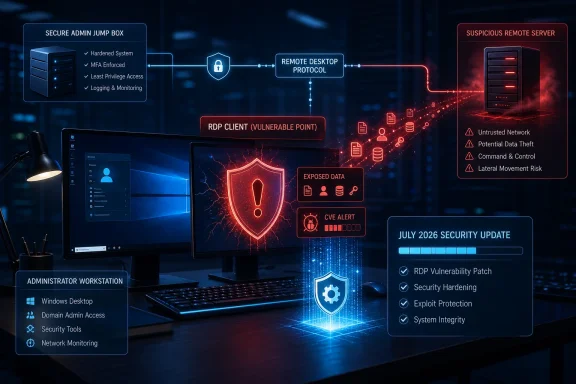 The RDP Client, Not the RDP Listener, Is in Scope
RDP security discussions often begin with exposed TCP port 3389, weak password controls, Network Level Authentication, and gateway placement. Those remain important controls, but CVE-2026-58533 is a different operational problem: patching only machines that host remote sessions does not fully address risk if administrators and support staff use unpatched Windows systems to connect to potentially untrusted hosts.The CVSS vector indicates network reachability, low attack complexity, no attacker privileges, and required user interaction. In practical terms, an attacker would need to persuade or induce a target to initiate an RDP connection to a hostile or compromised endpoint. That may be less immediately alarming than a wormable RDP server flaw, but it is meaningful in environments where help-desk teams, managed service providers, developers, and infrastructure administrators routinely connect to systems outside a tightly controlled estate.
The assessed impact is confidentiality only: the published scoring assigns high confidentiality impact, with no integrity or availability impact. That means the advisory does not describe remote code execution, privilege elevation, ransomware-style disruption, or a route to modify data. It does describe a potential data exposure from the connecting machine, which can still be serious when an RDP client is used from privileged administrative workstations.
A Small Bug Class With a Big Operational Footprint
Microsoft and NVD classify CVE-2026-58533 as CWE-908, Use of Uninitialized Resource. Broadly, that category covers cases where software uses a resource before it has been properly initialized, potentially allowing data left in memory or another resource state to be exposed unexpectedly.Neither Microsoft’s advisory nor the NVD entry currently provides a public proof of concept, packet sequence, affected RDP feature, or a detailed account of what information could be disclosed. That limits the value of speculation. Administrators should resist turning “information disclosure” into claims about credential theft, NTLM relay, clipboard leakage, or arbitrary memory extraction unless Microsoft or credible researchers provide evidence for those specific outcomes.
There is, however, enough public information to make sensible patching decisions. The NVD’s record reflects Microsoft’s 6.5 Medium CVSS score and confirms that user interaction is required. CISA’s SSVC assessment, added to the CVE record on July 14, lists exploitation as “none,” automation as “no,” and technical impact as “partial.” In other words, there is no indication of active exploitation or a readily automatable attack path at publication time.
That status should shape prioritization, not create complacency. An RDP client flaw becomes more consequential where privileged operators regularly connect to external vendor systems, customer networks, labs, acquisition environments, cloud VMs, or recovery infrastructure. A hardened RDP server does not protect an unpatched administrator workstation from a malicious server it elects to trust.
July Builds Mark the Patch Boundary
Microsoft’s affected-product data covers 18 Windows product entries when Server Core variants are included. The practical deployment message is that current July 2026 servicing should be the target across the fleet, while organizations on older Windows Server releases must verify that their Extended Security Update or other applicable servicing arrangements are functioning.The published fixed-build thresholds include:
| Product family | Systems below this build are affected |
|---|---|
| Windows 10 version 1607 / Windows Server 2016 | 14393.9339 |
| Windows 10 version 1809 / Windows Server 2019 | 17763.9020 |
| Windows 10 version 21H2 | 19044.7548 |
| Windows 10 version 22H2 | 19045.7548 |
| Windows 11 version 24H2 | 26100.8875 |
| Windows 11 version 26H1 | 28000.2525 |
| Windows Server 2022 | 20348.5386 |
| Windows Server 2025 | 26100.33158 |
| Windows Server 2012 | 9200.26226 |
| Windows Server 2012 R2 | 9600.23291 |
For administrators using Windows Server 2022, the July update is KB5099540, which brings the OS to build 20348.5386. Windows 11 version 26H1’s July update is KB5101649, reaching build 28000.2525. Those are useful anchor points, but they are not substitutes for checking the appropriate update catalog entry for each supported release, architecture, and servicing channel.
Patch the Machines That Hold the Keys
The priority group is not necessarily every office PC that has Remote Desktop Connection installed. It is the systems that regularly use it in high-trust work: privileged access workstations, domain administration endpoints, help-desk consoles, hypervisor management hosts, server-management jump boxes, and IT staff laptops.Organizations should also review whether RDP is being used for workflows that do not require it. Remote Desktop Gateway, VPN access controls, device compliance policies, and segmented admin networks reduce the likelihood that an operator will be prompted into connecting to an arbitrary endpoint, but they do not replace the patch. Endpoint detection tools may have limited ability to identify a pure information-disclosure event, especially before Microsoft has published exploit-specific indicators.
A proportionate response is to deploy the July updates through the normal expedited security process, then validate installation on endpoints assigned privileged roles. Teams that must defer broad patching should temporarily tighten policies around outbound RDP: use approved jump hosts, prohibit direct connections to unverified external addresses, and require administrators to validate the identity and ownership of a target before connecting.
Microsoft credits Kyeongmin Kim, known as @hareh4ru, of KAIST Hacking Lab for reporting the vulnerability. As of July 15, there is no public exploit and no reported in-the-wild exploitation. The next event to watch is not a configuration workaround; it is whether follow-on research reveals more about the affected RDP path and the information an attacker can obtain. Until then, the July update is the complete remediation, and the systems most worth checking are the ones from which administrators reach everywhere else.
References
- Primary source: MSRC
Published: 2026-07-14T07:00:00-07:00
Security Update Guide - Microsoft Security Response Center
 msrc.microsoft.com
