

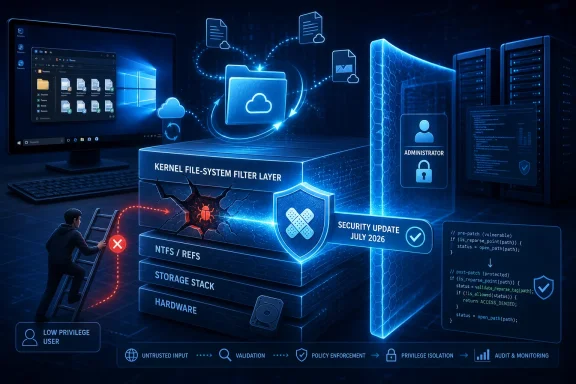
Microsoft published the advisory as part of its July Patch Tuesday release. The National Vulnerability Database lists the flaw with a CVSS 3.1 score of 7.8, rated High, using the vector AV:L/AC:L/PR:L/UI:N/S:U/C:H/I:H/A:H. In practical terms, exploitation requires local access and an existing low-privilege account, but does not require victim interaction and could compromise confidentiality, integrity, and availability once successful.
The Cloud Files Mini Filter Driver is part of Windows’ cloud-file virtualization infrastructure, the plumbing used by services such as OneDrive to show files in File Explorer before their full contents are present locally. That makes the component relevant even where an organization has not deliberately deployed a particular third-party sync client. The vulnerable code runs in the kernel-adjacent file-system filter path, which is exactly why a local bug can have consequences far beyond the permissions of the original user account.
Microsoft’s advisory does not provide public exploit code or a technical root-cause walkthrough. As of July 15, CISA’s SSVC metadata recorded exploitation as “none” and automation as “no,” while classifying the potential technical impact as total. That is not a reason to defer patching: it means there is no confirmed evidence of in-the-wild exploitation at publication time, not that a working local privilege-escalation exploit is impossible.
A Local Flaw That Changes the Post-Compromise Math
CVE-2026-58536 is not a network worm or a browser-drive-by bug. An attacker must already be able to execute code locally under an authorized account. That prerequisite matters for perimeter prioritization, but it should not minimize the risk for enterprise endpoints, shared workstations, virtual desktops, developer systems, or servers where a foothold can be obtained through phishing, malicious software, stolen credentials, or another vulnerability.
Elevation-of-privilege bugs are frequently chained with initial-access techniques. A malicious process that starts with standard-user rights is usually constrained by Windows security boundaries, endpoint controls, application permissions, and user-profile isolation. A successful kernel-level privilege escalation can erase much of that advantage, enabling tampering with protected files, credential theft, security-tool interference, persistence, or creation of administrative accounts.
The CVSS vector’s “PR:L” designation means the attacker needs low privileges rather than administrator rights. That is the central operational point: organizations should treat this as a post-compromise accelerator, not as a standalone remote entry point.
The July Builds That Close the Exposure
Microsoft’s affected-product data identifies a broad set of supported Windows client and server releases. The required protection arrives through the normal July cumulative updates rather than through a separate Cloud Files package.
For Windows 11 24H2 and Windows 11 25H2, the relevant July 14 update is KB5101650, which takes systems to OS Build 26100.8875 for 24H2 and Build 26200.8875 for 25H2. Microsoft’s release notes say the cumulative update is available through Windows Update, Windows Update for Business, Windows Server Update Services, and the Microsoft Update Catalog.
The vulnerable-version cutoffs reported by Microsoft through the NVD are:
| Product | Patched build threshold |
|---|---|
| Windows 10 version 1809 and Windows Server 2019 | 17763.9020 |
| Windows 10 version 21H2 | 19044.7548 |
| Windows 10 version 22H2 | 19045.7548 |
| Windows 11 version 24H2 | 26100.8875 |
| Windows 11 version 25H2 | 26200.8875 |
| Windows 11 version 26H1 | 28000.2525 |
| Windows Server 2022 | 20348.5386 |
| Windows Server 2025, including Server Core | 26100.33158 |
Windows Server 2022 receives the fix through KB5099540, which reaches OS Build 20348.5386. Windows Server 2025 receives KB5099536, reaching OS Build 26100.33158. The same coverage includes Server Core installations for the affected server generations.
Administrators should validate the installed cumulative update and OS build rather than assuming that an update scan completed successfully. The simplest checks are Settings’ Windows Update history on clients, winver for quick build verification, and managed-device reporting through Intune, Configuration Manager, WSUS, or the organization’s vulnerability-management platform.
Do Not Disable Cloud Files as a Substitute for Patching
The Cloud Files Mini Filter Driver may tempt administrators toward a service-level workaround: disable the component and reduce exposure. That is a poor default response unless Microsoft publishes a specific mitigation. Cloud Files is integrated with Windows file synchronization and placeholder behavior; disabling or altering its operation can disrupt OneDrive and other applications that depend on cloud-backed file access.
Microsoft has published a security fix, and its July cumulative updates are the supported remediation path. There is no vendor-issued workaround listed for CVE-2026-58536, and no indication that organizations need to remove OneDrive, block cloud sync clients, or disable File Explorer integration after deploying the update.
That distinction also matters for incident response. A process attempting to exploit the flaw would already have local execution, so network intrusion-prevention signatures are not a replacement for endpoint patching. Check Point has published an IPS detection entry for the CVE, but it should be viewed as a supplementary control, not a control that makes unpatched Windows endpoints safe.
Patch Rings Need a Shorter Delay Than Usual
For most environments, the response should be straightforward: deploy the July 2026 Windows cumulative updates through the normal expedited security-update process, then verify compliance. Organizations with staged update rings should consider moving systems exposed to untrusted code, shared-user workflows, development tools, or elevated local threat exposure into an earlier ring.
There are deployment considerations outside the CVE itself. Microsoft’s July Windows updates introduce hardening for third-party TDI transports, which can affect applications using sockets over unregistered transports. The vendor also documents existing update-related caveats, including a limited BitLocker recovery scenario on some managed devices with a particular PCR7 Group Policy configuration. Those issues justify testing, but they do not justify leaving high-value systems indefinitely below the fixed build.
For security teams, the right monitoring question is not whether an internet-facing service is exposed to CVE-2026-58536. It is whether standard-user code execution on a Windows device can still become administrator or SYSTEM-level control through an unpatched kernel-facing file-system component.
Microsoft has not disclosed exploit details, and neither Microsoft nor CISA had confirmed active exploitation as of July 15. That window can narrow quickly once a patch ships and researchers compare the fixed and vulnerable driver behavior. The practical milestone is therefore simple: Windows systems should be at the July 14, 2026 cumulative-update build levels before public technical analysis turns this local flaw into a more repeatable post-compromise technique.