

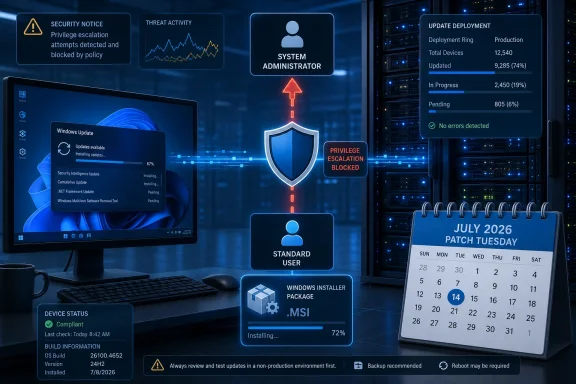
Microsoft describes the defect as an improper-authorization issue in Windows Installer. The practical consequence is not an initial break-in from the internet: an attacker must already be authorized to use the machine locally and have low-level access. But once that foothold exists, the vulnerable installer path could turn a standard-user compromise into full compromise of the system’s confidentiality, integrity, and availability.
Microsoft published the advisory alongside the July 2026 Patch Tuesday release. The National Vulnerability Database record, sourced from Microsoft, lists no user interaction requirement, low attack complexity, and a local attack vector. CISA’s SSVC data currently categorizes exploitation as “none” and automation as “no,” meaning there is no public indication that this specific vulnerability is being exploited at scale or is trivially weaponizable today.
That is useful context, but it should not turn into an excuse to defer the update. Elevation-of-privilege bugs are routinely paired with initial-access techniques such as phishing, malicious browser extensions, compromised remote-support tools, stolen VPN credentials, or malware already running under a user account. In those scenarios, the local prerequisite is already satisfied.
A Windows Installer flaw is an enterprise problem, not merely an MSI problem
Windows Installer is the component behind MSI-based application deployment, repair, maintenance, and removal. It sits close to one of the most sensitive boundaries in a Windows environment: the point where a user-context process requests system-level changes to files, services, registry keys, and application configuration.
CVE-2026-58540 is classified as CWE-285, or improper authorization. Microsoft has not disclosed the vulnerable code path, exploit mechanics, or whether particular installer configurations make exploitation easier. That lack of technical detail limits defensive detection guidance, but it also means administrators should avoid assuming the issue applies only to users manually double-clicking MSI packages.
The risk is more relevant in environments where ordinary users regularly receive software, where support teams permit user-driven repair operations, or where endpoint management tools install and update MSI packages under elevated contexts. Enterprise software deployment systems are not themselves identified as vulnerable by Microsoft’s advisory, but they make Windows Installer a frequently exercised component across the fleet.
The CVSS vector matters here. It requires low privileges, but it does not require an administrator token and does not require a victim to click a malicious prompt after the attacker has access. A successful exploit is scored for high impact across confidentiality, integrity, and availability—the standard profile of a route to SYSTEM-level or equivalent local control.
The affected list spans old servers and current Windows 11 builds
According to Microsoft’s affected-product data as mirrored in the National Vulnerability Database, the flaw is addressed by the July 14 servicing releases for the following Windows families:
- Windows 10 version 1607 through build 14393.9339, Windows 10 version 1809 through build 17763.9020, Windows 10 version 21H2 through build 19044.7548, and Windows 10 version 22H2 through build 19045.7548 are affected below those patched build levels.
- Windows 11 version 24H2 and Windows 11 version 25H2 are affected below build 26100.8875, while Windows 11 version 26H1 is affected below build 28000.2525.
- Windows Server 2012, 2012 R2, 2016, 2019, 2022, and 2025 are affected, including the corresponding Server Core installations where listed by Microsoft.
- Windows Server 2022 is remediated by the July update that advances the OS to build 20348.5386. Windows Server 2025 is affected below build 26100.33158.
This range is the more consequential part of the advisory. It includes long-lived server platforms that often host line-of-business applications, management infrastructure, file services, virtualization tooling, and operational workloads where a local foothold can have outsized value. It also includes older systems whose update cadence may be governed by Extended Security Updates or other exception processes rather than normal Windows Update rings.
For client systems, the July cumulative update is the correct delivery mechanism. Administrators do not need to hunt for a standalone Windows Installer package or attempt to replace msiexec.exe manually. Deploy the applicable July 14 cumulative update through Windows Update, Windows Update for Business, WSUS, Microsoft Configuration Manager, or the organization’s endpoint-management platform, then validate the installed OS build.
No known exploitation changes the priority, not the action
The first security question after a Windows privilege-escalation disclosure is whether attackers are already using it. In this case, the answer currently appears to be no. CISA’s publicly visible SSVC assessment marks exploitation as none, and Microsoft’s advisory does not list the flaw as publicly disclosed or exploited in the wild.
That lowers the immediate incident-response urgency compared with a zero-day being actively used against Windows endpoints. It does not lower the importance of patching a flaw that can transform low-privilege execution into total device compromise. Vulnerability management teams should treat CVE-2026-58540 as a normal but meaningful July deployment priority: test promptly, deploy broadly, and make exception decisions consciously rather than accidentally.
The designation that automation is “no” should also be read narrowly. It reflects the available assessment of repeatable, scalable exploitation at publication time. It is not a promise that proof-of-concept code will not appear after reverse engineers compare July’s patched binaries with June’s releases. Windows servicing changes are frequently examined by researchers and threat actors once security fixes ship.
That is why the most valuable remediation window is often the days immediately after Patch Tuesday, before a reliable exploit becomes common knowledge.
Patch validation should focus on build compliance and unexpected installer activity
For Windows 11 24H2 and 25H2, the key post-update checkpoint is build 26100.8875 or later. For Windows 11 26H1, it is 28000.2525 or later. Server teams should use their approved monthly update baselines and confirm the relevant build level, especially for Server Core nodes that are easy to miss in inventory reports.
Organizations with segmented patch rings should prioritize machines that meet two conditions: users can obtain code execution there, and the machine has access to privileged resources. That commonly includes shared workstations, jump boxes, Remote Desktop Session Host servers, developer endpoints, software-packaging systems, and servers used by administrators for routine management.
While Microsoft has not supplied vulnerability-specific detection logic, defenders can still use ordinary endpoint telemetry to investigate suspicious installer behavior. Unexpected executions of msiexec.exe, MSI files launched from user-writable folders, installer activity spawned by script hosts, or package installation attempts immediately following suspicious logons are all worth triaging. Those signals are not proof of CVE-2026-58540 exploitation; they are sensible hunting leads around a component now known to have had a high-impact authorization flaw.
Hardening practices remain useful as compensating controls, particularly during rollout. Least-privilege user accounts, application control through Windows Defender Application Control or AppLocker where appropriate, reduced local-administrator membership, and careful controls around remote access reduce the number of paths an attacker can use to reach the vulnerability’s local precondition. None replaces the update.
July’s patch is the only durable fix
Microsoft has not published a workaround or mitigation that removes exposure to CVE-2026-58540 without installing the July 14 updates. Disabling Windows Installer broadly would be a disruptive and unreliable response for most organizations, potentially breaking application deployment, repair, and removal while leaving uncertainty about whether every exploitable path has been eliminated.
The immediate task is therefore straightforward: bring affected Windows systems to Microsoft’s July 2026 cumulative-update baseline, confirm the resulting OS builds, and close any patch-management gaps involving older Windows Server versions. The unresolved variable is whether subsequent technical analysis turns this from a high-severity local escalation flaw into a routinely exploited post-compromise technique; timely patching is what keeps that question from becoming an operational problem.