

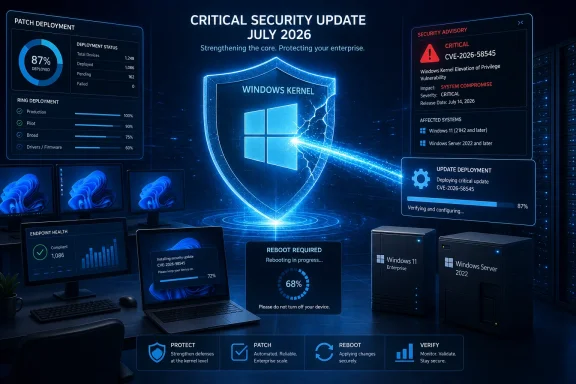
Microsoft classifies the issue as improper access control in the Windows Kernel. The company’s advisory does not identify the specific protection that can be bypassed, the affected kernel component, or a workaround. That restraint is normal for a newly patched kernel issue, but it leaves one practical conclusion: deploy the July cumulative updates rather than assuming endpoint controls alone reduce the exposure.
The National Vulnerability Database lists CVE-2026-58545 with a CVSS 3.1 vector of local attack, low attack complexity, low privileges required, and no user interaction. Its score works out to 5.5, reflecting high confidentiality impact but no stated integrity or availability impact. That is not the profile of a wormable bug or a remote initial-access vulnerability. It is, however, precisely the kind of weakness that becomes valuable after phishing, malware execution, credential theft, or a foothold through an unpatched application.
CISA’s SSVC assessment currently records no known exploitation, says the flaw is not automatable, and characterizes its technical impact as partial. In plain language, there is no public indication that attackers are actively using this bug, and it does not appear designed for mass-scale, hands-off compromise. But an authorized local attacker is a meaningful threat model in enterprise Windows estates, especially on shared workstations, jump servers, virtual desktop infrastructure, and systems where an initial compromise gives an attacker a standard-user token.
The July builds draw a clear patch boundary
Microsoft’s published version ranges make verification unusually straightforward. On Windows 11 24H2, devices are vulnerable below build 26100.8875; Windows 11 25H2 is covered by the same July cumulative update and reaches build 26200.8875. Windows 11 26H1 needs build 28000.2525 or later.
For mainstream Windows 11 24H2 and 25H2 systems, Microsoft Update Catalog identifies KB5101650 as the July 2026 cumulative update that delivers build 26100.8875 or 26200.8875, depending on the release. Administrators should treat the installed OS build—not merely a successful-looking update job—as the final confirmation that the machine crossed the fix boundary.
The affected Windows 10 releases are Windows 10 1607, 1809, 21H2, and 22H2. Microsoft lists the following minimum fixed builds:
- Windows 10 1607 and Windows Server 2016 require build 14393.9339 or later.
- Windows 10 1809 and Windows Server 2019 require build 17763.9020 or later.
- Windows 10 21H2 requires build 19044.7548 or later.
- Windows 10 22H2 requires build 19045.7548 or later.
The server side is just as important. Microsoft lists Windows Server 2012, Windows Server 2012 R2, Windows Server 2016, Windows Server 2019, Windows Server 2022, and Windows Server 2025—including Server Core installations—as affected. The specified thresholds are build 9200.26226 for Server 2012, 9600.23291 for Server 2012 R2, 20348.5386 for Server 2022, and 26100.33158 for Windows Server 2025.
That broad coverage matters because kernel security bypasses are rarely confined to the fleets that receive the most day-to-day desktop attention. Older line-of-business servers, long-lived management hosts, and Server Core deployments often have the greatest patching friction—and often concentrate administrative tools, privileged credentials, and remote-management access.
This is a foothold amplifier, not an entry point
The phrase security feature bypass can make a vulnerability sound vague or secondary. In operational terms, its severity depends on what sits around it.
CVE-2026-58545 does not give an internet-based attacker a direct route into an exposed Windows machine. It requires local access and low privileges. An attacker therefore needs some other route first: a malicious attachment, a browser exploit, stolen credentials, abused remote access, a compromised software supply chain, or physical access to a logged-in machine.
Once that foothold exists, a low-complexity kernel bypass can be used to defeat a guardrail that defenders assumed would constrain later activity. Microsoft’s advisory says the resulting confidentiality effect is high, which suggests the bypass may enable access to information that should otherwise be protected. It does not say the vulnerability grants SYSTEM privileges, runs arbitrary kernel code, disables Microsoft Defender, or bypasses BitLocker; organizations should avoid filling in those blanks with assumptions.
The distinction is important for incident response. A local kernel bug with low privileges required should be evaluated alongside evidence of endpoint intrusion, suspicious local tooling, credential access, unusual process trees, or unauthorized interactive logons. It should not be handled as if it were a stand-alone network emergency—unless other activity indicates an attacker is already present.
Patch it through normal change control, but do not defer it casually
The July 14 release date gives IT teams a normal Patch Tuesday deployment path. For organizations using Windows Update for Business, WSUS, Microsoft Configuration Manager, Intune, or third-party patch platforms, the priority is to ensure that the relevant July cumulative update is approved, installed, and followed by the required restart.
Because this is a Windows kernel fix, a reboot is not optional housekeeping. A machine that has downloaded the package but is pending restart remains on its pre-patch kernel. Security dashboards and compliance reports should distinguish between “update installed” and “current kernel build active after reboot.”
A sensible enterprise rollout should focus first on systems where local access is easy to obtain or particularly valuable:
- Prioritize shared endpoints, privileged access workstations, jump boxes, Remote Desktop Session Host systems, developer workstations, and VDI pools.
- Include Windows Server Core systems in inventory and compliance checks; their reduced interface does not remove the underlying kernel exposure.
- Review Windows 10 systems still receiving updates through enterprise support arrangements, since several older branches remain explicitly listed by Microsoft.
- Validate actual build numbers after deployment, particularly where servicing-stack issues, maintenance windows, or restart deferrals have historically left devices partially patched.
Microsoft has not published a workaround, mitigating configuration, exploit code, or evidence of exploitation for CVE-2026-58545. The absence of public technical details limits immediate detection engineering, but it also means defenders should not chase speculative indicators or disable unrelated Windows protections in the name of mitigation.
The real risk is patch lag on systems attackers already touch
The most useful reading of Microsoft’s advisory is not that every Windows PC faces an imminent compromise. It is that a low-privilege local foothold can become more useful than it should be on machines that miss the July kernel update.
That is a familiar and uncomfortable pattern in Windows incident response. Attackers do not need every vulnerability to be remotely exploitable; they chain weaknesses. The initial intrusion gets them onto a device, credentials expand reach, and local flaws erode the safeguards meant to contain them. A security feature bypass can be the quiet middle link in that chain.
For July 2026, the immediate action is concrete: install the cumulative update that moves each supported Windows release past Microsoft’s published fixed build. With no exploit reported and no technical disclosure yet available, organizations have a chance to close this gap before CVE-2026-58545 becomes more than a line item in a crowded Patch Tuesday.
References
- CVE-2026-58545 Windows Kernel Security Feature Bypass Vulnerability MSRC · 2026-07-14T07:00:00-07:00