

Microsoft’s July 14, 2026 security updates fix CVE-2026-58608, a Windows Print Spooler remote code execution vulnerability affecting supported Windows 10, Windows 11, and Windows Server installations. The flaw carries a Microsoft-assigned CVSS 3.1 score of 8.8 and could let an authenticated attacker execute code across a network without user interaction.
Detailed in Microsoft’s Security Update Guide and recorded by the National Vulnerability Database, the vulnerability stems from a race condition in Windows Print Spooler components. Microsoft identifies both improper synchronization and a use-after-free memory-safety error as underlying weaknesses.
Administrators should deploy the July cumulative security updates promptly, prioritizing print servers, Remote Desktop Session Host systems, and other machines that expose Print Spooler functionality to network users. Microsoft’s disclosure confirms the vulnerability exists, although the currently public technical information stops short of documenting the vulnerable function or a reproducible attack sequence.
CVE-2026-58608 is network-accessible, has low attack complexity, and requires no action from the victim. Its CVSS vector is AV:N/AC:L/PR:L/UI:N/S:U/C:H/I:H/A:H, meaning successful exploitation could compromise confidentiality, integrity, and availability within the affected system’s security scope.
The important qualifier is PR:L: an attacker requires low-level privileges before attempting exploitation. This is not described as an unauthenticated, internet-facing path into every Windows PC running the Print Spooler service.
That prerequisite still leaves substantial risk inside enterprise networks. A compromised domain account, malicious contractor, infected workstation, or attacker who has obtained ordinary credentials could potentially use the vulnerability as a second-stage route to code execution on another Windows system.
Print servers are the obvious priority because they are designed to receive connections from many users and computers. Shared application servers, virtual desktop infrastructure, and multi-user Windows hosts also deserve attention because an attacker may already have the access needed to satisfy the low-privilege requirement.
The vulnerability does not require social engineering or a user to open a document, install a printer, or approve a prompt, according to Microsoft’s scoring. Low attack complexity also indicates that exploitation does not depend on unusual conditions, although the race-condition classification suggests reliable exploitation may require careful timing and memory manipulation.
Microsoft has not publicly described the resulting execution context in the material available at publication. Administrators should therefore avoid assuming that “remote code execution” automatically means SYSTEM-level access in this particular case, even though the Print Spooler has historically been an attractive target because parts of the subsystem operate with elevated privileges.
The fixed build boundaries include:
Windows 10 requires additional scrutiny because ordinary support for version 22H2 ended on October 14, 2025. Devices still on that release need an applicable Extended Security Updates entitlement, while supported Windows 10 Enterprise LTSC and IoT Enterprise LTSC editions follow their own lifecycles.
Inventory systems should verify installed OS builds rather than treating a successful update scan as sufficient evidence. Administrators using Microsoft Configuration Manager, Windows Update for Business, WSUS, or third-party patch tools should confirm that endpoints have actually restarted and reached the fixed build for their release.
The National Vulnerability Database reproduces Microsoft’s description and scoring but was still awaiting its own enrichment at publication. That status does not cast doubt on the vulnerability; it means NIST had not yet completed an independent analysis of the affected configurations, scoring, and references.
Confidence is lower when it comes to the precise mechanics of exploitation. The public record identifies a race condition, improper synchronization, and a use-after-free condition, but Microsoft has not published a technical walkthrough, proof of concept, memory layout, or affected function.
There is also no confirmed public evidence in the reviewed advisories that CVE-2026-58608 was being exploited in the wild when Microsoft released the patch on July 14. It should not be labeled a zero-day solely because it affects the Print Spooler or resembles earlier Windows printing vulnerabilities.
That distinction matters. The 2021 PrintNightmare crisis involved public exploit code and emergency mitigation work around CVE-2021-34527, whereas the currently disclosed facts for CVE-2026-58608 point to a vendor-confirmed, patched vulnerability with more limited public attack knowledge.
The absence of public exploit details lowers immediate attacker readiness, but it is temporary protection at best. Patch comparison can allow researchers and threat actors to identify changed code after a security update ships, especially when Microsoft has already supplied useful clues about the weakness class and affected component.
That workaround carries operational consequences. Domain controllers, server workloads, and administrative hosts often have no legitimate reason to process print jobs, but disabling the service on print servers, Remote Desktop hosts, or line-of-business systems may break required printing workflows.
Network segmentation and firewall policy should also prevent arbitrary workstation-to-server access to printing interfaces. These controls are particularly useful against an authenticated attacker attempting lateral movement, but they do not replace the corrected binaries.
Microsoft’s Windows Protected Print Mode can reduce dependence on third-party print drivers and constrains parts of the modern printing architecture. It is a worthwhile hardening direction for compatible Windows 11 environments, but Microsoft’s advisory does not present it as a complete substitute for patching CVE-2026-58608.
Security teams should watch for subsequent revisions to the Microsoft Security Update Guide, NVD enrichment, exploit demonstrations, and any addition to the Cybersecurity and Infrastructure Security Agency’s Known Exploited Vulnerabilities catalog. For now, the practical dividing line is clear: systems below the July 14 fixed builds remain exposed to a vendor-confirmed network attack path, while updated systems contain Microsoft’s correction.
Detailed in Microsoft’s Security Update Guide and recorded by the National Vulnerability Database, the vulnerability stems from a race condition in Windows Print Spooler components. Microsoft identifies both improper synchronization and a use-after-free memory-safety error as underlying weaknesses.
Administrators should deploy the July cumulative security updates promptly, prioritizing print servers, Remote Desktop Session Host systems, and other machines that expose Print Spooler functionality to network users. Microsoft’s disclosure confirms the vulnerability exists, although the currently public technical information stops short of documenting the vulnerable function or a reproducible attack sequence.
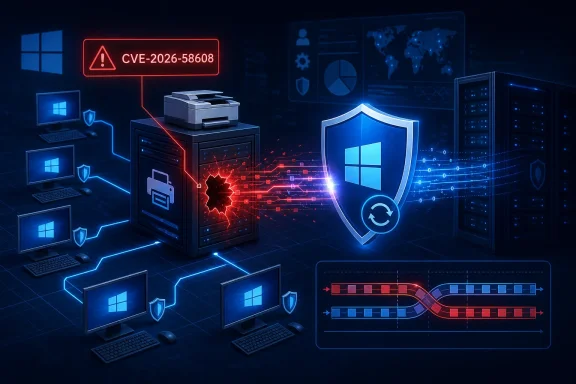 Authentication Narrows the Door, but Does Not Close It
CVE-2026-58608 is network-accessible, has low attack complexity, and requires no action from the victim. Its CVSS vector is AV:N/AC:L/PR:L/UI:N/S:U/C:H/I:H/A:H, meaning successful exploitation could compromise confidentiality, integrity, and availability within the affected system’s security scope.The important qualifier is PR:L: an attacker requires low-level privileges before attempting exploitation. This is not described as an unauthenticated, internet-facing path into every Windows PC running the Print Spooler service.
That prerequisite still leaves substantial risk inside enterprise networks. A compromised domain account, malicious contractor, infected workstation, or attacker who has obtained ordinary credentials could potentially use the vulnerability as a second-stage route to code execution on another Windows system.
Print servers are the obvious priority because they are designed to receive connections from many users and computers. Shared application servers, virtual desktop infrastructure, and multi-user Windows hosts also deserve attention because an attacker may already have the access needed to satisfy the low-privilege requirement.
The vulnerability does not require social engineering or a user to open a document, install a printer, or approve a prompt, according to Microsoft’s scoring. Low attack complexity also indicates that exploitation does not depend on unusual conditions, although the race-condition classification suggests reliable exploitation may require careful timing and memory manipulation.
Microsoft has not publicly described the resulting execution context in the material available at publication. Administrators should therefore avoid assuming that “remote code execution” automatically means SYSTEM-level access in this particular case, even though the Print Spooler has historically been an attractive target because parts of the subsystem operate with elevated privileges.
The July Builds Establish the Patch Boundary
Microsoft included the correction in the July 14 cumulative security updates. The affected-product data spans current Windows releases and older editions still receiving servicing through channels such as Long-Term Servicing Channel releases or Extended Security Updates.The fixed build boundaries include:
- Windows 10 versions 21H2 and 22H2 are protected at OS builds 19044.7548 and 19045.7548 through KB5099539.
- Windows 10 version 1607 and Windows Server 2016 are protected at build 14393.9339.
- Windows 10 version 1809 and Windows Server 2019 are protected at build 17763.9020.
- Windows 11 versions 24H2 and 25H2 receive the correction through the July servicing packages for those releases.
- Windows 11 version 26H1 is protected at build 28000.2525 through KB5101649.
- Windows Server 2022 is protected at build 20348.5386 through KB5099540.
- Windows Server 2025 is protected at build 26100.33158 through its July cumulative update.
- Windows Server 2012 and Windows Server 2012 R2 receive their respective July Monthly Rollups, KB5099445 and KB5099444, where applicable under Microsoft’s servicing programs.
Windows 10 requires additional scrutiny because ordinary support for version 22H2 ended on October 14, 2025. Devices still on that release need an applicable Extended Security Updates entitlement, while supported Windows 10 Enterprise LTSC and IoT Enterprise LTSC editions follow their own lifecycles.
Inventory systems should verify installed OS builds rather than treating a successful update scan as sufficient evidence. Administrators using Microsoft Configuration Manager, Windows Update for Business, WSUS, or third-party patch tools should confirm that endpoints have actually restarted and reached the fixed build for their release.
Microsoft’s Confirmation Raises Confidence Above Speculation
The supplied vulnerability metric concerns confidence in whether a flaw exists and how credible its technical details are. In this case, confidence in the vulnerability’s existence is high because Microsoft is both the affected vendor and the CVE Numbering Authority that published the record, and security updates containing a correction are already available.The National Vulnerability Database reproduces Microsoft’s description and scoring but was still awaiting its own enrichment at publication. That status does not cast doubt on the vulnerability; it means NIST had not yet completed an independent analysis of the affected configurations, scoring, and references.
Confidence is lower when it comes to the precise mechanics of exploitation. The public record identifies a race condition, improper synchronization, and a use-after-free condition, but Microsoft has not published a technical walkthrough, proof of concept, memory layout, or affected function.
There is also no confirmed public evidence in the reviewed advisories that CVE-2026-58608 was being exploited in the wild when Microsoft released the patch on July 14. It should not be labeled a zero-day solely because it affects the Print Spooler or resembles earlier Windows printing vulnerabilities.
That distinction matters. The 2021 PrintNightmare crisis involved public exploit code and emergency mitigation work around CVE-2021-34527, whereas the currently disclosed facts for CVE-2026-58608 point to a vendor-confirmed, patched vulnerability with more limited public attack knowledge.
The absence of public exploit details lowers immediate attacker readiness, but it is temporary protection at best. Patch comparison can allow researchers and threat actors to identify changed code after a security update ships, especially when Microsoft has already supplied useful clues about the weakness class and affected component.
Print Spooler Exposure Still Belongs on the Checklist
The primary response is to install the July 2026 security update rather than attempt to solve the issue solely through configuration. Where immediate patching is impossible, administrators can reduce exposure by disabling the Print Spooler service on systems that do not print and do not provide print services.That workaround carries operational consequences. Domain controllers, server workloads, and administrative hosts often have no legitimate reason to process print jobs, but disabling the service on print servers, Remote Desktop hosts, or line-of-business systems may break required printing workflows.
Network segmentation and firewall policy should also prevent arbitrary workstation-to-server access to printing interfaces. These controls are particularly useful against an authenticated attacker attempting lateral movement, but they do not replace the corrected binaries.
Microsoft’s Windows Protected Print Mode can reduce dependence on third-party print drivers and constrains parts of the modern printing architecture. It is a worthwhile hardening direction for compatible Windows 11 environments, but Microsoft’s advisory does not present it as a complete substitute for patching CVE-2026-58608.
Security teams should watch for subsequent revisions to the Microsoft Security Update Guide, NVD enrichment, exploit demonstrations, and any addition to the Cybersecurity and Infrastructure Security Agency’s Known Exploited Vulnerabilities catalog. For now, the practical dividing line is clear: systems below the July 14 fixed builds remain exposed to a vendor-confirmed network attack path, while updated systems contain Microsoft’s correction.
References
- Primary source: MSRC
Published: 2026-07-14T07:00:00-07:00
Security Update Guide - Microsoft Security Response Center
 msrc.microsoft.com
- Official source: support.microsoft.com
MS16-087: Security update for Windows print spooler components: July 12, 2016 | Microsoft Support
Resolves a vulnerability in Windows that could allow remote code execution if an attacker is able to execute a man-in-the-middle (MiTM) attack on a workstation or print server, or set up a rogue print server on a target network.support.microsoft.com - Official source: microsoft.com
- Official source: learn.microsoft.com
More information on Windows protected print mode for enterprises and developers | Microsoft Learn
More information on Windows protected print mode for enterprises and developerslearn.microsoft.com - Related coverage: cyber.gc.ca
Vulnerability in the Windows Print Spooler Service – UPDATE 1 - Canadian Centre for Cyber Security
Vulnerability in the Windows Print Spooler Service – UPDATE 1www.cyber.gc.ca - Related coverage: aha.org
