

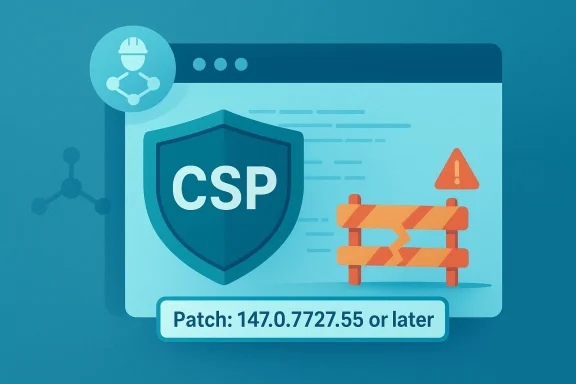
Chromium’s CVE-2026-5911 is the kind of browser flaw that looks modest in a bulletin but matters far more once you place it in the modern Chrome and Edge patching chain. Microsoft’s Security Update Guide says the issue affects Google Chrome prior to 147.0.7727.55 and allows a remote attacker to bypass content security policy through a crafted HTML page, while the CVE record itself identifies the problem as a policy bypass in ServiceWorkers. Google has already published the fix in its stable channel release notes, and Microsoft’s downstream tracking confirms the issue is now visible to enterprise defenders who rely on Edge and Chromium update workflows. ple: update to Chrome 147.0.7727.55 or later. The deeper story is more interesting. This is a Low-severity Chromium bug by Google’s own scale, but it still sits in a part of the browser stack that has outsized security value: policy enforcement, service worker control flow, and the boundary between trusted and untrusted web content. That makes it an important reminder that not every browser vulnerability needs code execution to matter.
Chro depends on multiple layers working together correctly, and ServiceWorkers occupy a particularly sensitive place in that architecture. They mediate offline behavior, caching, request interception, and other browser-side logic that can profoundly affect how a site executes and what it can access. When a flaw lets a remote attacker sidestep content security policy, the issue is not just theoretical; it can undermine one of the browser’s most important containment mechanisms.
The Microsoft Security Update Guide entrrete by stating that a crafted HTML page could be used to bypass CSP in Chrome builds before 147.0.7727.55. That detail matters because HTML pages are the universal delivery vehicle of the web. A vulnerability that can be triggered from an ordinary page, even if the end result is “only” policy bypass, can still become a stepping stone toward phishing, script injection, exploit chaining, or persistence tricks in enterprise web apps.
The broader Chromium ecosystem has made browser patching feels continued a pattern that security teams know well: the line between low- and medium-severity browser bugs and real operational risk is often thinner than the severity label suggests. Recent Chromium advisories surfaced in Microsoft’s Edge guidance have included policy enforcement bugs, UI spoofing flaws, side-channel leaks, and use-after-free issues, all of which reinforce the same lesson: browser security incidents often travel in families, not in isolation.
Google’s Chrome release cadence also matters here. Chrome 147.0.7727.55 is the patch baseline associated with the CVE, and the fact that this version is now in the stable channel means the vulnerability has crossed from “active disclosure” into “remediation available.” That transition is where enterprise patch teams should shift from triage to deployment. Google’s release notes and Microsoft’s update guidance together show the fix has moved into the mainstream distribution path.
That distinction is important because browser policy layers are not ornamental. CSP is one of the key defenses web applications use to limit sce injection risk, and constrain what resources a page can load. If an attacker can bypass CSP, they may be able to run code in a context that the site owner believed was hardened. That is why a low-severity classification in Chromium does not automatically mean low operational importance.
There is also a structural reason these bugs are risky: ServiceWorker behavior often crosses boundaries between the browser process, renderer process, and application-level assumptions. That be spectacular in isolation, but it can fit neatly into an attacker’s multi-stage chain. A seemingly narrow CSP bypass can become the first domino in a sequence that ends with credential theft or session hijacking. That is the sort of bug defenders cannot afford to dismiss simply because the severity label is low.
The real-world impact depends on the target site and the surrounding browser configuration. A consumer browsing a random site may see no obvious effect, while an enterprise user inside a SaaS environment with strong CSP assumptions may be exposed to a y failure. The same CVE can therefore look harmless in a lab and dangerous in a production tenant with sensitive workflows. That variance is exactly why security teams should treat browser policy bugs as contextual risks rather than abstract ones.
Enterprises also suffer from scale. A flaw that only affects a subset of pages can still become a meaningful incident if it touches authentication portals, document tools, or cloud application front ends. The practical takeaway is straightforward: browser hardening is only as strong as its we, and this CVE lands directly in that territory.
This matters because many organizations do not manage Chrome alone. They manage Edge, embedded WebView components, and a mixture of browsers across managed and unmanaged endpoints. Microsoft’s advisory model helps create a common reference point, so security teams do not have to infer patch status from browser family lineage alone. That reduces ambiguity during patch windows, especially when the vulnerability is newly disclosed.
Google’s stable-channel model means the fix is not just a theoretical upstream patch; it has already been promoted into production distribution. That reduces the uncertainty for fleet managers. The hard part is no longer waiting for Google to fix the issue; it is getting every device, profile, managed browser, and embedded Chromium instance onto a fixed build.
This is why browser-security advisories should be treated like change-management events, not just threat-intel alerts. Administrators need to know which release channels are in use, whether updates are centrally forced, and whether users can remain on older builds for extended periods. The version number is therefore both a technical marker and a governance test.
The common theme is trust boundary failure. Whether the bug involves a UI spoof, a security UI mistake, a download restriction bypass, or a CSP failure, the attacker is trying to persuade the browser to relax a rule. That makes the defense story less about one magical fix and more about relentless enforcement across subsystems. The browser has to be right everywhere, every time.
The upside is that these bugs often lend themselves to a clean fix once discovered. The downside is that their exploitability can be subtle, which means defenders may underestimate them if they focus only on headline-grabbing RCE cases. In operational terms, that makes disciplined patching more valuable than trying to rank every browser issue by intuition.
You should also review whether any internal web applications depend heavily on CSP assumptions. If a site’s trust model leans on script restrictions, inline-script blocking, or strict resource whitelisting, then a browser-side CSP bypass has more practical relevance than the “Low” label suggests. True for identity flows, finance apps, and admin consoles.
This incident also gives enterprises a chance to tighten a part of the security program that is often neglected: browser policy monitoring. A CSP bypass may not be headline-worthy, but it is exactly the kind of flaw that reveals whether a browser update process is truly mature. In that sense, the CVE is an opportunity to veriinventory accuracy, and endpoint visibility all at once.
Another risk is patch fragmentation. Chrome may update quickly while enterprise-managed browsers, embedded components, or deferred endpoints lag behind. That creates a ws are protected and others are not, which is precisely the kind of inconsistency attackers exploit. In browser security, uneven rollout is its own vulnerability class.
There is also a broader lesson for browser security teams: policy enforcement bugs deserve more attention than their severity label alone might imply. As web apps take on more business-critical work, browser policy becomes a control plane, not a footnote. That means small inconsistencies can have disproportionate consequences in the wrong environment.
Source: NVD / Chromium Security Update Guide - Microsoft Security Response Center
 Background
Chro depends on multiple layers working together correctly, and ServiceWorkers occupy a particularly sensitive place in that architecture. They mediate offline behavior, caching, request interception, and other browser-side logic that can profoundly affect how a site executes and what it can access. When a flaw lets a remote attacker sidestep content security policy, the issue is not just theoretical; it can undermine one of the browser’s most important containment mechanisms.The Microsoft Security Update Guide entrrete by stating that a crafted HTML page could be used to bypass CSP in Chrome builds before 147.0.7727.55. That detail matters because HTML pages are the universal delivery vehicle of the web. A vulnerability that can be triggered from an ordinary page, even if the end result is “only” policy bypass, can still become a stepping stone toward phishing, script injection, exploit chaining, or persistence tricks in enterprise web apps.
The broader Chromium ecosystem has made browser patching feels continued a pattern that security teams know well: the line between low- and medium-severity browser bugs and real operational risk is often thinner than the severity label suggests. Recent Chromium advisories surfaced in Microsoft’s Edge guidance have included policy enforcement bugs, UI spoofing flaws, side-channel leaks, and use-after-free issues, all of which reinforce the same lesson: browser security incidents often travel in families, not in isolation.
Google’s Chrome release cadence also matters here. Chrome 147.0.7727.55 is the patch baseline associated with the CVE, and the fact that this version is now in the stable channel means the vulnerability has crossed from “active disclosure” into “remediation available.” That transition is where enterprise patch teams should shift from triage to deployment. Google’s release notes and Microsoft’s update guidance together show the fix has moved into the mainstream distribution path.
What CVE-2026-5911 Actually Is
At its core, CVE-2026-5911 is a policy enforcement failure. The CVE description sayss in ServiceWorkers, and Microsoft’s guidance describes the practical effect as a remote attacker being able to bypass content security policy using a crafted HTML page. In browser-security terms, that means the issue is not about crashing the browser or directly taking over the machine; it is about getting the browser to do something it should have refused to do.That distinction is important because browser policy layers are not ornamental. CSP is one of the key defenses web applications use to limit sce injection risk, and constrain what resources a page can load. If an attacker can bypass CSP, they may be able to run code in a context that the site owner believed was hardened. That is why a low-severity classification in Chromium does not automatically mean low operational importance.
Why ServiceWorkers make the bug interesting
ServiceWorkers are powerful because they can sit between a page and network activity. That power is what makes policy em especially delicate. A bug in this area can alter how requests are handled, cached, or filtered, and that can ripple out into page integrity, script loading, and trust decisions. In practice, browser vendors have to make sure policy constraints survive all of those indirections.There is also a structural reason these bugs are risky: ServiceWorker behavior often crosses boundaries between the browser process, renderer process, and application-level assumptions. That be spectacular in isolation, but it can fit neatly into an attacker’s multi-stage chain. A seemingly narrow CSP bypass can become the first domino in a sequence that ends with credential theft or session hijacking. That is the sort of bug defenders cannot afford to dismiss simply because the severity label is low.
- It affects Google Chrome prior to 147.0.7727.55.
- It involves policy bypass in ServiceWorkers.
- It can be triggered by a crafted HTML page.
- The documented impact is a CSP bypass.
- Microsossue in its Security Update Guide for downstream visibility.
Why a CSP Bypass Still Matters
The obvious reaction to a low-severity browser issue is to shrug and prioritize only RCE-class bugs. That would be a mistake. Content security policy is one of the last lines of defense agains the browser, and once it is bypassed, an attacker may be able to execute code paths the site owner specifically tried to prohibit. In a modern web app, that can be enough to compromise a session, alter displayed content, or redirect the user into a fraudulent flow.The real-world impact depends on the target site and the surrounding browser configuration. A consumer browsing a random site may see no obvious effect, while an enterprise user inside a SaaS environment with strong CSP assumptions may be exposed to a y failure. The same CVE can therefore look harmless in a lab and dangerous in a production tenant with sensitive workflows. That variance is exactly why security teams should treat browser policy bugs as contextual risks rather than abstract ones.
Enterprise versus consumer impact
For consumers, the main concern is that a malicious page could undermine protections that many users never realize exist. That could enable phishing refinement, session misuse, or malicious script behavior that appears to come from a nterprises, the concern is larger because CSP is often part of a layered defense around line-of-business portals, internal dashboards, and identity flows.Enterprises also suffer from scale. A flaw that only affects a subset of pages can still become a meaningful incident if it touches authentication portals, document tools, or cloud application front ends. The practical takeaway is straightforward: browser hardening is only as strong as its we, and this CVE lands directly in that territory.
Microsoft’s Role in Downstream Visibility
Microsoft’s involvement here is not because it invented the bug. Rather, Microsoft’s Security Update Guide serves as a downstream visibility layer for Chromium-based Microsoft Edge environments, helping administrators determine whether their browser builds have inheritThat same pattern has appeared repeatedly across Chromium-origin advisories, and it is one of the reasons the Security Update Guide remains operationally useful to enterprises.This matters because many organizations do not manage Chrome alone. They manage Edge, embedded WebView components, and a mixture of browsers across managed and unmanaged endpoints. Microsoft’s advisory model helps create a common reference point, so security teams do not have to infer patch status from browser family lineage alone. That reduces ambiguity during patch windows, especially when the vulnerability is newly disclosed.
Why the same CVE appears in both ecosystems
Chromium vulnerabilities often surface in Microsoft’s guide because Edge rides on the Chromium codebase. When Google patches a browser engine bug, Microsoft has to ingest the relevant upstream changes into Edge before its own customers can be considered safe. That handoff is invisible to many end users, but it is critical for defenders who maintain asset inventories and compliance evidence.- Google publishes the upstream fix.
- Microsoft records the downstream impact in its guide.
- Administrators verify whether their Edge builds include the fix.
- Patch teams use the version baseline to confirm remediation.
- Security teams close the ticket only after deployment validation.
The Patch Baseline and What It Means
The important number in this advisory is 147.0.7727.55. That versie at which Chrome is no longer considered vulnerable to CVE-2026-5911, according to Microsoft’s description. This kind of version-based cutoff is standard browser-security hygiene, but it is only useful if organizations can reliably identify the build numbers actually running on their endpoints.Google’s stable-channel model means the fix is not just a theoretical upstream patch; it has already been promoted into production distribution. That reduces the uncertainty for fleet managers. The hard part is no longer waiting for Google to fix the issue; it is getting every device, profile, managed browser, and embedded Chromium instance onto a fixed build.
Version management is the real security control
Browser vulnerabilities are often resolvel, which sounds simple until you have to manage it across Windows, macOS, Linux, and mobile variations. A patch may exist, but endpoints can remain exposed if updates are deferred, policy-restricted, or simply not checked in yet. In other words, the fix exists on paper before it exists in reality.This is why browser-security advisories should be treated like change-management events, not just threat-intel alerts. Administrators need to know which release channels are in use, whether updates are centrally forced, and whether users can remain on older builds for extended periods. The version number is therefore both a technical marker and a governance test.
How This Fits Chromium’s 2026 Security Pattern
CVE-2026-5911 is part of a broader run of Chromium issues that show how browser security now spans memory safety, UI deception, side channels, and policy enforcement. Recent security notes in Chrome’s 2026 cycles have included bugs in Navigation, DevTools, WebView, and other subsystems, and Microsoft has repeatedly mirrored those findings for Edge visibility. That tells us something important: policy bypasses are not isolated oddities; they are one recurring expression of a larger browser-hardening problem.The common theme is trust boundary failure. Whether the bug involves a UI spoof, a security UI mistake, a download restriction bypass, or a CSP failure, the attacker is trying to persuade the browser to relax a rule. That makes the defense story less about one magical fix and more about relentless enforcement across subsystems. The browser has to be right everywhere, every time.
Why policy bugs keep recurring
Policy bugs recur because policy is hard to apply consistently once the browser begins composing multiple layers of behavior. One subsystem may be updated while another still assumes an older rule path, and a small mismatch can become a bypass. ServiceWorkers are especially exposed to this risk because they are powerful enough to shape request flow, but abstract enough that enforcement bugs can hide for a long time.The upside is that these bugs often lend themselves to a clean fix once discovered. The downside is that their exploitability can be subtle, which means defenders may underestimate them if they focus only on headline-grabbing RCE cases. In operational terms, that makes disciplined patching more valuable than trying to rank every browser issue by intuition.
What Administrators Should Do Now
The immediate action is to verify browser versions and ensure affected Chrome deployments are at 147.0.7727.55 or later. If your organization uses Edge or other Chromium-based browsers, check the downstream vendor’s guidance as well, because the patch may need to be coe goal is not merely awareness; it is version confirmation.You should also review whether any internal web applications depend heavily on CSP assumptions. If a site’s trust model leans on script restrictions, inline-script blocking, or strict resource whitelisting, then a browser-side CSP bypass has more practical relevance than the “Low” label suggests. True for identity flows, finance apps, and admin consoles.
Suggested response sequence
- Inventory Chrome and Chromium-based browser versions across managed devices.
- Confirm whether any systems remain below 147.0.7727.55.
- Check whether Edge or other Chromium consumers have received the equivalent downstream fix.
- Prioritize endpoints used for authentication, admin, or SaaSte patch success with post-update version reporting.
- Treat the issue as a patch-now browser update, not a backlog item.
- Focus on devices that visit high-value web apps.
- Recheck after update rollout to catch stragglers.
- Maintain browser inventory by channel and version.
- Escalate if policy restrictions prevent automatic updating.
Strengths and Opportunities
this vulnerability is the sort of bug for which a clear version fix exists, and that makes operational response much easier than with exploit-chain mysteries or in-the-wild zero-days. Microsoft’s downstream tracking also helps reduce confusion for organizations running mixed Chromium fleets. That means defenders can move quickly if they already have browser inventory and update enforcement in place.This incident also gives enterprises a chance to tighten a part of the security program that is often neglected: browser policy monitoring. A CSP bypass may not be headline-worthy, but it is exactly the kind of flaw that reveals whether a browser update process is truly mature. In that sense, the CVE is an opportunity to veriinventory accuracy, and endpoint visibility all at once.
- Clear fixed version: 147.0.7727.55.
- Downstream visibility through Microsoft’s Security Update Guide.
- Straightforward validation via version reporting.
- Low patch ambiguity compared with exploit-chain bugs.
- Useful trigger for reviewing browser governance.
- Good candidate for automated compliance checks.
Risks and Concerns
The biggest concern is that “Low severity” can lull organizations into delaying action. That would be a mistake, because policy bypasses are often more valuable to attackers than their label suggests. A remote attacker who can weaken CSP may not need a dramatic exploit if the target page is already a high-value web workflow.Another risk is patch fragmentation. Chrome may update quickly while enterprise-managed browsers, embedded components, or deferred endpoints lag behind. That creates a ws are protected and others are not, which is precisely the kind of inconsistency attackers exploit. In browser security, uneven rollout is its own vulnerability class.
- Delayed rollout on managed endpoints.
- Older browser channels remaining in use.
- Embedded Chromium components lagging behind.
- False reassurance from the “Low” severity label.
- Incomplete visibility into unmanaged devices.
- CSP assumptions not revalidated after patching.
The most likely failure mode
The most likely operational failure is not sophisticated exploitation; it is complacency. Teams may assume that a CSP bypass is too minor to schedule urgently, then leave a patched browser off the change calendar while othefor attention. That is how a fix that was already available becomes a real exposure in the field.Looking Ahead
The key question now is whether this CVE becomes just another routine Chromium patch note or part of a broader hardening conversation about policy enforcement in browser engines. The answer will depend on how quickly enterprises normalize versionsistently vendors like Microsoft continue surfacing upstream Chromium fixes in their downstream guidance. The more visible the patch path, the easier it becomes for administrators to act without delay.There is also a broader lesson for browser security teams: policy enforcement bugs deserve more attention than their severity label alone might imply. As web apps take on more business-critical work, browser policy becomes a control plane, not a footnote. That means small inconsistencies can have disproportionate consequences in the wrong environment.
What to watch next
- Whether Edge guidance explicitly maps the same fixed build baseline.
- Whether additional Chromium advicle touch policy enforcement.
- How quickly enterprise patch reporting shows compliance on Windows endpoints.
- Whether affected web applications need CSP reassessment after browser updates.
- Whether Google or Microsoft publish follow-up clarifications on exploitability.
Source: NVD / Chromium Security Update Guide - Microsoft Security Response Center
