

CVE-2026-63826 is a newly published Linux kernel use-after-free flaw in the legacy framebuffer subsystem, with fixes now identified in Linux 6.6.144, 6.12.95, 6.18.38, and 7.1.3. The issue is not a Windows host vulnerability, but it matters to Windows administrators and developers running Linux workloads through WSL 2, Hyper-V virtual machines, dual-boot systems, embedded Linux images, recovery environments, or appliance distributions that still expose the fbdev stack.
The National Vulnerability Database published the record on July 19, 2026, based on kernel.org information. NVD has not assigned a CVSS score or vector as of July 20, so organizations should not mistake the lack of a severity label for a clean bill of health. The underlying defect involves a kernel memory-safety condition: code can retain references to framebuffer display modes after the structures containing those modes have been freed.
The practical action is straightforward: update to a distribution kernel incorporating the relevant stable fix, or confirm that the vendor has backported it. Administrators should treat the published fixed-version numbers as a reliable minimum only for the upstream stable branches; distribution kernel package versions can differ substantially because vendors backport patches without changing the upstream base version.
The vulnerability sits in
According to the NVD description and the upstream patch discussion on the Linux kernel mailing list, two pointers can still refer to entries from that old, freed list. One is
The failure is more nuanced than a simple missing cleanup call. When the framebuffer console code builds a new modelist, it normally updates display-mode references for consoles that remain mapped to that framebuffer. But an unmapped console is skipped. For example, unbinding
A later
The second route is through sysfs. Because
That helper already existed because of an earlier fbcon cleanup fix, commit
Kernel mailing-list reporting shows that the defect was reported by syzbot, the automated Linux kernel fuzzing system. The final patch was authored by Ian Bridges and applied by fbdev maintainer Helge Deller in late June, then propagated into the upstream stable trees. The patch itself changes one file and adds only a small amount of code, but its importance lies in eliminating dereferences into freed kernel memory.
That limited patch scope should not be read as proof that exposure is trivial. Use-after-free bugs can produce crashes, memory corruption, or behavior shaped by allocator state. The CVE record does not presently describe a confirmed exploitation technique, affected hardware list, or a demonstrated privilege-escalation path. It is therefore more accurate to call this a kernel stability and memory-safety flaw than to assign it a severity category before NVD or Linux distributors complete their assessments.
The NVD version data further indicates that affected code dates back to Linux 2.6.12. That long history reflects the age of the framebuffer subsystem and its mode-management interfaces, not necessarily broad real-world exposure. Many current Linux desktops use DRM/KMS drivers for graphics, while fbdev remains especially relevant to console handling, older graphics drivers, headless or embedded environments, virtualized devices, and compatibility paths.
The question changes for machines where Windows is the management plane for Linux. IT teams should identify Linux guests, container hosts, developer workstations, embedded-device build systems, and WSL 2 deployments that use a separately maintained or custom Linux kernel. The CVE is in the Linux kernel’s fbdev code, so the relevant evidence is the running Linux kernel version and the distribution vendor’s security advisory—not the Windows build number.
A sensible short-term triage is to:
The immediate milestone is distribution-level patch availability and the arrival of a CVSS assessment, if NVD provides one. Until then, the concrete remediation is already clear: systems below Linux 6.6.144, 6.12.95, 6.18.38, or 7.1.3 should be checked for a vendor backport and updated where fbdev is present.
The National Vulnerability Database published the record on July 19, 2026, based on kernel.org information. NVD has not assigned a CVSS score or vector as of July 20, so organizations should not mistake the lack of a severity label for a clean bill of health. The underlying defect involves a kernel memory-safety condition: code can retain references to framebuffer display modes after the structures containing those modes have been freed.
The practical action is straightforward: update to a distribution kernel incorporating the relevant stable fix, or confirm that the vendor has backported it. Administrators should treat the published fixed-version numbers as a reliable minimum only for the upstream stable branches; distribution kernel package versions can differ substantially because vendors backport patches without changing the upstream base version.
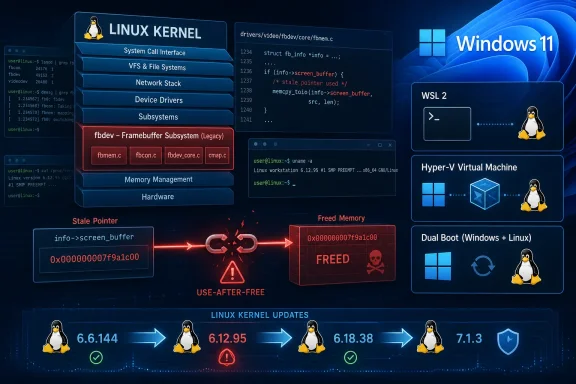 A stale mode pointer survives the modelist replacement
The vulnerability sits in drivers/video/fbdev/core/fbsysfs.c, specifically the store_modes() path. That handler accepts a framebuffer mode list supplied from userspace, replaces the framebuffer’s existing modelist, and frees the previous list after a successful replacement.According to the NVD description and the upstream patch discussion on the Linux kernel mailing list, two pointers can still refer to entries from that old, freed list. One is
fb_display*.mode, which records the video mode used by a console. The other is fb_info->mode, the framebuffer’s current mode pointer, which can be set through the mode sysfs attribute.The failure is more nuanced than a simple missing cleanup call. When the framebuffer console code builds a new modelist, it normally updates display-mode references for consoles that remain mapped to that framebuffer. But an unmapped console is skipped. For example, unbinding
fbcon changes the associated con2fb_map[i] entry to -1, yet may leave fb_display[i].mode populated. Replacing and freeing the old modelist then leaves that detached console pointing at memory that no longer belongs to it.A later
FBIOPUT_VSCREENINFO ioctl request using FB_ACTIVATE_INV_MODE can lead the kernel into fbcon_mode_deleted(), which compares the stale mode through fb_mode_is_equal(). Reading that already-freed object is the use-after-free tracked as CVE-2026-63826.The second route is through sysfs. Because
store_modes() did not clear fb_info->mode before destroying the old list, a subsequent read of the framebuffer’s mode attribute could invoke show_mode() and dereference the stale value through mode_string().The patch clears both references before freeing memory
The upstream fix is deliberately narrow. It callsfbcon_delete_modelist() while replacing the old modelist, then sets fb_info->mode to NULL before memory is released.That helper already existed because of an earlier fbcon cleanup fix, commit
a1f305893074, which cleared console mode pointers when a framebuffer was unregistered. CVE-2026-63826 extends the same protection to a different lifecycle event: modelist replacement through store_modes().Kernel mailing-list reporting shows that the defect was reported by syzbot, the automated Linux kernel fuzzing system. The final patch was authored by Ian Bridges and applied by fbdev maintainer Helge Deller in late June, then propagated into the upstream stable trees. The patch itself changes one file and adds only a small amount of code, but its importance lies in eliminating dereferences into freed kernel memory.
That limited patch scope should not be read as proof that exposure is trivial. Use-after-free bugs can produce crashes, memory corruption, or behavior shaped by allocator state. The CVE record does not presently describe a confirmed exploitation technique, affected hardware list, or a demonstrated privilege-escalation path. It is therefore more accurate to call this a kernel stability and memory-safety flaw than to assign it a severity category before NVD or Linux distributors complete their assessments.
Fixed upstream releases are already available
Kernel.org’s affected-version data identifies the issue as fixed in four maintained upstream lines:- Linux 6.6.144 fixes systems tracking the 6.6 long-term-support branch.
- Linux 6.12.95 fixes systems tracking the 6.12 long-term-support branch.
- Linux 6.18.38 fixes systems on the 6.18 stable branch.
- Linux 7.1.3 fixes systems on the 7.1 stable branch.
The NVD version data further indicates that affected code dates back to Linux 2.6.12. That long history reflects the age of the framebuffer subsystem and its mode-management interfaces, not necessarily broad real-world exposure. Many current Linux desktops use DRM/KMS drivers for graphics, while fbdev remains especially relevant to console handling, older graphics drivers, headless or embedded environments, virtualized devices, and compatibility paths.
Windows systems need an inventory check, not a host patch
For a standard Windows 11 or Windows Server installation, CVE-2026-63826 does not apply to the Windows kernel or Microsoft’s graphics stack. There is no Windows Update equivalent for this CVE.The question changes for machines where Windows is the management plane for Linux. IT teams should identify Linux guests, container hosts, developer workstations, embedded-device build systems, and WSL 2 deployments that use a separately maintained or custom Linux kernel. The CVE is in the Linux kernel’s fbdev code, so the relevant evidence is the running Linux kernel version and the distribution vendor’s security advisory—not the Windows build number.
A sensible short-term triage is to:
- Check each Linux system’s running kernel with
uname -rand compare its vendor package changelog against CVE-2026-63826. - Prioritize hosts that expose framebuffer devices, use virtual consoles, rely on older fbdev drivers, or permit local users to access framebuffer ioctls and framebuffer sysfs attributes.
- Apply the vendor’s kernel update and reboot into the updated kernel, rather than assuming an installed package is active.
- Avoid marking a system unaffected solely because it uses DRM/KMS for ordinary display output; distributions may still compile or load framebuffer-console support.
The immediate milestone is distribution-level patch availability and the arrival of a CVSS assessment, if NVD provides one. Until then, the concrete remediation is already clear: systems below Linux 6.6.144, 6.12.95, 6.18.38, or 7.1.3 should be checked for a vendor backport and updated where fbdev is present.
References
- Primary source: NVD / Linux Kernel
Published: 2026-07-20T01:03:53-07:00
NVD - CVE-2026-63826
 nvd.nist.gov
- Security advisory: MSRC
Published: 2026-07-20T01:03:53-07:00
Original feed URL
*[/i][/url][/i]Security Update Guide - Microsoft Security Response Center
 msrc.microsoft.com
