

CVE-2026-63829 closes a Linux kernel authorization flaw that can let a process holding
The issue was published to the National Vulnerability Database on July 19, 2026, with kernel.org as the source. The fix is already present in Linux kernel 6.12.95, 6.18.38, 7.1.3, and the 7.2-rc1 development line, according to the NVD’s affected-version data. NVD has not yet assigned CVSS v3 or CVSS v4 severity scores, so administrators should avoid treating the absence of a numerical rating as an assessment of low risk.
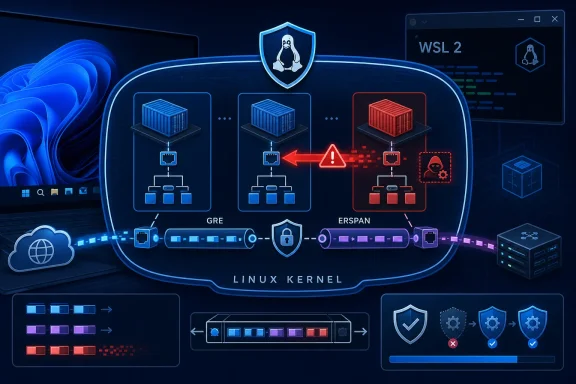
The vulnerable code sits in the Linux kernel’s IP GRE networking implementation. GRE—Generic Routing Encapsulation—is commonly used to carry traffic between networks, while ERSPAN extends the model for remote traffic mirroring. These are not typical desktop features, but they matter substantially in network labs, Kubernetes-adjacent infrastructure, SDN deployments, packet-analysis pipelines, and multi-tenant environments.
The flaw is a namespace authorization mismatch in the
Before the fix, Linux’s rtnetlink path checked
In practical terms, that means a capability intended to be constrained to one isolated networking context could be used to rewrite tunnel configuration in another. The kernel’s namespace design is specifically meant to stop that kind of authority bleed between containers, services, tenants, or test environments.
The NVD description says the weakness affects
That distinction matters. An attacker still needs meaningful control in a relevant Linux namespace, including
The placement of that validation is significant. The patched
That is why this is more than a cleanup of a final permission gate. A check performed after mutable state has begun changing can leave a window for unauthorized configuration impact, even if a later operation would have failed. The revised ordering ensures the caller is authorized for the tunnel’s actual namespace before the change request is interpreted.
The patch also aligns the netlink route with an earlier protection on an ioctl path. A previous Linux change, identified as commit
WSL 2 uses a real Linux kernel in a lightweight virtual machine. Docker Desktop and similar tools often use WSL 2 or a Linux VM backend. Hyper-V hosts commonly support Linux guest workloads, while Windows-based engineering organizations frequently run containers and network emulators inside WSL distributions.
The risk is therefore operational rather than native to Windows:
Administrators should not assume that a distribution’s visible kernel version must exactly equal one of those upstream releases. Red Hat, SUSE, Canonical, Debian, and other vendors commonly backport security fixes into supported kernel package streams while retaining their own version naming. A vendor advisory or package changelog confirming the relevant kernel.org backport is the correct evidence for a patched production system.
For self-built kernels and appliances that track upstream stable releases directly, the decision is simpler: move to the applicable fixed stable release or later. Systems carrying older long-term kernels should look for a maintained vendor branch containing one of the four kernel.org fixes referenced by NVD.
The issue deserves prompt remediation where a system combines all of the following: tunnel interfaces, separate network namespaces, and users or workloads that possess
Security teams should also avoid overstating the bug. The current public record does not document active exploitation, a public proof of concept, a CVSS assessment, or an indication that it is remotely reachable on its own. The vulnerability is best understood as a way to cross an intended administrative boundary after an attacker or workload has already gained privileged networking control in a related namespace.
The immediate task is to identify Linux hosts—not just physical servers, but WSL 2 instances, container nodes, and Hyper-V guests—that use GRE or ERSPAN. Once that inventory is clear, the patch decision is concrete: ensure the active kernel carries the namespace-aware
CAP_NET_ADMIN in one network namespace alter an IP GRE or ERSPAN tunnel associated with a different namespace. For Windows administrators, the immediate exposure is concentrated in WSL 2, Linux container hosts, and virtualized development environments where namespace separation and privileged networking are in active use—not in Windows networking itself.The issue was published to the National Vulnerability Database on July 19, 2026, with kernel.org as the source. The fix is already present in Linux kernel 6.12.95, 6.18.38, 7.1.3, and the 7.2-rc1 development line, according to the NVD’s affected-version data. NVD has not yet assigned CVSS v3 or CVSS v4 severity scores, so administrators should avoid treating the absence of a numerical rating as an assessment of low risk.
The vulnerable code sits in the Linux kernel’s IP GRE networking implementation. GRE—Generic Routing Encapsulation—is commonly used to carry traffic between networks, while ERSPAN extends the model for remote traffic mirroring. These are not typical desktop features, but they matter substantially in network labs, Kubernetes-adjacent infrastructure, SDN deployments, packet-analysis pipelines, and multi-tenant environments.
 The Boundary Check Was Applied to the Wrong Namespace
The flaw is a namespace authorization mismatch in the RTM_NEWLINK path used to modify existing tunnel devices. A tunnel change can involve two network namespaces: the namespace containing the device itself, known in the code as dev_net(dev), and the network namespace tied to the tunnel link, represented as t->net.Before the fix, Linux’s rtnetlink path checked
CAP_NET_ADMIN against the device’s namespace. That is normally a meaningful privilege check. But when a GRE or ERSPAN device has been created in, or moved into, a different network namespace, a process could be privileged in the device namespace while lacking administrative authority over the tunnel’s link namespace.In practical terms, that means a capability intended to be constrained to one isolated networking context could be used to rewrite tunnel configuration in another. The kernel’s namespace design is specifically meant to stop that kind of authority bleed between containers, services, tenants, or test environments.
The NVD description says the weakness affects
ipgre_changelink() and erspan_changelink(). Those functions process configuration changes to GRE-family tunnel devices. The underlying problem is not a memory-safety bug, remote code execution bug, or a mechanism for an unprivileged local user to become root from nothing. It is a privilege-boundary bypass between network namespaces.That distinction matters. An attacker still needs meaningful control in a relevant Linux namespace, including
CAP_NET_ADMIN there. But in a multi-namespace system, that capability is deliberately common enough to deserve scrutiny: container runtimes, network-management agents, privileged pods, CI systems, and lab automation can all be granted elevated networking rights without being trusted to administer every namespace on the host.The Patch Moves the Check Before Live Tunnel State Can Change
Kernel.org’s fix adds a helper namedrtnl_dev_link_net_capable() in net/core/rtnetlink.c. The helper requires CAP_NET_ADMIN in the tunnel’s link namespace while avoiding redundant checks when that namespace is already the device namespace checked by rtnetlink.The placement of that validation is significant. The patched
ipgre_changelink() and erspan_changelink() paths now perform the authority check before parsing attributes. According to the kernel description, the parsers can update live tunnel fields before the eventual tunnel-change routine executes; for example, ipgre_netlink_parms() can set the collect_md field early in processing.That is why this is more than a cleanup of a final permission gate. A check performed after mutable state has begun changing can leave a window for unauthorized configuration impact, even if a later operation would have failed. The revised ordering ensures the caller is authorized for the tunnel’s actual namespace before the change request is interpreted.
The patch also aligns the netlink route with an earlier protection on an ioctl path. A previous Linux change, identified as commit
8b484efd5cb4, added a comparable namespace-aware check for an IPv6 VTI path. CVE-2026-63829 brings the protection to RTM_NEWLINK operations affecting IP GRE and ERSPAN tunnels.Why Windows Shops Should Not Dismiss It as “Linux Only”
Windows does not use the Linux kernel IP GRE implementation, so ordinary Windows 11 and Windows Server networking stacks are not directly affected. The important caveat is that Windows estates increasingly run Linux networking stacks locally and nearby.WSL 2 uses a real Linux kernel in a lightweight virtual machine. Docker Desktop and similar tools often use WSL 2 or a Linux VM backend. Hyper-V hosts commonly support Linux guest workloads, while Windows-based engineering organizations frequently run containers and network emulators inside WSL distributions.
The risk is therefore operational rather than native to Windows:
- A standalone WSL 2 distribution used for development is unlikely to be a meaningful target unless it creates GRE or ERSPAN interfaces and delegates network-administration capability across namespaces.
- A Windows workstation running Docker Desktop, Kubernetes tooling, Minikube, kind, or a network lab may warrant review if its Linux environment creates tunnel devices or runs privileged networking components.
- Windows Server teams operating Hyper-V Linux guests should patch the guests based on their installed kernel packages, independent of the Windows host’s patch level.
- Enterprises using WSL 2 in managed developer environments should remember that the relevant update authority may be Microsoft’s WSL kernel delivery mechanism, a custom kernel configuration, or the guest distribution’s package management, depending on deployment design.
CAP_NET_ADMIN in one namespace to issue netlink changes.Fixed Kernel Versions Give Administrators a Clear Floor
NVD’s current record identifies Linux kernel versions from 3.16 onward as affected, with fixed stable points at 6.12.95, 6.18.38, and 7.1.3. The issue is also resolved in 7.2-rc1. Those version numbers are useful patch baselines, but distribution backports remain the more practical control point for most enterprises.Administrators should not assume that a distribution’s visible kernel version must exactly equal one of those upstream releases. Red Hat, SUSE, Canonical, Debian, and other vendors commonly backport security fixes into supported kernel package streams while retaining their own version naming. A vendor advisory or package changelog confirming the relevant kernel.org backport is the correct evidence for a patched production system.
For self-built kernels and appliances that track upstream stable releases directly, the decision is simpler: move to the applicable fixed stable release or later. Systems carrying older long-term kernels should look for a maintained vendor branch containing one of the four kernel.org fixes referenced by NVD.
Patch Priority Depends on Namespace Design, Not a Missing Score
Without a CVSS score, teams will need to make their own exposure decision. The technical details point to a priority higher than a routine desktop-only kernel update when GRE or ERSPAN tunnels coexist with delegated namespace privileges.The issue deserves prompt remediation where a system combines all of the following: tunnel interfaces, separate network namespaces, and users or workloads that possess
CAP_NET_ADMIN outside the tunnel’s own namespace. That profile is plausible in advanced container networking, telecom and observability systems, virtual routing labs, and multi-tenant infrastructure. It is much less plausible on a default developer WSL installation.Security teams should also avoid overstating the bug. The current public record does not document active exploitation, a public proof of concept, a CVSS assessment, or an indication that it is remotely reachable on its own. The vulnerability is best understood as a way to cross an intended administrative boundary after an attacker or workload has already gained privileged networking control in a related namespace.
The immediate task is to identify Linux hosts—not just physical servers, but WSL 2 instances, container nodes, and Hyper-V guests—that use GRE or ERSPAN. Once that inventory is clear, the patch decision is concrete: ensure the active kernel carries the namespace-aware
rtnl_dev_link_net_capable() check before allowing those tunnel-management paths back into service.References
- Primary source: NVD / Linux Kernel
Published: 2026-07-20T01:04:12-07:00
NVD - CVE-2026-63829
 nvd.nist.gov
- Security advisory: MSRC
Published: 2026-07-20T01:04:12-07:00
Original feed URL
Security Update Guide - Microsoft Security Response Center
 msrc.microsoft.com
