

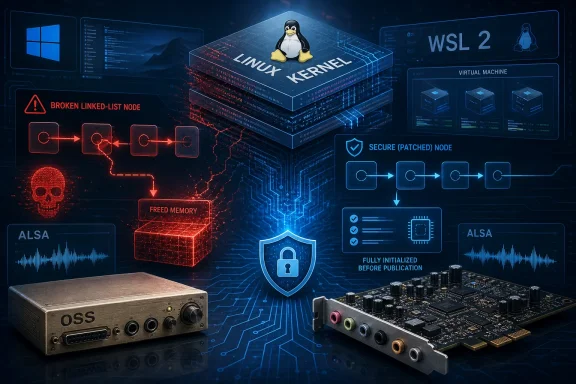
CVE-2026-64001 is a newly published Linux kernel vulnerability in the legacy OSS compatibility layer of ALSA, the Advanced Linux Sound Architecture subsystem. The flaw is a use-after-free condition in the code that handles OSS PCM configuration through procfs: under a specific allocation-failure path, the kernel can leave a list entry pointing to freed memory, which may later be dereferenced when an OSS audio device is opened. The fix is small but important because it corrects a core kernel lifetime rule—fully initialize an object before making it visible to other code—and extends locking discipline to a related procfs read path. For Windows users, the practical exposure is most relevant in Linux virtual machines, dual-boot systems, container hosts, embedded appliances, audio workstations, and potentially WSL 2 environments using a kernel build that includes the affected legacy code.
ALSA has been Linux’s primary audio architecture for more than two decades. It provides the kernel-level plumbing that connects applications to audio hardware, exposes PCM playback and capture interfaces, manages mixers and controls, and supports a substantial range of sound devices from integrated laptop codecs to professional multichannel interfaces.
The affected component, however, is not ALSA’s modern native interface. It is the ALSA OSS emulation layer, which exists to preserve compatibility with applications written for the older Open Sound System API. OSS was once a central part of Linux audio, but modern desktop and server distributions generally route contemporary applications through ALSA’s native interfaces and higher-level sound servers.
The lesson behind CVE-2026-64001 is broader than a single audio bug. Mature operating systems retain compatibility paths precisely because users depend on them, but each retained path adds code that must be tested, secured, and maintained across changing kernel internals.
The Linux kernel’s own affected-version data is more useful at this stage. It identifies the issue as affecting code introduced in the Linux 2.6.17 era and indicates that stable fixes are available through the relevant maintained branches, including fixes represented by Linux 6.12.93, 6.18.35, and 7.0.12, with the upstream fix incorporated in the 7.1 development line.
In this case, the affected ALSA OSS code creates a setup entry associated with OSS PCM configuration. The entry belongs on an internal linked list called
The result is a list that still contains a pointer to memory that no longer belongs to the setup entry. The next code path that walks that list can encounter the stale pointer and access freed memory.
More importantly, security engineering treats error paths as first-class execution paths. An attacker does not need an error to happen by accident if they can manipulate system state until a requested allocation is more likely to fail. Whether that is practically controllable in this exact case depends on environment, permissions, allocator behavior, kernel configuration, and other details not established by the CVE record.
The vulnerable scenario begins when a process writes a configuration that causes ALSA’s OSS layer to allocate a new setup entry. Before the patch, the entry was linked into the shared setup list too early.
If it reaches the freed entry, it may dereference data that has been released and potentially reused. The immediate outcome could be a kernel warning, audio subsystem malfunction, or a system crash. In some use-after-free cases, carefully arranged memory reuse can create conditions for more serious exploitation, but that outcome should not be presumed without a dedicated exploitability assessment.
This is one of the most reliable patterns in systems programming. Build the object privately, validate it, initialize every field that other code may consume, and only then expose it through a global pointer, list, map, queue, or callback registry.
That eliminates the dangling-list-pointer condition at its source. It is preferable to adding complicated rollback logic after publication because fewer shared-state transitions mean fewer opportunities for cleanup mistakes.
A list can be protected only if the protection begins before the list pointer is read. Reading the first entry before taking the mutex creates a window in which another thread may alter the list, free an entry, or otherwise invalidate assumptions. Taking the lock first makes the ownership and lifetime model consistent.
A UAF does not have one universal consequence. Its impact depends on what object was freed, who can influence the allocation and deallocation sequence, what data is accessed afterward, and which kernel mitigations are enabled.
In the most severe cases, an attacker may be able to influence what replaces the freed memory and steer execution or data handling in unsafe ways. Nothing in the currently published CVE record establishes that CVE-2026-64001 is reliably exploitable for privilege escalation or arbitrary code execution. That distinction is important: the flaw is real and fixed, but its final severity assessment remains incomplete.
They do not make a vulnerable kernel safe. Mitigations reduce risk; updates remove the known defect. Enterprises should regard them as complementary layers rather than alternatives.
The version data identifies fixed points in supported kernel series. Systems running Linux 6.12 should be at or beyond 6.12.93; systems on Linux 6.18 should be at or beyond 6.18.35; and systems on Linux 7.0 should be at or beyond 7.0.12. The upstream line identifies Linux 7.1 as containing the original fix.
That means a package version that appears numerically older than an upstream fixed release might already contain the patch, while a custom-built kernel with a newer-looking base version could omit a backport. The correct question is not simply “Is my version number bigger?” It is “Has my kernel vendor incorporated the fix for CVE-2026-64001?”
Even if such systems do not actively use OSS applications, operators should determine whether the OSS PCM compatibility module is built, loaded, or reachable. A legacy path that is unnecessary may be a candidate for configuration hardening, but removing it should follow testing rather than assumption.
WSL 2 runs a genuine Linux kernel in a lightweight virtual machine, rather than translating Linux system calls directly into Windows kernel operations. Therefore, Linux kernel vulnerabilities can matter to WSL 2 users when the relevant code is present and reachable in the supplied kernel.
Many typical WSL development environments use modern Linux audio stacks or have no meaningful reason to invoke legacy OSS PCM configuration. That reduces likely exposure, but it does not eliminate the need to install Microsoft-provided WSL kernel updates promptly.
For developers, the practical response is simple: update the guest kernel, restart into the new kernel, and verify the running release rather than assuming that installing updates automatically changes the active kernel.
Still, low probability is not zero probability. People who run older games, specialized recording tools, emulators, commercial legacy software, or manually configured OSS applications may interact with compatibility interfaces more often than they realize.
That makes targeted kernel security updates especially important. A current stable kernel containing a narrow security fix can be less disruptive than delaying updates until a larger distribution release forces multiple unrelated changes at once.
The vulnerability’s local and configuration-dependent nature may keep it below the top tier of emergency patching. But its kernel-level location means organizations should still include it in their established vulnerability-management process.
This is particularly important for teams that use automated scanners. A scanner that matches only upstream version ranges can produce false positives when a vendor has already backported a fix, or false negatives when it misreads a custom package naming scheme.
Administrators should identify Linux hosts running container platforms, determine whether OSS-related kernel code is enabled, and schedule host reboots after patched kernels are deployed. Workload disruption planning remains necessary even when the vulnerable path is unlikely to be exercised.
Verification should happen at two levels: package inventory and active runtime state. Both are necessary because a system can have a patched kernel installed while continuing to run the older vulnerable image until a reboot.
A narrow test plan is usually enough. The goal is not to prove every possible ALSA feature; it is to ensure that the workloads for which a system intentionally retains OSS compatibility still operate correctly.
Kernel and distribution maintainers may also publish advisories identifying package releases that carry the backported patch. Those notices are often the most actionable information for administrators because they translate an upstream commit into the exact package names used on a supported operating system.
For Windows users running Linux alongside Windows, the same principle applies across platforms: virtualization does not erase guest operating-system maintenance responsibilities. A current Windows host is valuable, but it does not automatically patch the Linux kernel running in a VM, appliance, container host, or WSL 2 environment.
CVE-2026-64001 is a focused fix for a specific ALSA OSS use-after-free, not a reason to panic about everyday audio playback. Its importance lies in what it reveals about kernel security hygiene: initialization order, memory ownership, error handling, and locking must agree perfectly when shared state is involved. Applying the applicable kernel update, rebooting into it, and confirming the active version is the sensible response—especially for systems that preserve legacy audio support long after the rest of the stack has moved on.
 Background
ALSA has been Linux’s primary audio architecture for more than two decades. It provides the kernel-level plumbing that connects applications to audio hardware, exposes PCM playback and capture interfaces, manages mixers and controls, and supports a substantial range of sound devices from integrated laptop codecs to professional multichannel interfaces.The affected component, however, is not ALSA’s modern native interface. It is the ALSA OSS emulation layer, which exists to preserve compatibility with applications written for the older Open Sound System API. OSS was once a central part of Linux audio, but modern desktop and server distributions generally route contemporary applications through ALSA’s native interfaces and higher-level sound servers.
Why legacy compatibility code remains relevant
Legacy code is not necessarily unused code. Audio compatibility layers continue to matter in specialized industrial software, old commercial applications, emulators, broadcast systems, retro-computing deployments, proprietary tools, and embedded products with long support cycles. A system administrator may never intentionally enable an OSS-oriented workflow, yet an older binary or application dependency can still interact with the compatibility interface.The lesson behind CVE-2026-64001 is broader than a single audio bug. Mature operating systems retain compatibility paths precisely because users depend on them, but each retained path adds code that must be tested, secured, and maintained across changing kernel internals.
The timing of the disclosure
The CVE record was added to the National Vulnerability Database on July 19, 2026, with NVD scoring still pending as of July 21, 2026. That means administrators should not wait for a numerical severity label before assessing exposure. A missing CVSS score is an incomplete classification state, not an indication that the issue is harmless.The Linux kernel’s own affected-version data is more useful at this stage. It identifies the issue as affecting code introduced in the Linux 2.6.17 era and indicates that stable fixes are available through the relevant maintained branches, including fixes represented by Linux 6.12.93, 6.18.35, and 7.0.12, with the upstream fix incorporated in the 7.1 development line.
The Vulnerability in Plain English
CVE-2026-64001 is a use-after-free, often abbreviated as UAF. This class of bug occurs when software releases memory but later continues to use a pointer that still refers to the now-invalid allocation.In this case, the affected ALSA OSS code creates a setup entry associated with OSS PCM configuration. The entry belongs on an internal linked list called
setup_list. The vulnerable sequence placed the new entry onto that shared list before all of the entry’s data had been successfully initialized.The failed initialization path
After publishing the entry, the code attempts to duplicate the task name associated with the configuration. That duplication can fail if memory allocation fails. On failure, the error path frees the setup entry—as it should—but fails to remove the already-published list node first.The result is a list that still contains a pointer to memory that no longer belongs to the setup entry. The next code path that walks that list can encounter the stale pointer and access freed memory.
Why memory allocation failure matters
At first glance, an allocation failure may sound too unusual to deserve urgent attention. In kernel security, that assumption is risky. Memory pressure can arise naturally from a heavily loaded system, a constrained virtual machine, a container density problem, device-driver activity, or an intentional attempt to exhaust allocatable memory.More importantly, security engineering treats error paths as first-class execution paths. An attacker does not need an error to happen by accident if they can manipulate system state until a requested allocation is more likely to fail. Whether that is practically controllable in this exact case depends on environment, permissions, allocator behavior, kernel configuration, and other details not established by the CVE record.
How the Bug Is Triggered
The affected function issnd_pcm_oss_proc_write(), which handles writes to a procfs interface associated with OSS PCM setup configuration. Procfs is a virtual filesystem through which the Linux kernel exposes operational information and control interfaces to user space.The vulnerable scenario begins when a process writes a configuration that causes ALSA’s OSS layer to allocate a new setup entry. Before the patch, the entry was linked into the shared setup list too early.
The subsequent device-open path
The stale entry becomes dangerous when a later OSS device-open operation invokessnd_pcm_oss_look_for_setup(). That function searches the same shared setup list to locate the applicable configuration.If it reaches the freed entry, it may dereference data that has been released and potentially reused. The immediate outcome could be a kernel warning, audio subsystem malfunction, or a system crash. In some use-after-free cases, carefully arranged memory reuse can create conditions for more serious exploitation, but that outcome should not be presumed without a dedicated exploitability assessment.
A sequence of events
The bug can be summarized as the following sequence:- A procfs write causes the OSS compatibility layer to allocate a new setup object.
- The new object is linked into
setup_listbefore its task-name field has been allocated successfully. - Task-name allocation fails.
- The cleanup path frees the object but leaves its list entry published.
- A later OSS PCM open searches
setup_list. - The search reaches the stale node and dereferences freed memory.
What the Patch Changes
The remediation is conceptually straightforward: allocate and initialize the setup entry completely before adding it to the shared list. By delaying publication, the code ensures that an allocation failure leaves no visible list node behind.This is one of the most reliable patterns in systems programming. Build the object privately, validate it, initialize every field that other code may consume, and only then expose it through a global pointer, list, map, queue, or callback registry.
Publish only fully valid objects
The patched logic changes the order of operations so that the task name is obtained before the setup entry becomes part ofsetup_list. If duplicating the task name fails, the object can be released without any other path knowing it existed.That eliminates the dangling-list-pointer condition at its source. It is preferable to adding complicated rollback logic after publication because fewer shared-state transitions mean fewer opportunities for cleanup mistakes.
Locking is tightened for procfs reads
The fix also moves retrieval of the initial iterator for a related procfs read path so it occurs only aftersetup_mutex has been acquired. This part of the change is easy to overlook, but it matters because it aligns list traversal with the same lifetime rules used for updates.A list can be protected only if the protection begins before the list pointer is read. Reading the first entry before taking the mutex creates a window in which another thread may alter the list, free an entry, or otherwise invalidate assumptions. Taking the lock first makes the ownership and lifetime model consistent.
Why Use-After-Free Bugs Are Serious
Use-after-free bugs have remained among the most consequential categories of native-code vulnerabilities because C-based systems code handles memory manually. The language gives kernel developers powerful control over performance and hardware interaction, but it does not automatically prevent stale pointers, invalid object lifetime assumptions, or unsafe ownership transfers.A UAF does not have one universal consequence. Its impact depends on what object was freed, who can influence the allocation and deallocation sequence, what data is accessed afterward, and which kernel mitigations are enabled.
Possible outcomes range widely
In a low-impact case, a stale pointer triggers a harmless-looking warning or a failed audio operation. In a more disruptive case, it can cause a kernel oops, a denial of service, or corrupted state that affects unrelated operations.In the most severe cases, an attacker may be able to influence what replaces the freed memory and steer execution or data handling in unsafe ways. Nothing in the currently published CVE record establishes that CVE-2026-64001 is reliably exploitable for privilege escalation or arbitrary code execution. That distinction is important: the flaw is real and fixed, but its final severity assessment remains incomplete.
Kernel mitigations help but do not replace patching
Modern Linux distributions employ defenses such as address-space layout randomization, hardened allocators, control-flow protections on supported hardware, slab freelist hardening, and optional memory-safety debugging tools. These protections can make exploitation more difficult or reveal bugs earlier.They do not make a vulnerable kernel safe. Mitigations reduce risk; updates remove the known defect. Enterprises should regard them as complementary layers rather than alternatives.
Affected Systems and Version Boundaries
The issue lies insound/core/oss/pcm_oss.c, the file implementing part of ALSA’s OSS PCM compatibility support. According to the published affected-version information, the bug has existed since Linux 2.6.17 and therefore spans a long historical range of kernels.The version data identifies fixed points in supported kernel series. Systems running Linux 6.12 should be at or beyond 6.12.93; systems on Linux 6.18 should be at or beyond 6.18.35; and systems on Linux 7.0 should be at or beyond 7.0.12. The upstream line identifies Linux 7.1 as containing the original fix.
Distribution package versions are what matter
Most users do not install a kernel directly from kernel.org. They receive a vendor-packaged kernel whose version string may include a distribution release, ABI number, build date, security suffix, or backported patch set.That means a package version that appears numerically older than an upstream fixed release might already contain the patch, while a custom-built kernel with a newer-looking base version could omit a backport. The correct question is not simply “Is my version number bigger?” It is “Has my kernel vendor incorporated the fix for CVE-2026-64001?”
Long-term support kernels deserve special attention
The age of the underlying defect creates a particular concern for long-lived kernel trees. Appliances, NAS systems, point-of-sale devices, media systems, industrial PCs, and specialized Linux distributions often remain on older kernel branches for years.Even if such systems do not actively use OSS applications, operators should determine whether the OSS PCM compatibility module is built, loaded, or reachable. A legacy path that is unnecessary may be a candidate for configuration hardening, but removing it should follow testing rather than assumption.
Relevance for Windows Users and WSL 2
WindowsForum readers may reasonably ask why a Linux ALSA vulnerability belongs on a Windows-focused site. The answer is that the boundary between Windows and Linux workloads is no longer cleanly divided. Windows PCs regularly host Linux through WSL 2, Hyper-V, third-party virtual machines, containers, remote development environments, and dual-boot installations.WSL 2 runs a genuine Linux kernel in a lightweight virtual machine, rather than translating Linux system calls directly into Windows kernel operations. Therefore, Linux kernel vulnerabilities can matter to WSL 2 users when the relevant code is present and reachable in the supplied kernel.
WSL exposure is conditional, not automatic
CVE-2026-64001 should not be treated as proof that every WSL installation is vulnerable. Exposure depends on the specific WSL kernel build, the presence and configuration of ALSA OSS compatibility code, whether the procfs interface is available, and whether a workload can exercise the necessary sequence.Many typical WSL development environments use modern Linux audio stacks or have no meaningful reason to invoke legacy OSS PCM configuration. That reduces likely exposure, but it does not eliminate the need to install Microsoft-provided WSL kernel updates promptly.
Virtual machines and developer workstations
The issue is more directly relevant to Linux desktop VMs used for audio development, multimedia testing, reverse engineering, driver work, or compatibility testing. A VM with a distribution-provided kernel may include ALSA OSS support by default, and its snapshot-heavy workflow can also lead to outdated kernel images persisting long after host software is current.For developers, the practical response is simple: update the guest kernel, restart into the new kernel, and verify the running release rather than assuming that installing updates automatically changes the active kernel.
Consumer Impact
For ordinary desktop Linux users, CVE-2026-64001 is likely to be a lower-probability exposure than vulnerabilities in network-facing services, browsers, graphics stacks, or common desktop privilege boundaries. The affected interface is tied to legacy OSS PCM behavior, not the ordinary path used by most modern audio applications.Still, low probability is not zero probability. People who run older games, specialized recording tools, emulators, commercial legacy software, or manually configured OSS applications may interact with compatibility interfaces more often than they realize.
Audio-focused users should not dismiss it
Musicians, streamers, and sound engineers sometimes maintain long-lived Linux environments because audio hardware tuning can be fragile. They may deliberately avoid broad upgrades in order to preserve low-latency configuration, driver behavior, plugin compatibility, or JACK/PipeWire routing.That makes targeted kernel security updates especially important. A current stable kernel containing a narrow security fix can be less disruptive than delaying updates until a larger distribution release forces multiple unrelated changes at once.
Practical consumer guidance
Consumers should take the following actions:- Install the latest kernel package offered by the distribution’s normal security-update channel.
- Reboot after the update, because a downloaded kernel does not protect the running system until it is booted.
- Verify the active kernel with the distribution’s standard system-information tools.
- Remove or disable unnecessary OSS compatibility components only if the distribution documents that configuration and the user has tested audio workloads afterward.
- Avoid relying on a CVSS score as the trigger for updating, since no NVD score had been assigned as of July 21, 2026.
Enterprise Impact
Enterprises should evaluate CVE-2026-64001 through asset classification and workload reachability rather than treating it as a generic desktop audio alert. On many server fleets, ALSA is present but irrelevant; on others, especially media processing, conferencing, call-center, kiosk, laboratory, training, and embedded fleets, audio support may be operationally meaningful.The vulnerability’s local and configuration-dependent nature may keep it below the top tier of emergency patching. But its kernel-level location means organizations should still include it in their established vulnerability-management process.
The operational challenge of backports
Enterprise Linux vendors commonly backport individual security fixes to a stable kernel package without changing the upstream base version in a way that is obvious at a glance. Security teams should consult vendor errata, package changelogs, and kernel release notes rather than attempting to infer status from the first three version fields alone.This is particularly important for teams that use automated scanners. A scanner that matches only upstream version ranges can produce false positives when a vendor has already backported a fix, or false negatives when it misreads a custom package naming scheme.
Container hosts need a different lens
Containers share the host kernel. Updating a vulnerable application container does nothing to fix a kernel flaw if the host is still running an affected kernel. Conversely, containerized applications cannot bring their own replacement kernel to solve the problem.Administrators should identify Linux hosts running container platforms, determine whether OSS-related kernel code is enabled, and schedule host reboots after patched kernels are deployed. Workload disruption planning remains necessary even when the vulnerable path is unlikely to be exercised.
Verification and Patch Management
The most defensible remediation path is to apply a vendor-supported kernel update that explicitly includes the relevant stable fix or otherwise documents remediation for CVE-2026-64001. Compiling an upstream kernel solely for this issue is generally unnecessary for managed desktops and servers unless the organization already owns that maintenance model.Verification should happen at two levels: package inventory and active runtime state. Both are necessary because a system can have a patched kernel installed while continuing to run the older vulnerable image until a reboot.
A practical remediation workflow
A sound patch-management process can follow this sequence:- Identify affected Linux systems, including VMs, WSL 2 installations, appliance-style deployments, media workstations, build servers, and container hosts.
- Check the running kernel and installed kernel packages through the operating system’s normal inventory tools.
- Review vendor security advisories or changelogs to establish whether the supplied kernel contains the fix or an equivalent backport.
- Deploy the updated kernel through standard change-control procedures.
- Reboot or otherwise transition systems into the updated kernel.
- Confirm the active kernel after restart and record the result in asset-management or vulnerability-tracking systems.
- Test critical audio and legacy workloads, especially where OSS emulation is intentionally used.
Testing matters in specialized environments
The patch changes initialization order and locking around a legacy configuration list, so broad functional disruption is not expected. Even so, organizations with custom audio middleware, embedded codecs, sound-device automation, or unusual procfs integration should validate playback, capture, configuration persistence, and device reconnect behavior after the kernel update.A narrow test plan is usually enough. The goal is not to prove every possible ALSA feature; it is to ensure that the workloads for which a system intentionally retains OSS compatibility still operate correctly.
Strengths and Opportunities
The response to CVE-2026-64001 has several positive characteristics that make remediation clearer than it can be for more ambiguous kernel flaws.- The defect has a well-defined root cause: a list entry was published before initialization could fail safely.
- The code change addresses the cause rather than merely masking a symptom: the setup object is now initialized before it becomes visible to list traversal.
- The associated locking improvement strengthens consistency: procfs readers now obtain the list iterator under the mutex that governs list lifetime.
- The affected source file is specific: administrators and maintainers can focus review on ALSA OSS PCM compatibility rather than the entire audio stack.
- Stable fixes have been identified across maintained kernel branches: this supports vendor backports and reduces uncertainty for upstream-oriented deployments.
- The issue provides a useful code-review example: shared objects should be fully initialized before publication, and all list traversal should follow the same lock-and-lifetime protocol.
Risks and Concerns
The limited public information currently available leaves several meaningful questions unanswered. Security teams should avoid both extremes: neither assuming catastrophic remote compromise nor dismissing the flaw because it appears in a legacy audio component.- No NVD CVSS assessment had been assigned as of July 21, 2026, so there is no authoritative numerical severity rating to guide prioritization.
- Public information does not establish a working exploit, reliable privilege-escalation path, or confirmed exploitation in the wild.
- The triggering condition includes an allocation failure, which may reduce practical exploit reliability but cannot be assumed to prevent deliberate triggering.
- Legacy code may be more widespread than administrators expect, particularly in embedded products and long-lived specialized deployments.
- Vendor versioning can obscure patch status, making simplistic version matching unreliable.
- Kernel updates require reboots, which can delay remediation in high-availability systems and container platforms.
- Disabling OSS compatibility without testing can create operational regressions, especially in older software stacks where the dependency is undocumented.
What to Watch Next
The next development to watch is the completion of vulnerability enrichment. A later NVD update may add CVSS data, a Common Weakness Enumeration classification, additional affected-product mappings, or more precise remediation guidance. Those additions may change how automated vulnerability platforms rank the issue.Kernel and distribution maintainers may also publish advisories identifying package releases that carry the backported patch. Those notices are often the most actionable information for administrators because they translate an upstream commit into the exact package names used on a supported operating system.
Signals that would raise urgency
Several future developments would justify faster escalation:- A credible proof of concept demonstrating that unprivileged local users can reliably trigger the stale-pointer condition.
- Evidence that the bug can be converted into privilege escalation rather than denial of service.
- Reports that the affected procfs interface is exposed in common default configurations.
- Confirmation that widely deployed appliance, embedded, or cloud images ship a vulnerable kernel with OSS support enabled.
- Active-exploitation reporting from trusted incident-response or government security organizations.
The broader maintenance message
CVE-2026-64001 also reinforces the importance of staying current on kernel point releases. The bug is rooted in a compatibility component that traces back to Linux 2.6.17, demonstrating how small lifetime mistakes can survive for years when they require an uncommon error path and a particular subsequent operation to become visible.For Windows users running Linux alongside Windows, the same principle applies across platforms: virtualization does not erase guest operating-system maintenance responsibilities. A current Windows host is valuable, but it does not automatically patch the Linux kernel running in a VM, appliance, container host, or WSL 2 environment.
CVE-2026-64001 is a focused fix for a specific ALSA OSS use-after-free, not a reason to panic about everyday audio playback. Its importance lies in what it reveals about kernel security hygiene: initialization order, memory ownership, error handling, and locking must agree perfectly when shared state is involved. Applying the applicable kernel update, rebooting into it, and confirming the active version is the sensible response—especially for systems that preserve legacy audio support long after the rest of the stack has moved on.
References
- Primary source: NVD / Linux Kernel
Published: 2026-07-21T01:01:48-07:00
NVD - CVE-2026-64001
 nvd.nist.gov
- Security advisory: MSRC
Published: 2026-07-21T01:01:48-07:00
Original feed URL
Security Update Guide - Microsoft Security Response Center
 msrc.microsoft.com
