

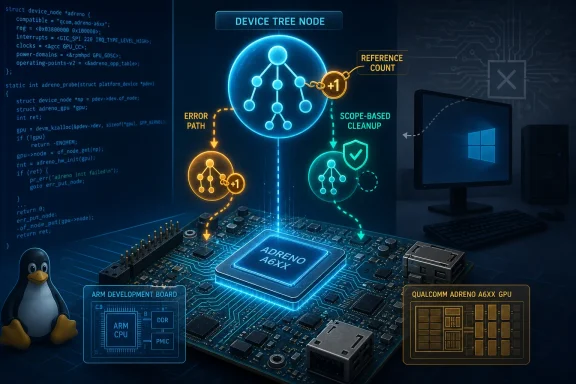
CVE-2026-64154 is a newly published Linux kernel vulnerability record for a flaw in Qualcomm Adreno A6xx GPU initialization code, but its technical significance is more nuanced than the presence of a CVE might suggest. The issue is a reference leak, not a demonstrated route to code execution, privilege escalation, or information disclosure: on certain early error paths, the driver can retain a reference to a Device Tree node that should have been released. The upstream correction is small—adopting the kernel’s scope-based cleanup mechanism—but it removes a class of error-handling mistake that can be difficult to spot and increasingly costly to maintain across long-lived mobile, embedded, and ARM-based systems.
Published in the CVE and NVD ecosystem on July 19, 2026, CVE-2026-64154 concerns the
The vulnerability description identifies a reference-counting problem involving
In the vulnerable implementation, the normal successful path performed that release manually near the end of the function. However, several error returns could occur before execution reached that line. In those cases, the driver exited without dropping the reference, leaving a reference leak behind.
That distinction matters. A reference leak generally does not behave like a conventional heap overflow or use-after-free bug. It does not, based on the currently published record, establish an attacker-controlled memory corruption primitive. Instead, it creates a resource-lifetime inconsistency: an object remains referenced when the code path that acquired it has already failed.
For affected platforms, the practical question is therefore not simply, “Is this a critical remote exploit?” It is, “Do we use this kernel driver, can initialization errors be induced or repeated, and does our kernel contain the corrected backport?” That is a more operationally useful framing than treating every newly assigned CVE as equivalent.
This approach is intentionally modest. It does not redesign GPU initialization, alter firmware handling, or change the device’s feature set. Instead, it moves responsibility for a routine cleanup action from a set of manually maintained return paths to compiler-assisted scope cleanup.
The change illustrates a recurring reality of kernel security work: many vulnerabilities arise not from complex algorithms, but from mundane ownership rules that are inconsistently enforced across exceptional paths.
The MSM DRM driver is Linux’s in-kernel graphics driver family for Qualcomm Snapdragon-era display and Adreno GPU hardware. Within it, Adreno-specific code handles the GPU generations and revisions that share broadly related architecture. The A6xx series includes GPUs found across multiple Snapdragon and Snapdragon-derived platforms, giving this area of code considerable relevance in the ARM Linux ecosystem.
Unlike a desktop graphics driver that can assume a comparatively standardized PCIe discovery process, embedded GPU drivers must frequently interrogate platform-specific configuration. Device Tree is one mechanism through which the operating system learns how a component is wired into the broader system.
A phandle is effectively a reference from one Device Tree node to another. When driver code calls
The ownership contract can be summarized in three steps:
Every early
The kernel’s scope-based cleanup helpers exist precisely to reduce this pattern. They are not a substitute for understanding ownership, but they make correct ownership behavior the default after a variable is declared with an appropriate cleanup handler.
If one of the intermediate stages fails, the function can return before reaching the manual
In this particular case, the affected object is a Device Tree node. Device Tree data is normally persistent for the life of the kernel, so the immediate memory impact of one leaked node reference may be low. That is one reason the issue should not be overstated as an immediate crash condition for ordinary end users.
Nevertheless, the leak is still a correctness issue and can matter under repeated failure scenarios. A driver probe path can be retried, a device can be unbound and rebound during testing or recovery, or a platform may repeatedly encounter an initialization condition that causes one of the vulnerable exits. Over time, otherwise small accounting failures can become difficult to diagnose.
A CVE identifier is not itself a severity rating. It is a tracking identifier for a publicly documented security-relevant defect. Maintainers and downstream vendors may issue a CVE for a resource leak because kernel objects, device lifecycle code, and driver initialization logic are security-sensitive surfaces even when the specific bug has no known direct exploit path.
The responsible interpretation is therefore straightforward: treat CVE-2026-64154 as a patch-management and software-quality issue first, not as evidence of an actively exploitable Adreno takeover bug.
That annotation instructs the compiler-supported cleanup framework to invoke the relevant release operation when the variable exits scope. In practical terms, a return statement no longer needs to remember to call
That is particularly useful in driver initialization code, where failure handling often has more paths than successful completion. It also makes future edits safer. A maintainer adding another conditional return after the variable declaration is less likely to reintroduce the same mistake.
The pattern does not eliminate all cleanup errors. Kernel developers still need to account for ownership transfers, variables that outlive a narrow scope, lock ordering, and interactions between automatically cleaned resources. But for a simple “acquire node, inspect it, then release it” lifecycle, it is an appropriate fit.
Scope-based cleanup annotations are a newer tool in the kernel’s maintenance toolbox. They reduce boilerplate where ownership is local and linear, especially for references, locks, and simple allocated resources. Their security value lies in making omission harder, not in changing the underlying semantics of reference counting.
CVE-2026-64154 is therefore part of a wider kernel-maintenance trend: replacing repetitive, error-prone cleanup choreography with narrowly targeted automatic cleanup where the lifetime rules are unambiguous.
The record also indicates that the issue is addressed in the 7.0 stable line through a fix level identified as 7.0.11, with the original corrected upstream commit appearing in the 7.1 development line. As with many Linux kernel CVEs, the exact operational answer depends less on a simple upstream version number and more on a distribution’s backport policy.
Administrators should therefore verify the vendor’s advisory and changelog rather than deciding exposure solely from
A practical verification workflow should include:
Many commercial devices use proprietary user-space graphics components, vendor-specific kernel changes, or different support paths for their GPU architecture. Some may not enable the relevant DRM configuration at all. Others may use an A6xx GPU but never exercise the problematic initialization error path under ordinary conditions.
That does not justify ignoring the update. It does mean that inventory and platform awareness are more valuable than broad alarm.
The A6xx GPU family is particularly relevant because it spans multiple generations of Snapdragon-class silicon. Linux graphics enablement for these platforms involves a complicated interaction between the kernel DRM driver, firmware, Mesa’s Freedreno userspace driver, display infrastructure, and platform power management.
For these users, applying the corrected kernel is usually the cleanest response. Because the change is tightly scoped and is designed to preserve behavior while improving cleanup, it should be lower risk than a broad driver rewrite. Still, users maintaining custom kernels should test resume, display output, GPU acceleration, and workload stability after an update.
For organizations that build their own kernel images, this is an opportunity to inspect the local code rather than waiting passively for a bulletin. The upstream change is conceptually simple enough to audit, but it should still be merged through the organization’s normal kernel maintenance process rather than copied blindly into unrelated branches.
That distinction is crucial for WindowsForum readers. A Qualcomm-branded GPU is not enough to establish exposure. The operating system, driver architecture, kernel, and execution environment all matter.
As a result, Windows on Arm users should not expect a Windows Update, GPU driver update, or firmware update specifically because of CVE-2026-64154. Installing unrelated driver packages in response to a Linux kernel CVE would not be a sensible mitigation.
The more relevant Windows maintenance advice remains unchanged: keep Windows, OEM firmware, chipset packages, and GPU drivers current through supported channels. That is good baseline hygiene, but it is separate from this Linux-specific fix.
Therefore, an ordinary WSL 2 installation on a Windows PC should not be assumed vulnerable merely because it runs Linux. The affected driver must be present and used. That said, developers working with custom WSL kernels, experimental ARM device passthrough, bespoke virtual machines, or hardware-specific Linux images should evaluate their actual kernel configuration rather than relying on general assumptions.
The immediate task is asset classification. Security teams need to distinguish generic Linux fleets from specialized ARM systems that actually contain the relevant driver and hardware combination.
A better workflow combines package data with configuration and hardware evidence. Relevant signals include the kernel configuration, loaded module status, Device Tree compatibility strings, DRM device information, and vendor-specific platform identifiers.
This is also a reminder that SBOM-style inventory is necessary but insufficient. A component can exist in source or a package while remaining inactive on a given deployment. Conversely, a customized appliance can be exposed even when its vendor version string obscures its upstream ancestry.
Organizations maintaining Yocto, Buildroot, Android Common Kernel derivatives, custom Ubuntu images, or bespoke embedded distributions may need to merge the correction directly. In those cases, a disciplined remediation record should note the upstream commit lineage, local test results, affected hardware, and the release image in which the change was deployed.
The absence of a CVSS score should not prevent action. It should shape prioritization. A sensible approach is to schedule the fix into the next normal kernel update window unless local testing reveals repeated GPU initialization failures or a business-critical device population makes the issue more urgent.
Developers and enthusiasts are more likely to encounter the affected code directly, particularly those experimenting with Snapdragon laptops, mobile devices, development boards, or upstream graphics enablement.
The patch itself is narrowly focused on cleanup behavior. The larger update risk is usually not the reference leak fix but the collection of unrelated changes bundled into a newer kernel package.
Maintainers should not interpret the patch as permission to automatically convert every manual cleanup path. Scope-based cleanup changes control flow expectations and destruction order. The strongest use case is one like this CVE: a single local reference is acquired, used within one scope, and should always be released as that scope ends.
A reference leak in an inactive graphics driver should not outrank an actively exploited browser flaw. But a reference leak in a repeatedly retried initialization path on a mission-critical embedded fleet should not be dismissed merely because no CVSS number has been assigned.
Security teams should document how they determined status. “Kernel version appears new enough” is less defensible than “Vendor advisory confirms the included backport” or “Source audit confirms the relevant cleanup annotation or equivalent release on every return path.”
Distribution and vendor advisories are the more actionable near-term signal. Mainstream Linux vendors, Android ecosystem maintainers, embedded distributions, and hardware suppliers may publish their own package mappings, fixed builds, or downstream patch references on different schedules.
Organizations with automated source analysis may use this incident to look for similar patterns: a function obtains a reference-counted object, then has multiple direct returns before an explicit put operation. Static analysis will not replace code review, but it can prioritize the places most likely to contain comparable ownership mistakes.
For Linux and embedded maintainers, the response is clear: validate whether the relevant Qualcomm graphics driver and kernel branch are present, obtain the vendor-backed update or apply the narrowly scoped upstream correction, and test the graphics stack normally. For Windows users, the key takeaway is equally clear: Windows itself is not implicated simply because a device contains Qualcomm hardware or because WSL 2 runs Linux workloads. The deeper lesson is that secure systems depend as much on disciplined resource ownership and accurate exposure analysis as they do on dramatic vulnerability headlines.
 Overview
Published in the CVE and NVD ecosystem on July 19, 2026, CVE-2026-64154 concerns the drm/msm/adreno portion of the Linux graphics stack. That code supports Qualcomm’s Adreno GPUs, specifically the A6xx generation in this case, through the MSM DRM driver. The affected function, a6xx_gpu_init(), participates in initializing the GPU driver’s hardware-specific state.The vulnerability description identifies a reference-counting problem involving
of_parse_phandle(), a Linux Device Tree helper. When this helper locates a referenced device node, it returns a node with an acquired reference. Kernel code must subsequently release that reference with of_node_put() once it no longer needs the node.In the vulnerable implementation, the normal successful path performed that release manually near the end of the function. However, several error returns could occur before execution reached that line. In those cases, the driver exited without dropping the reference, leaving a reference leak behind.
That distinction matters. A reference leak generally does not behave like a conventional heap overflow or use-after-free bug. It does not, based on the currently published record, establish an attacker-controlled memory corruption primitive. Instead, it creates a resource-lifetime inconsistency: an object remains referenced when the code path that acquired it has already failed.
For affected platforms, the practical question is therefore not simply, “Is this a critical remote exploit?” It is, “Do we use this kernel driver, can initialization errors be induced or repeated, and does our kernel contain the corrected backport?” That is a more operationally useful framing than treating every newly assigned CVE as equivalent.
A small patch with a broader lesson
The upstream repair replaces manual cleanup with the__free(device_node) cleanup annotation. The result is that the Device Tree node reference is released automatically when the variable leaves scope, including when the function returns early because initialization fails.This approach is intentionally modest. It does not redesign GPU initialization, alter firmware handling, or change the device’s feature set. Instead, it moves responsibility for a routine cleanup action from a set of manually maintained return paths to compiler-assisted scope cleanup.
The change illustrates a recurring reality of kernel security work: many vulnerabilities arise not from complex algorithms, but from mundane ownership rules that are inconsistently enforced across exceptional paths.
Background
Linux kernel graphics drivers operate close to hardware and firmware, where initialization can involve many dependencies: power domains, clocks, regulators, firmware blobs, interconnects, memory mappings, interrupts, command processors, and hardware configuration data. Qualcomm platforms commonly describe portions of this topology through Device Tree, particularly in embedded and mobile deployments.The MSM DRM driver is Linux’s in-kernel graphics driver family for Qualcomm Snapdragon-era display and Adreno GPU hardware. Within it, Adreno-specific code handles the GPU generations and revisions that share broadly related architecture. The A6xx series includes GPUs found across multiple Snapdragon and Snapdragon-derived platforms, giving this area of code considerable relevance in the ARM Linux ecosystem.
Unlike a desktop graphics driver that can assume a comparatively standardized PCIe discovery process, embedded GPU drivers must frequently interrogate platform-specific configuration. Device Tree is one mechanism through which the operating system learns how a component is wired into the broader system.
What Device Tree references mean
A Device Tree is a structured hardware-description data source used extensively by ARM and embedded Linux systems. Individual nodes can describe hardware blocks such as GPUs, clocks, memory regions, regulators, display controllers, IOMMUs, and power-management components.A phandle is effectively a reference from one Device Tree node to another. When driver code calls
of_parse_phandle(), it asks the kernel to resolve one such reference. That lookup is not merely a borrowed pointer in the ordinary sense; it returns an object whose reference count must be managed.The ownership contract can be summarized in three steps:
- The driver calls
of_parse_phandle()and receives a referenceddevice_node. - The driver uses that node to locate or validate related platform information.
- The driver calls
of_node_put()after it is finished, regardless of whether the broader operation succeeds or fails.
Why early error paths are different
Error handling is frequently more complex than the happy path. A function may fail because the expected Device Tree property is missing, hardware support is absent, an associated device cannot be found, a resource acquisition call fails, or initialization detects an invalid configuration.Every early
return changes the cleanup burden. If a resource was already acquired, each new exit path must account for it. This creates a familiar maintenance hazard: a developer can add a new check and return statement later without noticing that the added branch bypasses a cleanup call located farther down the function.The kernel’s scope-based cleanup helpers exist precisely to reduce this pattern. They are not a substitute for understanding ownership, but they make correct ownership behavior the default after a variable is declared with an appropriate cleanup handler.
The Technical Root Cause
The heart of CVE-2026-64154 is an imbalance between reference acquisition and reference release. The code obtains a Device Tree node throughof_parse_phandle(), then proceeds through several validation and setup stages. If all of those stages complete, the conventional cleanup call runs.If one of the intermediate stages fails, the function can return before reaching the manual
of_node_put() call. The reference then remains held longer than intended.A reference leak is not an ordinary memory leak
It is tempting to describe every unreleased kernel object as simply a memory leak, but reference leaks have their own implications. A reference count conveys ownership and liveness. When it remains elevated, the underlying object may not be released when the rest of the system expects it to be.In this particular case, the affected object is a Device Tree node. Device Tree data is normally persistent for the life of the kernel, so the immediate memory impact of one leaked node reference may be low. That is one reason the issue should not be overstated as an immediate crash condition for ordinary end users.
Nevertheless, the leak is still a correctness issue and can matter under repeated failure scenarios. A driver probe path can be retried, a device can be unbound and rebound during testing or recovery, or a platform may repeatedly encounter an initialization condition that causes one of the vulnerable exits. Over time, otherwise small accounting failures can become difficult to diagnose.
Why the CVE exists despite limited exploit evidence
The public record describes the issue as a vulnerability that has been resolved in the Linux kernel, but it does not currently provide a CVSS score, attack vector, exploitation scenario, or assigned CWE category. That absence is significant.A CVE identifier is not itself a severity rating. It is a tracking identifier for a publicly documented security-relevant defect. Maintainers and downstream vendors may issue a CVE for a resource leak because kernel objects, device lifecycle code, and driver initialization logic are security-sensitive surfaces even when the specific bug has no known direct exploit path.
The responsible interpretation is therefore straightforward: treat CVE-2026-64154 as a patch-management and software-quality issue first, not as evidence of an actively exploitable Adreno takeover bug.
The Upstream Fix
The correction uses the Linux kernel’s cleanup infrastructure. Rather than declaring the returned Device Tree pointer as an ordinary local variable and later releasing it manually, the fixed code marks the variable with__free(device_node).That annotation instructs the compiler-supported cleanup framework to invoke the relevant release operation when the variable exits scope. In practical terms, a return statement no longer needs to remember to call
of_node_put() first.Why scope cleanup improves this function
The revised ownership model is clearer because resource lifetime is declared near resource acquisition. A reader can see that the variable carries cleanup behavior at the point where it is initialized, rather than having to inspect every branch below to determine whether release is guaranteed.That is particularly useful in driver initialization code, where failure handling often has more paths than successful completion. It also makes future edits safer. A maintainer adding another conditional return after the variable declaration is less likely to reintroduce the same mistake.
The pattern does not eliminate all cleanup errors. Kernel developers still need to account for ownership transfers, variables that outlive a narrow scope, lock ordering, and interactions between automatically cleaned resources. But for a simple “acquire node, inspect it, then release it” lifecycle, it is an appropriate fit.
The historical context of cleanup helpers
Linux has traditionally relied heavily on explicit cleanup andgoto-based unwind paths. That model remains important because kernels must carefully control ordering when resources depend on one another. A driver may need to disable interrupts before releasing memory, stop DMA before powering down hardware, or unlock a mutex before putting a device reference.Scope-based cleanup annotations are a newer tool in the kernel’s maintenance toolbox. They reduce boilerplate where ownership is local and linear, especially for references, locks, and simple allocated resources. Their security value lies in making omission harder, not in changing the underlying semantics of reference counting.
CVE-2026-64154 is therefore part of a wider kernel-maintenance trend: replacing repetitive, error-prone cleanup choreography with narrowly targeted automatic cleanup where the lifetime rules are unambiguous.
Affected Kernel Scope
The published CVE record identifies the affected source file asdrivers/gpu/drm/msm/adreno/a6xx_gpu.c. The affected version information indicates that the issue applies beginning with Linux kernel version 6.5, while kernels earlier than 6.5 are listed as unaffected for this specific vulnerability.The record also indicates that the issue is addressed in the 7.0 stable line through a fix level identified as 7.0.11, with the original corrected upstream commit appearing in the 7.1 development line. As with many Linux kernel CVEs, the exact operational answer depends less on a simple upstream version number and more on a distribution’s backport policy.
Version numbers are not the whole story
Enterprise Linux distributions, Android-derived vendor kernels, embedded Linux build systems, and appliance vendors routinely backport individual fixes without adopting the latest upstream major release. A system reporting an older kernel version may already contain the correction. Conversely, a kernel bearing a newer-looking vendor string may have unusual patch selection.Administrators should therefore verify the vendor’s advisory and changelog rather than deciding exposure solely from
uname -r. This is especially important for devices based on long-term-support branches, where a vendor may maintain a heavily customized kernel tree for years.A practical verification workflow should include:
- Identify whether the running system uses Qualcomm A6xx GPU support through the MSM DRM driver.
- Determine the exact vendor kernel package, build, or source revision.
- Review the vendor’s kernel security bulletin or source changelog for the upstream fix.
- Update to the vendor-supported release that incorporates the patch.
- Reboot where required and validate the active kernel version after the change.
The Android and embedded complication
The most exposed populations are likely to be Android-adjacent, embedded, development-board, and ARM Linux environments running a mainline-derived or vendor-adapted MSM DRM stack. Yet even there, applicability is not automatic.Many commercial devices use proprietary user-space graphics components, vendor-specific kernel changes, or different support paths for their GPU architecture. Some may not enable the relevant DRM configuration at all. Others may use an A6xx GPU but never exercise the problematic initialization error path under ordinary conditions.
That does not justify ignoring the update. It does mean that inventory and platform awareness are more valuable than broad alarm.
Why Qualcomm Adreno A6xx Matters
Qualcomm’s Adreno GPUs are central to a vast ecosystem of ARM devices, but the Linux exposure model differs sharply across product categories. Mainline Linux support for Qualcomm platforms has improved substantially over time, and the MSM DRM driver is important to laptops, developer devices, single-board systems, automotive prototypes, handhelds, and custom industrial hardware that use compatible SoCs.The A6xx GPU family is particularly relevant because it spans multiple generations of Snapdragon-class silicon. Linux graphics enablement for these platforms involves a complicated interaction between the kernel DRM driver, firmware, Mesa’s Freedreno userspace driver, display infrastructure, and platform power management.
Mainline Linux systems
On a mainline or near-mainline ARM Linux system using Freedreno and MSM DRM, the affected code may be part of the standard graphics initialization path. Such systems include development environments where upstream kernel changes are adopted relatively quickly.For these users, applying the corrected kernel is usually the cleanest response. Because the change is tightly scoped and is designed to preserve behavior while improving cleanup, it should be lower risk than a broad driver rewrite. Still, users maintaining custom kernels should test resume, display output, GPU acceleration, and workload stability after an update.
Vendor kernels and downstream trees
Downstream vendor trees create more uncertainty. The actual source may have diverged materially from upstream, and a superficial search for the CVE number may return nothing. The relevant question is whether the locala6xx_gpu_init() implementation obtains a Device Tree node and can return from intervening error branches without a corresponding reference release.For organizations that build their own kernel images, this is an opportunity to inspect the local code rather than waiting passively for a bulletin. The upstream change is conceptually simple enough to audit, but it should still be merged through the organization’s normal kernel maintenance process rather than copied blindly into unrelated branches.
What This Means for Windows Users
For the typical Windows 11 desktop or laptop user, CVE-2026-64154 is not a Windows vulnerability. It is a flaw in Linux kernel source code related to a Qualcomm Adreno driver implementation. Windows systems using Qualcomm Snapdragon hardware generally use Windows-specific graphics drivers and platform software, not Linux’sdrm/msm/adreno driver.That distinction is crucial for WindowsForum readers. A Qualcomm-branded GPU is not enough to establish exposure. The operating system, driver architecture, kernel, and execution environment all matter.
Windows on Arm is not automatically affected
Windows on Arm devices may ship with Qualcomm processors and Adreno graphics hardware, but they do not ordinarily load the Linux MSM DRM subsystem. Microsoft’s graphics stack, display driver model, and OEM driver packages are distinct from the Linux DRM driver named in the CVE.As a result, Windows on Arm users should not expect a Windows Update, GPU driver update, or firmware update specifically because of CVE-2026-64154. Installing unrelated driver packages in response to a Linux kernel CVE would not be a sensible mitigation.
The more relevant Windows maintenance advice remains unchanged: keep Windows, OEM firmware, chipset packages, and GPU drivers current through supported channels. That is good baseline hygiene, but it is separate from this Linux-specific fix.
WSL 2 deserves a precise answer
Windows Subsystem for Linux version 2 runs a genuine Linux kernel inside a managed virtualized environment. However, WSL 2’s GPU acceleration architecture does not ordinarily expose a physical Qualcomm Adreno A6xx device through the Linux MSM DRM driver. Instead, WSL graphics integration is based on Windows-host-mediated GPU virtualization and the Linux-side components designed for that model.Therefore, an ordinary WSL 2 installation on a Windows PC should not be assumed vulnerable merely because it runs Linux. The affected driver must be present and used. That said, developers working with custom WSL kernels, experimental ARM device passthrough, bespoke virtual machines, or hardware-specific Linux images should evaluate their actual kernel configuration rather than relying on general assumptions.
Dual boot and external Linux devices
Windows users may still encounter this CVE in practical ways:- A dual-boot PC or ARM laptop may run a Linux distribution that uses the MSM DRM driver.
- A developer may manage Qualcomm-based boards, phones, kiosks, or test devices from a Windows workstation.
- An enterprise may use Windows endpoints while deploying Linux-based Qualcomm hardware at the edge.
- A Windows-based build pipeline may compile, sign, or distribute affected kernel images.
Enterprise Impact
Enterprise security teams should place CVE-2026-64154 into the category of kernel hygiene with platform-specific applicability. It deserves tracking where Qualcomm A6xx Linux systems exist, but it does not justify the same emergency response associated with a remotely exploitable network-service flaw or a broadly reachable privilege-escalation issue.The immediate task is asset classification. Security teams need to distinguish generic Linux fleets from specialized ARM systems that actually contain the relevant driver and hardware combination.
Inventory should be architecture-aware
A conventional vulnerability scanner may flag systems based on kernel package versions without knowing whether the target hardware has an Adreno A6xx GPU, whether the MSM DRM driver is enabled, or whether the faulty initialization path is reachable. That can produce noisy findings.A better workflow combines package data with configuration and hardware evidence. Relevant signals include the kernel configuration, loaded module status, Device Tree compatibility strings, DRM device information, and vendor-specific platform identifiers.
This is also a reminder that SBOM-style inventory is necessary but insufficient. A component can exist in source or a package while remaining inactive on a given deployment. Conversely, a customized appliance can be exposed even when its vendor version string obscures its upstream ancestry.
Patch governance and backport verification
Organizations operating supported distributions should look first to their vendor’s advisory channel. If the vendor has backported the patch, the distribution package is usually the preferred remediation path because it preserves the vendor’s tested kernel configuration.Organizations maintaining Yocto, Buildroot, Android Common Kernel derivatives, custom Ubuntu images, or bespoke embedded distributions may need to merge the correction directly. In those cases, a disciplined remediation record should note the upstream commit lineage, local test results, affected hardware, and the release image in which the change was deployed.
The absence of a CVSS score should not prevent action. It should shape prioritization. A sensible approach is to schedule the fix into the next normal kernel update window unless local testing reveals repeated GPU initialization failures or a business-critical device population makes the issue more urgent.
Consumer and Developer Impact
Most Linux consumers will receive this fix through their distribution’s normal kernel updates. The actual timing depends on how quickly maintainers backport it from upstream into supported branches. Users running mainstream distributions should avoid compiling a custom kernel solely for this issue unless they have a separate reason to do so.Developers and enthusiasts are more likely to encounter the affected code directly, particularly those experimenting with Snapdragon laptops, mobile devices, development boards, or upstream graphics enablement.
For users of rolling releases
Rolling-release users often receive kernel fixes rapidly, but they also encounter more frequent graphics-stack changes. Updating promptly is sensible, yet it should be paired with ordinary recovery planning: retain a known-good kernel entry, keep boot media available where practical, and test graphical login, external displays, suspend and resume, and GPU-accelerated workloads after a kernel transition.The patch itself is narrowly focused on cleanup behavior. The larger update risk is usually not the reference leak fix but the collection of unrelated changes bundled into a newer kernel package.
For kernel builders
Custom kernel maintainers should verify both build compatibility and behavior. Scope cleanup support requires the applicable kernel cleanup definitions and correct declaration syntax. A backport may need accompanying infrastructure if the destination branch predates the relevant helper support.Maintainers should not interpret the patch as permission to automatically convert every manual cleanup path. Scope-based cleanup changes control flow expectations and destruction order. The strongest use case is one like this CVE: a single local reference is acquired, used within one scope, and should always be released as that scope ends.
Strengths and Opportunities
CVE-2026-64154 has limited direct security drama, but it highlights several positive engineering and operational developments.- The upstream fix is tightly scoped. It addresses the reference imbalance without changing the GPU driver’s intended initialization behavior.
- The fix improves future maintainability. Automatic cleanup protects new early-return branches that may be added later within the same scope.
- The issue encourages more accurate vulnerability triage. Teams can distinguish real platform exposure from generic “Linux kernel CVE” noise.
- The patch supports safer kernel modernization. Cleanup helpers reduce repetitive error-path logic where the resource lifetime is local and well defined.
- The public record gives downstream maintainers a concrete audit target. Custom-kernel operators can inspect the named function and validate their backport status.
A better model for prioritization
The most useful outcome may be cultural rather than technical. Security programs often optimize for severity labels, raw CVE counts, or package version comparisons. This case rewards a more mature model that considers exploitability, reachable code, hardware dependence, deployment role, vendor patch status, and operational impact.A reference leak in an inactive graphics driver should not outrank an actively exploited browser flaw. But a reference leak in a repeatedly retried initialization path on a mission-critical embedded fleet should not be dismissed merely because no CVSS number has been assigned.
Risks and Concerns
The main risks associated with CVE-2026-64154 are not limited to the leak itself. They include misunderstanding the scope of the vulnerability, applying incorrect mitigations, and allowing source-level fixes to vanish in fragmented downstream kernel maintenance.- A lack of CVSS data can lead to either neglect or overreaction. “Not yet scored” does not mean harmless, but it also does not establish high severity.
- Hardware naming can create false positives. Qualcomm hardware on Windows does not imply use of Linux’s MSM DRM driver.
- Vendor kernel divergence can hide exposure. A customized kernel may carry the vulnerable logic without matching a simple upstream version check.
- Repeated initialization failures can magnify a small leak. Lab workflows, device rebinding, unstable hardware configurations, and recovery loops may make the defect more visible.
- Blind backporting can introduce build or lifecycle problems. Cleanup annotations should be applied with awareness of the destination kernel branch and available infrastructure.
The danger of version-only scanning
Version-only vulnerability assessment is particularly fragile here. The CVE’s affected range is useful, but downstream Linux maintenance is not a linear sequence of public upstream releases. A vendor can fix the issue in an older-looking package, or a device maker can omit the fix in a heavily modified newer-looking tree.Security teams should document how they determined status. “Kernel version appears new enough” is less defensible than “Vendor advisory confirms the included backport” or “Source audit confirms the relevant cleanup annotation or equivalent release on every return path.”
What to Watch Next
The next development to watch is NVD enrichment. As of the current publication state, CVE-2026-64154 does not have a published CVSS assessment from NIST, nor does it include a completed CWE mapping. Those fields may be populated later, but readers should remember that later metadata can refine a record without changing the underlying code fix.Distribution and vendor advisories are the more actionable near-term signal. Mainstream Linux vendors, Android ecosystem maintainers, embedded distributions, and hardware suppliers may publish their own package mappings, fixed builds, or downstream patch references on different schedules.
Questions maintainers should answer
For administrators and developers responsible for potentially affected devices, the relevant questions are concrete:- Does the deployed kernel include the MSM DRM Adreno A6xx driver?
- Does the actual hardware use a compatible Qualcomm Adreno A6xx GPU?
- Is the Device Tree-based initialization path present in the local kernel source?
- Has the upstream fix, or an equivalent error-path cleanup, been backported?
- Are GPU initialization failures, probe retries, or device rebinding events occurring in production?
- Can the patch be included in the next supported kernel release without waiting for a major platform refresh?
Signals worth monitoring
Kernel maintainers should also monitor for follow-on patches in adjacent MSM DRM code. A single reference leak fix does not imply that broader GPU code is unreliable, but it can motivate audits of nearbyof_parse_phandle() callers and early-return branches.Organizations with automated source analysis may use this incident to look for similar patterns: a function obtains a reference-counted object, then has multiple direct returns before an explicit put operation. Static analysis will not replace code review, but it can prioritize the places most likely to contain comparable ownership mistakes.
Looking Ahead
CVE-2026-64154 is a useful example of why kernel security cannot be reduced to sensational severity labels. The defect is real: an Adreno A6xx initialization routine could leak a Device Tree node reference when errors occurred before manual cleanup. Yet the available information does not support treating it as a broad Windows threat or a confirmed high-impact exploitation vector.For Linux and embedded maintainers, the response is clear: validate whether the relevant Qualcomm graphics driver and kernel branch are present, obtain the vendor-backed update or apply the narrowly scoped upstream correction, and test the graphics stack normally. For Windows users, the key takeaway is equally clear: Windows itself is not implicated simply because a device contains Qualcomm hardware or because WSL 2 runs Linux workloads. The deeper lesson is that secure systems depend as much on disciplined resource ownership and accurate exposure analysis as they do on dramatic vulnerability headlines.
References
- Primary source: NVD / Linux Kernel
Published: 2026-07-21T01:04:06-07:00
NVD - CVE-2026-64154
 nvd.nist.gov
- Security advisory: MSRC
Published: 2026-07-21T01:04:06-07:00
Original feed URL
Security Update Guide - Microsoft Security Response Center
 msrc.microsoft.com
