

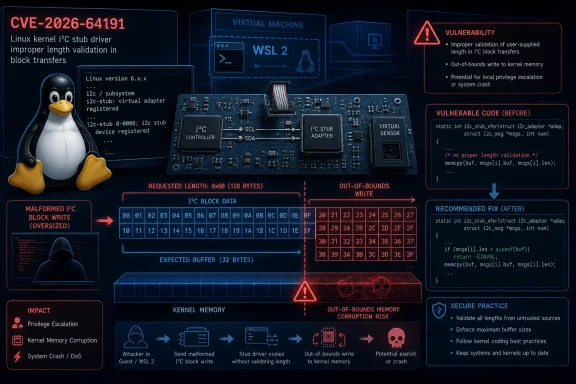
CVE-2026-64191 is a newly published Linux kernel vulnerability that turns a seemingly modest validation omission in the I²C stub driver into an out-of-bounds memory-access condition. The immediate risk is narrow: the flaw resides in a development and test module that is not built into standard kernels by default, must be explicitly loaded, and requires a local user to access an I²C device node. Yet the issue is still worth attention for Linux developers, hardware-validation teams, lab systems, custom WSL 2 environments, and Windows users who run Linux kernels outside the usual distribution defaults. The repaired code now refuses malformed I²C block transfers whose length is zero or exceeds the protocol buffer’s 32-byte limit, closing a path that could otherwise make the kernel read or write beyond a stack-resident data structure.
The vulnerability, tracked as CVE-2026-64191, concerns
That function has real value. I²C is widely used to connect low-speed components such as environmental sensors, battery-management controllers, touch controllers, EEPROMs, display bridge chips, and board-management devices. Being able to reproduce driver behavior against a predictable virtual device is useful for regression testing, bring-up work, automated validation, and teaching.
That is the central security lesson behind this CVE. Development-oriented code often has a smaller deployment footprint than mainstream drivers, but it still needs production-quality bounds checking when it exposes a kernel-to-userspace interface. The operating system cannot assume that every caller is well behaved simply because the feature was created for testing.
Long-lived bugs are common in mature systems software for a straightforward reason: code paths can remain logically correct for normal inputs while failing under malformed or adversarial input. The normal I²C testing workflow would use a legal block length, so the failure mode could remain invisible until targeted testing, fuzzing, code review, or a security audit exercises the invalid case.
The kernel’s SMBus data union contains a
But that check protected the wrong boundary. It could limit a register-range operation while still permitting the driver to use a block length greater than 32, despite the fixed-size SMBus block buffer not being large enough to contain that amount of data.
In practical terms, the code checked whether a request could exceed the simulated chip’s register model but did not first ensure that the request was valid for the in-memory communication buffer from which it would read or into which it would write.
The repair is intentionally small and direct. The updated code rejects requests when the supplied length is either zero or greater than
That is a textbook example of input validation at the point where untrusted or malformed data becomes an indexing or copy-length value.
The generic emulation path,
This is one of the recurring challenges in kernel security engineering: a framework may be safe by default, but custom implementations can inadvertently skip a precondition the framework would otherwise enforce. Shared helpers reduce duplicated code, yet specialized drivers sometimes need to operate beneath those helpers.
Whether that translates into a stable exploit depends on variables not resolved by the CVE record: kernel build options, compiler behavior, stack layout, mitigation configuration, operation direction, and the attacker’s ability to control adjacent memory or repeat the condition reliably.
In most properly configured systems, access to
That means ordinary Linux installations without the module loaded are generally not exposed through this exact code path. A laptop with a physical I²C touchpad or sensor does not become vulnerable simply because it uses I²C; the issue lies in the virtual i2c-stub driver, not the broad class of physical I²C controllers.
Privilege escalation cannot be ruled out categorically for memory-safety errors in kernel code, but it should not be asserted as established without a demonstrated exploit chain. The most responsible reading at publication is that this is a local kernel memory-safety flaw with constrained preconditions, not a demonstrated broadly exploitable root compromise.
The fix has been propagated through multiple stable-kernel branches. The CVE information identifies fixed maintenance points in long-term and stable series, including Linux 5.10.260, 5.15.211, 6.1.177, and 6.6.144, while additional stable references cover newer maintained branches.
For example, a vendor kernel can be based on an older long-term branch yet include the corrected
That command identifies the running kernel release. It does not, by itself, prove whether a vendor backport has been applied, but it is the starting point for matching the system against the distribution’s patched package level.
For systems that use the module, administrators can check whether it is loaded:
And they can inspect the module metadata when it is installed:
An absence of output from
Windows itself is not affected by CVE-2026-64191. The vulnerability exists in the Linux kernel’s I²C stub module. A Windows PC running no Linux kernel does not expose this driver.
However, standard WSL 2 environments are not a natural habitat for
The practical risk for an ordinary Windows developer using Ubuntu, Debian, Fedora, or another standard WSL distribution is therefore low. The vulnerable module must still exist in the WSL kernel configuration, be loaded, create an accessible device interface, and be deliberately targeted with an invalid SMBus ioctl request.
Those users may enable extra modules, load test drivers, pass through specialized hardware interfaces, or reproduce embedded-board workflows on a Windows workstation. In such an environment, the I²C stub module may be installed specifically because it supports testing.
A useful WSL maintenance sequence is:
Teams using Windows workstations for Linux kernel work should treat their local VM and WSL kernel baselines as part of the endpoint patching program, particularly when those systems build firmware, validate drivers, or handle proprietary source code.
The correct operational response is proportionate: include the fix in normal kernel update cycles for standard endpoints, then accelerate remediation where the vulnerable feature is demonstrably enabled and accessible.
Administrators may also use their system’s module policy mechanism to block loading of the module. The exact configuration approach differs among distributions and enterprise endpoint tools, so teams should apply the method consistent with their existing change-management process.
Containers deserve particular scrutiny. Device passthrough into containers is powerful but expands the kernel interface reachable by a workload. A container that does not need I²C should not receive an I²C device node merely because a broad “privileged” configuration is convenient.
Still, there are several cases where technically inclined consumers should pay attention.
Users should avoid overreacting by disabling real I²C hardware drivers. The CVE is not a warning against laptop touchpads, sensors, motherboard monitoring chips, or standard I²C functionality. Removing unrelated I²C support could break hardware without addressing the specific module at fault.
The useful takeaway is simple: this is a Linux kernel maintenance issue, not a Windows operating-system vulnerability. Windows users need not change their Windows Defender settings, firmware settings, or Windows device drivers in response to this CVE.
A local kernel memory-safety vulnerability on such a system can matter even if it has awkward prerequisites. Attackers often chain weaknesses: an initial foothold in a development environment can be combined with misconfigured device permissions or a deliberately installed test module.
Security teams should coordinate with platform engineering and hardware teams to answer three questions:
A shared kernel-development host with the module loaded may justify accelerated remediation. A locked-down production VM without the module can follow the normal kernel update window, assuming vendor guidance does not identify an expanded impact.
Checking only one of those values may appear safe in ordinary testing while leaving a gap at another boundary. This CVE exists precisely because the emulated register array was protected while the SMBus transfer buffer was not.
The reliable approach is to follow vendor advisories for packaged kernels, inspect custom source trees or patch sets, and validate module configuration where the organization actually uses I²C emulation.
Administrators should watch for several follow-on developments.
For WSL 2 users, the relevant question is whether they use Microsoft’s standard managed kernel or an override. Standard WSL kernel users should monitor WSL update availability; custom-kernel users should track their own build pipeline and upstream stable patches.
That assessment could change if researchers publish a reliable exploit, identify a configuration in which
Particular attention should go to custom ioctl handlers and specialized transfer callbacks, because those are the places most likely to bypass shared validation logic. The fix for CVE-2026-64191 is small; the engineering lesson is considerably larger.
CVE-2026-64191 should ultimately be remembered as a contained but instructive Linux kernel security fix: a test-oriented I²C emulator accepted a transfer length that was legal for neither the SMBus buffer nor the protocol, and a local caller could push the driver beyond its intended memory boundary. Most Windows users and ordinary WSL installations face little direct exposure, but developers and administrators running custom kernels, test modules, hardware labs, or shared Linux build environments should patch promptly, confirm whether
 Background
The vulnerability, tracked as CVE-2026-64191, concerns i2c-stub, a Linux kernel driver designed to emulate simple I²C devices. It is a test utility rather than a production hardware driver. Developers can load the module with a chosen chip address and use it to simulate register-based I²C peripherals without connecting a physical device.That function has real value. I²C is widely used to connect low-speed components such as environmental sensors, battery-management controllers, touch controllers, EEPROMs, display bridge chips, and board-management devices. Being able to reproduce driver behavior against a predictable virtual device is useful for regression testing, bring-up work, automated validation, and teaching.
A test component with a real kernel attack surface
The fact thati2c-stub is a test driver does not mean it operates in a harmless sandbox. Once loaded, it registers within the live kernel I²C subsystem and can be reached through the normal userspace I²C interface. A process that can open a relevant /dev/i2c-* device node may send SMBus transactions through an ioctl request.That is the central security lesson behind this CVE. Development-oriented code often has a smaller deployment footprint than mainstream drivers, but it still needs production-quality bounds checking when it exposes a kernel-to-userspace interface. The operating system cannot assume that every caller is well behaved simply because the feature was created for testing.
Why the disclosure is appearing now
The CVE record was published on July 20, 2026, after the fix had already been made available through Linux kernel maintenance channels. It describes a vulnerability that has existed since Linux 2.6.33, making this a long-lived defect rather than a regression introduced by a recent kernel feature.Long-lived bugs are common in mature systems software for a straightforward reason: code paths can remain logically correct for normal inputs while failing under malformed or adversarial input. The normal I²C testing workflow would use a legal block length, so the failure mode could remain invisible until targeted testing, fuzzing, code review, or a security audit exercises the invalid case.
The Vulnerable Code Path
The flaw occurs in the driver’sstub_xfer() transfer handler, specifically when processing an SMBus transaction of type I2C_SMBUS_I2C_BLOCK_DATA. In this transaction format, the first byte of the supplied block buffer represents the number of data bytes to transfer.The kernel’s SMBus data union contains a
block buffer sized for the protocol’s maximum block payload plus bookkeeping bytes. The supported maximum data length is I2C_SMBUS_BLOCK_MAX, which is 32 bytes. The first byte stores the length, leaving a total block array size of 34 bytes in the relevant union layout.The missing 32-byte boundary check
Before the fix, the I²C stub driver useddata->block[0] as the transfer length. It did contain a check intended to prevent the operation from running beyond the stub device’s emulated register array, which has 256 word-sized entries.But that check protected the wrong boundary. It could limit a register-range operation while still permitting the driver to use a block length greater than 32, despite the fixed-size SMBus block buffer not being large enough to contain that amount of data.
In practical terms, the code checked whether a request could exceed the simulated chip’s register model but did not first ensure that the request was valid for the in-memory communication buffer from which it would read or into which it would write.
The valid range is not merely a performance convention
The maximum block size is part of the SMBus interface contract. A request length of zero is invalid for this operation, and a length greater than 32 is also invalid. When kernel code accepts values outside this contract, it creates ambiguity: a caller believes it requested a transfer, while the driver may walk past the memory area allocated to represent the supplied transfer.The repair is intentionally small and direct. The updated code rejects requests when the supplied length is either zero or greater than
I2C_SMBUS_BLOCK_MAX, returning -EINVAL rather than continuing with unsafe processing.That is a textbook example of input validation at the point where untrusted or malformed data becomes an indexing or copy-length value.
Why the Existing Framework Did Not Save the Driver
One reason CVE-2026-64191 is technically interesting is that Linux already had similar validation in another part of the I²C stack. The flaw persisted becausei2c-stub took a more direct route through the subsystem.The generic emulation path,
i2c_smbus_xfer_emulated(), validates I²C block transaction sizes against the SMBus maximum. The I2C_SMBUS_BLOCK_DATA handling inside stub_xfer() also correctly enforced the maximum. Only the adjacent I2C_SMBUS_I2C_BLOCK_DATA case lacked equivalent validation.Direct implementation bypassed a shared safeguard
The I²C stub driver implements its own.smbus_xfer operation. That design is sensible for an emulator because it needs control over how an emulated device responds. However, it means the driver can bypass checks made in higher-level or alternative transfer paths.This is one of the recurring challenges in kernel security engineering: a framework may be safe by default, but custom implementations can inadvertently skip a precondition the framework would otherwise enforce. Shared helpers reduce duplicated code, yet specialized drivers sometimes need to operate beneath those helpers.
Consistency matters as much as a single fix
The corrected behavior aligns the I²C block-data case with two established expectations:- The standard SMBus block-data logic in the same driver already rejects lengths above 32.
- The generic SMBus emulation implementation already rejects invalid I²C block transfer lengths.
A narrow flaw with broader engineering relevance
The bug is not evidence that all I²C support is unsafe, nor does it imply that ordinary I²C peripherals are exposed. Instead, it illustrates a pattern security reviewers should recognize:- A field is technically constrained by a protocol specification.
- One path validates that constraint.
- A neighboring custom path validates a different, larger boundary.
- The larger boundary masks the absence of the smaller, safety-critical boundary.
Exploitability and Real-World Exposure
The reported proof condition is a KASAN-detected stack out-of-bounds access instub_xfer(). Kernel AddressSanitizer is a diagnostic feature used to detect invalid memory accesses during testing. Its appearance in the report confirms that malformed transfer lengths can push the driver outside the intended bounds of the SMBus data buffer.Whether that translates into a stable exploit depends on variables not resolved by the CVE record: kernel build options, compiler behavior, stack layout, mitigation configuration, operation direction, and the attacker’s ability to control adjacent memory or repeat the condition reliably.
Local access is required
This is not a remotely reachable network vulnerability. An attacker must already have local code execution on the Linux system or inside a Linux environment that exposes the relevant device interface. They must also be able to access an I²C device node and target an adapter backed by the loaded I²C stub module.In most properly configured systems, access to
/dev/i2c-* is restricted. Distribution policies commonly assign these nodes to a dedicated group or otherwise limit access through Unix file permissions, container device policies, and security modules. Those controls raise the practical bar, but they should be viewed as exposure reduction rather than a replacement for patching.The module must be intentionally present
The driver is associated withCONFIG_I2C_STUB, which is commonly built as a module rather than compiled directly into a running kernel. It is also not a component most desktop or server users load by accident. The module requires a chip_addr= parameter, reflecting its intended role as a simulated target device rather than an automatically detected piece of hardware.That means ordinary Linux installations without the module loaded are generally not exposed through this exact code path. A laptop with a physical I²C touchpad or sensor does not become vulnerable simply because it uses I²C; the issue lies in the virtual i2c-stub driver, not the broad class of physical I²C controllers.
Denial of service is the clearest concern
A malformed request can trigger an out-of-bounds access in kernel context. At a minimum, that creates a plausible local denial-of-service concern: a kernel warning, fault, or system instability is possible depending on build settings and the exact access.Privilege escalation cannot be ruled out categorically for memory-safety errors in kernel code, but it should not be asserted as established without a demonstrated exploit chain. The most responsible reading at publication is that this is a local kernel memory-safety flaw with constrained preconditions, not a demonstrated broadly exploitable root compromise.
Linux Versions and Patch Status
The CVE record identifies the affected source file asdrivers/i2c/i2c-stub.c and indicates that the defect traces back to Linux 2.6.33. That historical scope can sound alarming, but version lineage alone does not determine risk. The configuration and module-loading conditions are decisive.The fix has been propagated through multiple stable-kernel branches. The CVE information identifies fixed maintenance points in long-term and stable series, including Linux 5.10.260, 5.15.211, 6.1.177, and 6.6.144, while additional stable references cover newer maintained branches.
Do not rely only on the kernel’s major number
A machine running “Linux 6.6” is not necessarily safe or vulnerable. The relevant question is the full package release and the distribution’s backport policy. Enterprise distributions frequently retain an older-looking version string while incorporating individual security fixes from newer upstream releases.For example, a vendor kernel can be based on an older long-term branch yet include the corrected
i2c-stub code through a backported patch. Conversely, a custom-built kernel can use a modern base but omit stable updates. Administrators should consult their distribution’s security advisory, changelog, or source package information rather than making a decision from the first two version components alone.Check the active Linux kernel
Users can begin with the following command inside a Linux distribution:uname -rThat command identifies the running kernel release. It does not, by itself, prove whether a vendor backport has been applied, but it is the starting point for matching the system against the distribution’s patched package level.
For systems that use the module, administrators can check whether it is loaded:
lsmod | grep i2c_stubAnd they can inspect the module metadata when it is installed:
modinfo i2c-stubAn absence of output from
lsmod means the module is not currently loaded. It does not prove that it could not be loaded later by an administrator, test framework, boot-time configuration, or automation job.Implications for Windows and WSL 2
For WindowsForum readers, the key distinction is between a conventional Windows installation and a Windows machine that runs Linux through WSL 2, virtual machines, containers backed by Linux hosts, or physical dual-boot environments.Windows itself is not affected by CVE-2026-64191. The vulnerability exists in the Linux kernel’s I²C stub module. A Windows PC running no Linux kernel does not expose this driver.
Standard WSL 2 users are unlikely to encounter it
WSL 2 uses a real Linux kernel delivered separately from the Windows operating system image. Microsoft maintains that kernel on its own release cadence, typically distributing updates through Windows Update or the WSL update mechanism.However, standard WSL 2 environments are not a natural habitat for
i2c-stub. WSL 2 is primarily intended for Linux command-line workloads, developer tools, containers, server software, and cross-platform projects. Direct access to emulated I²C test adapters is not part of the normal WSL workflow.The practical risk for an ordinary Windows developer using Ubuntu, Debian, Fedora, or another standard WSL distribution is therefore low. The vulnerable module must still exist in the WSL kernel configuration, be loaded, create an accessible device interface, and be deliberately targeted with an invalid SMBus ioctl request.
Custom kernels change the assessment
The exposure picture changes for advanced users who specify a custom WSL kernel, build a bespoke Linux distribution, or use WSL as part of embedded development. Microsoft supports advanced WSL configurations that can point to a custom kernel through WSL configuration settings.Those users may enable extra modules, load test drivers, pass through specialized hardware interfaces, or reproduce embedded-board workflows on a Windows workstation. In such an environment, the I²C stub module may be installed specifically because it supports testing.
A useful WSL maintenance sequence is:
- Update WSL and restart its virtual machine environment.
- Confirm the active kernel version from within the distribution.
- Identify whether a custom kernel is configured.
- Check whether
i2c-stubis loaded or referenced by development scripts. - Update or rebuild custom kernels with the corrected stable patch.
Virtual machines and developer laptops deserve equal attention
The same caveat applies to Hyper-V, VMware, VirtualBox, and cloud-hosted Linux virtual machines. Virtualization does not remove kernel vulnerabilities. It can reduce access to physical hardware, but the vulnerable component is an emulated I²C device driver, so the relevant issue is the guest kernel configuration rather than the presence of a real I²C bus.Teams using Windows workstations for Linux kernel work should treat their local VM and WSL kernel baselines as part of the endpoint patching program, particularly when those systems build firmware, validate drivers, or handle proprietary source code.
Who Should Treat This as a Priority
Not every system needs the same response. CVE-2026-64191 should be triaged according to the presence of the module, access controls, and the system’s role.Highest-priority environments
The following environments warrant prompt patching and configuration review:- Hardware-validation systems should be prioritized because they are the most likely to load I²C stub intentionally and grant developers access to I²C test interfaces.
- Shared engineering servers should be prioritized because multiple users, CI jobs, or service accounts may have local execution and interact with test kernels.
- Custom WSL 2 kernel users should be prioritized when their workflows include embedded Linux, driver testing, I²C tooling, or modules outside the standard Microsoft kernel configuration.
- Educational and research labs should be prioritized because broad local access and experimental kernel configurations often coexist.
- Appliance-build systems should be prioritized if they produce or test custom Linux images with I²C emulation enabled.
Lower-priority but still patchable environments
An ordinary Linux desktop, cloud VM, or WSL instance that has never loadedi2c-stub is at much lower risk from this particular CVE. That does not justify indefinite deferral of kernel updates, especially if the system receives kernel security updates through routine package maintenance.The correct operational response is proportionate: include the fix in normal kernel update cycles for standard endpoints, then accelerate remediation where the vulnerable feature is demonstrably enabled and accessible.
Mitigation Before a Kernel Update Is Available
Patching the kernel is the preferred solution. The code fix is concise, targeted, and restores expected protocol validation. If a vendor package is not yet available, administrators can reduce exposure by ensuring that the test module is not loaded and cannot be casually loaded on systems that do not require it.Disable unnecessary test functionality
If the module is not required, remove it from test scripts, boot-time module lists, and automation configuration. On a running system, an administrator can unload it if no process depends on it:sudo modprobe -r i2c-stubAdministrators may also use their system’s module policy mechanism to block loading of the module. The exact configuration approach differs among distributions and enterprise endpoint tools, so teams should apply the method consistent with their existing change-management process.
Tighten device-node permissions
The vulnerability requires a process to communicate through an I²C device interface. Limiting access to/dev/i2c-* nodes remains good hardening practice. Development systems should avoid granting broad, permanent access to hardware-control device groups when a narrower, task-specific permission model is possible.Containers deserve particular scrutiny. Device passthrough into containers is powerful but expands the kernel interface reachable by a workload. A container that does not need I²C should not receive an I²C device node merely because a broad “privileged” configuration is convenient.
Do not confuse mitigation with remediation
Unloading or blockingi2c-stub reduces the chance of reaching the vulnerable function. It does not fix the underlying code, and it may be undone by future configuration changes. A patched kernel is still necessary for systems that retain the module as part of their testing environment.Consumer Impact
For most consumers, the direct impact is limited. The typical Windows 11 PC does not run the affected Linux driver. The typical Linux desktop also does not load an I²C test stub module or expose it to untrusted local users.Still, there are several cases where technically inclined consumers should pay attention.
Dual-boot users and home-lab operators
A dual-boot system running a mainstream Linux distribution should receive the corrected code through the distribution’s regular kernel updates. Home-lab users who install custom kernels, run hardware test environments, or use an old long-term kernel without vendor support should verify their update path.Users should avoid overreacting by disabling real I²C hardware drivers. The CVE is not a warning against laptop touchpads, sensors, motherboard monitoring chips, or standard I²C functionality. Removing unrelated I²C support could break hardware without addressing the specific module at fault.
WSL developers using standard distributions
A standard WSL developer should update WSL and their Linux distribution as part of routine maintenance. They should be particularly attentive if they have configured a custom kernel or imported a bespoke Linux environment built for embedded work.The useful takeaway is simple: this is a Linux kernel maintenance issue, not a Windows operating-system vulnerability. Windows users need not change their Windows Defender settings, firmware settings, or Windows device drivers in response to this CVE.
Enterprise Impact
Enterprises should view CVE-2026-64191 through the lens of engineering environment governance rather than broad endpoint emergency response. The risk increases where local users can execute code on shared systems and where specialized kernel modules are intentionally present.Development infrastructure is often the real target
A production application server may have no reason to loadi2c-stub. A firmware test rack, CI runner, hardware-in-the-loop environment, or Linux build server may have a much stronger reason. Those environments also commonly host privileged toolchains, signing materials, source code, device images, and access tokens.A local kernel memory-safety vulnerability on such a system can matter even if it has awkward prerequisites. Attackers often chain weaknesses: an initial foothold in a development environment can be combined with misconfigured device permissions or a deliberately installed test module.
Asset inventory must include kernel configuration
Traditional vulnerability management often inventories operating-system versions and installed packages. Kernel-module exposure is more nuanced. A system can possess a module without loading it, load it temporarily through a test job, or include it in a custom kernel that does not correspond neatly to a vendor’s standard package catalog.Security teams should coordinate with platform engineering and hardware teams to answer three questions:
- Is
CONFIG_I2C_STUBenabled in any supported kernel build? - Is the
i2c-stubmodule loaded, loadable, or used by automated test workflows? - Which users, containers, service accounts, or CI jobs can access the relevant I²C device nodes?
Patch SLAs should reflect actual exposure
This CVE is not an excuse for blanket alarm. Nor is “test driver” a reason to ignore it. A mature enterprise response assigns priority based on actual configuration, local-user trust boundaries, and the sensitivity of the system.A shared kernel-development host with the module loaded may justify accelerated remediation. A locked-down production VM without the module can follow the normal kernel update window, assuming vendor guidance does not identify an expanded impact.
Strengths and Opportunities
The handling of CVE-2026-64191 demonstrates several strengths in the Linux kernel security and maintenance process.- The flaw has a narrowly scoped corrective patch. Rejecting zero-length and oversized block transfers removes the unsafe condition without redesigning the driver’s intended behavior.
- The repair follows existing semantics. The corrected I²C block-transfer behavior now matches validation already present in a related stub-driver case and in the generic SMBus emulation path.
- Stable backports improve practical remediation. Organizations do not need to jump immediately to a newest feature kernel if their supported maintenance branch receives the fix.
- The incident provides a useful audit pattern. Kernel maintainers and driver authors can review custom transfer handlers for protocol fields that become lengths, offsets, array indices, or copy counts.
- The limited default exposure permits rational prioritization. Because the module is not ordinarily built in or loaded by default, defenders can focus first on custom kernels, test systems, and shared development environments.
A reminder to validate at every layer
The deeper opportunity is procedural. Code that receives an external length should validate it against every relevant constraint: the protocol maximum, the source buffer capacity, the destination buffer capacity, the backing storage range, and any operation-specific minimum.Checking only one of those values may appear safe in ordinary testing while leaving a gap at another boundary. This CVE exists precisely because the emulated register array was protected while the SMBus transfer buffer was not.
Risks and Concerns
The primary risk is not mass exploitation of consumer systems. It is the chance that organizations underestimate a test-only component that becomes security-relevant when combined with local access and permissive device controls.- Custom kernel builds can lag behind stable fixes. Teams that maintain their own WSL, embedded, appliance, or lab kernels must actively merge the patch rather than waiting for a desktop distribution package.
- Local access can be broader than expected. CI workers, IDE integrations, container workloads, and shared service accounts may possess execution rights or device permissions that administrators did not intend to treat as privileged.
- KASAN findings should not be dismissed as test-only noise. KASAN makes invalid accesses easier to detect, but the underlying faulty code can exist in kernels built without KASAN.
- Module presence and module use are different things. A module may not be loaded today yet still be introduced by a future test run, troubleshooting action, or automated setup script.
- Overbroad mitigations can create operational damage. Disabling unrelated I²C support or changing broad hardware-access policies without understanding the affected component can interrupt legitimate device functionality while failing to improve the real security posture.
The danger of version-string complacency
A common operational mistake is to equate an upstream version number with vulnerability status. That can lead to false positives when a vendor has backported the patch, or false negatives when a custom kernel carries an old copy of the affected driver despite a superficially modern environment.The reliable approach is to follow vendor advisories for packaged kernels, inspect custom source trees or patch sets, and validate module configuration where the organization actually uses I²C emulation.
What to Watch Next
The CVE entry was published very recently, and public severity metrics had not yet been populated at the time of disclosure. That is normal for a newly processed kernel CVE, particularly when the technical description is available before a complete scoring analysis is finalized.Administrators should watch for several follow-on developments.
Distribution advisories and backport confirmations
Major Linux distributions will determine their own package status, backport identifiers, and maintenance timelines. Enterprises should monitor the advisories for their actual deployed kernel packages rather than relying solely on the upstream CVE language.For WSL 2 users, the relevant question is whether they use Microsoft’s standard managed kernel or an override. Standard WSL kernel users should monitor WSL update availability; custom-kernel users should track their own build pipeline and upstream stable patches.
Evidence of exploitation or expanded impact
At publication, the available technical material establishes a local out-of-bounds access under specific conditions. It does not establish widespread exploitation in the wild or a universal privilege-escalation technique.That assessment could change if researchers publish a reliable exploit, identify a configuration in which
i2c-stub is more widely deployed than expected, or find related validation defects in other custom SMBus transfer implementations. Security teams should distinguish between confirmed facts and future possibilities, updating priority when evidence changes.Wider review of protocol-length handling
The most productive longer-term response is an audit of similar patterns. Any driver that handles variable-length protocol data should be reviewed for mismatches among wire-level limits, union or structure capacities, and backing-store sizes.Particular attention should go to custom ioctl handlers and specialized transfer callbacks, because those are the places most likely to bypass shared validation logic. The fix for CVE-2026-64191 is small; the engineering lesson is considerably larger.
CVE-2026-64191 should ultimately be remembered as a contained but instructive Linux kernel security fix: a test-oriented I²C emulator accepted a transfer length that was legal for neither the SMBus buffer nor the protocol, and a local caller could push the driver beyond its intended memory boundary. Most Windows users and ordinary WSL installations face little direct exposure, but developers and administrators running custom kernels, test modules, hardware labs, or shared Linux build environments should patch promptly, confirm whether
i2c-stub is in use, and treat strict length validation as a non-negotiable rule wherever userspace input reaches kernel memory.References
- Primary source: NVD / Linux Kernel
Published: 2026-07-22T01:02:16-07:00
NVD - CVE-2026-64191
 nvd.nist.gov
- Security advisory: MSRC
Published: 2026-07-22T01:02:16-07:00
Original feed URL
Security Update Guide - Microsoft Security Response Center
 msrc.microsoft.com
