

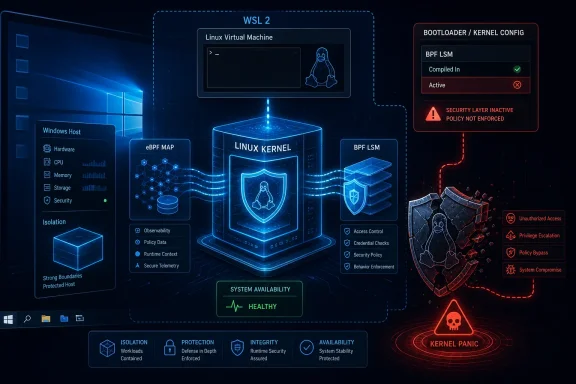
CVE-2026-64192 is a narrowly triggered Linux kernel vulnerability with an unusually severe outcome: a privileged process can cause an immediate kernel panic by creating and using a BPF inode-storage map on a system where BPF LSM support was compiled in but never initialized at boot. The newly published fix does not attempt to recover from corrupted state after the fact. Instead, it blocks the incompatible map type at creation time, returning an error before a map can reach the dangerous “zombie” state. For Windows users, the immediate concern is not the Windows kernel itself, which is unaffected, but Linux workloads running through WSL 2, Hyper-V Linux guests, containers, developer appliances, and security tooling that depend on an exposed Linux kernel.
CVE-2026-64192 emerges when the kernel is compiled with BPF LSM support enabled through
That distinction matters because the Linux kernel supports a modular security architecture. Features can be compiled in, selectable, ordered, or omitted through configuration and boot parameters. The relevant boot-time choice commonly involves the
That transforms a configuration mismatch into memory corruption affecting a kernel control-flow data structure. The resulting failure is deterministic enough to produce an immediate denial of service: an RCU callback pointer can be cleared, and the kernel subsequently attempts to execute code through a null function pointer. The system panics rather than safely refusing an unsupported request.
The fix is therefore important not because it changes the normal behavior of BPF inode storage, but because it restores a basic kernel invariant: a feature must not allocate or operate on per-object storage until the subsystem that owns that storage has completed initialization.
Maps are central to this model. A BPF map is a kernel-resident data structure used to exchange data between BPF programs and user space, or between BPF programs themselves. Different map types offer different lifetime and ownership semantics: hash tables, arrays, ring buffers, socket-local storage, cgroup storage, task storage, and object-attached storage.
BPF inode storage is one of the more specialized categories. It associates BPF-managed data with an inode, the kernel object that represents a filesystem file, directory, symbolic link, or other filesystem entity. That makes it useful for policies or observability logic that need metadata to persist with the file object while the inode remains alive.
For example, an organization could use BPF LSM hooks to audit or deny particular file operations based on runtime context. A platform team could use it to build policy prototypes without carrying a full out-of-tree kernel module. Security products can also use BPF’s telemetry and policy features to inspect activity closer to the kernel than traditional endpoint agents can.
That flexibility carries operational complexity. BPF LSM is dependent on BPF support, kernel configuration, privileges, verifier behavior, active LSM ordering, and boot-time initialization. CVE-2026-64192 is a reminder that flexible kernel subsystems require equally rigorous lifecycle controls.
The kernel must calculate each participating module’s offset correctly. This is not a cosmetic bookkeeping detail. The offset tells a module where its data begins within an allocated region that may contain storage belonging to several security components and internal structures.
When BPF LSM has initialized properly, its inode-storage offset points beyond reserved data and into the BPF LSM’s valid allocation region. When it has not initialized, the offset retains a compiled default that does not represent a valid BPF LSM location in the live system.
That difference is crucial. The BPF inode-storage code computes an address from
In other words, code that believes it is accessing an “owner storage” pointer instead touches a callback pointer the kernel may later invoke. The bug is not simply a null dereference at map creation. It is an incorrect interpretation of shared memory layout that damages future callback execution.
The delayed nature of RCU helps explain why the initial BPF action may not be the visible moment of failure. A map element cleanup operation or inode destruction path can write
Later, when the RCU subsystem runs its batch of callbacks, it attempts to call the now-null function pointer. On a conventional kernel configuration, that produces an instruction fetch at address zero and triggers a kernel panic.
That limitation should not make the issue seem trivial. Kernel panics are operationally expensive. A crash can interrupt applications, corrupt in-flight work, break clustered services, trigger failovers, complicate incident response, and cause data-loss exposure for workloads that have not completed durable writes.
It is also worth separating the triggering identity from the impact domain. The described pathway requires a privileged user capable of creating and updating the relevant BPF map. But a privileged local identity can include a container host administrator, a compromised root-level security agent, a maintenance tool, an automation system with broad capabilities, or a delegated BPF operator.
The
This is a classic lifecycle problem: code availability was mistaken for runtime readiness. The patched kernel introduces a direct readiness indicator instead of assuming the compile-time configuration proves the operational state.
That does not necessarily mean the system is insecure or misconfigured. Many systems intentionally do not use BPF LSM. The problem was that the pre-fix kernel continued to permit an inode-storage BPF map type whose safe behavior implicitly depended on BPF LSM having initialized.
The correction respects the administrator’s choice. A system without an active BPF LSM will now reject inode-storage map creation with
That choice serves two purposes:
This placement matters. Once a map exists, it may receive updates, attach to BPF programs, acquire references, and become entangled with object lifetimes. Blocking it before allocation is simpler, safer, and easier for userspace to recognize.
A failed map-create call is an ordinary operational error. A successfully created but structurally invalid map is far more dangerous because it appears usable until it modifies unrelated kernel metadata.
An inode-storage map created without initialized BPF LSM support is not a healthy but dormant resource. It is a map that can exist, potentially receive data, and participate in cleanup paths while lacking the storage layout it assumes. It is operationally alive enough to be manipulated but semantically invalid enough to destabilize the kernel.
The patch changes that contract. Applications cannot confuse “the map was created” with “the map is supported.” They receive a clear failure at the only safe boundary.
Developers should treat this as a feature-capability check, not as a transient fault. Retrying the operation will not help until the host boots with an LSM configuration that initializes BPF LSM, assuming the administrator intends to enable it.
Applications should also avoid using only compile-time assumptions or kernel-version checks. The correct question is not merely whether a kernel contains BPF support. It is whether the specific map type is available and usable on the currently booted system.
On hardened systems, unprivileged BPF access is often disabled or constrained. That materially reduces the chance of a low-privilege local account reaching this pathway directly. However, access control should not be confused with patch status. A vulnerability that requires privilege can still be relevant wherever privileged workload code is not fully trusted.
Examples include development servers with broad administrator access, multi-tenant build systems, appliance-style systems that expose BPF to a management plane, or endpoint products running privileged plugins.
A conventional unprivileged container typically should not be able to create the relevant BPF map. A privileged container, a container given powerful Linux capabilities, or a runtime configuration that exposes excessive host privileges is a different matter. The decisive question is whether workload code can reach the host kernel’s BPF map-creation interface with sufficient authorization.
This is another reason to minimize privileged containers. Even when a vulnerability is “only” a denial of service, the availability impact is imposed on the shared host and every workload that depends on it.
That distinction is essential for WindowsForum readers. Installing a Windows cumulative update will not, by itself, remediate a vulnerable Linux guest kernel. Conversely, a vulnerable Linux kernel running under virtualization does not mean Windows kernel-mode code is directly exposed to this specific bug.
The availability risk is instead tied to whichever Linux kernel instance runs the BPF workload: a WSL 2 distribution, a Hyper-V virtual machine, a Docker or Kubernetes host, an on-premises appliance, a cloud instance, or a dual-boot Linux installation.
For most desktop WSL users, the practical risk is low because the trigger requires privileged BPF actions and a specific LSM configuration mismatch. Yet developers and security engineers should not assume that “it runs inside Windows” makes kernel configuration irrelevant.
A WSL 2 environment may contain container tools, security experiments, eBPF development utilities, custom kernel configurations, or workloads imported from production Linux environments. If those environments use a kernel build with BPF LSM enabled but omit BPF from the active LSM stack, the vulnerability conditions may be present.
Still, guest availability can be business-critical. A panic can interrupt CI jobs, local development databases, Linux-only build pipelines, security collectors, test environments, and services accessed from Windows clients. In clustered or automated environments, repeated guest crashes can become a noisy operational incident even where host isolation works as designed.
A system may have an affected kernel version but lack BPF LSM entirely, have it compiled out, have no privileged BPF consumers, or have a boot configuration that initializes BPF correctly. Another system may look nearly identical in an inventory but use a custom
The priority should be to patch affected kernels first, then validate the systems where BPF LSM and inode-storage maps are actually part of operational workflows.
Products should distinguish unsupported map creation from a general BPF failure. A robust agent can record an actionable diagnostic, disable only the feature that depends on inode storage, select a compatible fallback where appropriate, and avoid repeated retries that generate noise.
A brittle agent may instead fail its entire initialization sequence. That would convert a kernel hardening fix into an avoidable monitoring gap. Testing should include hosts with BPF LSM compiled in but inactive, not merely fully enabled and fully disabled configurations.
This does not mean administrators should automatically add BPF to every
If BPF LSM is intentionally required, administrators should then validate the active configuration in a controlled maintenance window. If it is not required, the patched kernel will safely refuse inode-storage maps rather than permitting an unsafe partial state.
The issue becomes more relevant for people who compile custom kernels, work with eBPF observability projects, develop LSM programs, run container stacks locally, or import specialized Linux images. Those users may see a BPF operation that previously appeared to work fail with an unsupported-operation error after updating.
That failure should be viewed as protective. It means the kernel is refusing a map type that cannot safely operate in the host’s current BPF LSM state.
Developers maintaining related BPF storage types, LSM integrations, or optional subsystem hooks should ask several questions:
This is valuable in mixed environments. A developer may test successfully on one Linux machine, fail on a hardened server, and incorrectly conclude that a kernel version is too old or BPF is globally unavailable. Accurate detection avoids wasted troubleshooting and prevents risky attempts to work around the failure with excessive privileges.
Likewise, adding BPF to an LSM list merely to make an application stop failing should be evaluated as a deliberate security configuration change. The correct baseline is a patched kernel; enabling BPF LSM should occur only where its policy or observability capabilities are intentionally needed.
Watch for advisories from the maintainers of each Linux distribution, cloud image, container host operating system, embedded platform, or virtualization appliance in use. For WSL 2, users should monitor the kernel update channel associated with their installed WSL environment and ensure routine WSL updates are not deferred indefinitely.
A future score will help with prioritization frameworks, but the underlying facts already support a practical assessment: this is a local, privileged, configuration-dependent Linux kernel denial-of-service vulnerability with potentially serious availability consequences on systems that expose the relevant BPF capability.
CVE-2026-64192 is a concise example of how kernel reliability depends on disciplined boundaries between build-time capability, boot-time selection, and runtime readiness. Its fix is intentionally modest—a Boolean initialization state and an allocation-time rejection—but it prevents a privileged caller from turning an unsupported BPF map into a null callback and a system-wide crash. For Windows users operating Linux through WSL 2 or virtualization, the message is equally clear: treat Linux kernel updates and Linux boot configuration as first-class parts of the security posture, even when the desktop beneath them is Windows.
 Background
A kernel bug rooted in a configuration mismatch
The vulnerability exists at the boundary between two Linux facilities that are powerful independently but delicate when combined: extended Berkeley Packet Filter, or eBPF, and the Linux Security Module framework, usually shortened to LSM. BPF provides a programmable, verified execution environment inside the kernel. LSM provides framework-level hooks used by security systems such as SELinux, AppArmor, Landlock, and BPF LSM policies.CVE-2026-64192 emerges when the kernel is compiled with BPF LSM support enabled through
CONFIG_BPF_LSM=y, yet the BPF LSM is not actually selected during boot. In practical terms, the code needed for BPF LSM exists in the binary, but the running kernel has not performed the initialization work that makes BPF LSM’s per-object security storage valid.That distinction matters because the Linux kernel supports a modular security architecture. Features can be compiled in, selectable, ordered, or omitted through configuration and boot parameters. The relevant boot-time choice commonly involves the
lsm= parameter, which determines which security modules participate in the active LSM stack. A capability merely being present in a kernel image does not mean every supporting data structure has been initialized for safe use.Why this is more than a bad feature detection bug
At first glance, the issue may sound like a conventional feature-detection defect: an application requests a BPF map type that should be unavailable, and the kernel should return an error. The deeper issue is that the kernel instead allowed allocation and later performed pointer arithmetic based on an uninitialized layout offset.That transforms a configuration mismatch into memory corruption affecting a kernel control-flow data structure. The resulting failure is deterministic enough to produce an immediate denial of service: an RCU callback pointer can be cleared, and the kernel subsequently attempts to execute code through a null function pointer. The system panics rather than safely refusing an unsupported request.
The fix is therefore important not because it changes the normal behavior of BPF inode storage, but because it restores a basic kernel invariant: a feature must not allocate or operate on per-object storage until the subsystem that owns that storage has completed initialization.
Understanding BPF, LSM, and Inode Storage
BPF is no longer just a networking technology
BPF began as a packet-filtering mechanism, but modern eBPF is used for observability, networking, performance analysis, tracing, traffic control, runtime security, and policy enforcement. Programs are loaded through kernel interfaces, verified for safety constraints, then attached to specific execution points or hooks.Maps are central to this model. A BPF map is a kernel-resident data structure used to exchange data between BPF programs and user space, or between BPF programs themselves. Different map types offer different lifetime and ownership semantics: hash tables, arrays, ring buffers, socket-local storage, cgroup storage, task storage, and object-attached storage.
BPF inode storage is one of the more specialized categories. It associates BPF-managed data with an inode, the kernel object that represents a filesystem file, directory, symbolic link, or other filesystem entity. That makes it useful for policies or observability logic that need metadata to persist with the file object while the inode remains alive.
BPF LSM gives BPF a security-policy role
BPF LSM programs attach to Linux Security Module hooks. Rather than simply watching kernel events, they can participate in mandatory access-control decisions and auditing paths. This makes BPF LSM attractive for highly tailored security controls, particularly where a static policy language may be too rigid.For example, an organization could use BPF LSM hooks to audit or deny particular file operations based on runtime context. A platform team could use it to build policy prototypes without carrying a full out-of-tree kernel module. Security products can also use BPF’s telemetry and policy features to inspect activity closer to the kernel than traditional endpoint agents can.
That flexibility carries operational complexity. BPF LSM is dependent on BPF support, kernel configuration, privileges, verifier behavior, active LSM ordering, and boot-time initialization. CVE-2026-64192 is a reminder that flexible kernel subsystems require equally rigorous lifecycle controls.
Inode security blobs are shared kernel infrastructure
Linux security modules often need to retain state associated with kernel objects. For inodes, that state is stored in ani_security area, commonly described as a security blob. Multiple LSMs can reserve their own portions of that blob.The kernel must calculate each participating module’s offset correctly. This is not a cosmetic bookkeeping detail. The offset tells a module where its data begins within an allocated region that may contain storage belonging to several security components and internal structures.
When BPF LSM has initialized properly, its inode-storage offset points beyond reserved data and into the BPF LSM’s valid allocation region. When it has not initialized, the offset retains a compiled default that does not represent a valid BPF LSM location in the live system.
The Technical Failure Chain
The unsafe eight-byte offset
According to the vulnerability record, the uninitialized BPF LSM inode blob size remains at a default value of eight bytes. On affected systems, the valid offset should instead be beyond a reservedstruct rcu_head, typically at least 16 bytes.That difference is crucial. The BPF inode-storage code computes an address from
inode->i_security plus the BPF LSM offset. With the stale eight-byte value, the computed address does not land in BPF-owned inode-storage metadata. It aliases the func field of the rcu_head structure at the beginning of the security blob.In other words, code that believes it is accessing an “owner storage” pointer instead touches a callback pointer the kernel may later invoke. The bug is not simply a null dereference at map creation. It is an incorrect interpretation of shared memory layout that damages future callback execution.
Why RCU makes the crash occur later
Read-Copy-Update, or RCU, is a core Linux synchronization and deferred-reclamation mechanism. It enables fast read-side access while arranging certain cleanup work to run later, after the kernel determines it is safe.The delayed nature of RCU helps explain why the initial BPF action may not be the visible moment of failure. A map element cleanup operation or inode destruction path can write
NULL into what it assumes is BPF storage ownership metadata. But because the bad offset redirects that write, it actually clears a queued RCU callback function pointer.Later, when the RCU subsystem runs its batch of callbacks, it attempts to call the now-null function pointer. On a conventional kernel configuration, that produces an instruction fetch at address zero and triggers a kernel panic.
This is a denial-of-service vulnerability, not a silent data leak
The published description focuses on an immediate crash path. It does not establish arbitrary code execution, privilege escalation from an unprivileged account, or disclosure of sensitive information. The practical consequence is system availability loss.That limitation should not make the issue seem trivial. Kernel panics are operationally expensive. A crash can interrupt applications, corrupt in-flight work, break clustered services, trigger failovers, complicate incident response, and cause data-loss exposure for workloads that have not completed durable writes.
It is also worth separating the triggering identity from the impact domain. The described pathway requires a privileged user capable of creating and updating the relevant BPF map. But a privileged local identity can include a container host administrator, a compromised root-level security agent, a maintenance tool, an automation system with broad capabilities, or a delegated BPF operator.
Why Boot Parameters Matter
Compiled support is not active support
Linux distributions often enable broad sets of kernel features so one image can serve many hardware and deployment scenarios. A distribution kernel might include BPF LSM support even where most installed systems never use BPF LSM policy programs.The
lsm= boot parameter controls the active security-module configuration in systems where LSM ordering is explicitly specified. If BPF is absent from that active list, the BPF LSM initialization routine may never run. Before this fix, BPF inode-storage map support could still be compiled and reachable even though the supporting BPF LSM state was not ready.This is a classic lifecycle problem: code availability was mistaken for runtime readiness. The patched kernel introduces a direct readiness indicator instead of assuming the compile-time configuration proves the operational state.
Explicit LSM stacks can introduce accidental exposure
Administrators may setlsm= deliberately to control LSM ordering, enable a preferred security module, troubleshoot boot issues, meet a compliance baseline, or experiment with custom security stacks. In doing so, they can unintentionally omit BPF from the active stack.That does not necessarily mean the system is insecure or misconfigured. Many systems intentionally do not use BPF LSM. The problem was that the pre-fix kernel continued to permit an inode-storage BPF map type whose safe behavior implicitly depended on BPF LSM having initialized.
The correction respects the administrator’s choice. A system without an active BPF LSM will now reject inode-storage map creation with
-EOPNOTSUPP, meaning the operation is not supported in the current runtime configuration.The new guard is intentionally immutable after boot
The fix adds a globalbpf_lsm_initialized Boolean variable marked __ro_after_init. The value is set when the BPF LSM successfully registers through the LSM framework and becomes read-only after initialization.That choice serves two purposes:
- It makes the runtime state explicit. Map allocation can ask the direct question: did BPF LSM initialize successfully?
- It prevents later mutation of the readiness state. After early boot, the kernel treats this lifecycle fact as immutable, reducing the chance that ordinary runtime code can accidentally alter it.
The Fix: Fail Fast Instead of Cleaning Up Later
Map allocation becomes the enforcement point
The vulnerable behavior begins with creation ofBPF_MAP_TYPE_INODE_STORAGE. The remediation therefore gates allocation in inode_storage_map_alloc(). If BPF LSM did not initialize, the kernel returns -EOPNOTSUPP.This placement matters. Once a map exists, it may receive updates, attach to BPF programs, acquire references, and become entangled with object lifetimes. Blocking it before allocation is simpler, safer, and easier for userspace to recognize.
A failed map-create call is an ordinary operational error. A successfully created but structurally invalid map is far more dangerous because it appears usable until it modifies unrelated kernel metadata.
Why “zombie map states” are the key phrase
The vulnerability description refers to avoiding zombie map states. That phrase is particularly useful because it captures the mismatch between an object’s apparent existence and its actual usability.An inode-storage map created without initialized BPF LSM support is not a healthy but dormant resource. It is a map that can exist, potentially receive data, and participate in cleanup paths while lacking the storage layout it assumes. It is operationally alive enough to be manipulated but semantically invalid enough to destabilize the kernel.
The patch changes that contract. Applications cannot confuse “the map was created” with “the map is supported.” They receive a clear failure at the only safe boundary.
Compatibility effects for BPF applications
Well-designed BPF software should already handle map creation failures. After this change, applications that attempt to create inode-storage maps without active BPF LSM will receive a consistent unsupported-operation error rather than succeeding and risking a future crash.Developers should treat this as a feature-capability check, not as a transient fault. Retrying the operation will not help until the host boots with an LSM configuration that initializes BPF LSM, assuming the administrator intends to enable it.
Applications should also avoid using only compile-time assumptions or kernel-version checks. The correct question is not merely whether a kernel contains BPF support. It is whether the specific map type is available and usable on the currently booted system.
Exposure and Privilege Boundaries
Who can trigger the issue
The described crash path involves a privileged user creating and updating a BPF inode-storage map. BPF capabilities are intentionally restricted because BPF programs and maps interact with kernel subsystems that can affect system-wide behavior.On hardened systems, unprivileged BPF access is often disabled or constrained. That materially reduces the chance of a low-privilege local account reaching this pathway directly. However, access control should not be confused with patch status. A vulnerability that requires privilege can still be relevant wherever privileged workload code is not fully trusted.
Examples include development servers with broad administrator access, multi-tenant build systems, appliance-style systems that expose BPF to a management plane, or endpoint products running privileged plugins.
Containers are not an automatic safety boundary
Containers share the host Linux kernel. A container’s ability to invoke BPF operations depends on the host’s capability policy, seccomp profile, namespace configuration, kernel settings, and privileges granted to that container.A conventional unprivileged container typically should not be able to create the relevant BPF map. A privileged container, a container given powerful Linux capabilities, or a runtime configuration that exposes excessive host privileges is a different matter. The decisive question is whether workload code can reach the host kernel’s BPF map-creation interface with sufficient authorization.
This is another reason to minimize privileged containers. Even when a vulnerability is “only” a denial of service, the availability impact is imposed on the shared host and every workload that depends on it.
The attack surface is conditional but real
CVE-2026-64192 requires several conditions to align:- The kernel must include BPF LSM support.
- The BPF LSM must be inactive or uninitialized because of boot-time LSM selection.
- The vulnerable kernel must lack the fix.
- A sufficiently privileged actor must create and update an inode-storage BPF map.
- The affected cleanup or inode-destruction sequence must occur.
WSL 2, Windows Hosts, and Virtualized Linux
Windows itself is not the affected kernel
CVE-2026-64192 is a Linux kernel vulnerability. It does not describe a flaw in the Windows NT kernel, Windows file-system drivers, Microsoft Defender, the Hyper-V hypervisor, or the conventional Windows BPF implementation.That distinction is essential for WindowsForum readers. Installing a Windows cumulative update will not, by itself, remediate a vulnerable Linux guest kernel. Conversely, a vulnerable Linux kernel running under virtualization does not mean Windows kernel-mode code is directly exposed to this specific bug.
The availability risk is instead tied to whichever Linux kernel instance runs the BPF workload: a WSL 2 distribution, a Hyper-V virtual machine, a Docker or Kubernetes host, an on-premises appliance, a cloud instance, or a dual-boot Linux installation.
WSL 2 deserves targeted attention
WSL 2 runs a real Linux kernel in a lightweight virtual-machine architecture. That is a major improvement in Linux compatibility compared with the translation-based architecture used by the original WSL design, but it also means Linux kernel vulnerabilities must be evaluated as Linux kernel vulnerabilities.For most desktop WSL users, the practical risk is low because the trigger requires privileged BPF actions and a specific LSM configuration mismatch. Yet developers and security engineers should not assume that “it runs inside Windows” makes kernel configuration irrelevant.
A WSL 2 environment may contain container tools, security experiments, eBPF development utilities, custom kernel configurations, or workloads imported from production Linux environments. If those environments use a kernel build with BPF LSM enabled but omit BPF from the active LSM stack, the vulnerability conditions may be present.
Hyper-V isolation limits the blast radius, not the guest outage
A Linux guest panic in Hyper-V normally affects the guest rather than crashing the Windows host. That is meaningful isolation. The immediate result should be loss of service inside the guest VM, with the host continuing to run other workloads.Still, guest availability can be business-critical. A panic can interrupt CI jobs, local development databases, Linux-only build pipelines, security collectors, test environments, and services accessed from Windows clients. In clustered or automated environments, repeated guest crashes can become a noisy operational incident even where host isolation works as designed.
Enterprise Impact
Security teams must inventory runtime configuration
Enterprise vulnerability management often starts with package versions and CVE matching. That remains necessary, but CVE-2026-64192 illustrates why version-only scanning can overstate or understate practical risk.A system may have an affected kernel version but lack BPF LSM entirely, have it compiled out, have no privileged BPF consumers, or have a boot configuration that initializes BPF correctly. Another system may look nearly identical in an inventory but use a custom
lsm= parameter and privileged observability tooling that makes the path reachable.The priority should be to patch affected kernels first, then validate the systems where BPF LSM and inode-storage maps are actually part of operational workflows.
Endpoint and observability vendors should test for errors
BPF-based security, tracing, and monitoring products may depend on specialized map types. The fix changes an unsafe success path into a safe-EOPNOTSUPP failure path, which is the correct behavior but can reveal weak assumptions in agent installers or loaders.Products should distinguish unsupported map creation from a general BPF failure. A robust agent can record an actionable diagnostic, disable only the feature that depends on inode storage, select a compatible fallback where appropriate, and avoid repeated retries that generate noise.
A brittle agent may instead fail its entire initialization sequence. That would convert a kernel hardening fix into an avoidable monitoring gap. Testing should include hosts with BPF LSM compiled in but inactive, not merely fully enabled and fully disabled configurations.
Change management must include boot-loader review
Organizations that explicitly manage the LSM stack should review kernel command lines as part of remediation. The affected state is created not simply by a package choice, but by the relationship between a compiled kernel option and what the boot loader actually activates.This does not mean administrators should automatically add BPF to every
lsm= configuration. Enabling a security module is a security architecture decision that can alter policy behavior, ordering, compatibility, and supportability. The immediate, low-risk remediation is to install a kernel containing the fail-fast check.If BPF LSM is intentionally required, administrators should then validate the active configuration in a controlled maintenance window. If it is not required, the patched kernel will safely refuse inode-storage maps rather than permitting an unsafe partial state.
Consumer and Developer Impact
Most Windows users will never encounter this directly
A standard Windows PC without WSL, Linux VMs, containers, or Linux development tooling is not in scope. Even a typical WSL user is unlikely to create BPF inode-storage maps intentionally.The issue becomes more relevant for people who compile custom kernels, work with eBPF observability projects, develop LSM programs, run container stacks locally, or import specialized Linux images. Those users may see a BPF operation that previously appeared to work fail with an unsupported-operation error after updating.
That failure should be viewed as protective. It means the kernel is refusing a map type that cannot safely operate in the host’s current BPF LSM state.
Kernel developers should review similar feature gates
The most durable lesson extends beyond this single map type. Kernel code often has to reconcile compile-time options, boot-time subsystem activation, runtime registration, and object-specific allocations. A check at only one layer may not be sufficient.Developers maintaining related BPF storage types, LSM integrations, or optional subsystem hooks should ask several questions:
- Does successful compilation guarantee every required runtime structure exists?
- Can userspace create an object before its backing subsystem is initialized?
- Are layout offsets and callback pointers valid on all supported LSM combinations?
- Does cleanup assume state that allocation never proved was valid?
- Can an unsupported configuration fail at creation rather than during deferred destruction?
Strengths and Opportunities
A small patch with a strong security property
The remediation is a good example of defense through explicit lifecycle validation. Its principal strengths are straightforward:- The patch prevents the unsafe object from existing at all. This removes the corrupted-state pathway rather than attempting to detect it during cleanup.
- The behavior is predictable for userspace.
-EOPNOTSUPPclearly communicates that inode storage is unavailable under the current configuration. - The new flag reflects successful initialization, not merely compilation. This aligns map availability with the real state of BPF LSM infrastructure.
- The read-only-after-init treatment protects the state transition. The kernel records the initialization result once and then prevents routine later changes.
- The change is narrowly scoped. It should not alter systems where BPF LSM initializes successfully and inode-storage maps are legitimately supported.
Better operational diagnostics are possible
The new behavior also creates an opportunity for tools to improve their messages. Rather than reporting only “map creation failed,” BPF loaders can explain that inode storage requires initialized BPF LSM support and recommend checking the kernel’s active LSM configuration.This is valuable in mixed environments. A developer may test successfully on one Linux machine, fail on a hardened server, and incorrectly conclude that a kernel version is too old or BPF is globally unavailable. Accurate detection avoids wasted troubleshooting and prevents risky attempts to work around the failure with excessive privileges.
Risks and Concerns
The CVE’s narrow scope can invite false reassurance
Several concerns remain even after recognizing that the public description is limited to a denial-of-service crash:- Privileged code is often abundant in operational environments. Root-level agents, automation systems, and privileged containers may be more common than security models assume.
- Kernel version inventories do not reveal LSM boot configuration. Teams can miss the relevant runtime mismatch if they do not inspect boot parameters and active module state.
- An availability-only classification can still carry high business impact. A kernel panic can terminate critical workloads even without data theft or code execution.
- Custom kernels and vendor kernels may adopt fixes on different schedules. The presence of a public CVE does not guarantee every downstream image has incorporated the relevant stable backport.
- Feature fallback behavior may be inadequate. BPF applications that do not handle
-EOPNOTSUPPcleanly may lose monitoring or policy functionality after remediation.
Do not “fix” the problem by broadening privileges
Administrators encountering map-creation errors should not respond by making containers privileged, disabling security restrictions, or enabling BPF access indiscriminately. None of those actions resolves the lifecycle mismatch addressed by CVE-2026-64192, and they may widen other attack surfaces.Likewise, adding BPF to an LSM list merely to make an application stop failing should be evaluated as a deliberate security configuration change. The correct baseline is a patched kernel; enabling BPF LSM should occur only where its policy or observability capabilities are intentionally needed.
What to Watch Next
Distribution advisories and backport status
The CVE record identifies the Linux kernel as the affected product and points to stable-tree fixes, but downstream distribution availability is the practical question for administrators. Kernel packages often carry backported security fixes without matching the latest upstream version number, while custom and appliance kernels may lag behind.Watch for advisories from the maintainers of each Linux distribution, cloud image, container host operating system, embedded platform, or virtualization appliance in use. For WSL 2, users should monitor the kernel update channel associated with their installed WSL environment and ensure routine WSL updates are not deferred indefinitely.
NVD scoring may evolve
At publication, the record indicates that formal NVD CVSS assessments were not yet available. That is common for newly published entries and should not delay technical remediation decisions.A future score will help with prioritization frameworks, but the underlying facts already support a practical assessment: this is a local, privileged, configuration-dependent Linux kernel denial-of-service vulnerability with potentially serious availability consequences on systems that expose the relevant BPF capability.
Validation after patching
Administrators should validate both kernel patch deployment and expected application behavior. A useful sequence is:- Identify Linux kernels running on servers, developer workstations, WSL 2 instances, virtual machines, and container hosts.
- Confirm which systems include and actively use BPF LSM or inode-storage-based BPF tooling.
- Deploy vendor kernels that contain the CVE-2026-64192 fix.
- Test BPF applications on hosts where BPF LSM is active and where it is intentionally absent.
- Confirm that unsupported inode-storage creation fails safely rather than causing instability.
- Review privileged-container and BPF delegation policies to ensure unnecessary access is not granted.
CVE-2026-64192 is a concise example of how kernel reliability depends on disciplined boundaries between build-time capability, boot-time selection, and runtime readiness. Its fix is intentionally modest—a Boolean initialization state and an allocation-time rejection—but it prevents a privileged caller from turning an unsupported BPF map into a null callback and a system-wide crash. For Windows users operating Linux through WSL 2 or virtualization, the message is equally clear: treat Linux kernel updates and Linux boot configuration as first-class parts of the security posture, even when the desktop beneath them is Windows.
References
- Primary source: NVD / Linux Kernel
Published: 2026-07-22T01:01:38-07:00
NVD - CVE-2026-64192
 nvd.nist.gov
- Security advisory: MSRC
Published: 2026-07-22T01:01:38-07:00
Original feed URL
Security Update Guide - Microsoft Security Response Center
 msrc.microsoft.com
