

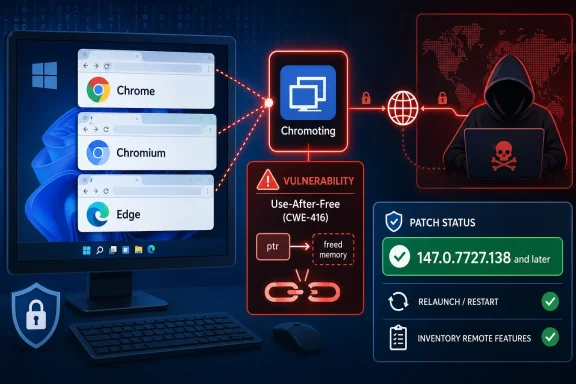
Google disclosed CVE-2026-7347 on April 28, 2026, as a high-severity use-after-free flaw in Chrome’s Chromoting component before version 147.0.7727.138 that could let a remote attacker execute arbitrary code through malicious network traffic. That is the plain inventory line; the more important story is that browser risk is no longer confined to the browser tab. Chromoting sits in the remote-access orbit of Chromium, where “network traffic” and “code execution” are an uncomfortable pairing for administrators who already treat remote-control tooling as privileged infrastructure. For Windows shops, the practical question is not whether this is a Chrome bug or an Edge bug, but whether every Chromium-derived endpoint has moved past the vulnerable code line.
CVE-2026-7347 arrived inside Google’s April 28 stable-channel desktop update, the kind of release most users experience as a small badge on the Chrome menu and most IT teams experience as another deployment race. The fixed Chrome line is 147.0.7727.138, with NVD recording the vulnerability as affecting Google Chrome versions prior to that build. The weakness is categorized as CWE-416, a use-after-free condition, and Chromium assigned it a high security severity.
The component name matters. Chromoting is the Chromium project’s remote-access technology, better known to ordinary users through Chrome Remote Desktop. A bug here does not sound like the classic “visit a malicious website” browser failure; the CVE language instead points to malicious network traffic as the route to exploitation.
That distinction changes the defensive posture. A browser vulnerability with a remote-control surface deserves attention from the same people who manage RDP exposure, remote support tools, help-desk agents, and privileged workstation access. Chrome may be the package being patched, but the blast radius belongs to the endpoint management conversation.
That “high complexity” field is doing a lot of work. It suggests exploitation may require particular timing, state, protocol conditions, or environmental setup rather than a commodity spray-and-pray trigger. But high complexity is not the same as low impact, and it is certainly not a reason to leave remote-access-adjacent code unpatched.
The uncomfortable combination is “no user interaction” plus “remote attacker.” Many browser bugs still depend on getting someone to open a page, render content, click a link, or otherwise participate in their own compromise. This one, at least as described in the public CVE text, shifts attention toward traffic handling and exposed services.
That does not mean every desktop running Chrome is immediately reachable from the internet. It does mean asset owners should stop treating browser updates as user-experience maintenance and start treating them as part of the same emergency hygiene that governs VPN clients, remote desktop brokers, collaboration agents, and endpoint management daemons.
Modern Chromium has layers of hardening intended to make this harder. Sandboxing, partitioned processes, allocator defenses, control-flow protections, and language-level migrations all raise the bar. The continued appearance of use-after-free CVEs is not proof that those mitigations have failed; it is proof that large C++ codebases handling hostile input remain a long-term security liability.
Chromoting is a particularly sensitive place for that liability to surface. Remote-control stacks must process input, negotiate sessions, handle state changes, and move data across trust boundaries. They are supposed to make one computer controllable from another, which means a memory-corruption bug in that neighborhood naturally attracts more scrutiny.
The industry’s slow turn toward memory-safe languages has often been framed as a future-facing engineering debate. CVE-2026-7347 is a reminder that the present still runs on code written before that debate was settled. Until those surfaces are rewritten, constrained, or retired, patch velocity remains the compensating control.
CPEs are useful for machine matching, but they are imperfect representations of modern software supply chains. Chromium is an upstream project, Chrome is Google’s downstream browser, Edge is Microsoft’s Chromium-based browser, and numerous other browsers pull from the same moving river of code on their own schedules. A CPE record that names Chrome does not automatically describe every Chromium derivative, even when the underlying code family is shared.
That matters for Windows administrators because Microsoft tracks Chromium issues through the Security Update Guide and Edge security release notes. Microsoft Edge frequently incorporates Chromium security fixes, but the relevant patch level is Edge’s version, not Chrome’s version number. A Chrome CPE is not a substitute for checking Edge’s actual release channel and build.
This is where scanners can mislead both ways. Some will flag only Google Chrome and miss Chromium-derived browsers. Others will map the CVE too broadly and produce noise on systems that never included the vulnerable component or already consumed the fix through a downstream update. The right operational answer is not to argue with the CPE field in isolation; it is to verify installed browser families and versions across the fleet.
This distinction is easy to lose in patch dashboards. A vulnerability can be sourced from Chrome, enriched by CISA, analyzed by NVD, and surfaced through MSRC, all while ultimately requiring administrators to update a browser. For the person responsible for reducing risk, the chain of custody is less important than the installed binary.
Edge also complicates the old mental model of “Chrome users patch Chrome.” Many organizations standardize on Edge because it integrates with Microsoft identity, management, and security tooling. Others allow Chrome and Edge side by side because web compatibility and user preference win out over standardization. In those environments, a single Chromium-class CVE may require two or more browser update checks, not one.
The Windows angle is therefore practical rather than parochial. If Chrome is installed, confirm it is at or beyond 147.0.7727.138 where that version line applies. If Edge is installed, confirm Microsoft has shipped and the device has received the corresponding Chromium security update. If other Chromium-based browsers are present, confirm their vendors have rebased on fixed Chromium code.
The issue is not merely that Chromoting can be used for remote desktop scenarios. It is that remote-access tooling tends to sit near higher-value workflows. Administrators use remote sessions to support executives, troubleshoot servers, reach lab machines, and manage unattended endpoints. A flaw in that space deserves a shorter patch clock than a routine feature update.
Enterprises should also think about dormant exposure. Chrome Remote Desktop may be installed, enabled, or previously authorized on machines where nobody currently remembers using it. Consumer Google accounts, unmanaged extensions, legacy support practices, and one-off work-from-home arrangements can leave behind remote-access pathways that do not show up in the same inventory as VPN or RDP.
That is why the best response to CVE-2026-7347 is twofold. Patch the browser, then check whether Chromoting-related functionality is allowed, needed, logged, and governed. Vulnerability management closes the known hole; configuration management reduces the chance that the next hole appears in a forgotten service.
That distinction matters in change control. When a release contains a cluster of high and critical issues, the burden of proof should shift. Instead of asking whether there is a known exploit for each individual CVE, administrators should ask whether there is a compelling reason not to deploy the browser update promptly.
There is no public indication in the CVE text that CVE-2026-7347 is known to be exploited in the wild. That is good news, but it is not a safe planning assumption. Browser vulnerabilities often become more exploitable after patches land, because attackers can study the diff, infer the bug class, and build weaponized tests against lagging systems.
The patch has already drawn the map. The vulnerable code existed before 147.0.7727.138; the fixed code exists after it. Every unmanaged endpoint that remains behind the line becomes easier to categorize, target, and pressure as time passes.
For enterprises, the harder part is proving completion. Chrome’s self-updater, Microsoft Edge Update, software distribution tools, VDI images, golden templates, kiosk devices, and offline machines all create separate lanes of responsibility. A dashboard that shows the installer package was deployed is not the same as evidence that the vulnerable executable is no longer running.
Admins should look especially hard at persistent desktops and shared systems. Browsers often remain open for days, and remote workers may sleep laptops rather than reboot them. In a memory-corruption update, process lifetime matters: the installed version on disk and the running version in memory can temporarily diverge.
There is also a policy dimension. If update deferrals are tuned for convenience rather than risk, browser security fixes will repeatedly arrive late. CVE-2026-7347 is a good excuse to revisit whether Chrome and Edge updates are allowed to move faster than the rest of the software estate.
Not every Chromium-derived application is automatically affected by this exact CVE. The vulnerable component, build lineage, compile-time options, and vendor integration all matter. But security teams that stop after checking “chrome.exe” may miss the broader lesson: shared browser engines have turned vulnerability response into an ecosystem exercise.
This is one of the quiet consequences of Chromium’s success. Standardization brought performance, compatibility, and developer convenience. It also created synchronized risk, where a bug in one upstream component can ripple across products with different brands, update cadences, and administrative owners.
For WindowsForum readers, this is familiar territory. The modern Windows endpoint is no longer just Windows plus Office plus a few line-of-business apps. It is a layered stack of identity agents, browsers, sync clients, remote tools, webview runtimes, and vendor update services, many of which carry browser-grade attack surface.
CVE-2026-7347 also invites a narrower policy review around Chrome Remote Desktop and Chromoting. If the feature is not required, it should not be casually available. If it is required, it should be governed like any other remote-access path, with account controls, logging expectations, and a clear owner.
The danger is treating this as yet another browser patch and moving on. The better reading is that remote-access code inside broadly deployed client software deserves the same seriousness as exposed server software. The endpoint is now a service surface, even when the user thinks of it as a laptop with a browser open.
Security teams do not need to panic. They do need to compress the time between upstream disclosure, vendor release, managed deployment, process restart, and fleet verification. That is the modern browser patch cycle, and it is increasingly unforgiving.
Source: NVD / Chromium Security Update Guide - Microsoft Security Response Center
 A Remote-Control Bug Hiding in a Browser Release
CVE-2026-7347 arrived inside Google’s April 28 stable-channel desktop update, the kind of release most users experience as a small badge on the Chrome menu and most IT teams experience as another deployment race. The fixed Chrome line is 147.0.7727.138, with NVD recording the vulnerability as affecting Google Chrome versions prior to that build. The weakness is categorized as CWE-416, a use-after-free condition, and Chromium assigned it a high security severity.The component name matters. Chromoting is the Chromium project’s remote-access technology, better known to ordinary users through Chrome Remote Desktop. A bug here does not sound like the classic “visit a malicious website” browser failure; the CVE language instead points to malicious network traffic as the route to exploitation.
That distinction changes the defensive posture. A browser vulnerability with a remote-control surface deserves attention from the same people who manage RDP exposure, remote support tools, help-desk agents, and privileged workstation access. Chrome may be the package being patched, but the blast radius belongs to the endpoint management conversation.
The CVSS Score Says High; the Attack Path Says Pay Attention
CISA’s ADP enrichment gives CVE-2026-7347 a CVSS 3.1 base score of 8.1, with the vector AV:N/AC:H/PR:N/UI:N/S:U/C:H/I:H/A:H. In English, that means the bug is network reachable, requires no privileges, requires no user interaction, and could compromise confidentiality, integrity, and availability if successfully exploited. The moderating factor is attack complexity, which is marked high.That “high complexity” field is doing a lot of work. It suggests exploitation may require particular timing, state, protocol conditions, or environmental setup rather than a commodity spray-and-pray trigger. But high complexity is not the same as low impact, and it is certainly not a reason to leave remote-access-adjacent code unpatched.
The uncomfortable combination is “no user interaction” plus “remote attacker.” Many browser bugs still depend on getting someone to open a page, render content, click a link, or otherwise participate in their own compromise. This one, at least as described in the public CVE text, shifts attention toward traffic handling and exposed services.
That does not mean every desktop running Chrome is immediately reachable from the internet. It does mean asset owners should stop treating browser updates as user-experience maintenance and start treating them as part of the same emergency hygiene that governs VPN clients, remote desktop brokers, collaboration agents, and endpoint management daemons.
Use-After-Free Remains the Memory-Safety Tax Chromium Keeps Paying
A use-after-free flaw is one of the old workhorses of browser exploitation. Software allocates memory, releases it, and then mistakenly continues to use the stale reference. If an attacker can influence what occupies that memory afterward, the bug can move from crash to code execution.Modern Chromium has layers of hardening intended to make this harder. Sandboxing, partitioned processes, allocator defenses, control-flow protections, and language-level migrations all raise the bar. The continued appearance of use-after-free CVEs is not proof that those mitigations have failed; it is proof that large C++ codebases handling hostile input remain a long-term security liability.
Chromoting is a particularly sensitive place for that liability to surface. Remote-control stacks must process input, negotiate sessions, handle state changes, and move data across trust boundaries. They are supposed to make one computer controllable from another, which means a memory-corruption bug in that neighborhood naturally attracts more scrutiny.
The industry’s slow turn toward memory-safe languages has often been framed as a future-facing engineering debate. CVE-2026-7347 is a reminder that the present still runs on code written before that debate was settled. Until those surfaces are rewritten, constrained, or retired, patch velocity remains the compensating control.
The CPE Entry Is Messy Because the Ecosystem Is Messy
NVD’s initial analysis added a CPE configuration for Google Chrome before 147.0.7727.138 and associated it with Windows, Linux, and macOS operating-system CPEs. That can look odd at first glance: the vulnerable application is Chrome, while the platforms are the operating systems on which the affected builds run. The user-facing prompt asking whether a CPE is missing reflects a broader problem with vulnerability databases, not necessarily a hidden extra product.CPEs are useful for machine matching, but they are imperfect representations of modern software supply chains. Chromium is an upstream project, Chrome is Google’s downstream browser, Edge is Microsoft’s Chromium-based browser, and numerous other browsers pull from the same moving river of code on their own schedules. A CPE record that names Chrome does not automatically describe every Chromium derivative, even when the underlying code family is shared.
That matters for Windows administrators because Microsoft tracks Chromium issues through the Security Update Guide and Edge security release notes. Microsoft Edge frequently incorporates Chromium security fixes, but the relevant patch level is Edge’s version, not Chrome’s version number. A Chrome CPE is not a substitute for checking Edge’s actual release channel and build.
This is where scanners can mislead both ways. Some will flag only Google Chrome and miss Chromium-derived browsers. Others will map the CVE too broadly and produce noise on systems that never included the vulnerable component or already consumed the fix through a downstream update. The right operational answer is not to argue with the CPE field in isolation; it is to verify installed browser families and versions across the fleet.
Microsoft’s Role Is Downstream, but Windows Risk Is Not Secondary
The MSRC entry for CVE-2026-7347 exists because Chromium vulnerabilities are relevant to Microsoft Edge. That does not make Microsoft the originator of the bug, and it does not mean Windows itself contains the vulnerable code. It means Microsoft has to account for Chromium security defects because Edge ships Chromium-derived code to Windows users by default.This distinction is easy to lose in patch dashboards. A vulnerability can be sourced from Chrome, enriched by CISA, analyzed by NVD, and surfaced through MSRC, all while ultimately requiring administrators to update a browser. For the person responsible for reducing risk, the chain of custody is less important than the installed binary.
Edge also complicates the old mental model of “Chrome users patch Chrome.” Many organizations standardize on Edge because it integrates with Microsoft identity, management, and security tooling. Others allow Chrome and Edge side by side because web compatibility and user preference win out over standardization. In those environments, a single Chromium-class CVE may require two or more browser update checks, not one.
The Windows angle is therefore practical rather than parochial. If Chrome is installed, confirm it is at or beyond 147.0.7727.138 where that version line applies. If Edge is installed, confirm Microsoft has shipped and the device has received the corresponding Chromium security update. If other Chromium-based browsers are present, confirm their vendors have rebased on fixed Chromium code.
Remote Access Turns Patch Latency Into an Exposure Window
Most organizations have learned to tolerate a few days of browser update lag. The stable channel rolls out gradually, users leave sessions open, managed policies defer restarts, and help desks avoid interrupting meetings. For ordinary rendering bugs, that delay is already risky; for remote-access-adjacent code, it is harder to defend.The issue is not merely that Chromoting can be used for remote desktop scenarios. It is that remote-access tooling tends to sit near higher-value workflows. Administrators use remote sessions to support executives, troubleshoot servers, reach lab machines, and manage unattended endpoints. A flaw in that space deserves a shorter patch clock than a routine feature update.
Enterprises should also think about dormant exposure. Chrome Remote Desktop may be installed, enabled, or previously authorized on machines where nobody currently remembers using it. Consumer Google accounts, unmanaged extensions, legacy support practices, and one-off work-from-home arrangements can leave behind remote-access pathways that do not show up in the same inventory as VPN or RDP.
That is why the best response to CVE-2026-7347 is twofold. Patch the browser, then check whether Chromoting-related functionality is allowed, needed, logged, and governed. Vulnerability management closes the known hole; configuration management reduces the chance that the next hole appears in a forgotten service.
The April 28 Chrome Release Was a Security Event, Not a Cosmetic Bump
The April 28 desktop stable-channel update was not a single-CVE maintenance nudge. Public reporting and vendor records show a broader set of Chromium security fixes landing around the same build line, including other memory-safety issues in high-value browser components. CVE-2026-7347 should therefore be treated as part of a release train that moved the security baseline, not as an isolated entry to be hand-waved because no exploit has been publicly confirmed.That distinction matters in change control. When a release contains a cluster of high and critical issues, the burden of proof should shift. Instead of asking whether there is a known exploit for each individual CVE, administrators should ask whether there is a compelling reason not to deploy the browser update promptly.
There is no public indication in the CVE text that CVE-2026-7347 is known to be exploited in the wild. That is good news, but it is not a safe planning assumption. Browser vulnerabilities often become more exploitable after patches land, because attackers can study the diff, infer the bug class, and build weaponized tests against lagging systems.
The patch has already drawn the map. The vulnerable code existed before 147.0.7727.138; the fixed code exists after it. Every unmanaged endpoint that remains behind the line becomes easier to categorize, target, and pressure as time passes.
The Consumer Advice Is Simple; the Enterprise Advice Is Not
For individual users, the advice is boring and correct: update Chrome, relaunch it, and verify the version. Browser updates often download silently but do not fully apply until the process restarts. A machine that has “updated” but not relaunched may still be running the old vulnerable code in live processes.For enterprises, the harder part is proving completion. Chrome’s self-updater, Microsoft Edge Update, software distribution tools, VDI images, golden templates, kiosk devices, and offline machines all create separate lanes of responsibility. A dashboard that shows the installer package was deployed is not the same as evidence that the vulnerable executable is no longer running.
Admins should look especially hard at persistent desktops and shared systems. Browsers often remain open for days, and remote workers may sleep laptops rather than reboot them. In a memory-corruption update, process lifetime matters: the installed version on disk and the running version in memory can temporarily diverge.
There is also a policy dimension. If update deferrals are tuned for convenience rather than risk, browser security fixes will repeatedly arrive late. CVE-2026-7347 is a good excuse to revisit whether Chrome and Edge updates are allowed to move faster than the rest of the software estate.
The Real Inventory Is Every Chromium Runtime Users Forgot They Had
The most obvious affected product is Google Chrome. The less obvious operational problem is that Chromium code appears in more places than users think. Edge is the big one on Windows, but Chromium-based browsers, embedded web runtimes, application shells, and remote-support packages can all complicate the cleanup picture.Not every Chromium-derived application is automatically affected by this exact CVE. The vulnerable component, build lineage, compile-time options, and vendor integration all matter. But security teams that stop after checking “chrome.exe” may miss the broader lesson: shared browser engines have turned vulnerability response into an ecosystem exercise.
This is one of the quiet consequences of Chromium’s success. Standardization brought performance, compatibility, and developer convenience. It also created synchronized risk, where a bug in one upstream component can ripple across products with different brands, update cadences, and administrative owners.
For WindowsForum readers, this is familiar territory. The modern Windows endpoint is no longer just Windows plus Office plus a few line-of-business apps. It is a layered stack of identity agents, browsers, sync clients, remote tools, webview runtimes, and vendor update services, many of which carry browser-grade attack surface.
The Fix Is a Version Number, but the Lesson Is Governance
The immediate remediation target is straightforward: move Chrome beyond the vulnerable pre-147.0.7727.138 state, and verify equivalent downstream fixes for Edge and other Chromium-based products. That is the part vulnerability scanners can usually express. The governance question is whether the organization can do that quickly, repeatably, and with evidence.CVE-2026-7347 also invites a narrower policy review around Chrome Remote Desktop and Chromoting. If the feature is not required, it should not be casually available. If it is required, it should be governed like any other remote-access path, with account controls, logging expectations, and a clear owner.
The danger is treating this as yet another browser patch and moving on. The better reading is that remote-access code inside broadly deployed client software deserves the same seriousness as exposed server software. The endpoint is now a service surface, even when the user thinks of it as a laptop with a browser open.
Security teams do not need to panic. They do need to compress the time between upstream disclosure, vendor release, managed deployment, process restart, and fleet verification. That is the modern browser patch cycle, and it is increasingly unforgiving.
The 147.0.7727.138 Line Draws the Week’s Work
The concrete work from CVE-2026-7347 is not exotic, but it is easy to leave half-finished. Treat the build number as the line, treat running processes as part of the evidence, and treat remote-access features as policy-bearing infrastructure rather than convenience software.- Chrome installations should be updated to 147.0.7727.138 or later where that stable-channel build applies.
- Edge installations should be checked against Microsoft’s current security release information rather than assumed safe because Chrome was patched.
- Systems should be restarted or browsers relaunched so that patched binaries replace vulnerable running processes.
- Chrome Remote Desktop and related Chromoting use should be inventoried, justified, and disabled where it is not needed.
- Vulnerability scanners should be validated against real installed browser versions because CPE mapping for Chromium-derived software can be incomplete or overly broad.
- Browser security updates should be allowed to move faster than ordinary application maintenance when remote code execution is in scope.
Source: NVD / Chromium Security Update Guide - Microsoft Security Response Center
