

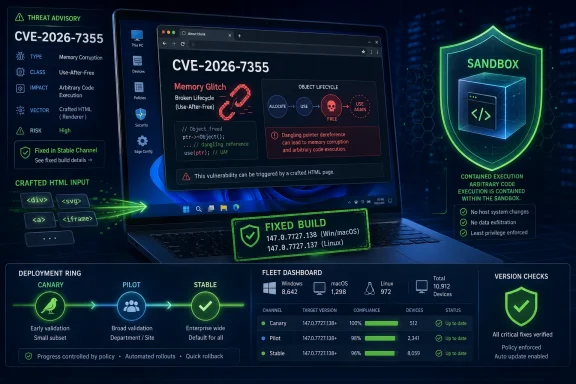
CVE-2026-7355 is a medium-rated use-after-free flaw in Chrome’s Media component, disclosed on April 28, 2026, and fixed in Google Chrome 147.0.7727.138 for Windows and macOS and 147.0.7727.137 for Linux. That sounds like a narrow browser bug, but it is really a reminder that “medium” in Chromium security language can still mean remote code execution after a user lands on the wrong page. The vulnerability’s public description says exploitation happens through crafted HTML and results in arbitrary code execution inside Chrome’s sandbox, which is precisely the kind of phrasing that should make desktop administrators check deployment rings rather than wait for the next monthly patch ritual. For Windows shops, the awkward truth is that Chrome, Edge, WebView2, Electron apps, and embedded Chromium runtimes have turned browser patching into operating-system patching by another name.
The first trap in CVE-2026-7355 is the severity label. Chromium calls the issue Medium, while the CISA-ADP CVSS 3.1 vector currently scores it at 8.8 High, with network attack vector, low attack complexity, no privileges required, and user interaction required. That is not a contradiction so much as a collision between two scoring cultures: Chromium triage thinks in exploit chains and sandbox boundaries, while CVSS tries to model technical impact in a product-neutral way.
The difference matters because many enterprise patch dashboards still flatten vulnerability management into color-coded queues. A “medium” item can sit behind a dozen louder CVEs, especially when there is no public exploit and no urgent vendor language. But this bug’s description includes the phrase administrators are trained to notice: arbitrary code execution.
The mitigating phrase is “inside a sandbox.” Chrome’s process isolation and sandboxing model are doing real work here, and the public record does not say CVE-2026-7355 by itself escapes that boundary. But sandbox-contained code execution is not harmless. It is a foothold in a renderer-adjacent environment, a primitive that can become dangerous when paired with a separate escape, logic flaw, or credential theft path.
That is why the right question is not whether CVE-2026-7355 deserves panic. It does not. The right question is whether your organization can prove that every Chrome installation, every managed browser channel, and every Chromium-based dependency has crossed the fixed-version line.
On a modern Windows fleet, the browser is the place where untrusted code arrives first. It is also the runtime for line-of-business portals, single sign-on flows, SaaS consoles, password managers, video conferencing, device management dashboards, and a growing pile of web-wrapped desktop apps. If the browser is late to patch, the operating system’s patch posture is less comforting than the compliance report suggests.
CVE-2026-7355 sits in the Media component, which is an especially ordinary attack surface. Users do not have to install a suspicious extension or run an executable to touch it. They browse, preview, stream, join calls, open training content, click internal links, and consume the modern web’s endless procession of codecs, containers, playback APIs, and hardware acceleration paths.
That ordinariness is the point. Browser bugs are rarely exotic from the user’s side. A crafted HTML page is enough of an initial condition that administrators should treat exposure as internet-facing, even when the vulnerable component sounds buried several layers below the address bar.
Chrome’s security architecture has steadily raised the cost of exploitation. Site isolation, sandboxing, compiler hardening, fuzzing, Control Flow Integrity, and sanitizers have all made the old browser-drive-by era harder to reproduce. Yet the Chrome release notes around this update are a reminder that bug classes survive architectural progress. The same April 28 stable update lists a dense run of use-after-free issues across Canvas, iOS, Accessibility, Views, GPU, ANGLE, Animation, Navigation, Media, WebMIDI, Cast, Codecs, WebRTC, WebView, and other subsystems.
That pattern tells a broader story than any single CVE can. Chromium’s complexity is not an accident or a governance failure; it is the price of being the web’s de facto operating layer. The browser decodes video, renders fonts, runs shaders, brokers USB and Bluetooth access, mediates authentication, hosts productivity apps, and tries to do all of that at interactive speed without collapsing battery life.
Memory safety bugs thrive in that terrain because object lifetimes become hard to reason about. Media pipelines are particularly rich in asynchronous behavior: buffers arrive, decoders initialize, streams pause, devices change, tabs background, permissions shift, GPU paths engage, and cleanup routines race against callbacks. If a reference survives longer than the object it points to, the browser’s security story begins to depend on mitigations rather than correctness.
A renderer or sandboxed process compromise can still expose sensitive browser state, manipulate what the user sees, interact with web session context, and become the first half of a chained exploit. Attackers do not always need a clean full-system compromise to win. If the target is a browser session authenticated into email, identity administration, cloud dashboards, CRM, or an internal code review system, “inside the browser” may already be close enough to the prize.
There is also the practical matter of exploit economics. A medium Chromium issue with no known public exploit may never become part of a real campaign. But if exploit developers discover a reliable chain that pairs this media flaw with a sandbox escape or a logic weakness, the severity discussion changes after the fact. Patch latency is where yesterday’s theoretical bug becomes tomorrow’s incident narrative.
This is why browser update policy should be more aggressive than conventional desktop application policy. Browsers parse attacker-controlled content continuously. They are not like PDF readers that some users open twice a month or niche utilities that live behind authenticated workflows. The browser is the front door, the mail slot, and increasingly the office itself.
That matters because organizations often react to CVE pages one at a time. A ticket appears for CVE-2026-7355, a scanner flags Chrome below 147.0.7727.138, and the remediation note says update Chrome. The tactical instruction is correct, but the strategic lesson is broader: the browser patch is the unit of defense, not the individual CVE.
This release also illustrates a normal but uncomfortable timing gap. Chrome publishes the advisory, NVD records the CVE, CISA-ADP enriches the score, NIST later adds CPE configuration and references, and scanners ingest the results on their own schedules. During that interval, two systems can disagree about severity, affected platforms, or whether the vulnerability is fully analyzed.
Administrators should not treat those discrepancies as noise. They are a sign that the vulnerability intelligence pipeline is a pipeline, not a single source of truth. If a Chrome advisory says the fixed build is available, waiting for NVD enrichment is usually the wrong dependency.
The mapping is not always intuitive. Chrome’s fixed version numbers do not match Edge’s version numbers, because Microsoft ships Edge on its own build train. A Chrome advisory may say 147.0.7727.138 while Edge release notes point to a different 147.0.x build family. The major Chromium generation is aligned, but the vendor patch metadata is not a simple string comparison across products.
That distinction matters for scanners and help desks. A Windows machine may be compliant for Chrome but lagging on Edge. Another may have Edge updated but an unmanaged Chrome install under a user profile. A third may have neither Chrome nor Edge exposed as a daily browser but still carry WebView2 Runtime used by Teams-era apps, management agents, or third-party software.
The operational answer is not to memorize every build number. It is to inventory Chromium surfaces as a class. If your vulnerability program can only see “Google Chrome” and “Microsoft Edge” as ordinary installed applications, it is probably undercounting exposure.
CPEs are classification tools, not fleet intelligence. They tell scanners what product-version combinations should be considered vulnerable. They do not tell you whether Chrome was installed system-wide or per-user, whether the vulnerable binary is still reachable, whether users can disable updates, whether the browser is managed by policy, or whether a stale portable copy sits in a developer tools folder.
The “are we missing a CPE?” prompt on NVD pages is almost comic in this context, because Chromium’s real reach extends beyond neat product rows. Electron applications bundle Chromium. Embedded browsers live inside enterprise software. WebView2 has become part of the Windows application substrate. Some of these inherit fixes quickly; others depend on vendor repackaging, application updates, or runtime channel behavior.
For defenders, the CPE entry should be a starting pistol rather than a finish line. It tells you the public record has caught up enough for scanners to begin alerting. It does not absolve you from knowing where Chromium actually runs.
The CVSS vector for CVE-2026-7355 includes UI:R, meaning user interaction is required. In an enterprise environment, that requirement should be interpreted realistically. It does not mean the attacker needs the user to install malware or approve an administrator prompt. It means the user has to do what users do all day.
Attackers have many ways to deliver crafted web content. Phishing emails remain the obvious path, but compromised legitimate sites, malvertising, poisoned search results, collaboration links, and watering-hole pages all give malicious HTML a chance to run. Browser isolation products and remote browser approaches can reduce risk, but most organizations still allow the local browser to directly render much of the internet.
This is why “no privileges required” is so important in the score. The attacker does not need an account on the target system. The browser is the parser, the user supplies the click, and the vulnerable component supplies the memory safety failure.
Chrome’s staged rollouts are sensible from a reliability standpoint. A vendor does not want to push a broken browser build to every desktop in the world at once. But enterprises cannot confuse staged consumer rollout with enterprise risk management. If a fixed stable build exists, managed environments should decide deliberately how fast to deploy it, not simply inherit whatever timing the updater happens to choose.
The best organizations treat browser patching as a near-real-time control. They test quickly, promote rapidly, and measure completion aggressively. The laggards discover that “Chrome auto-updates” is not a policy; it is a hope with a service name.
This is especially true on Windows, where multiple management systems may overlap. Intune, Configuration Manager, Group Policy, third-party patch platforms, Chrome Browser Cloud Management, Edge management policies, and endpoint security agents can all claim part of the browser lifecycle. Overlap is not the same as coverage. In fact, it can hide gaps when each tool assumes another is responsible.
Users can check Chrome manually through the About Chrome page, but that is not enterprise evidence. Administrators need device inventory, version telemetry, update status, and exception reporting. They need to know which machines are offline, which update services are disabled, which profiles carry user-level installs, and which unmanaged devices still access corporate resources.
Edge adds another layer. Microsoft’s Edge version numbers will not mirror Chrome’s 147.0.7727.138 string exactly, so validation must rely on Microsoft’s Edge security release notes and MSRC metadata rather than naive version matching. WebView2 deserves the same treatment because it may be present even where users never open Edge.
The uncomfortable but necessary move is to build a Chromium exposure view, not a browser-by-browser spreadsheet. If a device can render untrusted web content through Chromium, it belongs in the patch conversation.
Administrators sometimes dislike this asymmetry. Attackers may be reverse-engineering patches while defenders receive only a short description. But the alternative — publishing exploit-relevant detail before the ecosystem has updated — would be worse. Browser vendors are trying to disclose enough for prioritization without handing over a recipe.
The lack of detail should not become an excuse for delay. A use-after-free in Media, reachable through crafted HTML, fixed in a stable security update, and scored High by CISA-ADP is enough information for patch prioritization. Waiting for a proof of concept is how defenders turn vendor lead time into attacker lead time.
It is also worth remembering that patch diffing has become industrialized. Once a fixed build is public, skilled researchers and attackers can compare changes, identify likely security patches, and infer vulnerability shape. Restricted bug comments slow that process; they do not stop it.
That is the management inversion of the Chromium era. The web platform won, and then it spread everywhere. Desktop apps became web apps in native clothing. Admin consoles moved to SaaS. Identity moved to browser-mediated flows. Even security tools expose dashboards that depend on the same browser stack they are trying to protect.
Microsoft has made Edge and WebView2 central to the Windows application model because it is rational product strategy. Developers get a consistent rendering engine, Microsoft gets a modern web platform, and users get fewer legacy browser dependencies. But the security consequence is that Chromium patch cadence becomes a Windows operations dependency, not a Google-specific concern.
The same is true for Chrome in enterprises that standardize on Google’s browser. Chrome’s updater is mature, but it must still be governed. Policies can delay updates, broken services can strand endpoints, and nonpersistent VDI images can resurrect old builds every morning if the base image is stale.
That does not make scanners irrelevant. It makes them auditors of patch velocity. The useful metric is not simply how many vulnerable Chrome installations exist today, but how long they remain vulnerable after a stable security update drops. Browser patching should be measured in days, and for exposed high-impact bugs, sometimes hours.
Security teams should also watch for version skew. A fleet that is 95 percent patched can still have the 5 percent that matters: executives, developers, finance users, help desk technicians, identity administrators, and systems engineers. Risk is not evenly distributed across desktops.
The same logic applies to unmanaged or lightly managed endpoints. BYOD machines, contractor laptops, lab systems, kiosks, shared workstations, and jump boxes often fall outside the clean lanes of update enforcement. If those systems authenticate into corporate services through a browser, they are part of the attack surface whether procurement calls them assets or not.
One bug gets code running in a constrained browser process. Another bug escapes the sandbox. A credential theft technique captures session material. A social-engineering lure moves the user into a privileged workflow. A malicious page triggers behavior in a browser extension. An enterprise misconfiguration allows token replay. None of those pieces has to be spectacular if the chain is coherent.
This is where severity labels can understate operational danger. A medium vulnerability can become critical in context if it lands on a machine used for privileged administration or pairs with another known weakness. Conversely, a technically severe bug may be lower priority if it is unreachable in your environment. The art of vulnerability management is in reconciling vendor severity, exploitability, exposure, and business context.
For this specific CVE, there is no public evidence in the supplied record that it is being exploited in the wild. That matters. It argues against alarmism and for disciplined acceleration. Patch promptly, verify broadly, and avoid turning the advisory into theater.
A mature browser policy defines update deadlines, extension governance, safe rollback procedures, telemetry requirements, and exception handling. It also names owners. If Chrome is managed by one team, Edge by another, WebView2 by the desktop engineering group, and Electron apps by application owners, someone must still be accountable for Chromium exposure across the estate.
Rollback is the uncomfortable piece. Browser updates can break business workflows, and enterprises need a way to respond. But rollback should be controlled, time-limited, and risk-accepted. Leaving a vulnerable browser in place because a legacy portal misbehaves is not a workaround; it is a transfer of engineering debt into security risk.
The better answer is ring-based deployment with rapid testing. Canary and pilot groups find breakage early. Stable rings move quickly once the build clears. Critical security releases compress the timeline. Exceptions expire automatically unless renewed with justification.
Google, Microsoft, Mozilla, Apple, and the wider systems community are all wrestling with the same tension. Performance-critical, platform-integrated software has historically been written in languages that make memory lifetime errors possible. New components can be written more safely, but old components remain. Interoperability and standards pressure keep complexity high.
Media code is a particularly difficult frontier because it sits at the intersection of performance, hardware, third-party codecs, streaming standards, and hostile input. Every optimization is a possible edge case. Every edge case is a possible bug. Every bug in a browser is one phishing email away from real users.
That does not mean the situation is hopeless. It means the defense model has shifted. We no longer expect browsers to be bug-free; we expect them to be hardened, rapidly patched, well-inventoried, and monitored. CVE-2026-7355 is one more test of whether organizations have accepted that model.
There is a particular failure mode in browser patching where everyone assumes success because the median endpoint is current. The machines that fail are treated as statistical residue. But attackers do not target medians; they target accessible weaknesses, and enterprise environments are full of forgotten corners.
A good response to CVE-2026-7355 therefore includes both immediate and structural work. Immediate work closes the known gap. Structural work reduces the chance that the next Chromium advisory produces the same scramble with a different number.
Source: NVD / Chromium Security Update Guide - Microsoft Security Response Center
 A Medium Chrome Bug Still Carries a High Operational Cost
The first trap in CVE-2026-7355 is the severity label. Chromium calls the issue Medium, while the CISA-ADP CVSS 3.1 vector currently scores it at 8.8 High, with network attack vector, low attack complexity, no privileges required, and user interaction required. That is not a contradiction so much as a collision between two scoring cultures: Chromium triage thinks in exploit chains and sandbox boundaries, while CVSS tries to model technical impact in a product-neutral way.The difference matters because many enterprise patch dashboards still flatten vulnerability management into color-coded queues. A “medium” item can sit behind a dozen louder CVEs, especially when there is no public exploit and no urgent vendor language. But this bug’s description includes the phrase administrators are trained to notice: arbitrary code execution.
The mitigating phrase is “inside a sandbox.” Chrome’s process isolation and sandboxing model are doing real work here, and the public record does not say CVE-2026-7355 by itself escapes that boundary. But sandbox-contained code execution is not harmless. It is a foothold in a renderer-adjacent environment, a primitive that can become dangerous when paired with a separate escape, logic flaw, or credential theft path.
That is why the right question is not whether CVE-2026-7355 deserves panic. It does not. The right question is whether your organization can prove that every Chrome installation, every managed browser channel, and every Chromium-based dependency has crossed the fixed-version line.
The Browser Has Become the Soft Underbelly of Windows Management
Windows administrators used to think about browser security as an application lifecycle problem. Internet Explorer was part of Windows, Firefox lived in the software catalog, Chrome updated itself, and Edge eventually became Microsoft’s Chromium-shaped bridge between those worlds. That taxonomy is now obsolete.On a modern Windows fleet, the browser is the place where untrusted code arrives first. It is also the runtime for line-of-business portals, single sign-on flows, SaaS consoles, password managers, video conferencing, device management dashboards, and a growing pile of web-wrapped desktop apps. If the browser is late to patch, the operating system’s patch posture is less comforting than the compliance report suggests.
CVE-2026-7355 sits in the Media component, which is an especially ordinary attack surface. Users do not have to install a suspicious extension or run an executable to touch it. They browse, preview, stream, join calls, open training content, click internal links, and consume the modern web’s endless procession of codecs, containers, playback APIs, and hardware acceleration paths.
That ordinariness is the point. Browser bugs are rarely exotic from the user’s side. A crafted HTML page is enough of an initial condition that administrators should treat exposure as internet-facing, even when the vulnerable component sounds buried several layers below the address bar.
Use-After-Free Is Still the Browser Bug That Will Not Die
A use-after-free vulnerability is a memory safety bug in which software continues to use an object after it has been released. In the browser world, that can become a path to memory corruption, type confusion, or controlled execution under the right circumstances. The exact exploitability of any individual bug depends on implementation detail, allocator behavior, mitigations, and attacker skill, but the class remains one of the most durable sources of serious browser flaws.Chrome’s security architecture has steadily raised the cost of exploitation. Site isolation, sandboxing, compiler hardening, fuzzing, Control Flow Integrity, and sanitizers have all made the old browser-drive-by era harder to reproduce. Yet the Chrome release notes around this update are a reminder that bug classes survive architectural progress. The same April 28 stable update lists a dense run of use-after-free issues across Canvas, iOS, Accessibility, Views, GPU, ANGLE, Animation, Navigation, Media, WebMIDI, Cast, Codecs, WebRTC, WebView, and other subsystems.
That pattern tells a broader story than any single CVE can. Chromium’s complexity is not an accident or a governance failure; it is the price of being the web’s de facto operating layer. The browser decodes video, renders fonts, runs shaders, brokers USB and Bluetooth access, mediates authentication, hosts productivity apps, and tries to do all of that at interactive speed without collapsing battery life.
Memory safety bugs thrive in that terrain because object lifetimes become hard to reason about. Media pipelines are particularly rich in asynchronous behavior: buffers arrive, decoders initialize, streams pause, devices change, tabs background, permissions shift, GPU paths engage, and cleanup routines race against callbacks. If a reference survives longer than the object it points to, the browser’s security story begins to depend on mitigations rather than correctness.
The Sandbox Is a Seatbelt, Not a Permission Slip
The phrase “execute arbitrary code inside a sandbox” can lull organizations into underreaction. Sandboxes are designed precisely to contain untrusted or compromised code, and Chrome’s sandbox has been one of the great quiet security successes of the modern desktop. But a seatbelt does not make crashes operationally irrelevant.A renderer or sandboxed process compromise can still expose sensitive browser state, manipulate what the user sees, interact with web session context, and become the first half of a chained exploit. Attackers do not always need a clean full-system compromise to win. If the target is a browser session authenticated into email, identity administration, cloud dashboards, CRM, or an internal code review system, “inside the browser” may already be close enough to the prize.
There is also the practical matter of exploit economics. A medium Chromium issue with no known public exploit may never become part of a real campaign. But if exploit developers discover a reliable chain that pairs this media flaw with a sandbox escape or a logic weakness, the severity discussion changes after the fact. Patch latency is where yesterday’s theoretical bug becomes tomorrow’s incident narrative.
This is why browser update policy should be more aggressive than conventional desktop application policy. Browsers parse attacker-controlled content continuously. They are not like PDF readers that some users open twice a month or niche utilities that live behind authenticated workflows. The browser is the front door, the mail slot, and increasingly the office itself.
The April 28 Chrome Drop Was Not a One-CVE Event
Google’s April 28, 2026 stable channel update was substantial: 30 security fixes, including critical and high-severity issues alongside CVE-2026-7355. The update moved Chrome Stable to 147.0.7727.137/138 for Windows and macOS and 147.0.7727.137 for Linux, with the usual staged rollout language. CVE-2026-7355 was only one item in a much larger bundle.That matters because organizations often react to CVE pages one at a time. A ticket appears for CVE-2026-7355, a scanner flags Chrome below 147.0.7727.138, and the remediation note says update Chrome. The tactical instruction is correct, but the strategic lesson is broader: the browser patch is the unit of defense, not the individual CVE.
This release also illustrates a normal but uncomfortable timing gap. Chrome publishes the advisory, NVD records the CVE, CISA-ADP enriches the score, NIST later adds CPE configuration and references, and scanners ingest the results on their own schedules. During that interval, two systems can disagree about severity, affected platforms, or whether the vulnerability is fully analyzed.
Administrators should not treat those discrepancies as noise. They are a sign that the vulnerability intelligence pipeline is a pipeline, not a single source of truth. If a Chrome advisory says the fixed build is available, waiting for NVD enrichment is usually the wrong dependency.
Microsoft’s Role Is Both Straightforward and Messy
The user-supplied MSRC link points to the Microsoft side of the Chromium vulnerability universe, and that is where Windows administrators naturally look. Microsoft Edge is Chromium-based, and Microsoft tracks many Chromium CVEs in its Security Update Guide when they affect Edge or its associated runtime stack. In practice, that means Chrome vulnerabilities can become Microsoft vulnerabilities without being Windows kernel vulnerabilities.The mapping is not always intuitive. Chrome’s fixed version numbers do not match Edge’s version numbers, because Microsoft ships Edge on its own build train. A Chrome advisory may say 147.0.7727.138 while Edge release notes point to a different 147.0.x build family. The major Chromium generation is aligned, but the vendor patch metadata is not a simple string comparison across products.
That distinction matters for scanners and help desks. A Windows machine may be compliant for Chrome but lagging on Edge. Another may have Edge updated but an unmanaged Chrome install under a user profile. A third may have neither Chrome nor Edge exposed as a daily browser but still carry WebView2 Runtime used by Teams-era apps, management agents, or third-party software.
The operational answer is not to memorize every build number. It is to inventory Chromium surfaces as a class. If your vulnerability program can only see “Google Chrome” and “Microsoft Edge” as ordinary installed applications, it is probably undercounting exposure.
NVD’s CPE Record Is Useful, But It Is Not the Whole Asset Model
The NVD record for CVE-2026-7355 shows the affected application as Google Chrome versions before 147.0.7727.138, combined with operating-system CPEs for Windows, Linux, and macOS. That is a reasonable enrichment for a public vulnerability database. It is not, however, a complete description of your risk.CPEs are classification tools, not fleet intelligence. They tell scanners what product-version combinations should be considered vulnerable. They do not tell you whether Chrome was installed system-wide or per-user, whether the vulnerable binary is still reachable, whether users can disable updates, whether the browser is managed by policy, or whether a stale portable copy sits in a developer tools folder.
The “are we missing a CPE?” prompt on NVD pages is almost comic in this context, because Chromium’s real reach extends beyond neat product rows. Electron applications bundle Chromium. Embedded browsers live inside enterprise software. WebView2 has become part of the Windows application substrate. Some of these inherit fixes quickly; others depend on vendor repackaging, application updates, or runtime channel behavior.
For defenders, the CPE entry should be a starting pistol rather than a finish line. It tells you the public record has caught up enough for scanners to begin alerting. It does not absolve you from knowing where Chromium actually runs.
The Crafted HTML Page Remains the Most Efficient Delivery Vehicle
There is a reason browser vulnerabilities continue to attract attention even when they require user interaction. User interaction on the web is cheap. Convincing someone to visit a link, open a compromised site, load an ad, view a shared document, or click through a message is not an exotic attacker requirement.The CVSS vector for CVE-2026-7355 includes UI:R, meaning user interaction is required. In an enterprise environment, that requirement should be interpreted realistically. It does not mean the attacker needs the user to install malware or approve an administrator prompt. It means the user has to do what users do all day.
Attackers have many ways to deliver crafted web content. Phishing emails remain the obvious path, but compromised legitimate sites, malvertising, poisoned search results, collaboration links, and watering-hole pages all give malicious HTML a chance to run. Browser isolation products and remote browser approaches can reduce risk, but most organizations still allow the local browser to directly render much of the internet.
This is why “no privileges required” is so important in the score. The attacker does not need an account on the target system. The browser is the parser, the user supplies the click, and the vulnerable component supplies the memory safety failure.
Patch Velocity Is Now a Security Control in Its Own Right
There was a time when administrators could plausibly argue for a long test window on desktop application updates. That argument is weaker for browsers, and weaker still for high-churn Chromium security releases. The modern browser is patched too often, attacked too often, and used too broadly for quarterly thinking.Chrome’s staged rollouts are sensible from a reliability standpoint. A vendor does not want to push a broken browser build to every desktop in the world at once. But enterprises cannot confuse staged consumer rollout with enterprise risk management. If a fixed stable build exists, managed environments should decide deliberately how fast to deploy it, not simply inherit whatever timing the updater happens to choose.
The best organizations treat browser patching as a near-real-time control. They test quickly, promote rapidly, and measure completion aggressively. The laggards discover that “Chrome auto-updates” is not a policy; it is a hope with a service name.
This is especially true on Windows, where multiple management systems may overlap. Intune, Configuration Manager, Group Policy, third-party patch platforms, Chrome Browser Cloud Management, Edge management policies, and endpoint security agents can all claim part of the browser lifecycle. Overlap is not the same as coverage. In fact, it can hide gaps when each tool assumes another is responsible.
Verification Beats Assumption Every Time
For CVE-2026-7355, the practical verification step is simple for Chrome: ensure desktop installations are at or above the fixed build, with Windows and macOS systems reaching 147.0.7727.138 and Linux reaching the fixed 147.0.7727.137 build from Google’s stable update line. But the hard part is proving that across the fleet.Users can check Chrome manually through the About Chrome page, but that is not enterprise evidence. Administrators need device inventory, version telemetry, update status, and exception reporting. They need to know which machines are offline, which update services are disabled, which profiles carry user-level installs, and which unmanaged devices still access corporate resources.
Edge adds another layer. Microsoft’s Edge version numbers will not mirror Chrome’s 147.0.7727.138 string exactly, so validation must rely on Microsoft’s Edge security release notes and MSRC metadata rather than naive version matching. WebView2 deserves the same treatment because it may be present even where users never open Edge.
The uncomfortable but necessary move is to build a Chromium exposure view, not a browser-by-browser spreadsheet. If a device can render untrusted web content through Chromium, it belongs in the patch conversation.
The Public Bug Link Is Restricted for a Reason
The Chromium issue tracker reference for CVE-2026-7355 requires permission, which is normal for fresh browser security issues. Google often restricts bug details until a majority of users have received the fix, and may keep restrictions in place longer if shared third-party libraries are involved. That is not secrecy for its own sake; it is a race-control mechanism.Administrators sometimes dislike this asymmetry. Attackers may be reverse-engineering patches while defenders receive only a short description. But the alternative — publishing exploit-relevant detail before the ecosystem has updated — would be worse. Browser vendors are trying to disclose enough for prioritization without handing over a recipe.
The lack of detail should not become an excuse for delay. A use-after-free in Media, reachable through crafted HTML, fixed in a stable security update, and scored High by CISA-ADP is enough information for patch prioritization. Waiting for a proof of concept is how defenders turn vendor lead time into attacker lead time.
It is also worth remembering that patch diffing has become industrialized. Once a fixed build is public, skilled researchers and attackers can compare changes, identify likely security patches, and infer vulnerability shape. Restricted bug comments slow that process; they do not stop it.
The Windows Admin’s Chromium Problem Is Bigger Than Chrome
For WindowsForum readers, CVE-2026-7355 is less interesting as a Chrome-only event than as another entry in the long migration of security responsibility from the operating system into the application runtime layer. Windows can be fully patched and still run a vulnerable browser. The browser can be patched and still leave a vulnerable embedded runtime. A runtime can be updated while an application bundles an older engine internally.That is the management inversion of the Chromium era. The web platform won, and then it spread everywhere. Desktop apps became web apps in native clothing. Admin consoles moved to SaaS. Identity moved to browser-mediated flows. Even security tools expose dashboards that depend on the same browser stack they are trying to protect.
Microsoft has made Edge and WebView2 central to the Windows application model because it is rational product strategy. Developers get a consistent rendering engine, Microsoft gets a modern web platform, and users get fewer legacy browser dependencies. But the security consequence is that Chromium patch cadence becomes a Windows operations dependency, not a Google-specific concern.
The same is true for Chrome in enterprises that standardize on Google’s browser. Chrome’s updater is mature, but it must still be governed. Policies can delay updates, broken services can strand endpoints, and nonpersistent VDI images can resurrect old builds every morning if the base image is stale.
Scanners Will Find the Bug After Users Have Already Faced It
Vulnerability scanners are good at making invisible debt visible. They are less good at being the first line of browser defense. By the time a scanner flags CVE-2026-7355, the advisory has been published, the fixed build has been released, and users may already have spent days browsing with the vulnerable version.That does not make scanners irrelevant. It makes them auditors of patch velocity. The useful metric is not simply how many vulnerable Chrome installations exist today, but how long they remain vulnerable after a stable security update drops. Browser patching should be measured in days, and for exposed high-impact bugs, sometimes hours.
Security teams should also watch for version skew. A fleet that is 95 percent patched can still have the 5 percent that matters: executives, developers, finance users, help desk technicians, identity administrators, and systems engineers. Risk is not evenly distributed across desktops.
The same logic applies to unmanaged or lightly managed endpoints. BYOD machines, contractor laptops, lab systems, kiosks, shared workstations, and jump boxes often fall outside the clean lanes of update enforcement. If those systems authenticate into corporate services through a browser, they are part of the attack surface whether procurement calls them assets or not.
The Exploit Chain Is the Real Unit of Risk
CVE-2026-7355 by itself is described as code execution inside the sandbox. In isolation, that may not yield full host compromise. But attackers increasingly operate in chains, and defenders should think in chains too.One bug gets code running in a constrained browser process. Another bug escapes the sandbox. A credential theft technique captures session material. A social-engineering lure moves the user into a privileged workflow. A malicious page triggers behavior in a browser extension. An enterprise misconfiguration allows token replay. None of those pieces has to be spectacular if the chain is coherent.
This is where severity labels can understate operational danger. A medium vulnerability can become critical in context if it lands on a machine used for privileged administration or pairs with another known weakness. Conversely, a technically severe bug may be lower priority if it is unreachable in your environment. The art of vulnerability management is in reconciling vendor severity, exploitability, exposure, and business context.
For this specific CVE, there is no public evidence in the supplied record that it is being exploited in the wild. That matters. It argues against alarmism and for disciplined acceleration. Patch promptly, verify broadly, and avoid turning the advisory into theater.
The Enterprise Browser Policy Has to Grow Up
Many organizations still manage browsers as if the default updater plus a few homepage and extension policies constitute governance. That model is insufficient. Browser management now needs the same seriousness once reserved for operating systems and endpoint protection.A mature browser policy defines update deadlines, extension governance, safe rollback procedures, telemetry requirements, and exception handling. It also names owners. If Chrome is managed by one team, Edge by another, WebView2 by the desktop engineering group, and Electron apps by application owners, someone must still be accountable for Chromium exposure across the estate.
Rollback is the uncomfortable piece. Browser updates can break business workflows, and enterprises need a way to respond. But rollback should be controlled, time-limited, and risk-accepted. Leaving a vulnerable browser in place because a legacy portal misbehaves is not a workaround; it is a transfer of engineering debt into security risk.
The better answer is ring-based deployment with rapid testing. Canary and pilot groups find breakage early. Stable rings move quickly once the build clears. Critical security releases compress the timeline. Exceptions expire automatically unless renewed with justification.
CVE-2026-7355 Is a Small Window Into a Larger Memory-Safety Reckoning
The recurring parade of use-after-free bugs in Chromium is not lost on browser engineers. The industry’s move toward memory-safe languages, hardened allocators, and safer abstractions is not fashion; it is a response to decades of C and C++ vulnerability patterns. Chrome already benefits from layers of mitigation, but large browser engines cannot be rewritten overnight.Google, Microsoft, Mozilla, Apple, and the wider systems community are all wrestling with the same tension. Performance-critical, platform-integrated software has historically been written in languages that make memory lifetime errors possible. New components can be written more safely, but old components remain. Interoperability and standards pressure keep complexity high.
Media code is a particularly difficult frontier because it sits at the intersection of performance, hardware, third-party codecs, streaming standards, and hostile input. Every optimization is a possible edge case. Every edge case is a possible bug. Every bug in a browser is one phishing email away from real users.
That does not mean the situation is hopeless. It means the defense model has shifted. We no longer expect browsers to be bug-free; we expect them to be hardened, rapidly patched, well-inventoried, and monitored. CVE-2026-7355 is one more test of whether organizations have accepted that model.
The Version Number Is the Least Interesting Part, Until It Is Missing
The concrete remediation for Chrome is plain enough: get to the fixed stable build or later. The broader remediation is to make sure that answer can be produced automatically for every endpoint and every Chromium-based runtime that matters. If that sounds basic, ask how many organizations can do it in under an hour.There is a particular failure mode in browser patching where everyone assumes success because the median endpoint is current. The machines that fail are treated as statistical residue. But attackers do not target medians; they target accessible weaknesses, and enterprise environments are full of forgotten corners.
A good response to CVE-2026-7355 therefore includes both immediate and structural work. Immediate work closes the known gap. Structural work reduces the chance that the next Chromium advisory produces the same scramble with a different number.
This Patch Cycle Leaves Five Lessons for Windows Fleets
CVE-2026-7355 should not be treated as a crisis, but it should be treated as a drill. The organizations that handle it cleanly are the ones that have already decided browser updates are security updates, not convenience updates.- Chrome installations before 147.0.7727.138 on Windows and macOS should be treated as exposed to CVE-2026-7355, while Linux systems should be checked against the fixed 147.0.7727.137 stable build line.
- The Medium Chromium severity label should not cause deprioritization when the public description includes remote arbitrary code execution through crafted HTML.
- Microsoft Edge and WebView2 require separate validation because Edge’s build numbering does not match Chrome’s fixed version string even when both track Chromium.
- NVD CPE enrichment is useful for scanner logic, but it does not replace asset inventory for embedded Chromium runtimes, per-user installs, and bundled application engines.
- Browser patch success should be measured by time-to-compliance across real devices, not by the assumption that automatic updates eventually work.
- Restricted Chromium bug details are normal for fresh security fixes and should not delay deployment when the fixed build and vulnerability class are already public.
Source: NVD / Chromium Security Update Guide - Microsoft Security Response Center
