

Google and Microsoft documented CVE-2026-7918 on May 6–7, 2026, as a high-severity Chromium GPU use-after-free fixed in Chrome 148.0.7778.96 and addressed in Microsoft Edge’s Chromium-based 148.0.7778.xxx security update for supported desktop platforms. The short answer to the CPE question is: probably not in the way many admins expect. The longer answer is more revealing, because this CVE exposes the awkward seam between Chromium as an upstream project, Chrome as Google’s branded product, and Edge as Microsoft’s downstream browser. Security scanners want a neat product identifier; browser supply chains increasingly refuse to be that neat.
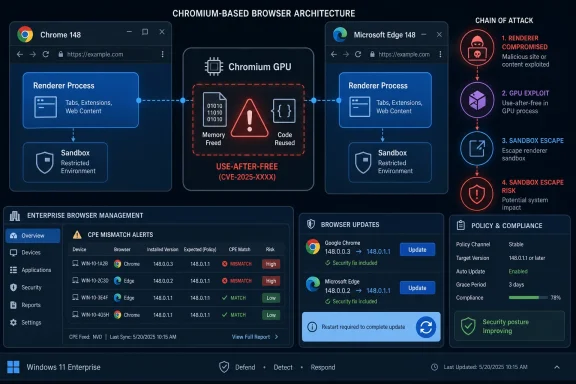
CVE-2026-7918 is a classic modern browser bug in both form and consequence. It is a use-after-free in Chromium’s GPU component, meaning memory that should no longer be trusted may still be reachable in a way that can be abused. The published description says exploitation requires a renderer process that has already been compromised, but that condition should not lull anyone into treating this as a footnote.
Browser exploitation often works as a chain, not as a single magic trick. One bug gets code running inside the renderer sandbox; another bug helps punch out of it. CVE-2026-7918 lives in that second category: not necessarily the first door kicked open, but potentially the hallway that leads from “bad web page” to “host compromise.”
That is why the CPE question matters. If an inventory or vulnerability management platform keys only on
The NVD-style configuration shown in the supplied details is trying to say that Chrome before 148.0.7778.96 is vulnerable on major desktop operating systems. That is reasonable as far as Google Chrome goes. But it is incomplete if the operational question is, “Where does this Chromium flaw appear in my environment?”
That means Edge belongs in the remediation conversation even if the original CPE configuration is centered on Google Chrome. The product row in Microsoft’s entry identifies Microsoft Edge (Chromium-based), gives the release date as May 7, 2026, marks customer action as required, and shows a fixed build family of 148.0.7778.xxx. For WindowsForum readers, that is the practical line: Edge fleets should be updated, verified, and reported just as Chrome fleets should be.
The awkwardness is that CVE databases, vendor advisories, and enterprise scanners do not always model shared code cleanly. Chromium is not a single installed product in most Windows environments. It is an upstream engine consumed by Chrome, Edge, Brave, Vivaldi, Opera, Electron apps, and other software with different release cadences and different exposure surfaces.
So, are we missing a CPE? If the record is intended to describe Google Chrome only, the existing Chrome CPE is the expected anchor. If the record is intended to drive enterprise detection for Microsoft Edge, then yes, a Microsoft Edge CPE would make the data more useful. The absence is less a smoking gun than a reminder that CPE was built for a simpler software world.
This is why GPU bugs are uncomfortable. The browser can sandbox the renderer tightly, but it still has to ask other processes to do useful work. The GPU process becomes one of those places where untrusted web input, complex parsing, driver interactions, shared memory, and cross-process messaging meet.
A use-after-free in that zone is not automatically exploitable in the wild. Attackers still need reliable memory shaping, a way to reach the vulnerable path, and usually another bug or technique to get the renderer into a useful compromised state. But the potential consequence — sandbox escape — is exactly why the Chromium severity is high.
The phrase “crafted HTML page” also deserves attention. It means the attack surface is the everyday web, not a local admin action or a rare protocol handler. User interaction is still required in the sense that a person must visit or be steered to content, but phishing, malvertising, compromised sites, and embedded third-party content have made that a low bar in real-world campaigns.
That distinction matters for exploit writers, but it should not become an excuse for slow patching. Renderer compromise bugs are common enough that defenders should assume attackers can pair weaknesses when the payoff is high. Browser vendors certainly do; their security model treats sandbox escapes as serious precisely because the renderer is expected to be hostile after the first stage of exploitation.
This is the difference between vulnerability scoring and operational risk. The CVSS vector supplied by CISA-ADP scores the issue as high, with network attack vector, required user interaction, high attack complexity, and high impact to confidentiality, integrity, and availability. That maps well to a chained browser exploit: not trivial, but potentially severe.
The absence of public exploit evidence in early advisories should be read carefully. It means defenders have not been told this is being exploited in the wild, not that exploitation is impossible or unattractive. Google’s practice of restricting bug details until most users are updated exists because premature disclosure can turn an academic-looking flaw into a working exploit path.
This was not a one-off emergency patch where a single CVE tells the whole story. It was a broad train release containing critical and high-severity fixes across major browser subsystems. In that context, CVE-2026-7918 is one important carriage in a much longer train.
For managed environments, that argues against cherry-picking urgency solely by whether one CVE appears in a scanner report. If Chrome 148 is behind, the fleet is missing a bundle of fixes. If Edge 148 is behind, the fleet is missing Microsoft’s downstream incorporation of Chromium security work. The remediation target is the browser version, not just the single CVE.
The release cadence also creates a timing gap. Google ships Chrome. Microsoft ingests Chromium and ships Edge. Linux distributions may package Chromium differently or redirect users to snaps, flatpaks, vendor repositories, or downstream builds. During that interval, vulnerability intelligence systems often show partial truth: one vendor’s CPE, one platform’s fixed version, one downstream product’s advisory.
Microsoft’s own advisory text is explicit that Edge consumes Chromium and that the latest version is no longer vulnerable. That makes Edge patch verification a first-class response item. The fixed build family shown by Microsoft — 148.0.7778.xxx — is intentionally less precise than Google’s Chrome version because Edge’s packaging and channel numbering can vary.
This is also where asset inventory has to grow up. “Chrome installed: yes/no” is not enough. “Chromium-based browser present: yes/no” is closer. “Browser channel, version, update policy, execution frequency, and embedded runtime exposure” is what a mature program actually needs.
The WebView2 angle is especially easy to underplay. Not every Chromium-derived exposure looks like a user launching a browser icon. Enterprise apps, line-of-business portals, sign-in flows, and desktop wrappers may depend on Microsoft’s evergreen web runtime. A browser engine vulnerability can therefore matter even in environments where users are told not to browse with Edge.
The question “Are we missing a CPE?” should be reframed as “Which products need distinct machine-readable coverage?” For Google Chrome, the
The challenge is that CPE has always struggled with inherited vulnerabilities. Shared libraries and upstream projects do not map cleanly to user-visible products. A bug in Chromium can be fixed in Chrome, Edge, Electron, or a Linux Chromium package at different times, with different version numbers and different advisory language.
That is why CPE absence should not be treated as proof of non-exposure. It is evidence of a modeling boundary. The security team’s job is to cross that boundary before attackers do.
For Chrome, administrators should verify the installed version through management tooling rather than relying on user self-reporting. For Edge, they should confirm the stable channel version and policy state, especially in environments that defer updates. Extended Stable channels require separate attention because they may receive security fixes without moving on the same visible cadence as Stable.
The biggest mistake is treating browser updates like traditional monthly OS patches. Browsers are internet-facing application platforms with weekly and sometimes emergency cadence. They need their own compliance clock, and that clock should be measured in days, not quarters.
There is also a user-experience wrinkle. Chrome and Edge can update silently, but the running browser process may remain old until restart. Enterprises that brag about fast deployment while leaving browsers open for weeks are really bragging about staged downloads. For sandbox escape-class bugs, that distinction matters.
High attack complexity often means exploit reliability requires skill, environmental assumptions, or chaining. It does not mean defenders get to wait. Browser exploit developers are specialists precisely because they know how to turn high-complexity primitives into repeatable chains when the target population is large enough.
The changed scope element is one of the most important parts of the vector. It reflects the possibility that exploitation crosses a security boundary — in this case, the browser sandbox. In plain English, that is the difference between code trapped in a constrained renderer and code escaping into a more powerful context.
The practical severity also depends on who you are. A consumer machine with auto-update and a normal browsing pattern may be fixed quickly. A managed enterprise with update deferrals, kiosk systems, legacy web apps, and long-lived sessions may remain exposed longer. A high-risk organization targeted by exploit brokers should treat browser sandbox escapes as strategic vulnerabilities, even when the public advisory is quiet.
The Chromium issue linked for CVE-2026-7918 is permission-restricted, which is normal for recent security bugs. As a result, defenders do not yet have public technical detail about the exact object lifetime error, reachable API, exploit preconditions, or mitigations that made exploitation harder. We have the component, the weakness class, the affected version range, and the sandbox-escape consequence.
That is enough to patch. It is not enough to write a reliable detection signature for exploitation. This is another reason version management remains the center of browser defense. Network indicators and behavioral detections may emerge later, but the first response is boring: update the browser, restart it, and verify the version.
Memory safety work in Chromium has improved over the years, but use-after-free bugs continue to surface because browsers are sprawling C++ systems under relentless feature pressure. The GPU stack adds another layer of complexity, straddling browser code, OS interfaces, graphics APIs, and hardware drivers. CVE-2026-7918 is not an anomaly; it is a specimen.
On Linux, the vulnerable or fixed state may depend on whether Chromium came from a distribution repository, a snap, a flatpak, Google’s Chrome repository, a third-party package, or a manually installed build. The same upstream CVE can appear under different package names, update mechanisms, and version strings. In a mixed fleet, this is where tidy dashboards go to die.
Windows has fewer packaging variants for mainstream Chrome and Edge, but it has its own complications: per-user installs, enterprise MSI deployments, update services disabled by policy, and application control rules that allow old portable browsers to linger. macOS adds mobile device management profiles, user-level app bundles, and delayed restarts. The operating system CPEs in the record are therefore less interesting than the actual update path on each endpoint.
The underlying lesson is that vulnerability management should not stop at CPE matching. It should reconcile installed software inventory, vendor release notes, browser management telemetry, and runtime reality. CVE-2026-7918 is a manageable bug; the hard part is proving that every browser engine instance has actually moved past it.
Microsoft Edge is the most important downstream case for Windows environments because it is both widely deployed and tightly integrated into Microsoft’s platform. But it is not alone. Other Chromium-based browsers and applications may need their own updates, and some will lag. The public CVE record may not enumerate them all on day one.
This is why the phrase “Chrome vulnerability” is increasingly imprecise. Sometimes it means a bug in Google-specific Chrome code. Sometimes it means a bug in Chromium code that Edge also inherits. Sometimes it means a bug in a third-party library used by Chromium and other projects. Each case demands a different patch map.
For IT teams, the better mental model is browser engine exposure. Ask which endpoints run Chromium-derived code, which channels they track, how quickly they update, and whether users can run unmanaged alternatives. That model is more work than reading a CPE line, but it better matches reality.
But filing a CPE correction or enrichment request is not remediation. It is hygiene. The operational response should proceed whether or not the database is perfect. Waiting for metadata to catch up is how a known fixed vulnerability remains exploitable in practice.
A good internal advisory should therefore name both Chrome and Edge, state the fixed versions or build families, and call out the need to restart browsers after update. It should also instruct teams to check other Chromium-based browsers where they are permitted in the environment. That last clause matters because “not officially supported” does not mean “not installed.”
The CPE debate is useful because it reveals dependency blindness. It is dangerous only if it becomes a procedural delay. CVE-2026-7918 does not care whether your dashboard has a green check mark.
This is also a good moment to audit how your tools represent Chromium-derived vulnerabilities. If Chrome appears and Edge does not, your visibility is incomplete. If every Windows machine appears vulnerable merely because the OS CPE is present, your visibility is noisy. Either failure mode can lead to bad decisions.
A better workflow is to treat vendor advisories as starting points, not final truth. Google tells you what Chrome fixed. Microsoft tells you what Edge consumed. Your inventory tells you what is actually installed. Your endpoint telemetry tells you what is still running.
Source: NVD / Chromium Security Update Guide - Microsoft Security Response Center
 The CPE Is Not the Vulnerability, but It Can Become the Blind Spot
CVE-2026-7918 is a classic modern browser bug in both form and consequence. It is a use-after-free in Chromium’s GPU component, meaning memory that should no longer be trusted may still be reachable in a way that can be abused. The published description says exploitation requires a renderer process that has already been compromised, but that condition should not lull anyone into treating this as a footnote.Browser exploitation often works as a chain, not as a single magic trick. One bug gets code running inside the renderer sandbox; another bug helps punch out of it. CVE-2026-7918 lives in that second category: not necessarily the first door kicked open, but potentially the hallway that leads from “bad web page” to “host compromise.”
That is why the CPE question matters. If an inventory or vulnerability management platform keys only on
google:chrome, it may correctly identify Chrome but fail to flag Chromium-derived browsers that consume the same vulnerable code. If it keys too broadly on operating systems such as Windows, Linux, and macOS without tying the condition to a browser package, it can create noisy findings that admins learn to distrust.The NVD-style configuration shown in the supplied details is trying to say that Chrome before 148.0.7778.96 is vulnerable on major desktop operating systems. That is reasonable as far as Google Chrome goes. But it is incomplete if the operational question is, “Where does this Chromium flaw appear in my environment?”
Microsoft’s Entry Is the Clue That This Is Bigger Than Chrome
Microsoft’s Security Update Guide entry makes the key point without much drama: the CVE was assigned by Chrome, and Microsoft Edge consumes Chromium, so Edge documents the issue to announce that the latest Chromium-based Edge is no longer vulnerable. That wording is bureaucratic, but it is important. Microsoft is not claiming ownership of the original bug; it is claiming responsibility for shipping the fix to Edge users.That means Edge belongs in the remediation conversation even if the original CPE configuration is centered on Google Chrome. The product row in Microsoft’s entry identifies Microsoft Edge (Chromium-based), gives the release date as May 7, 2026, marks customer action as required, and shows a fixed build family of 148.0.7778.xxx. For WindowsForum readers, that is the practical line: Edge fleets should be updated, verified, and reported just as Chrome fleets should be.
The awkwardness is that CVE databases, vendor advisories, and enterprise scanners do not always model shared code cleanly. Chromium is not a single installed product in most Windows environments. It is an upstream engine consumed by Chrome, Edge, Brave, Vivaldi, Opera, Electron apps, and other software with different release cadences and different exposure surfaces.
So, are we missing a CPE? If the record is intended to describe Google Chrome only, the existing Chrome CPE is the expected anchor. If the record is intended to drive enterprise detection for Microsoft Edge, then yes, a Microsoft Edge CPE would make the data more useful. The absence is less a smoking gun than a reminder that CPE was built for a simpler software world.
The GPU Process Has Become a Security Boundary by Necessity
The GPU component in Chromium is not just about drawing pixels faster. Modern browsers route compositing, video decode, WebGL, WebGPU, canvas acceleration, and other graphics-adjacent workloads through specialized processes and drivers. That architecture improves performance and can improve isolation, but it also creates a large, highly privileged interface between web content and the operating system’s graphics stack.This is why GPU bugs are uncomfortable. The browser can sandbox the renderer tightly, but it still has to ask other processes to do useful work. The GPU process becomes one of those places where untrusted web input, complex parsing, driver interactions, shared memory, and cross-process messaging meet.
A use-after-free in that zone is not automatically exploitable in the wild. Attackers still need reliable memory shaping, a way to reach the vulnerable path, and usually another bug or technique to get the renderer into a useful compromised state. But the potential consequence — sandbox escape — is exactly why the Chromium severity is high.
The phrase “crafted HTML page” also deserves attention. It means the attack surface is the everyday web, not a local admin action or a rare protocol handler. User interaction is still required in the sense that a person must visit or be steered to content, but phishing, malvertising, compromised sites, and embedded third-party content have made that a low bar in real-world campaigns.
“Renderer Already Compromised” Is a Condition, Not a Comfort Blanket
Some vulnerability descriptions sound less severe than they are because they describe only one stage of a chain. CVE-2026-7918 does not say that a single web page trivially escapes the sandbox from a clean start. It says an attacker who has compromised the renderer process may potentially escape the sandbox through the GPU flaw.That distinction matters for exploit writers, but it should not become an excuse for slow patching. Renderer compromise bugs are common enough that defenders should assume attackers can pair weaknesses when the payoff is high. Browser vendors certainly do; their security model treats sandbox escapes as serious precisely because the renderer is expected to be hostile after the first stage of exploitation.
This is the difference between vulnerability scoring and operational risk. The CVSS vector supplied by CISA-ADP scores the issue as high, with network attack vector, required user interaction, high attack complexity, and high impact to confidentiality, integrity, and availability. That maps well to a chained browser exploit: not trivial, but potentially severe.
The absence of public exploit evidence in early advisories should be read carefully. It means defenders have not been told this is being exploited in the wild, not that exploitation is impossible or unattractive. Google’s practice of restricting bug details until most users are updated exists because premature disclosure can turn an academic-looking flaw into a working exploit path.
Chrome 148 Was a Security Train, Not a One-Bug Hotfix
The Chrome desktop update that fixed CVE-2026-7918 landed as part of a much larger security release. Google’s stable-channel update for Chrome 148 listed 127 security fixes and shipped version 148.0.7778.96 for Linux, with 148.0.7778.96 or .97 builds for Windows and macOS. That is not unusual for Chrome, but it changes how admins should think about the event.This was not a one-off emergency patch where a single CVE tells the whole story. It was a broad train release containing critical and high-severity fixes across major browser subsystems. In that context, CVE-2026-7918 is one important carriage in a much longer train.
For managed environments, that argues against cherry-picking urgency solely by whether one CVE appears in a scanner report. If Chrome 148 is behind, the fleet is missing a bundle of fixes. If Edge 148 is behind, the fleet is missing Microsoft’s downstream incorporation of Chromium security work. The remediation target is the browser version, not just the single CVE.
The release cadence also creates a timing gap. Google ships Chrome. Microsoft ingests Chromium and ships Edge. Linux distributions may package Chromium differently or redirect users to snaps, flatpaks, vendor repositories, or downstream builds. During that interval, vulnerability intelligence systems often show partial truth: one vendor’s CPE, one platform’s fixed version, one downstream product’s advisory.
The Edge Angle Is Where Windows Shops Can Trip
For Windows administrators, Microsoft Edge is not an optional curiosity. It is part of the baseline desktop reality, present across Windows 10 and Windows 11 estates, used directly by users, invoked by WebView2 runtimes, and embedded in workflows even where Chrome is the preferred browser. Ignoring Edge because the CVE says “Chrome” is a mistake.Microsoft’s own advisory text is explicit that Edge consumes Chromium and that the latest version is no longer vulnerable. That makes Edge patch verification a first-class response item. The fixed build family shown by Microsoft — 148.0.7778.xxx — is intentionally less precise than Google’s Chrome version because Edge’s packaging and channel numbering can vary.
This is also where asset inventory has to grow up. “Chrome installed: yes/no” is not enough. “Chromium-based browser present: yes/no” is closer. “Browser channel, version, update policy, execution frequency, and embedded runtime exposure” is what a mature program actually needs.
The WebView2 angle is especially easy to underplay. Not every Chromium-derived exposure looks like a user launching a browser icon. Enterprise apps, line-of-business portals, sign-in flows, and desktop wrappers may depend on Microsoft’s evergreen web runtime. A browser engine vulnerability can therefore matter even in environments where users are told not to browse with Edge.
The NVD Configuration Is a Map With Missing Roads
The supplied NVD change history shows an initial CPE configuration that combines a Google Chrome application CPE with desktop operating system CPEs for Windows, Linux, and macOS. Structurally, that is a familiar pattern: vulnerable application, constrained by platforms where the application runs. It is not wrong, but it is not the whole operational universe.The question “Are we missing a CPE?” should be reframed as “Which products need distinct machine-readable coverage?” For Google Chrome, the
google:chrome CPE is the obvious identifier. For Microsoft Edge, a separate microsoft:edge or equivalent CPE would help scanners connect Microsoft’s advisory to installed Edge versions. For Chromium open-source packages, distribution-specific identifiers may be needed because packaging is not uniform.The challenge is that CPE has always struggled with inherited vulnerabilities. Shared libraries and upstream projects do not map cleanly to user-visible products. A bug in Chromium can be fixed in Chrome, Edge, Electron, or a Linux Chromium package at different times, with different version numbers and different advisory language.
That is why CPE absence should not be treated as proof of non-exposure. It is evidence of a modeling boundary. The security team’s job is to cross that boundary before attackers do.
Patch Management Needs Version Truth, Not Advisory Theater
The immediate remediation is straightforward: update Chrome to at least 148.0.7778.96 and update Microsoft Edge to the relevant 148.0.7778.xxx build or later. But “patched” is one of those words that becomes slippery at enterprise scale. A machine may have downloaded the update but not restarted the browser. A user may have multiple browser profiles. A VDI image may be current while persistent desktops lag behind.For Chrome, administrators should verify the installed version through management tooling rather than relying on user self-reporting. For Edge, they should confirm the stable channel version and policy state, especially in environments that defer updates. Extended Stable channels require separate attention because they may receive security fixes without moving on the same visible cadence as Stable.
The biggest mistake is treating browser updates like traditional monthly OS patches. Browsers are internet-facing application platforms with weekly and sometimes emergency cadence. They need their own compliance clock, and that clock should be measured in days, not quarters.
There is also a user-experience wrinkle. Chrome and Edge can update silently, but the running browser process may remain old until restart. Enterprises that brag about fast deployment while leaving browsers open for weeks are really bragging about staged downloads. For sandbox escape-class bugs, that distinction matters.
Severity Scores Explain the Shape of the Threat, Not the Urgency of Your Fleet
The CISA-ADP CVSS 3.1 score of 8.3 lands CVE-2026-7918 in high-severity territory. The vector tells a plausible story: remote network attack, no privileges required, user interaction required, high complexity, changed scope, and high impact across confidentiality, integrity, and availability. That is a more nuanced score than “everything is critical,” and it should be treated as such.High attack complexity often means exploit reliability requires skill, environmental assumptions, or chaining. It does not mean defenders get to wait. Browser exploit developers are specialists precisely because they know how to turn high-complexity primitives into repeatable chains when the target population is large enough.
The changed scope element is one of the most important parts of the vector. It reflects the possibility that exploitation crosses a security boundary — in this case, the browser sandbox. In plain English, that is the difference between code trapped in a constrained renderer and code escaping into a more powerful context.
The practical severity also depends on who you are. A consumer machine with auto-update and a normal browsing pattern may be fixed quickly. A managed enterprise with update deferrals, kiosk systems, legacy web apps, and long-lived sessions may remain exposed longer. A high-risk organization targeted by exploit brokers should treat browser sandbox escapes as strategic vulnerabilities, even when the public advisory is quiet.
The Disclosure Tells Us Less Than We Want, by Design
Google’s advisory highlights externally reported vulnerabilities but withholds some bug details until most users are updated. That policy frustrates researchers and defenders who want root-cause clarity immediately. It is also sensible. A detailed bug tracker entry for a memory safety flaw can be an exploit developer’s roadmap.The Chromium issue linked for CVE-2026-7918 is permission-restricted, which is normal for recent security bugs. As a result, defenders do not yet have public technical detail about the exact object lifetime error, reachable API, exploit preconditions, or mitigations that made exploitation harder. We have the component, the weakness class, the affected version range, and the sandbox-escape consequence.
That is enough to patch. It is not enough to write a reliable detection signature for exploitation. This is another reason version management remains the center of browser defense. Network indicators and behavioral detections may emerge later, but the first response is boring: update the browser, restart it, and verify the version.
Memory safety work in Chromium has improved over the years, but use-after-free bugs continue to surface because browsers are sprawling C++ systems under relentless feature pressure. The GPU stack adds another layer of complexity, straddling browser code, OS interfaces, graphics APIs, and hardware drivers. CVE-2026-7918 is not an anomaly; it is a specimen.
Linux Packaging Shows Why “Chromium” Is Not One Thing
The Ubuntu note around this CVE is a useful example of how downstream packaging complicates vulnerability tracking. Ubuntu’schromium-browser package has long been a transitional path to the Chromium snap rather than a traditional distro-maintained browser package. That means a scanner looking only for a Debian-style package may tell a misleading story.On Linux, the vulnerable or fixed state may depend on whether Chromium came from a distribution repository, a snap, a flatpak, Google’s Chrome repository, a third-party package, or a manually installed build. The same upstream CVE can appear under different package names, update mechanisms, and version strings. In a mixed fleet, this is where tidy dashboards go to die.
Windows has fewer packaging variants for mainstream Chrome and Edge, but it has its own complications: per-user installs, enterprise MSI deployments, update services disabled by policy, and application control rules that allow old portable browsers to linger. macOS adds mobile device management profiles, user-level app bundles, and delayed restarts. The operating system CPEs in the record are therefore less interesting than the actual update path on each endpoint.
The underlying lesson is that vulnerability management should not stop at CPE matching. It should reconcile installed software inventory, vendor release notes, browser management telemetry, and runtime reality. CVE-2026-7918 is a manageable bug; the hard part is proving that every browser engine instance has actually moved past it.
The Browser Supply Chain Has Outgrown Single-Vendor Thinking
Chromium’s success created a security paradox. A shared engine means fixes can propagate across a huge ecosystem, reducing duplicated engineering effort and giving users the benefit of Google’s and the broader community’s security work. But it also means one upstream flaw can ripple through many products that users perceive as unrelated.Microsoft Edge is the most important downstream case for Windows environments because it is both widely deployed and tightly integrated into Microsoft’s platform. But it is not alone. Other Chromium-based browsers and applications may need their own updates, and some will lag. The public CVE record may not enumerate them all on day one.
This is why the phrase “Chrome vulnerability” is increasingly imprecise. Sometimes it means a bug in Google-specific Chrome code. Sometimes it means a bug in Chromium code that Edge also inherits. Sometimes it means a bug in a third-party library used by Chromium and other projects. Each case demands a different patch map.
For IT teams, the better mental model is browser engine exposure. Ask which endpoints run Chromium-derived code, which channels they track, how quickly they update, and whether users can run unmanaged alternatives. That model is more work than reading a CPE line, but it better matches reality.
Security Teams Should File the CPE Gap, but Not Wait for It
If your scanner does not flag Edge for CVE-2026-7918, that is worth escalating to the vendor. The Microsoft advisory exists, Edge has a documented fixed build family, and customer action is required. Vulnerability management tools should be able to connect those dots without forcing admins into custom exceptions.But filing a CPE correction or enrichment request is not remediation. It is hygiene. The operational response should proceed whether or not the database is perfect. Waiting for metadata to catch up is how a known fixed vulnerability remains exploitable in practice.
A good internal advisory should therefore name both Chrome and Edge, state the fixed versions or build families, and call out the need to restart browsers after update. It should also instruct teams to check other Chromium-based browsers where they are permitted in the environment. That last clause matters because “not officially supported” does not mean “not installed.”
The CPE debate is useful because it reveals dependency blindness. It is dangerous only if it becomes a procedural delay. CVE-2026-7918 does not care whether your dashboard has a green check mark.
The Useful Answer for WindowsForum Readers Is Operational, Not Philosophical
The right response to CVE-2026-7918 is neither panic nor complacency. It is a fast browser patch cycle, with explicit Edge coverage and version verification. The bug’s exploit chain requirements make it less straightforward than a drive-by one-shot remote code execution flaw, but the potential sandbox escape makes it too serious for leisurely treatment.This is also a good moment to audit how your tools represent Chromium-derived vulnerabilities. If Chrome appears and Edge does not, your visibility is incomplete. If every Windows machine appears vulnerable merely because the OS CPE is present, your visibility is noisy. Either failure mode can lead to bad decisions.
A better workflow is to treat vendor advisories as starting points, not final truth. Google tells you what Chrome fixed. Microsoft tells you what Edge consumed. Your inventory tells you what is actually installed. Your endpoint telemetry tells you what is still running.
The Patch Line Is Clear Even When the Metadata Is Messy
The concrete lessons from CVE-2026-7918 are narrow enough to act on and broad enough to remember the next time a Chromium CVE lands.- Chrome desktop installations should be updated to 148.0.7778.96 or later, with Windows and macOS environments accepting the corresponding .96 or .97 build as applicable.
- Microsoft Edge should be verified on the 148.0.7778.xxx security update line or later, because Microsoft documents the Chromium fix as incorporated into Edge.
- A missing or incomplete CPE entry should be treated as a scanner-content issue, not as evidence that a Chromium-based downstream product is safe.
- Browser restarts should be part of compliance measurement, because downloaded updates do not protect sessions still running old code.
- Environments that permit alternative Chromium-based browsers should inventory and update them separately rather than assuming Chrome and Edge coverage is enough.
- Security teams should tune vulnerability reporting to distinguish real browser exposure from noisy operating-system-level CPE matches.
Source: NVD / Chromium Security Update Guide - Microsoft Security Response Center
