

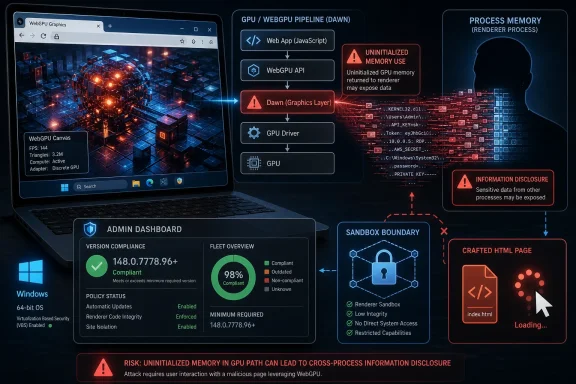
Google and the Chromium project disclosed CVE-2026-7924 on May 6, 2026, describing a high-severity uninitialized-use flaw in Dawn that affected Google Chrome before version 148.0.7778.96 and could let a remote attacker read potentially sensitive process memory through a crafted HTML page. The bug is not the loudest vulnerability in Chrome 148, but it is one of the more revealing ones. It sits at the intersection of GPU acceleration, browser sandboxing, and the uncomfortable fact that modern browsers now expose extraordinarily complex graphics stacks to ordinary websites. For Windows users and administrators, the lesson is simple: Chrome, Edge, and every Chromium-family browser are now part of the operating system’s attack surface, whether Microsoft ships the vulnerable code or not.
CVE-2026-7924 is classified as an uninitialized use in Dawn, the Chromium graphics layer best known for implementing WebGPU plumbing. In plain English, that means code may have used memory before it had been properly initialized, creating a path for data already sitting in process memory to be exposed where it should not have been visible.
That matters because browsers are not just document viewers anymore. A modern webpage can ask for video decoding, hardware compositing, shader compilation, 3D rendering, machine-learning acceleration, audio processing, and cross-origin isolation features that would have sounded absurdly ambitious in the Internet Explorer 6 era. The browser has become a user-space operating system with a URL bar.
The published description says the attack path involved a crafted HTML page and could allow a remote attacker to obtain potentially sensitive information from process memory. That phrasing is narrower than “remote code execution,” and the CVSS vector assigned by CISA’s ADP process reflects that: network-accessible, low attack complexity, no privileges required, user interaction required, high confidentiality impact, and no direct integrity or availability impact.
That combination often leads people to underrate the bug. They should not. In browser exploitation, information disclosure is rarely the final act. It is often the supporting actor that makes the final act possible.
But every abstraction has a cost. When browsers expose more of the GPU pipeline to web content, they also inherit the fragility of graphics drivers, shader compilers, device queues, buffer management, and cross-process synchronization. The browser vendors have spent years wrapping those components in sandboxes, validation layers, broker processes, and permissions models, yet the core bargain remains: more capability means more code reachable from untrusted pages.
CVE-2026-7924 appears to be a confidentiality issue rather than a takeover bug. Still, confidentiality bugs inside rendering or graphics-adjacent code are not harmless bookkeeping mistakes. They can reveal memory contents that help attackers bypass address-space randomization, infer object layouts, recover tokens or fragments of sensitive data, or stabilize a chain that would otherwise crash too often to be useful.
That is why the “High” Chromium severity and the “Medium” CVSS 3.1 score can coexist without contradiction. CVSS is a scoring framework; browser severity is an exploitation-context judgment. A vulnerability that leaks memory through a web page may not score like a wormable server bug, but in the browser world it can still be a serious building block.
CVE-2026-7924 is therefore best understood as one tile in a much larger mosaic. Chrome 148 did not merely polish a product; it swept through renderer, browser, graphics, media, and component-level code with the kind of volume that reminds enterprise admins why browser patching has become a first-class security program. The browser update channel is now effectively a rolling Patch Tuesday with less ceremony and more urgency.
For home users, the advice remains almost boring: restart the browser and make sure the version number is at or above the fixed build. For managed Windows environments, the answer is more complicated. Admins need to confirm that Chrome’s automatic update mechanisms are not blocked, that update rings are not lagging behind policy assumptions, and that third-party Chromium browsers are not quietly sitting outside normal compliance reports.
The “crafted HTML page” language is also important. This is not a local attacker with a keyboard. It is the web doing what the web does: delivering untrusted content into a parser, renderer, graphics stack, and sandbox boundary at scale. If a user can browse, they can be presented with the trigger condition.
This distinction matters for WindowsForum readers because Microsoft Edge now lives in a strange political and operational space. It is part Windows component, part Microsoft cloud gateway, part enterprise policy endpoint, and part Chromium downstream. When Chromium lands a major security update, Edge customers naturally ask whether they are protected immediately, later that day, later that week, or only after their enterprise ring catches up.
Microsoft’s Edge security release notes around this period stated that the company was aware of recent Chromium security fixes and was actively working on releasing a security fix. That kind of wording is familiar to admins who track downstream browser vendors: the upstream patch exists, but downstream packaging, validation, signing, staged rollout, and channel differences can introduce a gap.
That gap is not scandalous by itself. Every vendor downstream of Chromium has to integrate and ship. But it is operationally significant. A Chrome version number is not an Edge version number, and a Chromium CVE marked fixed upstream does not automatically prove every Chromium-derived browser on a fleet is already patched.
The “Are we missing a CPE?” prompt in NVD is less a smoking gun than a reminder of how awkward vulnerability metadata becomes when a component is embedded across products. Dawn is part of Chromium. Chromium is embedded in Chrome, Edge, Electron applications, Android WebView variants, Linux distributions, and countless derivative browsers and app shells. A single bug can appear in a place where the scanner has a CPE, another place where it has only a package name, and a third place where it sees nothing at all.
For Windows shops, that is the real inventory problem. If vulnerability management says “Chrome fixed,” but the environment also contains Edge, Brave, Vivaldi, Electron-based collaboration tools, kiosk shells, developer-installed Chromium snapshots, and embedded browser runtimes, the CPE record is only the beginning of the conversation.
The problem is not that CPEs are useless. They are useful for matching known vulnerable software against known assets. The problem is that Chromium has become infrastructure, and infrastructure rarely maps cleanly to one product name.
A memory disclosure bug in a browser is not the same as a medium-severity bug in a niche internal utility. It is reachable through web content, it affects a high-value application, and it exists in software that most users run all day. The required user interaction is not “convince the victim to run a suspicious installer”; it is “convince the victim to load a page,” which phishing campaigns, malvertising networks, compromised sites, and watering-hole attacks already do at industrial scale.
The absence of known exploitation in the public advisory should temper panic. There is no need to invent a zero-day campaign where one has not been disclosed. But lack of disclosed exploitation is not the same as low priority. Browser vulnerabilities compress the distance between disclosure and practical abuse, especially when the underlying bug class is familiar and the patched build is available for diffing.
The better triage model is not “Medium means wait.” It is “web-reachable confidentiality bug in a dominant browser means patch promptly, verify completion, and look for downstream lag.”
Graphics and compute APIs blur the line between webpage and workstation workload. A site can now legitimately ask the browser to marshal buffers, compile shaders, schedule GPU work, and coordinate data movement across process and device boundaries. The whole point is performance. The whole risk is that performance-sensitive code often has less tolerance for defensive simplicity.
Dawn and WebGPU are not reckless projects. Quite the opposite: WebGPU was designed after years of painful lessons from lower-level graphics APIs and earlier web graphics layers. But safer does not mean simple. It means a great deal of validation code must be correct, every time, across driver ecosystems and operating systems that were never designed with hostile webpages as the primary client.
That is the new normal. The web platform absorbs native capabilities, then the browser security model absorbs the consequences. Users get more powerful web apps. Attackers get more interesting bug classes. Admins get another reason to treat browser version drift as a security incident waiting to happen.
Enterprises are different. They delay, stage, test, pin, mirror, and manage. Sometimes that discipline prevents outages. Sometimes it converts a patched vulnerability into a known exposure window.
The challenge with CVE-2026-7924 is that it was disclosed as part of a large release containing many security fixes. If an organization holds Chrome 148 for compatibility testing, it is not holding back one theoretical bug. It is holding back a trainload of fixes across a browser that processes untrusted content constantly.
That does not mean every company should abandon staged rollout. It means browser rings need shorter security exceptions than office suites, ERP clients, or monthly operating-system updates. The browser is the front door for too much hostile input to live comfortably on slow-moving change control.
The first operational question is whether managed endpoints are actually running the fixed Chrome version or later. The second is whether users have restarted the browser, because a downloaded update sitting behind a pending relaunch is not the same as a protected process. The third is whether Edge, Electron apps, and secondary Chromium browsers have received equivalent updates.
This is also where Windows management tooling can mislead. Software inventory may report an installed package version while long-running browser processes remain old. Vulnerability scanners may detect Chrome but miss portable browsers in user profiles. App control may lock down installation paths while leaving developer tools, packaged apps, or remote browser sessions out of view.
CVE-2026-7924 is not a reason to ban WebGPU or panic over Dawn. It is a reason to close the gap between what policy says is installed and what users are actually running.
The downside is correlated risk. A flaw in a shared component can ripple across browsers, embedded runtimes, and application shells. Organizations that think they have diversified because users can choose among several Chromium-based browsers may discover they diversified the logo, not the engine.
This is not an argument that everyone should immediately switch engines. Browser monoculture is a complex outcome of performance, standards, developer tooling, market pressure, and user expectations. But it is an argument for more honest risk accounting. A Chromium vulnerability is not just a Chrome issue in the way a Windows vulnerability is not just an issue for one laptop model.
That accounting should extend to procurement. If a vendor ships a desktop app built on Chromium or Electron, security teams should ask how quickly it rebases after Chromium security releases, how it exposes runtime version information, and whether it can be patched independently of a full application upgrade.
But MSRC cannot make every downstream state obvious. It cannot prove that a third-party Chromium browser is patched. It cannot tell whether a user delayed a relaunch. It cannot inventory an unmanaged portable browser in a Downloads folder. It cannot guarantee that an Electron application has moved beyond a vulnerable Chromium base.
This is where vulnerability management has to become less advisory-driven and more evidence-driven. The authoritative question is not whether a CVE page exists. It is whether the vulnerable code is still executing on machines you are responsible for.
That is an uncomfortable standard, but it is the correct one. Modern endpoint risk lives in running processes, not just installed programs.
Yet quiet bugs are often where the architecture shows through. This one reminds us that browsers now broker access to graphics hardware, that web content reaches deeply into performance-sensitive subsystems, and that memory hygiene remains foundational even in projects built with modern security assumptions.
It also shows the limits of severity labels. A “High” Chromium issue and a “Medium” CVSS score can both be true. The practical decision for admins does not require resolving that taxonomy debate. The fixed build exists; the vulnerable versions are known; the exposure path is the web.
Security teams should resist the urge to treat this as merely another row in a monthly spreadsheet. Browser bugs deserve operational urgency because browsers are where users, identity, cloud consoles, SaaS data, and arbitrary internet content collide.
Source: NVD / Chromium Security Update Guide - Microsoft Security Response Center
 A Memory Leak in the Graphics Stack Is Still a Browser Bug
CVE-2026-7924 is classified as an uninitialized use in Dawn, the Chromium graphics layer best known for implementing WebGPU plumbing. In plain English, that means code may have used memory before it had been properly initialized, creating a path for data already sitting in process memory to be exposed where it should not have been visible.That matters because browsers are not just document viewers anymore. A modern webpage can ask for video decoding, hardware compositing, shader compilation, 3D rendering, machine-learning acceleration, audio processing, and cross-origin isolation features that would have sounded absurdly ambitious in the Internet Explorer 6 era. The browser has become a user-space operating system with a URL bar.
The published description says the attack path involved a crafted HTML page and could allow a remote attacker to obtain potentially sensitive information from process memory. That phrasing is narrower than “remote code execution,” and the CVSS vector assigned by CISA’s ADP process reflects that: network-accessible, low attack complexity, no privileges required, user interaction required, high confidentiality impact, and no direct integrity or availability impact.
That combination often leads people to underrate the bug. They should not. In browser exploitation, information disclosure is rarely the final act. It is often the supporting actor that makes the final act possible.
Dawn Makes the Web Faster, and That Is the Trade
Dawn is part of Chromium’s answer to a web that increasingly wants native-like graphics and compute behavior. It is associated with WebGPU, the API family designed to give webpages more modern, lower-overhead access to GPU capabilities than older layers such as WebGL. That is good for browser games, design tools, scientific visualization, local AI experiments, CAD-style workloads, and the general push to make “open a tab” compete with “install an app.”But every abstraction has a cost. When browsers expose more of the GPU pipeline to web content, they also inherit the fragility of graphics drivers, shader compilers, device queues, buffer management, and cross-process synchronization. The browser vendors have spent years wrapping those components in sandboxes, validation layers, broker processes, and permissions models, yet the core bargain remains: more capability means more code reachable from untrusted pages.
CVE-2026-7924 appears to be a confidentiality issue rather than a takeover bug. Still, confidentiality bugs inside rendering or graphics-adjacent code are not harmless bookkeeping mistakes. They can reveal memory contents that help attackers bypass address-space randomization, infer object layouts, recover tokens or fragments of sensitive data, or stabilize a chain that would otherwise crash too often to be useful.
That is why the “High” Chromium severity and the “Medium” CVSS 3.1 score can coexist without contradiction. CVSS is a scoring framework; browser severity is an exploitation-context judgment. A vulnerability that leaks memory through a web page may not score like a wormable server bug, but in the browser world it can still be a serious building block.
Chrome 148 Was Not a Routine Point Release
The fix arrived in the Chrome 148 stable channel update for desktop, with version 148.0.7778.96 for Linux and 148.0.7778.96/97 for Windows and macOS. That release carried a very large security payload: public reporting around the update counts 127 security fixes, including multiple critical vulnerabilities elsewhere in the browser stack.CVE-2026-7924 is therefore best understood as one tile in a much larger mosaic. Chrome 148 did not merely polish a product; it swept through renderer, browser, graphics, media, and component-level code with the kind of volume that reminds enterprise admins why browser patching has become a first-class security program. The browser update channel is now effectively a rolling Patch Tuesday with less ceremony and more urgency.
For home users, the advice remains almost boring: restart the browser and make sure the version number is at or above the fixed build. For managed Windows environments, the answer is more complicated. Admins need to confirm that Chrome’s automatic update mechanisms are not blocked, that update rings are not lagging behind policy assumptions, and that third-party Chromium browsers are not quietly sitting outside normal compliance reports.
The “crafted HTML page” language is also important. This is not a local attacker with a keyboard. It is the web doing what the web does: delivering untrusted content into a parser, renderer, graphics stack, and sandbox boundary at scale. If a user can browse, they can be presented with the trigger condition.
The Edge Angle Is Microsoft’s Chromium Dependency in Miniature
The user-facing CVE entry appears in Microsoft’s Security Update Guide because Microsoft Edge is Chromium-based. That does not mean the vulnerability was necessarily created by Microsoft, nor that Windows itself is vulnerable in the same way a kernel driver would be. It means Microsoft ships and maintains a browser that inherits large portions of Chromium’s security reality.This distinction matters for WindowsForum readers because Microsoft Edge now lives in a strange political and operational space. It is part Windows component, part Microsoft cloud gateway, part enterprise policy endpoint, and part Chromium downstream. When Chromium lands a major security update, Edge customers naturally ask whether they are protected immediately, later that day, later that week, or only after their enterprise ring catches up.
Microsoft’s Edge security release notes around this period stated that the company was aware of recent Chromium security fixes and was actively working on releasing a security fix. That kind of wording is familiar to admins who track downstream browser vendors: the upstream patch exists, but downstream packaging, validation, signing, staged rollout, and channel differences can introduce a gap.
That gap is not scandalous by itself. Every vendor downstream of Chromium has to integrate and ship. But it is operationally significant. A Chrome version number is not an Edge version number, and a Chromium CVE marked fixed upstream does not automatically prove every Chromium-derived browser on a fleet is already patched.
CPE Confusion Is a Symptom of a Bigger Inventory Problem
The NVD change record listed an affected Chrome CPE with versions up to, but excluding, 148.0.7778.96, combined with operating-system CPEs for Windows, Linux, and macOS. That is a conventional way to describe a cross-platform application vulnerability, but it can look odd to readers expecting a tidy “Google Chrome on Windows” product line.The “Are we missing a CPE?” prompt in NVD is less a smoking gun than a reminder of how awkward vulnerability metadata becomes when a component is embedded across products. Dawn is part of Chromium. Chromium is embedded in Chrome, Edge, Electron applications, Android WebView variants, Linux distributions, and countless derivative browsers and app shells. A single bug can appear in a place where the scanner has a CPE, another place where it has only a package name, and a third place where it sees nothing at all.
For Windows shops, that is the real inventory problem. If vulnerability management says “Chrome fixed,” but the environment also contains Edge, Brave, Vivaldi, Electron-based collaboration tools, kiosk shells, developer-installed Chromium snapshots, and embedded browser runtimes, the CPE record is only the beginning of the conversation.
The problem is not that CPEs are useless. They are useful for matching known vulnerable software against known assets. The problem is that Chromium has become infrastructure, and infrastructure rarely maps cleanly to one product name.
The CVSS Number Understates the Operational Risk
CISA’s ADP vector gives CVE-2026-7924 a 6.5 Medium score under CVSS 3.1: network attack vector, low complexity, no privileges, required user interaction, unchanged scope, high confidentiality impact, and no integrity or availability impact. That score is internally logical. It also risks sending the wrong signal to teams that triage by number alone.A memory disclosure bug in a browser is not the same as a medium-severity bug in a niche internal utility. It is reachable through web content, it affects a high-value application, and it exists in software that most users run all day. The required user interaction is not “convince the victim to run a suspicious installer”; it is “convince the victim to load a page,” which phishing campaigns, malvertising networks, compromised sites, and watering-hole attacks already do at industrial scale.
The absence of known exploitation in the public advisory should temper panic. There is no need to invent a zero-day campaign where one has not been disclosed. But lack of disclosed exploitation is not the same as low priority. Browser vulnerabilities compress the distance between disclosure and practical abuse, especially when the underlying bug class is familiar and the patched build is available for diffing.
The better triage model is not “Medium means wait.” It is “web-reachable confidentiality bug in a dominant browser means patch promptly, verify completion, and look for downstream lag.”
WebGPU-Era Browsers Are Harder to Reason About
The most interesting part of CVE-2026-7924 is not its score. It is where it lives. Browser security used to be explained through a relatively small set of mental models: JavaScript engine bugs, DOM confusion, renderer sandbox escapes, plugin disasters, and certificate mistakes. Those models still matter, but the surface has widened.Graphics and compute APIs blur the line between webpage and workstation workload. A site can now legitimately ask the browser to marshal buffers, compile shaders, schedule GPU work, and coordinate data movement across process and device boundaries. The whole point is performance. The whole risk is that performance-sensitive code often has less tolerance for defensive simplicity.
Dawn and WebGPU are not reckless projects. Quite the opposite: WebGPU was designed after years of painful lessons from lower-level graphics APIs and earlier web graphics layers. But safer does not mean simple. It means a great deal of validation code must be correct, every time, across driver ecosystems and operating systems that were never designed with hostile webpages as the primary client.
That is the new normal. The web platform absorbs native capabilities, then the browser security model absorbs the consequences. Users get more powerful web apps. Attackers get more interesting bug classes. Admins get another reason to treat browser version drift as a security incident waiting to happen.
The Patch Window Is Where Policy Meets Reality
Chrome’s automatic updater is one of the quiet success stories of consumer security. Most people do not download browser patches by hand, and they should not have to. The software updates itself, nags for a restart, and eventually gets the new code running.Enterprises are different. They delay, stage, test, pin, mirror, and manage. Sometimes that discipline prevents outages. Sometimes it converts a patched vulnerability into a known exposure window.
The challenge with CVE-2026-7924 is that it was disclosed as part of a large release containing many security fixes. If an organization holds Chrome 148 for compatibility testing, it is not holding back one theoretical bug. It is holding back a trainload of fixes across a browser that processes untrusted content constantly.
That does not mean every company should abandon staged rollout. It means browser rings need shorter security exceptions than office suites, ERP clients, or monthly operating-system updates. The browser is the front door for too much hostile input to live comfortably on slow-moving change control.
Windows Admins Should Track Browsers Like They Track Endpoint Agents
There is still a habit in some Windows environments of treating browsers as userland preferences rather than managed security components. That habit is obsolete. Chrome and Edge should be inventoried, version-checked, policy-managed, and reported with the same seriousness as endpoint detection agents or VPN clients.The first operational question is whether managed endpoints are actually running the fixed Chrome version or later. The second is whether users have restarted the browser, because a downloaded update sitting behind a pending relaunch is not the same as a protected process. The third is whether Edge, Electron apps, and secondary Chromium browsers have received equivalent updates.
This is also where Windows management tooling can mislead. Software inventory may report an installed package version while long-running browser processes remain old. Vulnerability scanners may detect Chrome but miss portable browsers in user profiles. App control may lock down installation paths while leaving developer tools, packaged apps, or remote browser sessions out of view.
CVE-2026-7924 is not a reason to ban WebGPU or panic over Dawn. It is a reason to close the gap between what policy says is installed and what users are actually running.
The Browser Monoculture Has a Security Tax
Chromium’s dominance has a pragmatic upside: a bug fixed upstream can protect a huge portion of the web quickly. Google finds or receives a report, patches Chromium, ships Chrome, and downstream vendors follow. The speed and scale of that ecosystem are real advantages.The downside is correlated risk. A flaw in a shared component can ripple across browsers, embedded runtimes, and application shells. Organizations that think they have diversified because users can choose among several Chromium-based browsers may discover they diversified the logo, not the engine.
This is not an argument that everyone should immediately switch engines. Browser monoculture is a complex outcome of performance, standards, developer tooling, market pressure, and user expectations. But it is an argument for more honest risk accounting. A Chromium vulnerability is not just a Chrome issue in the way a Windows vulnerability is not just an issue for one laptop model.
That accounting should extend to procurement. If a vendor ships a desktop app built on Chromium or Electron, security teams should ask how quickly it rebases after Chromium security releases, how it exposes runtime version information, and whether it can be patched independently of a full application upgrade.
Microsoft’s Security Guide Is Necessary but Not Sufficient
The MSRC entry gives Windows admins a familiar place to look. It confirms the vulnerability, describes the impact, lists the Chromium-derived nature of the issue, and aligns it with Microsoft’s vulnerability management ecosystem. That is useful, especially for organizations whose processes revolve around Microsoft advisories.But MSRC cannot make every downstream state obvious. It cannot prove that a third-party Chromium browser is patched. It cannot tell whether a user delayed a relaunch. It cannot inventory an unmanaged portable browser in a Downloads folder. It cannot guarantee that an Electron application has moved beyond a vulnerable Chromium base.
This is where vulnerability management has to become less advisory-driven and more evidence-driven. The authoritative question is not whether a CVE page exists. It is whether the vulnerable code is still executing on machines you are responsible for.
That is an uncomfortable standard, but it is the correct one. Modern endpoint risk lives in running processes, not just installed programs.
The Quiet Bugs Often Teach the Loudest Lessons
The critical vulnerabilities in Chrome 148 will understandably draw more attention. Remote code execution and use-after-free headlines are easier to explain and easier to prioritize. CVE-2026-7924 is quieter: an information disclosure bug, a crafted page, a memory initialization flaw, a component name many users have never heard.Yet quiet bugs are often where the architecture shows through. This one reminds us that browsers now broker access to graphics hardware, that web content reaches deeply into performance-sensitive subsystems, and that memory hygiene remains foundational even in projects built with modern security assumptions.
It also shows the limits of severity labels. A “High” Chromium issue and a “Medium” CVSS score can both be true. The practical decision for admins does not require resolving that taxonomy debate. The fixed build exists; the vulnerable versions are known; the exposure path is the web.
Security teams should resist the urge to treat this as merely another row in a monthly spreadsheet. Browser bugs deserve operational urgency because browsers are where users, identity, cloud consoles, SaaS data, and arbitrary internet content collide.
The Chrome 148 Fix Leaves a Short Checklist Behind
The useful response to CVE-2026-7924 is not drama; it is verification. The patch is available, the affected version boundary is clear, and the operational risk sits mostly in lagging update channels, stale processes, and incomplete inventory.- Chrome on desktop should be updated to 148.0.7778.96 or later, with Windows and macOS environments also seeing the 148.0.7778.97 build in the stable and extended-stable release stream.
- Users must relaunch the browser after updating, because a patched installer does not protect an already-running vulnerable process.
- Edge administrators should track Microsoft’s Chromium security update cadence separately from Chrome’s version numbers, because downstream integration can introduce timing differences.
- Vulnerability teams should look beyond the Chrome CPE and search for Chromium-based browsers, Electron applications, and embedded runtimes that may carry the same vulnerable code.
- CVSS 6.5 should not be treated as permission to wait if the affected software is a browser exposed to arbitrary web content every business day.
- There is no public advisory language indicating active exploitation of CVE-2026-7924, but the availability of a patch and the browser attack surface make prompt remediation the sensible default.
Source: NVD / Chromium Security Update Guide - Microsoft Security Response Center
